Food processing plants across the United States operate under unrelenting pressure. Escalating ingredient costs, strict FDA Food Safety Modernization Act (FSMA) 204 traceability rules, and razor-thin margins mean that plant floors can no longer rely on cumbersome software. Legacy enterprise platforms built decades ago are overly rigid, expensive to maintain, and ill-equipped to handle the fast-paced realities of perishable batches, catch-weight variances, and dynamic recipe scaling.
American food businesses are actively migrating to agile, open architectures to stay competitive. Duocron Solution solves this operational bottleneck by delivering a custom-built, industry-ready platform powered by ERPNext. Engineered specifically for batch and process manufacturing, Duocron provides comprehensive bi-directional lot traceability, automated FEFO inventory controls, dynamic recipe calculations, and real-time shop floor data capture. By pairing open-source flexibility with enterprise-grade depth, Duocron establishes the leading standard for Food ERP Software USA, giving process plants total operational control without punitive user fees or vendor lock-in.
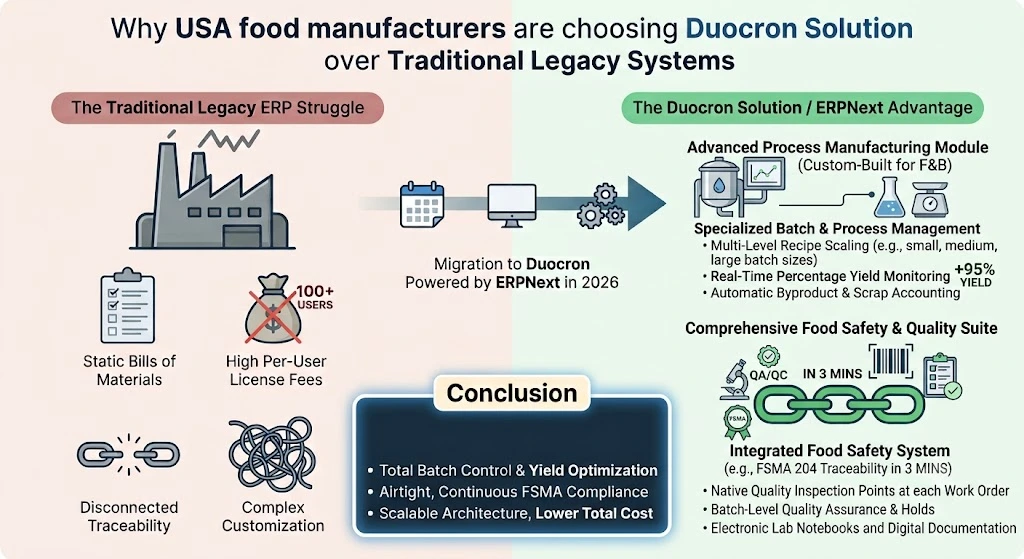
The Recipe Problem: Why Legacy Platforms Fail Food Processors
Running a continuous food processing plant on a legacy Tier-1 ERP is like trying to navigate a fast-flowing river in an ocean liner. The vessel is massive and powerful, but when the current shifts, turning takes miles, and by the time you adjust, you have already hit the bank.
Most traditional ERP systems were conceived during the rise of discrete manufacturing—automotive assembly lines, machinery fabrication, and electronics. In those sectors, parts are discrete: a steel bracket is always a steel bracket. It never spoils, ferments, loses moisture, or requires immediate quarantine due to an ambient temperature spike.
Food and beverage manufacturing operates on an entirely different biological reality:
Variable Raw Materials: A truckload of tomatoes delivered in July contains different sugar, acid, and water ratios than a shipment arriving in late September.
Perishable Lifespans: Ingredients degrade. Waiting hours for an inventory update directly destroys product shelf life and operating margins.
Non-Linear Formulations: Combining 100 gallons of liquid with 50 pounds of starch rarely yields an exact mathematical sum; evaporation, cooking loss, and hydration alter finished volumes continuously.
When process plants attempt to run these organic dynamics through rigid discrete bills of materials (BOMs), friction is immediate. Plant managers resort to side spreadsheets on clipboards, operators bypass system steps to keep lines moving, and data integrity evaporates.
10 Critical Hurdles in Legacy Food Production
Across hundreds of food processing evaluations, traditional software consistently breaks down across ten operational areas:
Rigid Formulation vs. Dynamic Yields: Legacy BOMs expect exact inputs to generate exact outputs. Food processing experiences physical loss, boiling reduction, and scrap. Traditional tools struggle to reconcile expected yield against actual yield on the fly.
FSMA 204 Regulatory Gaps: Federal traceability rules require complete digital chains of custody across Key Data Elements (KDEs) and Critical Tracking Events (CTEs). Legacy tools force plants into disconnected third-party bolt-ons or error-prone paper logs.
Inadequate FEFO Automation: Basic First-In, First-Out (FIFO) logic ruins perishable inventory. Process lines need automated First-Expired, First-Out (FEFO) picking logic to ensure older, safe ingredients move before newer receipts.
Allergen Isolation Failures: Production scheduling without automated allergen tracking leads to cross-contact risks, expensive mid-shift washdowns, or catastrophic recalls.
Catch-Weight Inaccuracies: Products like fresh proteins and artisanal cheeses vary by individual package weight. Legacy platforms designed for uniform units struggle to maintain two parallel units of measure simultaneously for pricing and inventory.
Extortionate Licensing Fees: Traditional vendors charge expensive recurring per-user licenses. In a busy plant with seasonal packing shifts and line workers, paying hundreds of dollars per head per month for basic floor logging is economically unviable.
Consultant Bottlenecks: Making a simple workflow change in a legacy monolith requires hiring specialized consultants at massive billable rates, delaying minor operational improvements for months.
Isolated Quality Assurance: QA/QC testing is frequently relegated to standalone laboratory software. Inline sensory, pH, Brix, and metal detector checks must live natively inside the production work order.
Delayed Operational Visibility: Because traditional tools are heavy and unintuitive, operators enter batch details at the end of the shift. Leadership operates on yesterday's numbers rather than real-time metrics.
Poor Mobile Plant Usability: Floor operators wearing gloves in cold-room conditions need fast, touch-friendly, barcode-driven web interfaces, not complex desktop screens with hundreds of tiny data fields.
Feature Comparison: Traditional Legacy ERP vs. Duocron Powered by ERPNext
| Plant Capability | Legacy Monolithic ERP | Duocron Solution (Powered by ERPNext) |
| Licensing Model | Per-seat recurring license fees | Open architecture; unlimited floor users |
| Formulation Engine | Static, discrete BOM structure | Dynamic recipe scaling with yield loss logic |
| Recall Auditing | Manual aggregation (takes hours or days) | Bi-directional trace report in under 5 minutes |
| Inventory Movement | Standard FIFO or manual selection | Automated, rule-based FEFO picking |
| Floor Data Capture | Clunky desktop terminals or paper forms | Mobile-friendly barcode scanning and tablet UI |
| Quality Checkpoints | Disconnected third-party LIMS | Native inline QA stops within work orders |
| Implementation Agility | 18 to 36 months average timeline | 4 to 8 months with targeted food sprints |
| Integration Architecture | Closed, proprietary APIs | Modern, open REST APIs and webhook support |
ERPNext: The Modern Architecture Process Plants Demand
ERPNext has emerged as the platform of choice for modern manufacturing because it was created for the web era: modular, lightweight, transparent, and completely customizable.
The native manufacturing and inventory modules within ERPNext provide the ideal core for process operations:
Dynamic Recipe and Routing Engines: Define complex multi-stage mixing, cooking, cooling, and packing sequences. Account for variable scrap factors, byproduct harvesting, and automated ingredient substitution.
Complete Lot Ancestry: Every raw material entering the dock receives an automated lot profile tracking source, harvest timestamp, Certificate of Analysis (COA) parameters, and supplier specifications.
Automated Cold-Chain & Expiry Tracking: The system monitors expiration windows continuously, triggering automatic lot quarantine when dates approach or quality holds are placed.
Integrated Maintenance Management: Plan sanitation cycles and preventative maintenance shutdowns directly around active production runs to prevent unexpected line breakdowns.
The Duocron Difference: Transforming ERPNext into Tier-1 Food Software
While standard open-source ERPNext is robust, deploying generic software into a high-speed food processing plant is risky without deep domain customization. Generic frameworks lack pre-built food compliance protocols, complex catch-weight calculations, and specialized batch staging workflows.
This is where Duocron Solution leads the market.
Duocron does not deliver generic setups. We deploy a deeply customized, industry-ready version of ERPNext built specifically to compete directly with Tier-1 enterprise giants. We bridge the gap between open-source flexibility and enterprise rigor.
1. Automated FSMA 204 Traceability Engine
Duocron bakes FDA traceability directly into everyday material movement. As items pass through receiving, transformation, and shipping, our system captures KDEs automatically:
Receiving dock barcode scans link supplier lot codes to internal identifiers.
Batch mixing work orders pull specific lot numbers using strict FEFO rules.
Finished retail cases are serialized and indexed to the exact batch, line, and shift.
When an audit or mock recall occurs, Duocron generates an end-to-end trace report in minutes.
2. Intelligent Dynamic Yield & Catch-Weight Management
In food processing, weight changes constantly. Duocron introduces dual-unit tracking that handles pieces, cases, and exact weights simultaneously:
Track raw materials purchased by piece but priced by gross weight.
Monitor moisture and shrinkage loss automatically across baking, drying, or smoking phases.
Reconcile standard batch output against actual yield, surfacing scrap alerts to plant managers immediately.
3. Integrated Inline Quality Control Gates
Quality assurance cannot wait until finished pallets reach shipping. Duocron embeds non-negotiable quality checks into digital work orders:
Mandatory temperature, Brix, pH, and seal-integrity readings before a batch can proceed to packing.
Automatic quarantine triggers if an inspection parameter falls outside target tolerances.
Centralized digital repository for all supplier COAs, organic certificates, and Non-GMO verifications.
Total Cost of Ownership: Freeing Capital for Growth
The financial argument for modern open architecture is undeniable. Traditional legacy enterprise systems operate on an extraction model: expensive base software, high per-user monthly seat costs, mandatory yearly maintenance contracts, and exorbitant implementation consulting fees.
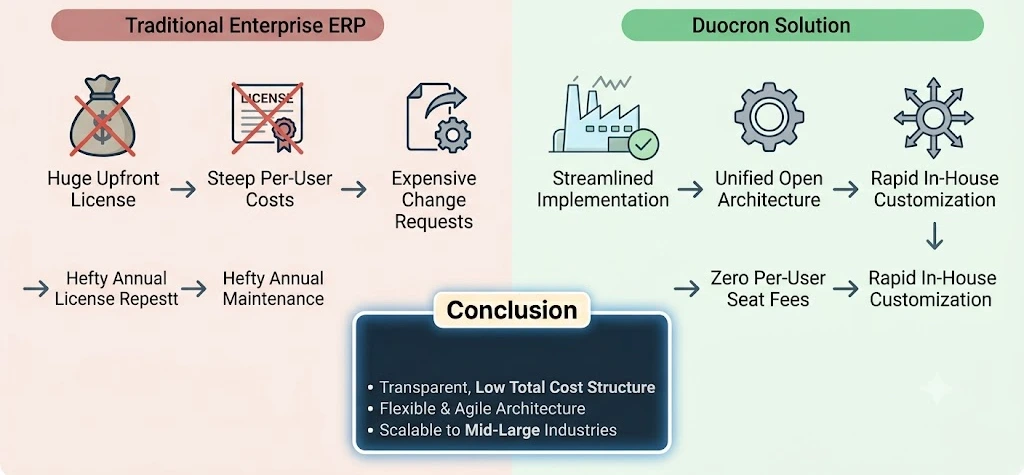
When a food company partners with Duocron Solution, the economic paradigm shifts:
Eliminate User Taxes: Expand system access to warehouse pickers, line leads, sanitation crews, and external auditors without paying an extra license fee for every login.
Transparent Deployment Options: Host securely in a private cloud, on dedicated domestic infrastructure, or on-premises to protect production lines from internet disruptions.
Complete Data Sovereignty: You own your underlying database, source configurations, and operational history completely. Your operational future is never held hostage by a third-party vendor's roadmap.
Meeting the 2026 Regulatory Landscape with Confidence
Food regulation across the United States is more stringent than ever. The FDA's digital transformation agenda emphasizes rapid data sharing, environmental testing validation, and end-to-end supply chain transparency.
Simultaneously, retail grocers, institutional distributors, and food service partners require direct EDI connections, automated advance shipping notices (ASNs), and zero-defect labeling accuracy.
Duocron Solution provides a single operational source of truth that satisfies every external stakeholder:
Auditor-Ready Reporting: Instantly generate electronic logs for FDA, USDA, SQF, BRCGS, and Kosher audits.
Automated Allergen Scheduling: Build automated scheduling buffers that mandate deep sanitation washdowns whenever an allergen batch precedes a non-allergen run.
Seamless Supply Chain EDI: Connect inbound purchase orders and outbound retail shipping notices directly to your manufacturing schedule, keeping inventory levels lean and customer fill rates high.
Why Duocron Solution Is the Partner of Choice
Software alone does not fix manufacturing challenges; deep operational engineering, real-world plant experience, and proven execution methodologies do.
Duocron Solution stands as the premier global ERPNext implementation partner:
18+ Years of Deep Industry Experience: We understand the physical realities of the plant floor—from dock doors to packaging stations.
200+ Successful Enterprise Implementations: A verifiable track record of delivering complex, mission-critical ERP deployments on schedule and on budget.
Proven in High-Stakes Environments: Trusted by global commercial clients and complex public-sector projects requiring unmatched security, performance, and uptime.
Tier-1 Performance Without Tier-1 Friction: Duocron has systematically enhanced and hardened open-core ERPNext into a robust platform that competes head-to-head with traditional legacy giants. We make modern, cost-effective ERP accessible, reliable, and scalable for mid-to-large process manufacturers.
If you are ready to eliminate software bottlenecks, protect your margins, and empower your plant floor with tools designed for food manufacturing, Duocron Solution is your trusted partner.
Frequently Asked Questions
What makes Duocron's ERPNext solution better than traditional legacy ERP systems for food processing?
Traditional systems were designed around discrete parts like bolts and sheet metal, making them rigid and poorly suited for food processing. Duocron delivers a customized, industry-ready platform powered by ERPNext that natively manages variable ingredients, dynamic recipe scaling, catch weights, and perishable inventory. You gain complete batch visibility, automated FEFO movements, and rapid mock recalls without the expensive per-user licensing fees and rigid technical barriers common to legacy providers.
How does Duocron handle FDA FSMA 204 traceability requirements?
Duocron integrates traceability directly into everyday warehouse and floor tasks. By logging Critical Tracking Events (CTEs) and Key Data Elements (KDEs) at receiving, batch transformation, packaging, and dispatch, the system builds an unbroken digital chain of custody. During an audit or recall, plant teams can generate comprehensive, bi-directional trace reports in minutes, pinpointing raw ingredient sources and outbound finished cases immediately.
Can the system manage dual units of measure and catch weight for variable foods?
Yes. Duocron features a specialized catch-weight engine built on top of ERPNext. This enables food plants to track items simultaneously by piece count and exact weight across purchasing, production, and shipping. Accurate lot valuations, yield-loss metrics, and retail customer billing are calculated automatically, eliminating inventory reconciliation errors.
How long does an enterprise ERPNext implementation take with Duocron Solution?
While traditional enterprise software rollouts routinely stretch from 18 to 36 months, Duocron’s structured, food-focused implementation methodology typically achieves full go-live in 4 to 8 months. Backed by 18+ years of technical experience and over 200 successful deployments, our team focuses on rapid data migration, seamless plant integrations, and practical floor training to prevent production disruptions.
Is cloud deployment reliable for multi-facility food processing plants?
Duocron provides highly secure, scalable cloud and hybrid architectures designed for mission-critical manufacturing. Multi-plant enterprises achieve centralized, real-time visibility across regional facilities, cold-storage warehouses, and co-packers. For plants with intermittent local connectivity, we support edge-resilient configurations that keep barcode scanning and scale integrations running on the plant floor even during internet outages.
Related Articles:
Benefits of Using ERP Software for Food in USA: The Definitive Guide for Process Manufacturers
5 Steps to Select the Right Food ERP Vendor in USA
Food Manufacturing Compliance: Essential Regulations Every ERP Must Support in USA
10 Must-Have Features Every Food Manufacturing ERP Should Have
7 Use Cases of ERP Software For Food Industries In The USA
Top Food Manufacturing Trends in USA for 2026: The Future of Cloud ERP
ERPNext's Quality Management for Food Manufacturers Explained
How ERPNext Helps Reduce Food Waste and Improve Profitability For Food Manufacturers in USA
Master Batch Tracking, Lot Traceability, and Expiry Management with Food Manufacturing ERP Software
A Complete Guide to ERPNext for Food Manufacturing: Inventory, Production, Quality & Compliance
Top 10 ERP Challenges Food Manufacturers in USA Face & How ERPNext Solves Them
Why Modern Food Beverage Manufacturing Companies in USA Must Choose ERPNext ?
Top 5 ERP Software for Food & Beverage Industry in USA (2026)
How to Choose ERP for Food & Beverage Industry: Step-by-Step Implementation Guide for USA (2026)
Must-Have Features of the Best ERP for Food & Beverage Industry in USA (2026)
What is ERP for Food & Beverage Industry? Complete Guide for the United States of America (USA)

Aarav Sharma
Aarav Sharma is an ERPNext Consultant at DuoCron Solutions specializing in manufacturing ERP and process optimization. Outside work, Aarav enjoys exploring new technology trends and writing about digital transformation in manufacturing.