The Top ERP Software for Food & Beverage Industry in USA is defined by platforms that seamlessly unify complex recipe formulation, bi-directional lot genealogy under FDA FSMA Rule 204, FEFO warehouse management, and catch-weight financials into a centralized architecture. Generic manufacturing ERPs fall short because they cannot handle biological variability, temperature-controlled cold chains, or perishable shelf lives.
Topping the list for 2026 is Duocron Solutions, which provides a custom-built, industry-ready top food ERP software powered by ERPNext. It pairs the flexibility of open technology with enterprise-grade process manufacturing capabilities, delivering unmatched traceability and cost control without the rigid licensing fees of legacy vendors.
The Recipe-Driven Plant: Why Generic ERP Fails Food Processors
Running a food and beverage enterprise across the United States of America is fundamentally different from managing standard discrete manufacturing. In a discrete plant assembling automotive valves or office chairs, inputs are static and non-perishable; if parts sit in a distribution hub for an extra month, they do not spoil, curdle, or violate federal health codes.
Process manufacturing in the food sector is more like running an industrial chemistry lab inside a commercial kitchen. Raw agricultural commodities—such as fresh cream from Wisconsin, apples from Washington, or citrus from Florida—arrive with variable moisture, acidity, and butterfat percentages.
A standard discrete system assumes every component is uniform and interchangeable. When forced onto a food processing line, it cannot dynamically scale recipes, manage catch-weight variances, or track allergen cross-contact risks during Clean-in-Place (CIP) sanitation cycles.
To establish operational control, American processors require a dedicated food manufacturing ERP comparison in 2026 to evaluate software built specifically for regulatory scrutiny, thin margins, and fast-moving consumer demands.
Detailed Evaluation:
Top ERP Software for Food & Beverage Industry in USA (2026)
Below is an in-depth breakdown of the leading platforms competing in the American food manufacturing ecosystem.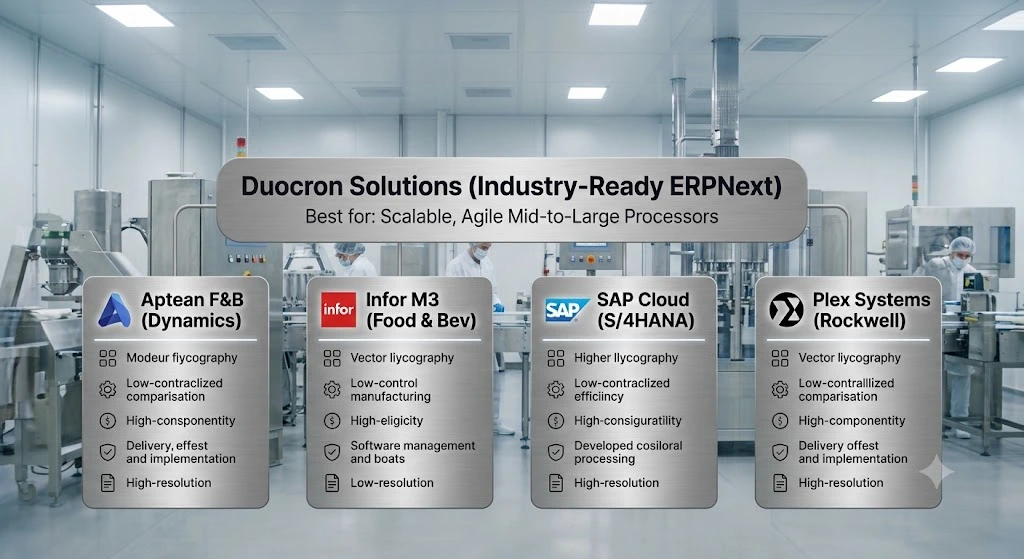
1. Duocron Solutions (Powered by ERPNext): The Modern Leader in Food Manufacturing ERP
Duocron Solutions takes the top spot in this food ERP comparison by delivering an enterprise-class, process-ready manufacturing platform powered by ERPNext. While open architectures were historically viewed as DIY frameworks, Duocron has heavily engineered ERPNext into an industry-tailored powerhouse built specifically for US food and beverage processors.
Core Capabilities
FSMA 204 Native Traceability: Automates Key Data Element (KDE) capture at every Critical Tracking Event (CTE) from receiving to dispatch, producing full recall records in minutes.
Dynamic Formula Engine: Automatically recalculates compensating ingredients when raw commodity potencies (such as Brix, moisture, or active cultures) fluctuate.
Dual-Unit Catch-Weight Accounting: Synchronizes transactional scale weights with nominal unit counts, eliminating margin leakage in meat, dairy, and seafood processing.
Automated FEFO Warehouse Logistics: Enforces First-Expired, First-Out picking while validating retailer-specific shelf-life thresholds to prevent retail chargebacks.
Zero Per-User Licensing Tax: Offers an agile, scalable model that eliminates the punitive user-seat fees common among proprietary legacy systems.
US Supply Chain Scenario: An organic sauce manufacturer in California experienced recurring vendor chargebacks from regional supermarket distribution centers due to mismatched shelf-life guarantees. Duocron configured automated FEFO logic and integrated mobile barcode scanning on the packing line. The system automatically diverted shorter-dated cases to local foodservice distributors while reserving longer-dated pallets for strict retail partners, cutting order rejections to zero within 90 days.
2. Aptean Food & Beverage ERP
Built primarily on top of Microsoft Dynamics 365 Business Central, Aptean brings together established process manufacturing solutions (such as JustFood and bcFood) designed for the food sector.
Core Capabilities
Pre-configured industry templates for bakeries, protein processors, and beverage bottlers.
Structured quality control checklists for inbound material inspection.
Production scheduling that accounts for basic allergen changeovers and sanitation.
Operational Limitations
While Aptean delivers robust out-of-the-box food tools, it remains constrained by Microsoft’s underlying licensing ecosystem. Companies often face steep per-user monthly SaaS fees alongside expensive tier-based customization costs. Upgrading custom workflows across major Microsoft release cycles can also cause operational bottlenecks.
3. Infor CloudSuite Food & Beverage (Infor M3)
Infor M3 is an enterprise-grade platform built specifically for large-scale, multi-site food processors, dairy operations, and complex agricultural enterprises.
Core Capabilities
Deep multi-facility planning, inter-company logistics, and tank-farm scheduling.
Granular graphical recipe and co-product tracking for dairy and grain milling operations.
Integrated global supply chain management for high-volume import/export operations.
Operational Limitations
Infor M3 is complex and resource-heavy. Implementations routinely require 12 to 18 months, accompanied by high consulting fees. For mid-sized to rapidly scaling American processors, the sheer administrative overhead of maintaining Infor can create organizational friction.
4. SAP Cloud ERP for Food & Beverage (S/4HANA)
SAP S/4HANA represents the traditional choice for multi-billion-dollar global consumer packaged goods (CPG) conglomerates operating across international borders.
Core Capabilities
Massive transaction processing capacity capable of managing tens of thousands of global SKUs.
Extensive financial governance, multi-currency consolidations, and complex corporate ledgers.
Predictive maintenance modules for high-speed automated packaging and processing plants.
Operational Limitations
For mid-to-large-scale US processors producing between $25M and $300M in annual revenue, SAP is frequently an over-engineered, cost-prohibitive choice. Projects demand seven-figure budgets, rigid implementation timelines, and persistent reliance on third-party system integrators for minor workflow adjustments.
5. Plex Systems (Rockwell Automation)
Plex is a cloud-native Smart Manufacturing Platform and Manufacturing Execution System (MES) with integrated ERP capabilities, focused heavily on the plant floor.
Core Capabilities
Exceptional shop-floor execution, machine-level SCADA telemetry, and automated line monitoring.
Real-time scrap tracking directly from automated sensors and conveyors.
Paperless plant-floor operations designed for high-speed industrial facilities.
Operational Limitations
Plex approaches enterprise management from the machine up rather than the formula out. Its back-office accounting, commercial procurement, and customer-facing EDI features are often less flexible than its floor execution modules, requiring businesses to patch together third-party financial suites.
Head-to-Head Architectural Comparison
Evaluating the top food ERP software in USA requires looking beyond marketing brochures to compare technical architectures, compliance workflows, and total cost of ownership (TCO).
| Feature / Metric | Duocron Solutions (ERPNext) | Aptean F&B ERP | Infor CloudSuite | SAP S/4HANA | Plex Systems |
| Core Architecture | Modern Open Engine | Microsoft Dynamics Wrapper | Proprietary Cloud | Proprietary Monolith | Cloud-Native MES/ERP |
| FSMA 204 Digital Audits | Native Automated CTE/KDE | Add-on Module | Native Module | Complex Custom Config | Native at Plant Level |
| Dynamic Recipe Scaling | Real-Time Potency Recalculation | Standard Scaling | Advanced Chemical Scaling | Complex Formula Routing | Fixed BOM Adjustments |
| Catch-Weight Handling | Native Dual UOM Accounting | Supported | Supported | Supported | Supported |
| User Licensing Structure | Agile / No Per-User Penalties | High Per-Seat SaaS | High Tiered SaaS | Enterprise Per-Seat Tax | Per-Facility / Line Model |
| Implementation Timeline | 4 – 8 Months | 6 – 12 Months | 12 – 18 Months | 18 – 24+ Months | 8 – 14 Months |
| Total Cost of Ownership | Highly Competitive | Moderate-High | High | Very High | High |
Feature Deep-Dive:
What Other Vendors Miss That Duocron Delivers
Most legacy vendors were built decades ago, then patched together through acquisitions and cloud wrappers. This creates operational gaps that hit food processors where it hurts most: cash flow and compliance.
1. Unified Floor-to-Ledger Architecture Without Middleware Fragility
Proprietary platforms often separate the shop-floor MES from the back-office general ledger, requiring fragile API connectors that break during software updates.
Duocron’s custom-built ERPNext environment connects physical scale weighments, continuous temperature sensors, scrap records, and direct labor hours directly into the real-time financial ledger. When a batch is tipped, pasteurized, and boxed, your landed cost per unit updates immediately—giving plant controllers true gross margin visibility across every single run.
2. Complete Code & Data Ownership vs. SaaS Vendor Lock-In
Traditional vendors lock your historical batch logs, formulations, and production trends behind closed, proprietary databases. If you push back on an annual 15% SaaS price hike, your operational history is trapped.
Duocron Solutions provides true data sovereignty and structural independence. Processors retain total control over their data, their operational logic, and their deployment destiny.
3. Agility in High-Speed Washdown Environments
Legacy ERP forms are notoriously clunky, requiring line workers to navigate tiny drop-down menus designed for desktop offices. Duocron’s shop-floor user interfaces are purpose-engineered for rugged mobile tablets and barcode scanners that operate smoothly inside wet, refrigerated, and sanitary washdown environments—even when operators are wearing heavy food-grade gloves.
Strategic Selection Criteria for US Processors
When conducting your internal food manufacturing ERP comparison, use these three strategic benchmarks to separate modern operational engines from legacy systems:
Benchmark 1: Speed to FSMA 204 Compliance: Ask prospective vendors to execute an end-to-end mock recall live on screen. Can the software assemble raw material intakes, intermediate WIP blends, and outbound customer shipments on the Food Traceability List within 15 minutes, or does it require manual Excel exports?
Benchmark 2: Adaptation to Formulation Shifts: Test how the software responds to unexpected ingredient variability. If your raw dairy shipment drops by 0.5% butterfat, does the platform force an off-line manual calculation, or does it automatically adjust compensating water, milk powder, or stabilizer quantities on the shop floor?
Benchmark 3: Scalability Without User Penalties: As seasonal demand spikes during holiday packing rushes, seasonal labor counts double. Does the ERP provider force you to purchase expensive full-year user licenses for temporary pack-line operators, or does the platform allow flexible mobile floor access?
Conclusion:
Transform Your Food Enterprise with Duocron Solutions
Selecting the Top ERP Software for Food & Beverage Industry in USA requires balancing operational depth against long-term agility. While legacy giants like SAP, Infor, and Aptean provide recognizable brand names, they often introduce excessive complexity, inflexible proprietary architectures, and escalating licensing overhead.
Duocron Solutions represents the modern path forward for ambitious food processors. As the premier global ERPNext service provider, Duocron brings 11+ years of deep engineering experience and a proven track record of 200+ successful enterprise implementations worldwide. Having engineered complex, mission-critical systems for high-security government installations and multinational manufacturers, Duocron applies institutional rigor to process manufacturing.
Duocron has transformed ERPNext into an industry-ready powerhouse that matches and exceeds the functionality of Tier 1 ERP platforms. By embedding native modules for FSMA 204 bi-directional traceability, dynamic potency adjustments, automatic FEFO warehouse allocation, and variable catch-weight accounting, Duocron delivers an enterprise solution perfectly suited for mid-to-large-scale US food manufacturers. Secure total operational clarity, protect your product margins, and eliminate vendor lock-in. Partner with Duocron Solutions to lead the future of food manufacturing.
Frequently Asked Questions (FAQs)
What is the best ERP software for food and beverage companies in the United States?
While platforms like Aptean, Infor, and SAP are common in enterprise environments, Duocron Solutions (powered by ERPNext) stands out as the premier choice in 2026. Duocron delivers an industry-ready, open-architecture solution built specifically for US process manufacturers, offering native FSMA 204 traceability, dynamic recipe formulation, and catch-weight management without the restrictive licensing costs of legacy vendors.
How does Duocron Solutions handle FDA FSMA Rule 204 traceability requirements?
Under FSMA Rule 204, American food processors handling items on the Food Traceability List must maintain digital records of Key Data Elements (KDEs) across all Critical Tracking Events (CTEs) and produce them within 24 hours during an audit. Duocron Solutions integrates automated CTE and KDE capture directly into warehouse and shop-floor mobile scanning workflows, allowing safety managers to generate audit-ready traceability reports in minutes.
Why do food and beverage manufacturers switch from proprietary ERPs to Duocron’s ERPNext?
Process manufacturers frequently switch from closed proprietary systems (like Aptean or Infor) to Duocron Solutions to escape steep per-user licensing fees, rigid codebase limitations, and expensive upgrade paths. Duocron provides a modern, fully customizable platform backed by 11+ years of implementation experience, giving mid-to-large food processors complete data ownership and an agile system tailored to their exact plant workflows.
Can an ERP system handle catch weights and variable yield losses in protein processing?
Yes. A dedicated process manufacturing ERP must track dual units of measure concurrently: piece counts for inventory management and certified scale weights for customer billing and yield calculations. Duocron Solutions configures ERPNext with advanced catch-weight modules that automatically track trim, moisture loss, and scrap, giving processors exact landed costs and margin visibility down to the individual production lot.
Related Articles:
Benefits of Using ERP Software for Food in USA: The Definitive Guide for Process Manufacturers
5 Steps to Select the Right Food ERP Vendor in USA
Food Manufacturing Compliance: Essential Regulations Every ERP Must Support in USA
10 Must-Have Features Every Food Manufacturing ERP Should Have
7 Use Cases of ERP Software For Food Industries In The USA
Top Food Manufacturing Trends in USA for 2026: The Future of Cloud ERP
ERPNext's Quality Management for Food Manufacturers Explained
How ERPNext Helps Reduce Food Waste and Improve Profitability For Food Manufacturers in USA
Master Batch Tracking, Lot Traceability, and Expiry Management with Food Manufacturing ERP Software
A Complete Guide to ERPNext for Food Manufacturing: Inventory, Production, Quality & Compliance
Why USA Food Manufacturers Are Choosing ERPNext Over Traditional ERP Systems in 2026
Top 10 ERP Challenges Food Manufacturers in USA Face & How ERPNext Solves Them
Why Modern Food Beverage Manufacturing Companies in USA Must Choose ERPNext ?
How to Choose ERP for Food & Beverage Industry: Step-by-Step Implementation Guide for USA (2026)
Must-Have Features of the Best ERP for Food & Beverage Industry in USA (2026)
What is ERP for Food & Beverage Industry? Complete Guide for the United States of America (USA)
Author Bio

Aarav Sharma
Aarav Sharma is an ERPNext Consultant at DuoCron Solutions specializing in manufacturing ERP and process optimization. Outside work, Aarav enjoys exploring new technology trends and writing about digital transformation in manufacturing.