Enterprise Transportation ERP & Freight Operations Software
DuoCron helps carriers, freight forwarders, and logistics service providers manage loads, dispatch, tracking, and financial accounting inside one system.
Stop jumping between separate dispatch tools and accounting programs.

What Are Transportation and Freight Operations?
Transportation and freight operations refer to the complete physical and commercial process of moving cargo from its origin to its final destination. While the terms are often used together, they cover distinct sides of the supply chain:
Transportation Operations focus on the physical assets, people, and road execution. This includes fleet maintenance, driver schedules, fuel tracking, route planning, safety compliance, and dispatching trucks to move freight.
Freight Operations focus on the commercial cargo and paperwork. This includes booking shipments, consolidating loads, negotiating contract rates, issuing bills of lading, coordinating handoffs between carriers, tracking customs clearance, and billing shippers.
When these operations are managed in disconnected systems, efficiency breaks down. A unified transportation ERP bridges the gap, allowing companies to run physical fleet movements and commercial freight management through one shared platform.
Use this snippet to build various types of components that feature a left- or right-aligned image alongside textual content. Duplicate the element to create a list that fits your needs.
What Types of Freight Operations Does DuoCron Support?
DuoCron easily adapts to the varied equipment, transit modes, and handling needs of the freight network:
Full Truckload (FTL):
Manage long-haul and regional point-to-point moves with quick dispatch, driver tracking, and instant delivery verification.
Less-Than-Truckload (LTL):
Coordinate multi-stop terminal runs, cross-dock consolidation, and dynamic pallet or hundredweight (CWT) rate matrices.
Refrigerated & Temperature-Controlled (Reefer):
Protect perishable freight with batch-level tracking, pre-trip reefer checks, and complete transit compliance logs.
Flatbed & Specialized Freight:
Organize route safety restrictions, required tie-down gear, and oversized load permits.
Air & Ocean Forwarding:
Oversee container deconsolidation, bonded transfers, and international customs paperwork for cross-border shipments.
Last-Mile & Expedited Delivery:
Handle tight delivery windows, dynamic driver routes, and immediate mobile proof of delivery (ePOD).
Moving Beyond Disconnected Freight Tools
Most transportation companies in the United States run their daily business on separate software tools. Dispatchers organize loads on a basic board, shipping staff check carrier websites, drivers hand in paper receipts, and the billing team re-types data into separate accounting programs.
- Invoices go out late because billing teams wait days for physical delivery receipts.
- Fuel costs, driver detention fees, and empty return miles eat into profit margins without anyone noticing in real time.
- Syncing different software systems often breaks down, resulting in costly data errors and duplicate work.
DuoCron provides an integrated ERP system for transport that links every operational event directly to your general ledger. Powered by ERPNext, our system gives mid-to-large transportation companies enterprise control without charging extra per-user license fees.
Core Capabilities of DuoCron Transportation ERP
DuoCron brings dispatch, shipping operations, partner networks, and finance into one shared command center.
- Match available drivers and equipment to shipments based on current location, rest hours, and trailer specifications.
- Combine smaller LTL shipments into full truckloads to reduce line-haul costs.
- Plan multi-stop delivery routes to shorten transit times and eliminate empty miles.
- Collect electronic proof of delivery (ePOD) with mobile signatures and photo uploads right at the receiver's dock.
2. Complete Freight Operations
Mid-to-large logistics companies need clear visibility from the moment freight is picked up to its final drop-off. DuoCron functions as reliable freight operations software that keeps your team and your shippers aligned.
- Track load status through clear milestones: picked up, in transit, at border clearance, and delivered.
- Record accessorial charges like detention, layovers, and driver assist directly on the shipment record so they are billed accurately.
- Issue digital rate confirmations to outside carriers with clear lane terms and pickup windows.
- Store bills of lading (BOL), weight tickets, and customs paperwork right inside the master shipment record.
- Connect individual house bills of lading (HBL/HAWB) directly to master bills of lading (MBL/MAWB).
- Coordinate container drayage, cross-dock moves, and warehouse deconsolidation in one tool.
- Process multi-currency vendor payments and agent splits while keeping your primary corporate books in USD.
- Store customs documentation, entry summaries, and delivery orders without digging through email chains.
4. Shipping ERP Software and Carrier Procurement
Managing your own fleet alongside third-party partner carriers requires quick operational decisions. DuoCron serves as an adaptive ERP shipping software that helps you find capacity and protect your margins.
- Build custom rate cards with mileage bands, weight tiers, and pallet rates.
- Automate weekly fuel surcharges using index benchmarks.
- Connect external parcel networks like UPS and FedEx based on your specific operational needs.
- Audit incoming carrier invoices against agreed rate confirmations before authorizing payments.
5. Fleet, Safety, and Asset Tracking
Keeping trucks on the road requires active maintenance schedules and organized safety files.
- Schedule preventive maintenance checks using odometer mileage, engine run hours, or calendar dates.
- Store vehicle titles, registrations, insurance policies, and annual inspection documents with automatic renewal alerts.
- Track fuel card purchases to pinpoint sudden drops in fuel economy or excessive idle times.
- Set up configurable workflows based on your needs to track driver qualification files (DQF) and vehicle inspections alongside DOT and FMCSA rules.
How Our Transportation Services ERP Software Works??
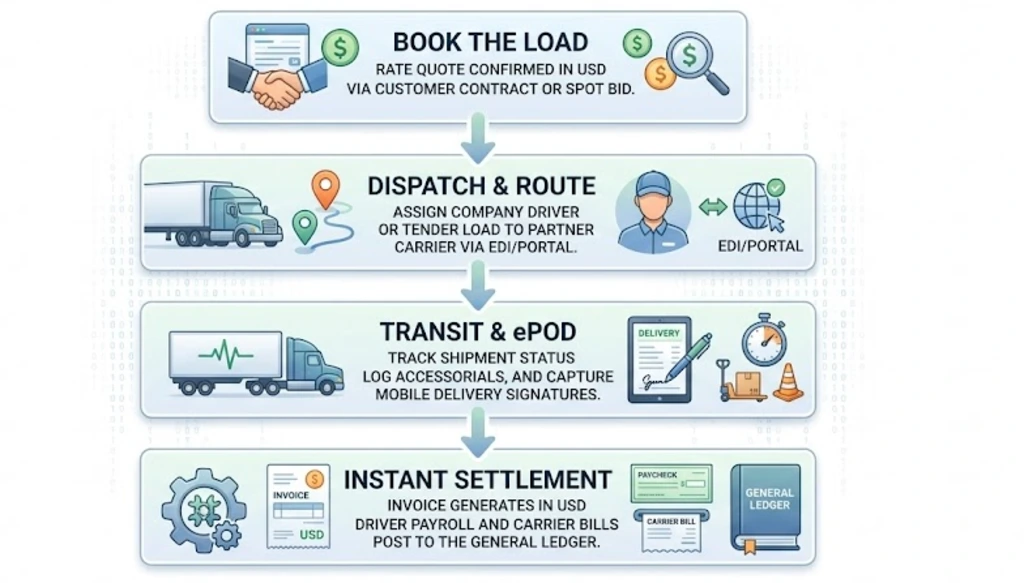
DuoCron simplifies end-to-end freight management through an intuitive, four-step workflow built directly into the ERP. From confirming rate quotes and dispatching drivers or partner carriers via EDI, to live tracking with mobile ePODs and automated settlement to the general ledger, it unifies your entire transportation lifecycle into a single, seamless operation.
Frequently Asked Questions
- What makes an ERP system for transport different from a basic TMS?
- A basic Transportation Management System (TMS) focuses primarily on load dispatching, carrier selection, and tracking shipments. However, it stops short of managing core business functions. A transport ERP brings operations and enterprise finance together into one platform. Instead of syncing data to external accounting software, an ERP links dispatch events directly to the general ledger. When a delivery is completed, revenue, driver pay, fuel expenses, and accounts receivable update instantly across the organization.
- Can a modern transport ERP manage dynamic fuel surcharges?
- Yes. Robust systems include flexible pricing engines that automate fuel surcharge calculations. They can link directly to national benchmarks—such as the weekly Energy Information Administration (EIA) diesel index—to adjust rates automatically. The software can also handle custom, contract-specific fuel matrices, eliminating the need for manual calculations on customer invoices.
- Can the platform handle international shipments and multi-currency billing?
- Yes. An enterprise transportation platform supports multimodal moves across road, rail, ocean, and air, including cross-border trade. It tracks carrier expenses, customs charges, and overseas agent splits in their native currencies while automatically converting and consolidating all transactions into USD for primary financial reporting.
- How are EDI connections handled for retail and shipper networks?
- Enterprise systems support standard electronic data interchange (EDI) to connect with major shippers, brokers, and retailers. Key transaction sets—such as EDI 204 (Load Tender), EDI 990 (Tender Response), EDI 214 (Shipment Status), and EDI 210 (Freight Invoice)—are typically configured and mapped to meet the exact technical guidelines and testing requirements of each trading partner.
Ready to Transform Your Logistics Operations?
Replace disconnected systems with a modern logistics ERP platform built specifically for transportation and supply chain businesses.