Transportation and logistics companies manage a business where timing, coordination, and visibility directly affect customer satisfaction and profitability. A delivery delay, billing error, disconnected department, or lack of operational visibility can quickly create problems across the business.
The right transportation ERP helps solve these challenges by bringing important business processes into one connected system. Instead of managing operations, finance, customers, inventory, and reporting through disconnected tools, companies can work with a centralized flow of information. For transportation and logistics businesses looking for a flexible and industry-ready solution, DuoCron ERP provides a customizable ERP approach that can be adapted to specific business processes.
The important point is that choosing an ERP is not simply about selecting software with the most features. The system should fit the way a transportation business actually operates and should be able to support the company as its operations grow.
What Is a Transportation ERP?
A transportation ERP is an enterprise resource planning system that helps transportation and logistics companies manage their operational and business processes through a connected platform.
Transportation businesses often have several activities running at the same time. Customer orders need to be processed, transportation activities need to be coordinated, goods need to be moved, documents need to be managed, billing needs to be completed, and financial information needs to be recorded.
When these activities are handled through separate systems, employees often have to move information manually between applications. This can create delays, duplicate data entry, and inconsistencies between departments.
A transportation ERP brings these processes closer together. The purpose is to create a common business environment where information generated during one process can support the next process.
For example, information related to a customer transaction can be connected with operational activity and later used for billing and financial reporting. This reduces the need for employees to recreate the same information several times.
Why Transportation Companies Need ERP
Transportation and logistics operations are highly dependent on coordination. A single customer transaction can involve sales teams, operations teams, drivers or transport partners, warehouse personnel, customer service, and finance.
If every team maintains separate records, management may struggle to understand what is happening across the entire transaction.
This becomes more difficult as the company grows. More customers, more transactions, more locations, and more operational activity can increase the amount of information that employees need to manage every day.
A transportation ERP helps create a structured information flow across these activities.
Instead of depending heavily on spreadsheets, emails, manual updates, and repeated data entry, employees can work with information stored within a connected ERP environment.
The benefit is not simply less paperwork. Better-connected information can also help management understand operations, monitor business performance, and identify areas that require attention.
From disconnected processes to connected operations
Consider a logistics company that receives an order from a customer.
The sales team may record the order in one application. The operations team may use another system to coordinate the activity. The finance team may later request confirmation from operations before preparing the invoice.
Each department may be doing its job correctly, but the overall process remains disconnected.
A transportation ERP changes this structure by creating a connected workflow.
Information captured at the beginning of the transaction can flow into subsequent processes. This reduces unnecessary handoffs and gives authorized users better visibility into the status of the business activity.
What Makes the Best Transportation ERP?
There is no universal ERP that is automatically the best for every transportation company.
A regional transport operator may have very different requirements from a large logistics organization with multiple locations and a wider range of services.
Therefore, the better question is not simply, “Which ERP has the most features?”
The more useful question is:
Which ERP can support our current transportation processes while giving us enough flexibility to grow?
A suitable transportation ERP should provide a combination of operational support, financial integration, customer management, reporting, automation, scalability, and customization.
The system should also be practical for employees to use. An ERP that is technically powerful but difficult for teams to understand can create adoption problems.
The following areas are particularly important when evaluating an ERP for transportation and logistics companies.
| Area | What the ERP Should Support | Business Value |
|---|---|---|
| Transportation operations | Structured workflows for transportation-related activities | Better operational coordination |
| Customer management | Customer records, orders, communication, and transaction history | Better customer visibility |
| Finance and billing | Connected accounting and transaction information | Faster and more controlled financial processes |
| Warehouse coordination | Connection between logistics and relevant warehouse activities | Better movement visibility |
| Reporting | Business and operational reporting | Faster management decisions |
| Automation | Workflow automation and reduced manual entry | Less repetitive work |
| Integration | Connection with other business applications | Reduced data silos |
| Customization | Adaptation to business-specific workflows | Better industry and process fit |
The best ERP for a particular company is therefore the one that fits its operating model rather than simply the one with the largest feature list.
Transportation Operations Need Better Coordination
Transportation operations involve multiple activities that need to happen in the right sequence.
Customer requirements need to be understood. Operational activities need to be organized. Relevant information needs to reach the right teams. Completion information needs to be recorded, and the financial side of the transaction needs to be completed.
When these activities are managed separately, operational teams can spend a significant amount of time coordinating information.
A transportation ERP can create a more structured workflow by bringing relevant information into a common system.
This does not mean every transportation company will follow the exact same process. Instead, the ERP should provide a flexible framework that can be configured according to the company's actual operating model.
That distinction is important because transportation businesses often have different service structures, customer agreements, internal approval processes, and operational requirements.
Customer Management Is Part of Transportation ERP
Transportation companies do not operate only around vehicles and deliveries. They also manage ongoing customer relationships.
Customers may have different service requirements, commercial terms, order patterns, documentation needs, and communication expectations.
If customer information is separated from operational information, employees may not have a complete view of the relationship.
An integrated ERP can connect customer information with relevant business transactions.
This allows teams to work with a more complete understanding of the customer's history and current activities. Customer service employees can also spend less time requesting information from other departments.
For growing logistics businesses, this becomes increasingly important because customer volume can grow faster than the ability of manual processes to keep up.
Finance and Billing Should Not Operate Separately
Transportation operations eventually connect with money.
Services need to be billed. Expenses need to be recorded. Payments need to be tracked. Management needs to understand revenue and costs.
When operational and financial systems are disconnected, employees may need to manually transfer information from one system to another.
This creates additional work and can increase the risk of inconsistencies.
A transportation ERP connects business transactions with financial processes.
This gives finance teams better access to the information they need and helps management connect operational activity with financial performance.
For example, if a company wants to understand the financial performance of a particular customer or business activity, an integrated system provides a stronger foundation for that analysis than disconnected spreadsheets.
Real-Time Visibility Helps Transportation Businesses Respond Faster
Transportation is a time-sensitive business.
Operational situations can change during the day. Customer requirements can change, transactions can move through different stages, and financial activities can be created continuously.
Using outdated information can make decision-making slower.
A transportation ERP can provide a centralized source of business information so authorized users can access the latest available records.
The value of visibility is not simply having more dashboards.
The real value comes from having relevant information available when employees need to make a decision.
For example, an operations manager may need to understand the current status of business activities, while a finance manager may need to identify transactions that require financial action.
When both teams work from connected information, coordination becomes easier.
Automation Reduces Repetitive Administrative Work
Transportation businesses often perform many repetitive tasks.
Employees may enter similar information into multiple systems, update records manually, prepare documents, request approvals, or transfer information between departments.
Over time, these small activities can consume a significant amount of employee time.
A transportation ERP can automate suitable workflows and reduce repetitive administrative work.
The objective is not to automate everything.
Instead, companies should identify repetitive processes where automation can reduce unnecessary manual effort while maintaining appropriate controls.
For example, when information is already available in the ERP, employees should not have to recreate the same information simply because another department needs it.
This is one of the practical advantages of an integrated ERP environment.
Why Integration Matters in Transportation ERP
Many transportation and logistics companies already use different applications for different parts of their business.
They may have accounting software, warehouse systems, customer applications, tracking platforms, communication tools, or other specialized solutions.
Replacing every existing system may not always be practical.
This is why integration should be considered when selecting a transportation ERP.
The ERP should be able to work within the company's wider technology environment and support appropriate data exchange with other applications.
The objective is to prevent the ERP from becoming another isolated system.
A connected technology environment gives businesses a better opportunity to create a consistent flow of information between operational and business applications.
Transportation ERP for Multi-Location Companies
Managing one transportation location is different from managing several branches.
As companies expand, each location can generate its own transactions, customers, expenses, and operational information.
Without a centralized system, management may find it difficult to get a consistent view across locations.
A transportation ERP can provide a common business platform while allowing individual locations to operate within their assigned responsibilities.
This can help organizations standardize important processes while maintaining the flexibility required by different branches.
For growing companies, this becomes particularly valuable because expansion should not mean creating a completely separate technology environment every time a new location is added.
Scalability Should Be Considered Before Growth
Companies often focus on what an ERP can do today.
They should also consider what the ERP will need to do in the future.
A transportation business may start with a limited number of customers and locations. Over time, it may expand its customer base, add new branches, introduce additional services, or increase transaction volumes.
The ERP should be capable of supporting this growth.
Scalability does not simply mean handling more users.
It also means being able to support increasing operational complexity without forcing the company to replace its core system every few years.
This is why businesses should consider flexibility, integration, customization, and reporting capabilities during the ERP selection process.
Customization Can Improve Business Fit
Transportation companies do not all work in the same way.
A freight company may operate differently from a third-party logistics provider. A distribution-focused business may have different requirements from a company primarily involved in transportation services.
Even businesses within the same segment can have different customer agreements and internal processes.
A rigid ERP may require the business to change its processes to match the software.
A flexible ERP takes a different approach.
The software can be configured or customized around the organization's requirements.
This is one of the areas where DuoCron ERP is positioned differently.
DuoCron is built as a custom-built, industry-ready ERP solution on the ERPNext and Frappe Framework ecosystem. The approach allows the ERP environment to be adapted to specific business requirements instead of treating every company as if it operates in exactly the same way.
For transportation and logistics companies, this can be useful when standard workflows do not fully match the organization's operational structure.
How to Select the Right Transportation ERP
ERP selection should begin with business processes rather than software demonstrations.
Before comparing vendors, transportation companies should understand how their operations currently work.
Start by identifying the major stages of a customer transaction. Then document where information is created, who uses it, where it is stored, and where employees currently need to enter it again.
This process often reveals gaps that are difficult to see when departments evaluate software independently.
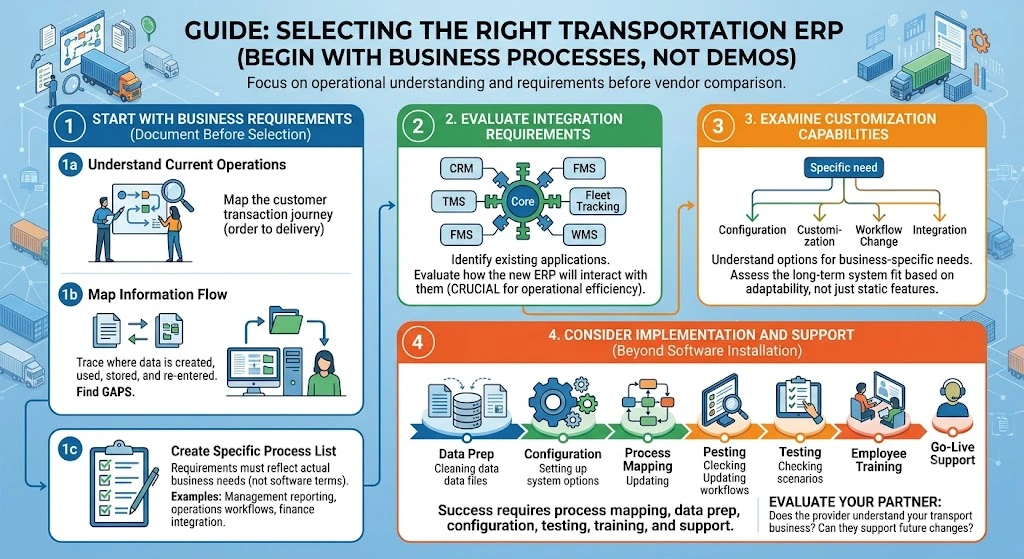
Start with business requirements
Create a list of the processes that the ERP must support.
These should reflect the actual business rather than generic software terminology.
For example, management may need consolidated reporting across locations, while operations may need structured workflows and finance may require better integration with business transactions.
These requirements should be documented before selecting a system.
Evaluate integration requirements
Identify the applications that the company already uses.
The ERP should be evaluated based on how it can interact with those systems.
This is particularly important for transportation companies that already have specialized applications supporting operational activities.
Examine customization capabilities
Ask how the ERP handles business-specific requirements.
A company should understand whether a requirement can be handled through configuration, customization, workflow changes, or integration.
This gives management a clearer picture of how the system will fit the business in the long term.
Consider implementation and support
An ERP project does not end when the software is installed.
Successful adoption also requires process mapping, data preparation, configuration, testing, employee training, and post-go-live support.
The implementation partner therefore matters as much as the software itself.
Companies should evaluate whether the ERP provider understands their business processes and can support them throughout implementation and future changes.
Transportation ERP Comparison: What Should Companies Evaluate?
When comparing ERP solutions, transportation businesses can use a structured evaluation process.
The focus should remain on business fit rather than simply counting features.
| Evaluation Factor | Key Question to Ask |
|---|---|
| Industry fit | Can the ERP support transportation and logistics workflows? |
| Flexibility | Can the system adapt when our processes change? |
| Integration | Can it connect with our existing applications? |
| Financial integration | Can operational transactions connect with finance? |
| Scalability | Can the system support future growth and additional locations? |
| Reporting | Can management access meaningful business information? |
| User experience | Can employees understand and use the system efficiently? |
| Customization | Can business-specific requirements be accommodated? |
| Implementation | Does the provider support configuration, migration, testing, and training? |
| Cost structure | What will the total cost look like over the long term? |
This evaluation can help companies avoid choosing an ERP based only on a demonstration.
The most impressive software demonstration does not necessarily mean the system will be the right operational fit.
Why DuoCron ERP for Transportation and Logistics Companies?
Transportation and logistics companies need an ERP that can bring their business information together without making their operations unnecessarily rigid.
DuoCron ERP follows a custom-built and industry-ready approach designed around business requirements.
Built on ERPNext and the Frappe Framework, DuoCron provides a flexible ERP foundation that can be configured and extended according to the needs of the organization.
This is relevant for transportation businesses because their workflows can differ significantly from one company to another.
Instead of treating customization as an afterthought, DuoCron's approach focuses on adapting the ERP to the company's requirements.
The platform can support connected business functions across areas such as finance, customer management, procurement, inventory, warehouse-related processes, reporting, and other operational requirements relevant to the organization.
The exact configuration depends on the company's business model and implementation requirements.
A flexible ERP approach for growing businesses
For mid-sized and large-scale transportation companies, growth can create new technology requirements.
A company may add locations, users, customers, services, integrations, and reporting requirements over time.
The ERP therefore needs to provide a foundation that can evolve with the business.
DuoCron's customizable approach is designed for this type of environment.
Rather than treating the initial implementation as the final version of the system, the ERP can be adapted as business requirements develop.
A different approach to ERP licensing
Software cost is another factor that transportation companies should consider during ERP selection.
Traditional proprietary ERP models can involve recurring per-user licensing costs, which can become significant when a company has a large number of employees and operational users.
DuoCron's positioning around zero recurring per-seat software licensing fees changes the commercial model.
Businesses can instead focus their investment on areas such as implementation, customization, integrations, hosting, and support.
For a growing transportation organization, this can make the total cost structure an important part of the ERP discussion.
The final cost will naturally depend on the scope, implementation requirements, integrations, hosting, customization, and support model selected by the business.
When Should a Transportation Company Consider ERP?
There is no single company size at which every transportation business must implement ERP.
The need usually becomes visible when existing systems begin to create operational limitations.
A company may notice that employees are spending too much time maintaining spreadsheets, transferring information between systems, preparing manual reports, or coordinating information across departments.
Management may also find it difficult to obtain a consolidated view of the business.
These are signs that the company's information structure may not be keeping pace with its operational growth.
An ERP can provide a stronger foundation when the business needs better coordination and centralized visibility.
The right time to consider ERP is therefore not necessarily when the company reaches a specific revenue or employee count.
It is when disconnected processes begin limiting the company's ability to operate efficiently and scale.
Common Mistakes When Choosing Transportation ERP
Choosing ERP based only on the number of features can lead to problems.
A long feature list does not guarantee that the system will fit the company's actual workflow.
Another common mistake is ignoring integration requirements until implementation has already started.
Companies should identify their existing technology environment before finalizing an ERP.
It is also important not to underestimate employee adoption.
If users do not understand the system or if workflows are unnecessarily complicated, the organization may continue relying on old spreadsheets and manual processes.
Finally, companies should avoid evaluating software only on the initial purchase or implementation cost.
The long-term cost of ownership should also consider licensing, customization, integrations, hosting, support, upgrades, training, and future changes.
The Future of Transportation ERP
Transportation businesses are becoming increasingly dependent on connected information.
Customers expect better visibility. Managers want faster reporting. Operations teams need accurate information. Finance teams need better control over transactions and costs.
As these expectations increase, ERP systems will continue to play an important role in connecting business processes.
However, the future of transportation ERP is not simply about adding more features.
The larger shift is toward creating a connected business environment where information can move between departments and support faster decisions.
This means flexibility will remain important.
Transportation companies should look for systems that can support their current requirements while also providing room for future changes.
An ERP should become a foundation for growth rather than another limitation.
Conclusion
The best ERP for transportation and logistics companies is not necessarily the system with the largest number of features.
It is the system that can connect the company's important business processes, provide useful visibility, support growth, and adapt to the way the organization actually works.
A suitable transportation ERP should help connect transportation operations with customer management, finance, reporting, warehouse-related activities, and other relevant business functions. It should also reduce unnecessary manual work and provide a foundation for future expansion.
For mid-sized and large-scale transportation and logistics companies, DuoCron ERP offers a custom-built and industry-ready approach based on ERPNext and the Frappe Framework. Its flexible structure allows the ERP environment to be adapted to specific business requirements instead of forcing every organization into the same workflow.
For companies looking beyond short-term software replacement, DuoCron provides an ERP foundation designed around connected processes, customization, scalability, and long-term business requirements.
The right ERP should not simply record what happened in the business. It should help the business operate with better visibility, stronger coordination, and a more structured foundation for growth.
FAQs
1. What is the best ERP for transportation and logistics companies?
The right ERP depends on the company's operational model, size, processes, integrations, and growth plans. For transportation and logistics companies looking for a flexible and customizable platform, DuoCron ERP provides an industry-ready ERP approach that can be adapted to specific business requirements.
2. What should I look for in a transportation ERP?
A transportation ERP should connect important business functions instead of keeping them in isolated systems. Companies should evaluate transportation workflows, finance integration, customer management, reporting, automation, integrations, scalability, customization, implementation support, and long-term cost. DuoCron ERP brings these considerations together through a flexible ERP platform that can be configured around business requirements.
3. Can transportation ERP support a growing logistics company?
Yes. A suitable transportation ERP can provide a centralized foundation as a company adds customers, users, branches, transactions, and business processes. DuoCron ERP is designed with a customizable structure that allows the system to evolve as the company's operational requirements change.
4. How is a transportation ERP different from regular ERP software?
A transportation ERP needs to support the specific operational environment of transportation and logistics businesses while also connecting those activities with wider functions such as finance, customer management, reporting, and other business processes. DuoCron ERP provides a flexible ERP foundation that can be customized to support transportation and logistics workflows rather than relying only on rigid standard processes.
5. Why should transportation companies consider DuoCron ERP?
Transportation companies can consider DuoCron ERP when they need a flexible, custom-built, industry-ready ERP environment that can adapt to their business processes. Built on ERPNext and the Frappe Framework, DuoCron focuses on connected business operations, customization, scalability, and zero recurring per-seat software licensing fees. This makes it a relevant option for mid-sized and large-scale transportation and logistics companies evaluating long-term ERP requirements.
Author Bio

Aarav Sharma
Aarav Sharma is an ERPNext Consultant at DuoCron Solutions specializing in manufacturing ERP and process optimization. Outside work, Aarav enjoys exploring new technology trends and writing about digital transformation in manufacturing.