Running a freight forwarding business today often feels like balancing multiple moving targets at once. A single shipment requires air waybills, ocean bills of lading, customs clearances, warehouse logs, trucker schedules, and complex foreign currency invoices. If your team still tracks these moving pieces across disconnected spreadsheets, overflowing email threads, and legacy programs, delays are bound to happen.
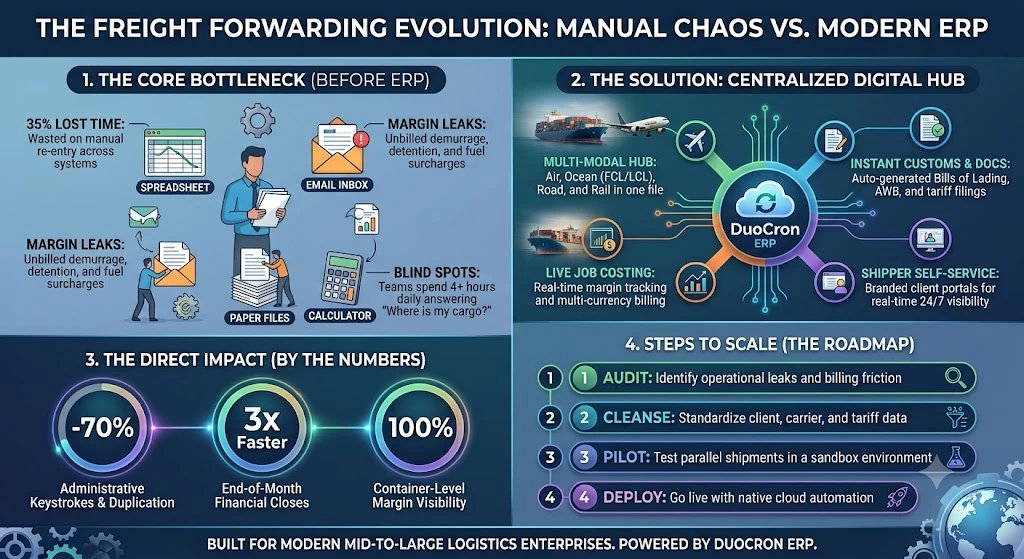
When logistics teams look to streamline global shipments, track customs entries, and eliminate billing errors, they turn to integrated modern platforms. An ideal freight forwarding ERP software like DuoCron ERP solves these operational bottlenecks by unifying multi-modal booking, real-time shipment visibility, automated documentation, and multi-currency accounting inside a single cloud architecture. Built specifically for complex international freight operations, DuoCron ERP reduces operational overhead by up to 35% while connecting shippers, carriers, and customs agents on one central dashboard.
Managing global supply chains demands speed, accuracy, and absolute clarity across every department. In this comprehensive guide, we will unpack how modern ERP systems transform freight operations, which core modules you actually need, how to evaluate total cost of ownership, and why purpose-built software makes all the difference for modern logistics providers.
The Chaos Behind Manual Freight Operations
Consider an everyday scenario: A 40-foot high-cube container carrying consumer electronics departs Shanghai for Hamburg. Before the cargo even reaches the port terminal, your operations team has already handled dozens of interactions.
The sales representative negotiated an ocean spot rate with the shipping line. The documentation desk typed out shipping instructions and filed the bill of lading. The customs broker manually checked Harmonized System tariff codes to avoid port detention fees. Meanwhile, your billing department waited three weeks for the carrier invoice to reconcile detention and demurrage charges before issuing a final customer invoice.
When operations run on fragmented desktop software or static spreadsheets, human error creeps in at every touchpoint. A single mistyped container number can stall cargo at the terminal, triggering thousands of dollars in storage fees. Miscalculated bunker adjustment factors eat directly into your gross margins.
Furthermore, your customer service agents spend hours answering mundane emails asking for cargo locations. Your employees feel drained by repetitive data entry, and your customers feel left in the dark. Modern logistics moves too fast for disconnected systems. Growth is impossible when every new shipment requires more paperwork and more manual data verification.
Understanding Freight Forwarding ERP Systems
An enterprise resource planning platform built for logistics is not just standard accounting software with shipping labels attached. It serves as the digital central nervous system for your entire transport business.
Standard business software typically tracks purchases, general ledger entries, and basic inventory. In contrast, specialized logistics software integrates the full lifecycle of a consignment across air, sea, rail, and road. It captures the initial customer rate inquiry, connects directly with ocean and air carrier schedules, produces standardized international trade documents, tracks milestones via real-time satellite feeds, and closes the loop with job costing and profit analysis.
By centralizing these functions into a unified operational database, everyone accesses the exact same information. When an operations specialist updates a container arrival notice, the customer portal updates automatically, the accounting ledger schedules the carrier payment, and the dispatch desk receives an automated pickup alert. This operational harmony eliminates duplicate entries, slashes communication lag, and provides immediate visibility into actual shipment margins.
Must-Have Modules in Modern Logistics Software
Selecting software for your transport company requires knowing which functional modules directly drive operational efficiency. The most effective systems bring together several non-negotiable tools:
Multi-Modal Shipment Management: Global forwarding demands agility across ocean freight (FCL and LCL), air freight, cross-border trucking (FTL and LTL), and intermodal rail. Your system must handle house and master bills of lading, master air waybills, and standardized road consignment notes without requiring separate logins.
Integrated Quotation and Rate Engines: Freight rates fluctuate daily due to fuel surcharges, seasonal peak demands, and port congestion. Modern platforms store contracted carrier tariffs, spot rates, and customer price sheets. This capability allows your sales representatives to generate accurate, profitable quotes in minutes rather than hours.
Customs Compliance and Trade Documentation: International shipping documents must adhere to strict regulatory formats. The right software auto-generates certificates of origin, packing lists, commercial invoices, and dangerous goods declarations directly from your operational master file.
Consignment-Level Job Costing and Accounting: General ledger accounting alone is insufficient for logistics. Forwarders must see shipment-level profitability in real time. Your platform should automatically reconcile accounts payable against carrier manifests, detect billing discrepancies, and handle multi-currency conversions instantly.
Warehouse and Container Freight Station Management: If you manage bonded storage, pallet consolidation, cross-docking, or deconsolidation hubs, your software must monitor physical warehouse inventory, rack locations, and carton barcoding alongside transport moves.
Customer and Vendor Self-Service Portals: Shippers now expect the same on-demand visibility they enjoy in retail tracking. An intuitive web portal allows your clients to request bookings, upload customs paperwork, review milestone updates, and download commercial invoices independently.
Tangible Business Benefits of Cloud Systems
Upgrading from outdated software to a centralized, cloud-based platform yields substantial operational and financial returns.
Radical Reduction in Manual Admin Time
Manual data entry remains the single largest operational drain on freight operations. When staff retype shipper information from an email quote into a booking confirmation, and then retype it into a customs declaration, mistakes multiply. Automated operational workflows eliminate up to 70% of redundant administrative keystrokes. Customer details, cargo measurements, and routing legs pass cleanly from the initial quote through to the final billing statement.
Complete Protection of Profit Margins
Unbilled accessorial charges quietly erode logistics margins. When a trucker charges an unexpected chassis split fee or a terminal issues an unexpected detention invoice, manual reconciliation processes often miss them. Specialized systems attach all estimated carrier costs directly to the job file prior to execution. When the actual vendor bill arrives, the platform matches the amounts automatically, flagging discrepancies before invoices are settled.
Seamless Regulatory Compliance
Customs regulations evolve continually across international borders. Automated compliance engines track global tariff updates, mandatory safety filings, and trade sanctions lists. Standardizing documentation through structured data fields helps forwarders avoid costly customs inspections, cargo holds, and terminal penalties.
Superior Client Retention
In an industry where freight rates can quickly become commoditized, customer experience acts as your primary competitive differentiator. Providing corporate shippers with automated status notifications, branded tracking links, and real-time performance analytics builds long-term trust. When shippers receive reliable information before they even have to ask, their loyalty stays with your brand.
Evaluating Total Cost of Ownership
Investing in new business infrastructure requires a balanced financial assessment. Forwarding executives often look solely at upfront software license fees while overlooking hidden operational costs.
Subscription Licensing Versus On-Premise Servers
Old-school legacy software relied on on-premise servers. These systems demanded hefty capital expenditures, dedicated climate-controlled server rooms, uninterrupted power backups, and internal IT teams to run manual database updates.
Modern Software-as-a-Service (SaaS) options eliminate these unpredictable infrastructure investments. Operating under predictable monthly or annual subscriptions, cloud platforms scale along with your shipment volume. System security, data backups, and regulatory updates happen seamlessly behind the scenes without disrupting your daily operations.
Understanding Indirect Implementation Expenses
Software pricing proposals rarely tell the whole financial story. You must account for data migration from legacy spreadsheets, custom API integrations with preferred carrier systems, and comprehensive staff onboarding. A system that appears inexpensive initially can quickly turn costly if your team requires six months of custom coding just to generate a standard shipping manifest. Prioritize turnkey, industry-native platforms designed to minimize lengthy onboarding cycles.
Five Warning Signs You Have Outgrown Your Current Setup
Many growing logistics providers delay technological upgrades until systemic bottlenecks begin harming client relationships. If your organization faces any of the following operational hurdles, your current infrastructure has reached its limit:
Financial Books Take Weeks to Close: If your accounting department takes twenty to thirty days after month-end to reconcile carrier invoices and calculate net profit margins, you are flying blind without current financial metrics.
Billing Discrepancies Stall Payments: Frequent disputes from clients over incorrect accessorial fees or mistaken currency conversion rates indicate your billing and operational records are out of sync.
Customer Service Inboxes Are Constantly Overwhelmed: When your support staff spends half their working day manually answering "Where is my shipment?" queries, your business lacks essential tracking automation.
Double Entry Across Multiple Disconnected Systems: If your operations team manages bookings in one software, completes customs filings in another, and processes invoices in a third, human error is an inevitable daily reality.
Difficulty Scaling Shipment Volumes Without Adding Headcount: If processing twenty additional containers every week forces you to immediately hire more administrative data-entry staff, your underlying software cannot scale efficiently.
Implementation Roadmap for Smooth Software Adoption
Adopting enterprise software does not have to disrupt your daily shipping flow. Following a disciplined, step-by-step rollout plan ensures operations continue without interruption:
Audit Current Operational Workflows: Document every touchpoint a shipment passes through, from sales quotation to final cash collection. Identify your most frustrating operational bottlenecks, such as manual rate lookups, billing delays, or lost delivery receipts.
Cleanse and Organize Historical Master Data: Do not migrate messy, outdated data into a modern architecture. Take time to audit, standardize, and de-duplicate your client contact books, vendor profiles, tariff sheets, and historical cost codes.
Select Focused Departmental Champions: Designate tech-savvy representatives from ocean operations, air freight, customs, and accounting to participate in early sandbox testing. Their peer leadership helps address practical workflow questions before company-wide training begins.
Run Parallel Testing Protocols: Before shutting down legacy systems entirely, run selected active consignments through your new platform alongside your old setup. This parallel testing confirms that documentation layouts, customs transmissions, and accounting entries match your operational requirements.
Establish Continuous Training Routines: Software implementation is an ongoing evolution, not a one-time project. Schedule brief, weekly review sessions during the first ninety days post-launch to address edge cases, refine custom reporting templates, and reinforce operational best practices.
Emerging Technology Trends in Freight Operations
Digital logistics continues to evolve rapidly. Staying competitive requires understanding how modern operational software leverages emerging industry technologies:
AI-Driven Document Extraction
Logistics runs on countless unstructured documents: commercial invoices, packing lists, inspection certificates, and delivery receipts. Modern platforms use intelligent document processing to read incoming PDFs, extract container numbers and line-item weights, and auto-populate shipment bookings without manual intervention.
End-to-End API Carrier Integrations
Direct Application Programming Interfaces (APIs) are swiftly replacing slow, batch-processed Electronic Data Interchange (EDI) connections. Direct API pipes connect your dispatch system directly into ocean shipping line systems, airline reservation networks, and major trucking brokers. This automation allows you to verify container availability, reserve space, and receive gate-in confirmations in real time.
Automated Carbon Tracking and ESG Disclosures
Corporate cargo owners increasingly demand transparency regarding the environmental impact of their distribution networks. Modern supply chain platforms now include automated carbon footprint calculators compliant with international standards like the GLEC framework. This feature lets forwarders provide certified emissions data on customer invoices automatically, turning sustainability tracking into a clear commercial advantage.
Why DuoCron ERP Delivers Clear Operational Advantages
Selecting the right technological foundation is one of the most critical decisions a logistics executive will make. Forwarding requires a balanced combination of deep operational flexibility and rigorous financial controls. DuoCron ERP was created specifically to eliminate the friction points that hold back mid-market and large-scale freight enterprises.
While generic ERP software often requires months of expensive custom programming to handle basic international shipping concepts, DuoCron ERP arrives ready for real-world logistics workflows. The platform natively links multi-modal shipment bookings with automated documentation, direct customs gateways, and robust international accounting.
By unifying your operations, DuoCron ERP ensures your sales team quotes accurately, your documentation desks generate compliant waybills without re-keying data, and your finance department tracks container-level profitability as it happens. Built on scalable cloud infrastructure with dedicated data protection and high platform uptime, DuoCron ERP provides the technological engine mid-sized and large freight enterprises need to outpace global competitors and sustainably scale their shipment capacity.
Frequently Asked Questions
What is freight forwarding ERP software and why is it essential?
Freight forwarding ERP software is an integrated management platform designed to automate and unify end-to-end transport operations. It connects multi-modal freight booking, carrier rate sheets, international customs documentation, real-time shipment milestone tracking, and multi-currency accounting inside a single operational interface. Modern forwarding companies rely on specialized systems like DuoCron ERP to eliminate manual data entry, prevent unbilled carrier costs, ensure trade compliance, and scale shipment operations without requiring proportional increases in administrative staff.
How does DuoCron ERP reduce operational costs for freight forwarders?
DuoCron ERP cuts operational expenditures by automating labor-intensive workflows across your entire shipping lifecycle. By transferring consignment details directly from initial customer quotes into booking manifests, customs declarations, and accounting ledgers, the platform eliminates up to 70% of manual data entry. Furthermore, DuoCron ERP provides consignment-level job costing that matches estimated carrier charges against final vendor invoices, preventing margin leakage from unbilled storage fees, detention, and fuel surcharges.
Can DuoCron ERP manage multi-modal operations in different currencies?
Yes, DuoCron ERP natively supports multi-modal freight operations, including ocean shipping (FCL and LCL), international air cargo, cross-border trucking, and intermodal rail freight. Designed specifically for global logistics, DuoCron ERP features an enterprise-grade multi-currency accounting engine. It automatically calculates live exchange rates, manages foreign vendor payables, generates multi-currency customer invoices, and posts realized and unrealized foreign currency gains or losses directly to your financial balance sheet.
How long does it take to implement DuoCron ERP in an active business?
Implementation timelines depend on the operational scale of your organization, the number of active branches, and historical data migration needs. However, because DuoCron ERP comes pre-configured with industry-standard logistics workflows and trade documentation templates, standard onboarding takes between four and twelve weeks. DuoCron provides dedicated logistics implementation specialists who guide your team through data cleansing, system setup, parallel testing, and user onboarding to ensure zero disruption to ongoing cargo movements.
Does DuoCron ERP provide tracking portals for my shipping customers?
Yes, DuoCron ERP includes integrated customer-facing self-service portals that give your shippers modern, real-time tracking visibility. Through branded web portals, your clients can track cargo milestones, review live delivery estimates, upload essential customs forms, request spot rate quotes, and download commercial invoices independently. This self-service transparency improves the customer experience while significantly reducing the volume of routine status-update phone calls and emails handled by your internal support teams.
Author Bio

Aarav Sharma
Aarav Sharma is an ERPNext Consultant at DuoCron Solutions specializing in manufacturing ERP and process optimization. Outside work, Aarav enjoys exploring new technology trends and writing about digital transformation in manufacturing.