ERP Software for Supply Chain Management
DuoCron connects procurement, demand planning, supplier management, production schedules, and financial accounting on one shared platform.
Stop guessing your inventory needs and start managing your end-to-end supply chain with complete operational clarity.

What Is Supply Chain Management (SCM) & Why Does It Need ERP?
Supply Chain Management (SCM) is the active coordination of every activity required to turn raw materials into finished products and deliver them to your customers.
A complete supply chain spans every step of a product's lifecycle:
Sourcing raw materials and components from vendors
Manufacturing and assembling finished goods
Warehousing inventory safely across facilities
Delivering orders accurately to buyers
Managing returns and product repairs
An efficient supply chain ensures the right items reach the right customer on time—without tying up unnecessary working capital.
However, running these stages on disconnected point solutions and spreadsheets creates costly data blind spots. For example, your warehouse team might show an item as in stock, while your sales team already sold it online an hour earlier.
This is why growing businesses invest in modern ERP systems for supply chain management.
An ERP platform serves as the central brain of your entire operation. By using integrated ERP and SCM software, every action synchronizes across departments in real time:
A new customer order immediately alerts the warehouse team to pick and pack.
Low stock levels automatically notify procurement to order more materials.
Warehouse receipts instantly update accounting ledgers without manual data entry.
With a unified system, your teams stop wasting hours exporting spreadsheets or chasing down updates, allowing your entire supply chain to move faster with complete accuracy.
Common Supply Chain Problems Resolved by DuoCron ERP
DuoCron provides the flexible operational rules needed to run diverse commercial supply chain networks using unified ERP software for supply chain coordination:
Zero Real-Time Visibility:
Teams struggle to track true stock levels across multiple locations and transit routes.
Inaccurate Purchasing:
Guessing customer demand leads to overbuying dead stock or underbuying high-demand items.
Vendor Delays:
Unmonitored suppliers miss shipping deadlines, which stalls factory production lines.
High Operational Waste:
Inefficient warehouse paths and manual paperwork drive up operating expenses.
Messy Customer Returns:
Manual return handling delays customer refunds and lets returned items collect dust in receiving docks
Core Capabilities of DuoCron SCM Solutions
DuoCron ERP is designed around the five foundational pillars of supply chain operations, giving your teams the specific tools needed to run an agile operation.
1. Planning: Predictive Demand & Resource Strategy
Accurate planning stops stockouts and prevents over-purchasing. This module helps you align your cash flow with market demand.
Predictive Demand Forecasting: Analyzes historical sales velocity, seasonal trends, and current orders to predict exact stock needs by SKU and region.
Automated Material Requirements Planning (MRP): Automatically calculates the raw materials, tools, and labor capacity needed to hit your delivery deadlines.
Dynamic Safety Stock Buffers: Automatically adjusts minimum safety stock thresholds based on changing supplier lead times and sales speed.
Budget and Capacity Alignment: Keeps purchasing schedules aligned with available cash and working capital targets.
2. Sourcing: Strategic Procurement & Supplier Management
Buying supplies at the right cost keeps profit margins healthy. DuoCron centralizes your entire purchasing process.
Automated Purchase Orders: Generates and sends POs to approved vendors as soon as inventory drops below your defined reorder points.
Supplier Performance Tracking: Automatically scores vendors based on on-time delivery rates, pricing consistency, and defect percentages.
Automated 3-Way Invoice Matching: Cross-references purchase orders, receiving slips, and supplier invoices to prevent duplicate payments and overcharges.
Landed Cost Calculations: Factors in shipping fees, import duties, customs, and taxes to calculate your true per-unit cost accurately.
The manufacturing engine coordinates raw materials, machines, and staff to produce quality products without wasted downtime.
Multi-Level Bill of Materials (BOM): Organizes complex assembly steps, component recipes, and machine routing paths in one clear interface.
Work Order Scheduling: Schedules factory floor jobs based on live machine availability, labor shifts, and verified component stock.
Live Work-in-Progress (WIP) Tracking: Uses barcode and mobile scans at assembly stations to show the live status of every production batch.
In-Line Quality Checkpoints: Pauses production lines and routes suspicious units to quarantine automatically if quality checks fail.
4. Delivering: Warehouse Logistics & Fulfillment
Fast fulfillment builds customer loyalty. DuoCron organizes your distribution network to ship orders quickly at low carrier rates.
Smart Warehouse Management (WMS): Calculates the fastest pick, pack, and ship routes through your aisles using wave and batch picking.
Multi-Location Inventory Tracking: Gives you complete stock visibility across main warehouses, retail shelves, and third-party logistics (3PL) centers.
Carrier Integration & Rate Shopping: Compares carrier rates automatically to find the best shipping price and prints carrier-compliant labels in seconds.
Live Shipment Tracking: Sends automatic transit status updates to both your operations desk and your end customer.
4. Returning: Efficient Reverse Logistics
Returns are an inevitable part of doing business. DuoCron turns an expensive headache into a smooth, automated workflow.
Quick RMA Creation: Generates Return Merchandise Authorizations (RMAs) while checking warranty terms and return windows automatically.
Intelligent Disposition Routing: Tells warehouse staff where returned items must go—back to stock, into repairs, back to the vendor, or to recycling.
Instant Financial Settlements: Triggers customer refunds, store credits, or replacement orders as soon as the returned item passes warehouse inspection.
Return Reason Analytics: Tracks recurring product defects to help production and design teams fix product issues early.
Key Benefits of ERP in Supply Chain Management :
Adopting DuoCron ERP software for supply chain workflows gives growing companies clear operational advantages:
| Operational Area | Without Integrated ERP | With DuoCron ERP | Core Business Benefit |
| Inventory Accuracy | Manual stock counts, batch updates, spreadsheet errors | Real-time stock tracking across all warehouses and stores | Lower Carrying Costs: Protects cash flow by holding only the stock you actually need, eliminating expensive dead stock. |
| Purchasing | Manual PO authoring, reactive ordering after stockouts | Automated purchase orders based on real-time reorder points | Smarter Vendor Negotiations: Uses real supplier performance metrics to secure better pricing tiers and reliable delivery windows. |
| Fulfillment Time | Slow manual picking, disconnected carrier websites | Optimized pick paths, one-click label printing, live tracking | Higher On-Time Delivery Rates: Connects picking, packing, and carrier dispatch to ship customer orders without operational friction. |
| Customer Returns | Untracked return piles, delayed customer credits | Structured RMA workflows, rapid restocking, automated refunds | Total Business Visibility: Gives complete clarity over margins, inventory turnover, and processing costs directly from one dashboard. |
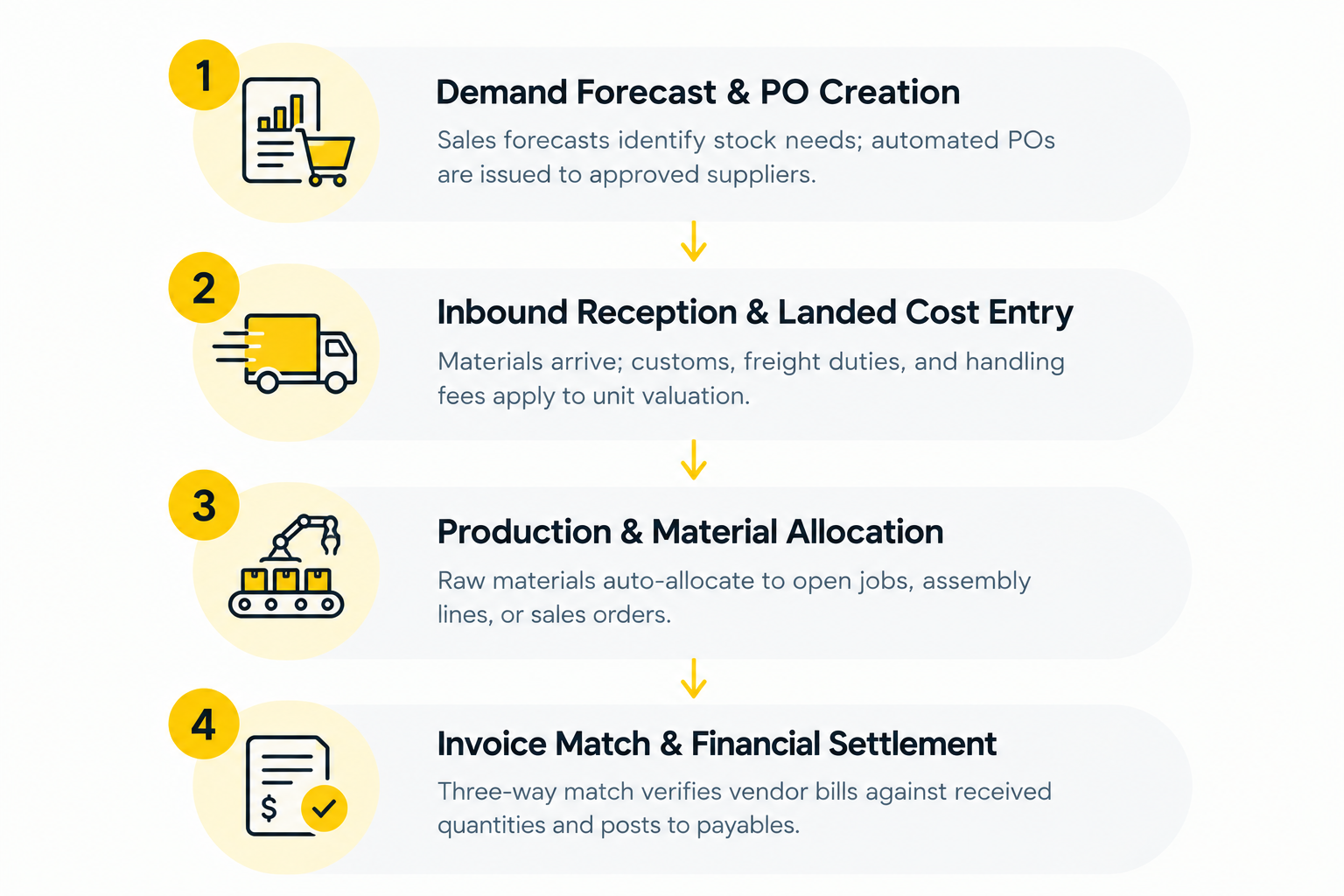
End-to-End Supply Chain Workflow: Forecast to Financial Settlement
DuoCron unifies the entire supply chain cycle from initial procurement planning to final general ledger closeout of the finished good:
Frequently Asked Questions
- How long does it take to implement DuoCron ERP for supply chain operations?
- Implementation timelines typically range from 6 to 16 weeks depending on the number of facilities, data migration complexity, and whether custom third-party integrations (such as specialized 3PLs or EDI setups) are required.
- Can DuoCron ERP integrate with existing warehouse hardware and barcode scanners?
- Yes. duoCron ERP features native support for standard handheld RFID scanners, barcode scanners, and thermal label printers, allowing warehouse staff to perform put-away, cycle counts, and picking without switching devices.
- How does DuoCron ERP handle multi-currency and international suppliers?
- DuoCron ERP includes native multi-currency support, automated landed cost calculations (factoring in freight, customs, and duties), and localized compliance features to support international supply networks.
- Can DuoCron ERP handle demand spikes and sudden seasonal changes?
- Yes. DuoCron ERP uses predictive demand forecasting that factors in historical seasonal trends, current sales pipeline speed, and custom market indicators. This lets your team automatically adjust safety stock levels, plan supplier orders well in advance, and avoid costly stockouts during peak selling periods.
- How does DuoCron ERP prevent stockouts and over-purchasing?
- The system replaces manual guesswork with automated Material Requirements Planning (MRP) and dynamic reorder points. When stock dips to a preset threshold, DuoCron calculates the exact quantity needed based on real-time consumption rates and supplier lead times, instantly generating purchase orders for approved vendors.
- Does DuoCron ERP support third-party logistics (3PL) and external freight carriers?
- Yes. DuoCron ERP integrates directly via APIs with major shipping carriers, freight forwarders, and 3PL warehouse partners. This allows your team to automate rate shopping, print carrier-compliant shipping labels in one click, and receive real-time tracking updates without leaving the system.
Take Control of Your Supply Chain Today!!
Stop managing your critical procurement and forecasting on scattered spreadsheets. Unify your purchasing, inventory planning, and financial reporting with DuoCron ERP software for supply chain management.