Returns are a normal part of modern logistics. Products may come back because of damage, wrong shipments, quality issues, customer cancellations, excess inventory, warranty claims, or delivery problems. When returns are handled manually, companies can quickly lose visibility into inventory, costs, customer credits, and the actual reason behind each return.
A reverse logistics ERP helps bring these activities into one connected workflow. It can track the return request, authorize the return, receive the product, inspect it, decide what happens next, update inventory, and connect the outcome with billing or customer credits.
For companies looking for a flexible system, DuoCron ERP provides a custom-built, industry-ready ERP approach based on ERPNext and the Frappe Framework. It can connect returns and reverse logistics with inventory, warehouse operations, sales, procurement, finance, and customer management while supporting business-specific workflows.
This guide explains how a logistics ERP handles returns, how reverse logistics works, which features matter, and how businesses can build a more controlled returns process.
What Is Reverse Logistics?
Reverse logistics is the process of moving goods backward through the supply chain.
Traditional logistics generally follows this direction:
Supplier → Warehouse → Customer
Reverse logistics works in the opposite direction:
Customer → Carrier → Warehouse → Inspection → Final Disposition
The final disposition can vary.
A returned product may be:
- Put back into sellable inventory
- Sent for repair
- Repacked and resold
- Sent to a different warehouse
- Returned to the supplier
- Sent for recycling
- Scrapped
- Held for quality inspection
- Used as a replacement component
- Returned under warranty
A reverse logistics ERP helps businesses track these decisions instead of treating every returned item as ordinary inventory.
Why Do Logistics Companies Need an ERP for Returns?
Returns involve much more than moving a package back to a warehouse.
A typical return can affect several departments at the same time.
The warehouse needs to receive the product. Quality teams may need to inspect it. Inventory needs to be updated. Customer service may need to communicate with the customer. Finance may need to issue a refund or credit note.
Without an integrated system, each department may maintain separate records.
This creates questions such as:
- Has the returned product actually arrived?
- Where is it now?
- Has it been inspected?
- Can it be resold?
- Why was it returned?
- Who should receive the credit?
- Has the customer already received a refund?
- What is the actual cost of the return?
- Should the product go back to the supplier?
A reverse logistics ERP connects these activities into one traceable process.
How Does a Logistics ERP Handle Returns?
A well-designed ERP can manage returns through a series of connected stages.
Step 1: Return Request
The process usually begins when a customer, warehouse, sales representative, or service team raises a return request.
The request can include:
- Customer details
- Original order
- Product
- Quantity
- Reason for return
- Invoice information
- Serial or batch number
- Photos or supporting documents
- Return location
- Expected return date
Connecting the return to the original order is particularly important.
It gives the business context instead of creating an isolated return transaction.
Step 2: Return Authorization
Not every return should automatically be accepted.
Depending on company policy, the ERP can support an approval process.
For example:
Return Request → Review → Approval → Return Authorization → Shipment
Approval rules can depend on the product, customer, reason, warranty status, value, or other business conditions.
This helps prevent unauthorized returns from entering the warehouse without proper documentation.
Step 3: Reverse Shipment
Once the return is approved, the product needs to move back.
The ERP can record information such as:
- Pickup location
- Return destination
- Carrier
- Shipment details
- Tracking number
- Expected arrival
- Transportation cost
If the company uses a TMS or carrier platform, the ERP can exchange relevant information through APIs or other integrations.
Step 4: Return Receiving
When the product arrives, warehouse staff need to confirm what was actually received.
The ERP can compare:
Expected Return Quantity vs Actual Received Quantity
This is useful when customers return only part of an order.
For example, if a customer was authorized to return 20 units but only 18 arrive, the system should preserve that difference.
Step 5: Inspection and Quality Check
A returned item should not always go directly into available inventory.
It may be:
- Damaged
- Used
- Defective
- Incorrectly shipped
- Expired
- Contaminated
- Missing components
- Fully functional
An inspection workflow can determine the product's condition.
This is particularly important for industries where returned goods require quality or regulatory checks before they can be resold.
Step 6: Inventory Disposition
After inspection, the ERP needs to determine what happens to the returned product.
This is known as disposition.
A typical disposition workflow may look like:
Return Received → Inspection → Disposition Decision
Then the product may move to:
Sellable Stock
or
Repair
or
Repackaging
or
Quarantine
or
Supplier Return
or
Scrap
or
Recycling
The ERP should record the reason and destination for each decision.
Reverse Logistics ERP and Inventory Management
Returns can create major inventory problems when they are not recorded correctly.
For example, a warehouse may physically receive 100 returned units but only 60 may be suitable for resale.
If all 100 are added to available stock, inventory records become misleading.
A reverse logistics ERP can separate returned inventory into appropriate statuses.
For example:
| Inventory Status | Meaning |
|---|---|
| Return Pending | Return approved but not received |
| Received | Product physically received |
| Inspection Hold | Awaiting inspection |
| Damaged | Product cannot currently be sold |
| Repair | Product requires repair |
| Resalable | Product can return to available stock |
| Supplier Return | Product will be sent back to supplier |
| Scrap | Product is not economically recoverable |
This provides better visibility into what the company actually owns and what it can sell.
How ERP Handles Different Return Reasons
Not all returns should follow the same workflow.
The reason for the return can determine what happens next.
Damaged Product
A damaged product may need inspection and repair or disposal.
The ERP can record the damage reason and associated costs.
Wrong Product Shipped
If the warehouse sent the wrong product, the return can be linked to the original fulfillment transaction.
The company may then arrange a replacement shipment.
Customer Change of Mind
Some businesses allow customers to return products even when there is no product defect.
The ERP can manage the return according to the company's commercial policy.
Quality Issue
Quality-related returns may require a more detailed inspection and potentially supplier or manufacturing investigation.
The return can be linked to batch, serial, product, supplier, or production information where applicable.
Warranty Return
Warranty returns may require service workflows.
The ERP can connect the returned product to the customer, original sale, serial number, warranty terms, repair activity, and replacement.
Reverse Logistics ERP and Customer Refunds
Returns often create financial transactions.
A customer may be entitled to:
- Full refund
- Partial refund
- Replacement
- Store credit
- Credit note
- Refund after inspection
- Refund after deduction of certain charges
The ERP should connect the return outcome with the financial transaction.
For example:
Return Approved → Product Received → Inspection Passed → Credit Approved → Credit Note/Refund
This reduces the need for employees to manually reconcile return records with finance.
Return-to-Supplier Management
Reverse logistics does not always end with the customer.
Sometimes the returned product needs to go back to the supplier.
For example:
Customer → Logistics Warehouse → Inspection → Supplier
This can happen when products are defective, damaged during manufacturing, or covered under supplier agreements.
An ERP can maintain the connection between the customer return and supplier return.
This helps answer:
- Which supplier supplied the product?
- Which batch was involved?
- How many units were returned?
- What was the reason?
- Has the supplier accepted the return?
- Has a supplier credit been received?
Reverse Logistics and 3PL Operations
For 3PL providers, returns can become more complex because the logistics company may be managing returns on behalf of multiple customers.
Each customer can have different:
- Return policies
- Inspection rules
- Disposition rules
- Storage charges
- Handling charges
- Packaging requirements
- Billing structures
A reverse logistics ERP should therefore support customer-specific workflows.
For example:
Customer A: Returned goods go directly to sellable inventory after basic inspection.
Customer B: Every return requires quality approval.
Customer C: Damaged goods must be held for customer authorization before disposal.
The ERP should be able to manage these differences without forcing every customer into the same process.
How ERP Connects Returns With Warehouse Operations
Returns should not operate as a completely separate warehouse process.
Once goods come back, they need to be received, identified, inspected, stored, moved, or dispatched again.
An integrated ERP can connect return transactions with warehouse activities.
For example:
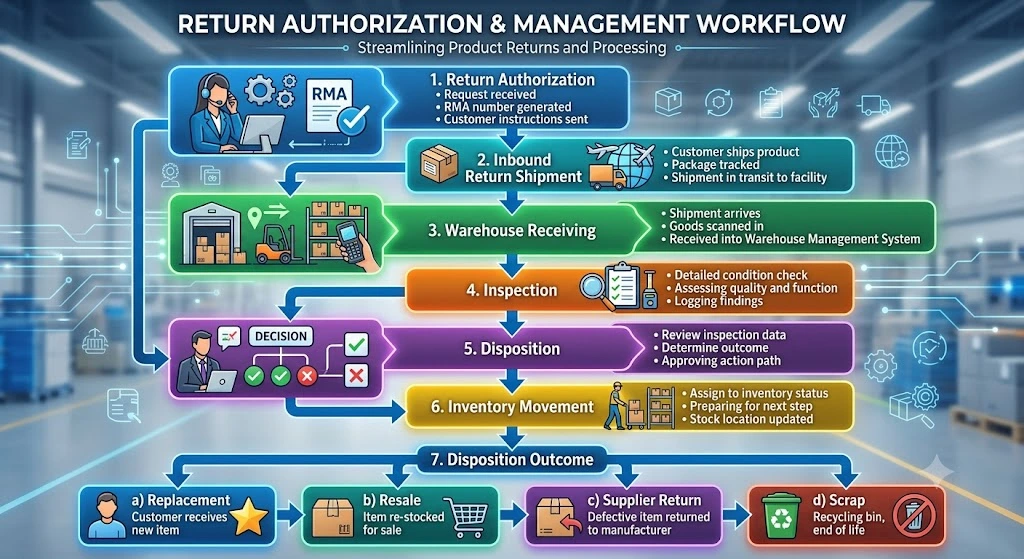
This creates a traceable flow from the original return request to the final outcome.
Reverse Logistics and Transportation Costs
Returns also create transportation expenses.
A company may need to pay for:
- Customer pickup
- Reverse shipment
- Special handling
- Repacking
- Inter-warehouse movement
- Supplier return shipment
- Disposal transportation
These costs can be tracked against the return transaction.
This helps businesses understand the financial impact of returns rather than looking only at the refunded product value.
For example, a product may have a selling price of $500, but the actual return cost could include pickup, inspection, repackaging, restocking, and reshipping.
Without reverse logistics cost visibility, the business may underestimate the true cost of returns.
Return Cost Analysis
A good reverse logistics ERP should help companies analyze the complete return cost.
Potential cost elements include:
- Reverse transportation
- Warehouse handling
- Inspection
- Repair
- Repackaging
- Restocking
- Disposal
- Customer refunds
- Replacement shipment
- Administrative processing
The business can then identify which return types create the highest operational impact.
For example, if a specific product repeatedly comes back damaged, the company may need to investigate packaging or transportation practices.
This turns return data into an operational improvement tool.
Serial and Batch Tracking in Reverse Logistics
Serial and batch tracking becomes important when businesses need to know exactly which product was returned.
A return transaction can capture:
- Serial number
- Batch number
- Product code
- Original order
- Customer
- Shipment
- Return reason
- Inspection result
- Final disposition
This creates a stronger audit trail.
For industries dealing with regulated, high-value, or traceable products, this level of visibility can be particularly important.
Reverse Logistics for E-Commerce and Distribution
E-commerce businesses often experience high return volumes.
A customer may place an order online, receive the product, and later request a return.
The reverse process can involve:
Online Return Request → Return Approval → Carrier Pickup → Warehouse Receipt → Inspection → Refund → Inventory Update
An ERP can connect the return to the original order and financial transaction.
This reduces manual reconciliation between the e-commerce platform, warehouse, customer service team, and finance department.
Reverse Logistics and Replacement Orders
Sometimes customers do not want a refund.
They want another product.
For example, a customer may receive the wrong size or a damaged product and request a replacement.
The ERP can connect the original return with the replacement order.
This creates a clear relationship between:
Original Order → Return → Replacement Order
The warehouse can then process the returned product while preparing the replacement shipment.
This is much easier to manage when both processes exist within the same connected system.
Reverse Logistics ERP and Reporting
Returns create valuable operational data.
A logistics ERP can provide reports such as:
- Returns by customer
- Returns by product
- Returns by warehouse
- Returns by reason
- Return value
- Return quantity
- Average return processing time
- Damaged goods
- Supplier-related returns
- Warranty returns
- Resalable returns
- Scrap value
- Reverse transportation cost
Managers can use this information to identify recurring problems.
For example, a high number of returns for one product may indicate a product-quality issue.
A high number of damaged returns from one transportation route may indicate a handling or packaging problem.
Key Reverse Logistics ERP Features
When evaluating software, logistics companies should look beyond basic return transactions.
Important capabilities include:
- Return request management
- Return authorization
- Return shipment tracking
- Warehouse receiving
- Inspection workflows
- Quarantine inventory
- Disposition management
- Serial and batch tracking
- Replacement order management
- Supplier returns
- Customer refunds and credit notes
- Reverse transportation tracking
- Return cost analysis
- Customer-specific return rules
- Workflow approvals
- Reporting and dashboards
- WMS, TMS, carrier, and e-commerce integrations
The exact feature set should depend on the company's operating model.
How Reverse Logistics ERP Improves Operations
An integrated reverse logistics process can improve several areas of the business.
Better Inventory Accuracy
Returned products can be separated from available inventory until their condition is confirmed.
Faster Return Processing
Employees have a defined workflow instead of managing returns through emails and spreadsheets.
Better Customer Experience
Customers can receive clearer updates about return status, refunds, replacements, and approvals.
Lower Operational Waste
Businesses can identify repeated return causes and improve processes.
Better Financial Control
Return transactions can be connected with refunds, credit notes, replacement orders, and associated costs.
Stronger Traceability
The business can follow a product from the original sale through its return and final disposition.
Common Reverse Logistics Challenges Without ERP
Without an integrated system, companies often face disconnected return information.
A return request may exist in one application, warehouse receipt information in another, and financial adjustments in a spreadsheet.
This can lead to:
- Duplicate data entry
- Missing return records
- Incorrect inventory
- Delayed refunds
- Poor return visibility
- Unclear product ownership
- Untracked return costs
- Difficult reconciliation
- Slow customer communication
The larger the operation becomes, the harder these problems are to manage manually.
How to Implement Reverse Logistics ERP
Implementing a reverse logistics ERP should start with process mapping.
1. Map Current Return Processes
Document how returns currently happen.
Identify who creates the return, who approves it, who receives the goods, who inspects them, and who authorizes the final disposition.
2. Define Return Reasons
Create standardized return reasons.
This makes future reporting more useful.
3. Define Disposition Rules
Decide what happens to different types of returned goods.
For example:
Good Condition → Resell
Minor Damage → Repair
Quality Issue → Quarantine
Non-Recoverable → Scrap
4. Connect Returns With Finance
Define when refunds, credit notes, or supplier credits should be generated.
5. Integrate External Systems
Connect the ERP with the systems involved in the return process.
These may include:
- E-commerce platforms
- WMS
- TMS
- Carrier systems
- Customer portals
- Payment systems
6. Measure Return Performance
Track return volume, processing time, costs, reasons, and final disposition.
This helps the business improve the reverse logistics process over time.
Why DuoCron ERP for Reverse Logistics?
DuoCron ERP provides a flexible approach for businesses that need reverse logistics to work as part of their wider ERP environment.
Built on ERPNext and the Frappe Framework, DuoCron combines an open-source foundation with custom-built, industry-ready capabilities.
For logistics operations, the system can connect return management with:
- Inventory
- Warehouse operations
- Sales
- Procurement
- Customer management
- Finance
- Billing
- Reporting
- WMS integrations
- TMS integrations
- Carrier integrations
The advantage is that returns do not have to remain an isolated process.
They can become part of the same operational and financial workflow used by the business.
Custom Workflows for Different Return Policies
Every logistics business has different return rules.
DuoCron can support business-specific workflows so that return authorization, inspection, disposition, billing, and inventory processes can reflect actual operational requirements.
This is particularly relevant for 3PL, distribution, fulfillment, manufacturing, and multi-warehouse businesses.
Open-Source ERP Foundation
DuoCron is built on ERPNext and the Frappe Framework, providing an open-source technology foundation.
This allows businesses to build and extend workflows according to their operational requirements.
No Recurring Per-User Software Licensing Fees
DuoCron's model does not rely on traditional recurring per-user software licensing fees.
Businesses can instead invest in implementation, customization, integrations, hosting, training, support, and other services required to operate the ERP.
The total ERP cost still depends on the scope of the project, but the pricing structure does not have to grow simply because more employees need system access.
The Future of Reverse Logistics
Reverse logistics is becoming an increasingly important part of supply chain management.
Companies are handling more returns, more product variations, more customer expectations, and more complex fulfillment networks.
This makes visibility increasingly important.
Future reverse logistics systems will need to connect return requests, transportation, warehouse operations, product condition, inventory, financial transactions, and customer communication.
Automation can reduce repetitive work, while analytics can help companies identify the causes behind returns.
The objective is not simply to process returns faster.
It is to understand why products are coming back, what they cost, where they go, and how the business can reduce unnecessary returns in the future.
Final Thoughts
Returns are not simply a warehouse problem. They can affect inventory, transportation, customer service, finance, procurement, quality, and profitability.
A reverse logistics ERP brings these activities together.
From return authorization and inbound transportation to inspection, disposition, inventory updates, refunds, replacements, and supplier returns, an integrated ERP can create a more controlled and traceable process.
For logistics companies, the right system should also be flexible enough to support different customer requirements and integrate with existing WMS, TMS, carrier, e-commerce, and other platforms.
DuoCron ERP offers a custom-built, industry-ready approach on an ERPNext and Frappe open-source foundation. Its flexible architecture can help businesses connect reverse logistics with their broader ERP operations while avoiding traditional recurring per-user software licensing fees.
For mid-sized and large logistics operations, the goal should be more than simply recording returns. The ERP should help turn reverse logistics data into better inventory control, lower operational waste, stronger customer service, and better business decisions.
Frequently Asked Questions
1. What is a reverse logistics ERP?
A reverse logistics ERP is an ERP system that manages product returns and related processes such as return authorization, receiving, inspection, inventory disposition, refunds, replacements, supplier returns, and reverse transportation. It connects these activities with warehouse, finance, customer, and inventory operations.
2. How does ERP help with product returns?
An ERP can manage the complete return lifecycle from the initial return request through authorization, shipment, warehouse receiving, inspection, disposition, inventory updates, and financial settlement. This provides better visibility and reduces manual reconciliation.
3. Can an ERP track returned inventory?
Yes. A reverse logistics ERP can track returned inventory using statuses such as received, inspection hold, damaged, repair, resalable, supplier return, or scrap. Serial and batch tracking can provide additional traceability where required.
4. Can reverse logistics ERP manage refunds and replacements?
Yes. An integrated ERP can connect returns with refunds, credit notes, replacement orders, and related financial transactions. This helps customer service, warehouse, sales, and finance teams work from connected information.
5. Is DuoCron ERP suitable for reverse logistics?
DuoCron ERP can support reverse logistics workflows by connecting returns with inventory, warehouse management, customer management, finance, billing, and external logistics systems. Built on ERPNext and the Frappe Framework, DuoCron provides a custom-built and industry-ready ERP approach without traditional recurring per-user software licensing fees.
Related Articles:
10 Best Logistics ERP Software In The USA: 2026 Comparison
What Is ERP in Logistics? Features, Benefits and Examples
ERP for Freight Forwarding Companies: Complete Guide
Best ERP for Transportation and Logistics Companies
ERP for 3PL Companies: Warehouse, Billing and Customer Management
ERP vs TMS vs WMS: What Does a Logistics Company Need?
How to Integrate ERP With Carriers, TMS, WMS and 3PL Partners
ERP for Cold-Chain Logistics and Temperature-Controlled Warehouses
How ERP Improves Inventory and Logistics Management
Open-Source ERP for Logistics: Features, Costs and Limitations
Logistics ERP Implementation Checklist for US Companies
Author Bio

Aarav Sharma
Aarav Sharma is an ERPNext Consultant at DuoCron Solutions specializing in manufacturing ERP and process optimization. Outside work, Aarav enjoys exploring new technology trends and writing about digital transformation in manufacturing.