Cold-chain logistics is different from standard warehousing and transportation. Products may need to remain within a defined temperature range from receiving and storage to picking, transportation, and final delivery. Even a small process failure can affect product quality, inventory value, and customer trust.
A cold-chain logistics ERP helps connect these operations through one integrated business system. It can bring inventory, warehouse operations, procurement, orders, transportation, quality records, monitoring data, and financial processes together. For temperature-controlled warehouses, the ERP can also work with sensors, monitoring systems, WMS platforms, and logistics partners to improve visibility across the cold chain.
DuoCron ERP provides a custom-built, industry-ready ERP approach for logistics businesses that need their core operations connected with warehouse and supply-chain systems. Built on ERPNext and the Frappe Framework, it can be configured around cold-chain workflows, integrations, traceability requirements, and temperature-sensitive inventory processes.
What Is a Cold-Chain Logistics ERP?
A cold-chain logistics ERP is an enterprise resource planning system designed to support logistics operations where products must remain within controlled temperature conditions.
It brings business and operational processes into a connected environment.
Depending on the operation, this can include:
- Temperature-controlled warehousing
- Inventory management
- Batch and lot tracking
- Receiving and putaway
- Order management
- Picking and dispatch
- Transportation coordination
- Carrier management
- Quality checks
- Temperature monitoring
- Exception management
- Customer management
- Procurement
- Billing and finance
- Reporting and analytics
The key difference from a general logistics ERP is the importance of product condition and environmental control.
For a normal shipment, knowing where a product is may be enough.
For a cold-chain shipment, the business may also need to know whether the product remained within its required temperature range throughout the relevant handling and transportation stages.
Why Do Cold-Chain Businesses Need ERP?
Cold-chain operations involve more than simply keeping products cold.
The business has to coordinate inventory, facilities, equipment, employees, transportation, customers, suppliers, and quality requirements.
When these activities are managed through disconnected spreadsheets and systems, it becomes difficult to maintain a complete operational picture.
For example, consider a temperature-sensitive shipment entering a warehouse.
The business may need to know:
- When the shipment arrived
- Which products were received
- Which batches were involved
- What quantity was received
- What temperature was recorded
- Where the products were stored
- How long they remained in storage
- When they were picked
- Which vehicle transported them
- What temperature conditions were maintained
- When the customer received them
An integrated ERP can connect these events to the same business transaction.
This creates a more complete record of the product journey.
What Makes Cold-Chain Logistics Different?
Temperature-sensitive logistics introduces operational requirements that do not exist to the same degree in conventional warehousing.
Temperature Control
Products may have defined storage or transportation temperature requirements.
The operation must therefore monitor environmental conditions and identify deviations.
Limited Exposure Time
Some products may have strict handling or exposure requirements.
The business may need to track how long products remain outside controlled environments during loading, unloading, staging, or transportation.
Product Sensitivity
Temperature excursions can affect product quality.
This makes exception management and traceability important parts of the logistics process.
Specialized Storage
A cold-chain warehouse may contain multiple temperature zones.
For example, different areas may be designed for different storage conditions.
The ERP needs to support inventory visibility across these locations.
Equipment Dependency
Refrigeration systems, freezers, cold rooms, monitoring devices, generators, and other equipment can directly affect warehouse operations.
Equipment downtime can therefore become a business issue rather than simply a maintenance issue.
Cold-Chain ERP and Temperature-Controlled Warehouses
Temperature-controlled warehouses require tighter coordination between inventory and environmental conditions.
A cold-chain ERP can provide a central business layer around warehouse operations.
The warehouse may use a WMS or other specialized systems for execution, while the ERP manages broader business transactions and connects them with procurement, sales, finance, customers, and logistics.
A typical flow can look like:
Inbound Shipment → Receiving → Temperature Check → Putaway → Controlled Storage → Picking → Staging → Dispatch → Delivery
Each stage can create information that becomes part of the overall operational record.
Temperature Monitoring and ERP Integration
Temperature monitoring is one of the most important areas in cold-chain operations.
Modern warehouses may use sensors and monitoring systems to capture temperature information continuously or at defined intervals.
The ERP does not necessarily need to replace those specialized monitoring systems.
Instead, it can integrate with them.
For example:
Temperature Sensor → Monitoring Platform → ERP
The monitoring platform may capture detailed readings while the ERP receives relevant events, alerts, or summarized information.
This creates a connection between environmental monitoring and business operations.
What Can Temperature Monitoring Integration Provide?
Depending on the technology and configuration, the system may capture or use information such as:
- Temperature readings
- Time of reading
- Storage location
- Sensor identifier
- Temperature range
- Minimum and maximum values
- Excursion events
- Alert status
- Corrective action
- Related inventory
- Related shipment
This can help teams connect a temperature event with the products and transactions affected by it.
Temperature Excursion Management
A temperature excursion occurs when conditions move outside the defined acceptable range.
The important issue is not simply recording the event.
The business needs a process for responding to it.
For example:
Temperature Deviation → Alert → Inventory Identification → Quality Review → Decision → Corrective Action
Depending on the business process, affected inventory may be placed on hold while the appropriate team reviews the situation.
The ERP can help connect the event with:
- Warehouse location
- Product
- Batch or lot
- Quantity
- Shipment
- Customer
- Quality status
- Corrective action
- Final disposition
This creates a structured record instead of relying on emails or manual spreadsheets.
Cold-Chain Inventory Management
Inventory management becomes more complex when products have temperature requirements.
The ERP needs to show not only how much inventory is available but also where it is and what operational conditions apply.
Important inventory information can include:
- Product
- Batch or lot
- Quantity
- Warehouse
- Temperature zone
- Storage location
- Expiry date
- Status
- Quality hold
- Allocation status
- Available quantity
This can give warehouse and supply-chain teams a more complete view of stock.
Batch and Lot Traceability
Traceability is especially important for temperature-sensitive products.
A cold-chain ERP can connect batch or lot information across multiple stages.
For example:
Supplier Batch → Receiving → Storage → Order Allocation → Shipment → Customer
If a problem is identified later, the company can use this information to determine which inventory and transactions may be affected.
This is particularly useful when dealing with recalls, quality investigations, customer complaints, or temperature excursions.
FEFO and Expiry Management
Many cold-chain products have defined shelf lives.
Managing inventory only according to quantity is therefore not enough.
The ERP can support First Expired, First Out (FEFO) workflows where inventory with the earliest expiry is prioritized for use or dispatch, subject to the company's operating rules.
For example, if two batches are available:
- Batch A expires sooner.
- Batch B expires later.
The system can help prioritize Batch A when fulfilling an eligible order.
This can reduce unnecessary expiry and improve inventory utilization.
Expiry Alerts
The ERP can also support alerts around upcoming expiry dates.
Teams may use these alerts to:
- Prioritize stock
- Plan dispatch
- Contact customers
- Review slow-moving inventory
- Adjust procurement
- Reduce avoidable wastage
For businesses handling high-value temperature-sensitive products, better expiry visibility can have a direct operational impact.
Multi-Zone Cold Storage Management
Not every product necessarily requires the same temperature condition.
A cold-chain warehouse may therefore contain multiple zones.
For example:
- Ambient
- Chilled
- Frozen
- Deep frozen
- Specialized temperature-controlled areas
The exact ranges depend on the products and business requirements.
The ERP should be able to distinguish these locations and associate inventory with the appropriate storage environment.
This helps prevent a common operational problem: treating all warehouse space as if it were interchangeable.
Receiving Temperature-Sensitive Inventory
Receiving is a critical control point.
When temperature-sensitive products arrive, the warehouse may need to verify more than quantity.
The receiving workflow may include:
Vehicle Arrival → Shipment Verification → Product Inspection → Temperature Check → Quantity Check → Batch Verification → Quality Decision → Putaway
The ERP can capture relevant receiving information and link it to the purchase order, supplier, product, batch, and warehouse transaction.
If the temperature is outside the expected range, the inventory can be routed into the appropriate exception or quality workflow.
Cold-Chain Warehouse Picking
Picking temperature-sensitive inventory requires careful coordination.
The warehouse needs to know:
- Which product to pick
- Which batch to pick
- Which quantity is required
- Which location contains the inventory
- Which expiry should be prioritized
- Whether the stock is available for dispatch
A connected ERP and WMS environment can help coordinate these requirements.
For example:
Customer Order → Inventory Allocation → FEFO Selection → Warehouse Pick → Pack → Cold Staging → Dispatch
The exact workflow can vary by warehouse, but the objective is to reduce unnecessary handling and maintain inventory accuracy.
Cold Staging and Dispatch
The time between controlled storage and transportation can be operationally important.
Products may move from cold storage to a staging area before being loaded onto a vehicle.
The business may need to control:
- Staging location
- Shipment priority
- Loading sequence
- Vehicle assignment
- Temperature condition
- Dispatch time
- Product exposure
- Documentation
ERP integration can help connect these activities to the shipment record.
This gives the logistics team better visibility into what is ready to leave the warehouse and under what conditions.
Cold-Chain Transportation Management
Cold-chain transportation introduces another layer of temperature control.
A refrigerated vehicle may need to maintain specific conditions during transportation.
A logistics ERP can connect transportation information with the underlying customer order and inventory transaction.
The flow may look like:
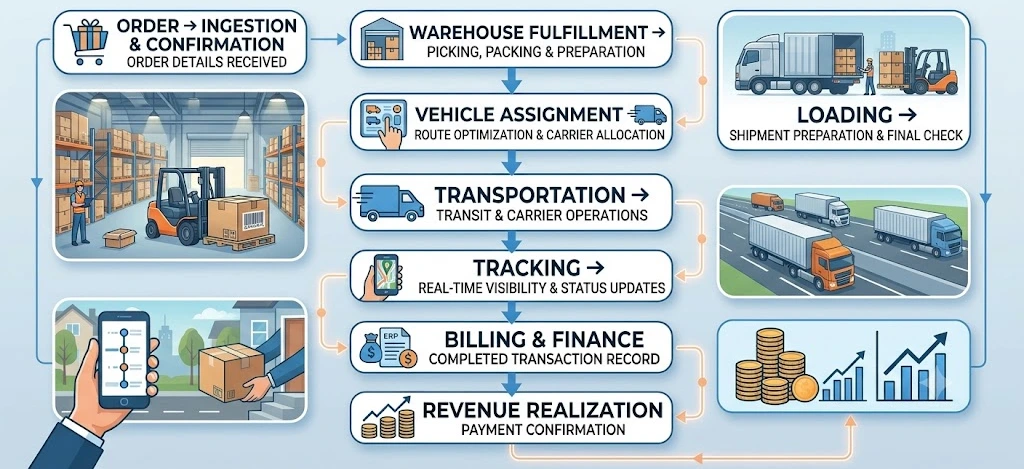
If vehicle temperature data is available through a connected monitoring platform, that information can also be integrated into the broader logistics architecture.
Carrier and 3PL Integration
Many cold-chain companies work with external carriers or 3PL partners.
This creates a need for system-to-system integration.
A cold-chain ERP may need to exchange information such as:
- Shipment details
- Product information
- Quantity
- Delivery location
- Vehicle information
- Tracking number
- Temperature requirements
- Dispatch status
- Delivery status
- Proof of delivery
- Freight charges
Integrating these systems reduces dependence on manual data exchange.
It also creates a clearer connection between warehouse activity, transportation, and customer delivery.
ERP Integration With IoT and Sensors
Cold-chain operations increasingly depend on connected monitoring devices.
Sensors can capture environmental conditions while the ERP provides the business context around those readings.
This creates an important distinction.
The sensor answers:
“What is the temperature?”
The ERP helps answer:
“Which inventory, shipment, warehouse, customer, or business process is affected by that temperature event?”
Connecting these two layers can make temperature data more useful.
For example, a temperature alert could be associated with a specific storage location and inventory batch.
The business can then investigate the event and determine the appropriate action.
Quality Management in Cold-Chain Logistics
Quality cannot be separated from cold-chain operations.
A temperature deviation does not automatically mean that all affected products should be discarded.
The appropriate decision may depend on the product, duration of exposure, temperature range, quality procedures, and business rules.
The ERP can support a structured workflow such as:
Deviation Detected → Inventory Hold → Quality Review → Decision → Release / Reject / Other Action
This helps ensure that quality decisions are documented and traceable.
Cold-Chain Compliance and Audit Readiness
Cold-chain operations may be subject to industry-specific requirements, contractual obligations, and internal quality procedures.
An ERP can support audit readiness by maintaining organized records.
Relevant records may include:
- Receiving records
- Temperature observations
- Inventory movements
- Batch information
- Storage locations
- Shipment records
- Delivery information
- Exception reports
- Corrective actions
- User activity
- Quality decisions
The exact compliance requirements depend on the industry, product category, geography, and operating model.
The ERP should therefore be configured around the actual requirements of the business rather than assuming that one workflow applies to every cold-chain operation.
How ERP Improves Cold-Chain Visibility
Visibility is one of the biggest benefits of connecting cold-chain operations.
Instead of viewing warehouse, inventory, transportation, and finance information separately, management can connect these areas.
For example, a dashboard could help answer:
- How much temperature-sensitive inventory is available?
- Where is it stored?
- Which batches are approaching expiry?
- Which shipments are currently in transit?
- Are any temperature excursions active?
- Which orders are waiting for dispatch?
- Which deliveries are delayed?
- What inventory is currently on quality hold?
This allows teams to work from a shared operational picture.
Cold-Chain ERP and Inventory Cost Control
Temperature-controlled logistics can be expensive.
Cold storage requires infrastructure, energy, equipment, maintenance, monitoring, and specialized handling.
Inventory losses can add further costs.
ERP can help businesses understand these costs by connecting operational transactions with financial information.
For example, the system can help track:
- Storage charges
- Handling charges
- Transportation costs
- Freight
- Inventory value
- Product losses
- Expiry-related losses
- 3PL charges
- Customer billing
This gives finance and operations teams a more connected view of logistics costs.
Cold-Chain ERP and Customer Service
Customers increasingly expect visibility into their orders.
For temperature-sensitive shipments, they may also need confidence that the required handling conditions were maintained.
An integrated ERP can provide customer-facing teams with information such as:
- Order status
- Shipment status
- Tracking information
- Delivery status
- Product or batch information
- Relevant documentation
- Exception information
When this information is connected to the ERP, customer service teams spend less time searching across different systems.
Common Challenges in Cold-Chain ERP Implementation
Implementing ERP in a temperature-controlled logistics environment requires careful planning.
Treating cold-chain logistics like normal warehousing
Temperature requirements should be incorporated into the process design from the beginning.
Ignoring sensor and monitoring integration
If monitoring systems remain completely disconnected from business transactions, teams may have temperature data without sufficient business context.
Poor batch traceability
Batch and lot relationships should be maintained across receiving, storage, allocation, shipment, and delivery.
Weak exception handling
Temperature excursions, equipment failures, rejected receipts, and shipment delays should have defined workflows.
Overlooking warehouse execution
The ERP should work with the actual warehouse process and WMS environment rather than assuming that inventory exists only as accounting quantities.
Building too many manual processes
Manual spreadsheets and repeated data entry can reduce the value of an integrated ERP.
How to Choose a Cold-Chain Logistics ERP
Before selecting an ERP, cold-chain businesses should evaluate the system against their actual operational requirements.
Important questions include:
Can it manage temperature-sensitive inventory?
The ERP should support inventory attributes and workflows relevant to controlled storage.
Can it handle batch and expiry tracking?
Traceability and expiry management should be built into the operational process.
Can it integrate with monitoring systems?
The ERP should be able to work with sensors, IoT platforms, or temperature-monitoring applications where required.
Can it integrate with WMS and TMS?
Warehouse and transportation systems may already be part of the technology environment.
Can it connect with carriers and 3PLs?
External logistics partners should not become isolated information silos.
Can it support exception workflows?
Temperature deviations and other operational exceptions should be visible and actionable.
Can it scale?
The system should support additional warehouses, customers, products, transportation partners, and transaction volumes as the business grows.
Why DuoCron ERP for Cold-Chain Logistics?
DuoCron ERP takes a flexible approach to ERP implementation.
Rather than treating every logistics business as identical, the system can be configured around the organization's actual workflows, integrations, and operating requirements.
For cold-chain businesses, this can include workflows around:
- Temperature-controlled inventory
- Warehouse operations
- Batch and lot traceability
- Expiry management
- FEFO
- Quality holds
- Temperature exceptions
- Carrier coordination
- 3PL operations
- Customer orders
- Procurement
- Billing
- Reporting
- External system integration
DuoCron is built on ERPNext and the Frappe Framework, providing an open foundation for customization and integration.
Its custom-built, industry-ready approach is particularly relevant when a business has requirements that do not fit neatly into a standard ERP workflow.
A Connected Platform Instead of Isolated Systems
Cold-chain businesses often have several specialized technologies.
There may be:
- ERP
- WMS
- TMS
- Temperature monitoring systems
- IoT devices
- Carrier platforms
- 3PL systems
- Customer portals
DuoCron can serve as the central business layer while integrating with these systems.
The goal is not to eliminate every specialized application.
The goal is to make the overall technology environment work together.
Flexible ERP Without Recurring Per-User Software Licensing
DuoCron also follows a different commercial approach from traditional proprietary ERP models.
The platform does not rely on recurring per-seat software licensing fees as the primary software cost model.
Businesses can instead invest in implementation, customization, integrations, hosting, and support according to their requirements.
For growing logistics organizations, this can make it easier to plan an ERP environment around operational needs rather than continuously increasing software costs based on user count.
When Should a Cold-Chain Business Consider ERP?
A cold-chain business may need a more integrated ERP environment when operational complexity starts increasing.
Common signs include:
- Multiple temperature-controlled warehouses
- Several logistics partners
- Multiple carriers
- Large product catalogs
- High inventory values
- Frequent batch movements
- Manual temperature records
- Spreadsheet-based inventory management
- Difficulty tracking product history
- Delayed shipment visibility
- Repeated billing reconciliation
- Poor visibility across warehouses
- Growing customer or order volumes
The exact point at which ERP becomes necessary depends on the company's size and operating model.
However, increasing complexity usually makes disconnected systems harder to manage.
The Future of Cold-Chain Logistics ERP
Cold-chain logistics is becoming increasingly connected.
ERP systems are likely to work more closely with WMS, TMS, IoT devices, monitoring platforms, analytics systems, and automated warehouse technologies.
This can create a more connected operating model:
Sensors → Monitoring → ERP → WMS/TMS → Operations → Customer
The next stage is not simply collecting more data.
The real opportunity is turning that data into useful business actions.
A temperature alert should lead to investigation.
An expiry warning should support inventory planning.
A shipment delay should become visible to the relevant team.
A delivery event should update the order.
A warehouse transaction should update inventory and financial records.
This is where integrated ERP architecture becomes valuable.
Final Thoughts
Cold-chain logistics requires more control than simply moving products from one location to another.
Temperature, inventory, expiry, batch traceability, warehouse conditions, transportation, quality, and delivery all need to work together.
A cold-chain logistics ERP can provide the connected business layer required to coordinate these processes.
For temperature-controlled warehouses, the ERP can connect inventory and warehouse operations with temperature monitoring, quality workflows, transportation, carriers, 3PL partners, customers, and finance.
The strongest approach is not necessarily to replace every specialized logistics system.
It is to connect the systems so that each one performs its role while important business information remains synchronized.
DuoCron ERP provides a custom-built, industry-ready ERP approach that can be adapted to cold-chain logistics workflows and integrated with the surrounding technology environment. Built on ERPNext and the Frappe Framework, it can provide a flexible foundation for businesses looking to connect their cold-chain operations without relying entirely on rigid, one-size-fits-all ERP processes.
For a temperature-controlled logistics operation, the objective is simple: protect product integrity, improve visibility, control inventory, and keep the entire cold chain connected.
Frequently Asked Questions
1. What is a cold-chain logistics ERP?
A cold-chain logistics ERP is an ERP system designed to support temperature-sensitive logistics operations. It can connect inventory, warehouse management, batch tracking, expiry management, transportation, quality, temperature monitoring, customer orders, billing, and other business processes.
2. Can ERP track temperature-controlled inventory?
Yes. A cold-chain ERP can be configured to manage temperature-related inventory information, storage zones, batches, expiry dates, quality status, and temperature exceptions. It can also integrate with external sensors or temperature-monitoring platforms when required.
3. How does ERP help temperature-controlled warehouses?
ERP can connect receiving, inventory, storage, picking, dispatch, quality, and financial processes. When integrated with a WMS and monitoring systems, it can provide a more complete view of where temperature-sensitive inventory is located and what operational events have affected it.
4. Can a cold-chain ERP integrate with WMS, TMS, IoT and 3PL systems?
Yes. A cold-chain ERP can integrate with specialized systems such as WMS, TMS, IoT monitoring platforms, carrier systems, and 3PL platforms. The specific integration method depends on the systems involved and may use APIs, webhooks, EDI, or other supported interfaces.
5. Why choose DuoCron ERP for cold-chain logistics?
DuoCron ERP provides a custom-built, industry-ready ERP approach based on ERPNext and the Frappe Framework. It can be configured around cold-chain inventory, warehouse, traceability, quality, transportation, integration, and billing requirements, while avoiding recurring per-seat software licensing fees.
Related Articles:
10 Best Logistics ERP Software In The USA: 2026 Comparison
What Is ERP in Logistics? Features, Benefits and Examples
ERP for Freight Forwarding Companies: Complete Guide
Best ERP for Transportation and Logistics Companies
ERP for 3PL Companies: Warehouse, Billing and Customer Management
ERP vs TMS vs WMS: What Does a Logistics Company Need?
How to Integrate ERP With Carriers, TMS, WMS and 3PL Partners
How ERP Improves Inventory and Logistics Management
Open-Source ERP for Logistics: Features, Costs and Limitations
How Logistics ERP Handles Returns and Reverse Logistics
Logistics ERP Implementation Checklist for US Companies
Author Bio

Aarav Sharma
Aarav Sharma is an ERPNext Consultant at DuoCron Solutions specializing in manufacturing ERP and process optimization. Outside work, Aarav enjoys exploring new technology trends and writing about digital transformation in manufacturing.