ERP for Logistics Companies in the USA
Complete Logistics Management Software for Streamlining Logistics, Freight, Fleet & Supply Chain Operations
What Is Logistics ERP Software?
A logistics ERP is a centralized software platform that connects every operational and financial unit of a supply chain business into a single database. Instead of juggling separate software for dispatch, warehouse floors, accounting ledgers, and customer support, companies run their entire business through one source of truth.
A modern logistics ERP system processes customer orders, manages inventory movements across distribution hubs, calculates dynamic freight rates, and syncs directly with general ledgers. Since, DuoCron ERP is powered by ERPNext, it offers mid-to-large logistics enterprises the agility of modern open-core architecture alongside enterprise-grade financial controls. It eliminates data silos, cuts duplicate manual entries, and gives decision-makers real-time visibility into operational margins.
Who DuoCron ERP Is Built For ?
A logistics ERP is a centralized software platform that connects every operational and financial unit of a supply chain business into a single database. Instead of juggling separate software for dispatch, warehouse floors, accounting ledgers, and customer support, companies run their entire business through one source of truth.
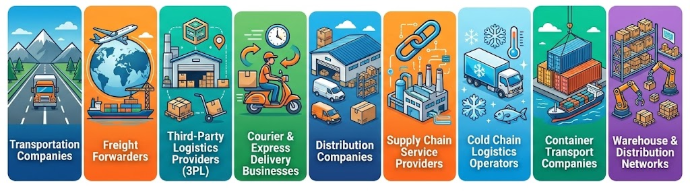
Mid-market and enterprise logistics providers face complex, high-volume operational cycles across national borders and state lines. DuoCron ERP provides specialized enterprise logistics software engineered specifically for organizations that have outgrown entry-level tools:
Third-Party Logistics (3PL) Providers: Multi-client operators managing shared warehouse space, value-added services, and tailored client billing models.
Freight Forwarders: Domestic and international operators balancing air, ocean, rail, and intermodal freight alongside customs documentation.
Asset-Based Motor Carriers: Truckload (TL) and Less-Than-Truckload (LTL) carriers operating regional, inter-state, or national fleets.
Cold-Chain Distributors: Temperature-sensitive food, beverage, and life-sciences supply chains requiring strict climate logs and lot traceability.
Contract Warehousing Networks: Distribution providers running high-velocity fulfillment centers across multiple regions.

Industries We Serve :
Challenges Faced by U.S. Logistics Companies
Operating a logistics business in the United States brings distinct operational pressures to mid & large enterprises:
- Fragmented Tech Stacks: Teams often waste hours re-entering load information across standalone dispatch tools, disconnected warehouse software, and third-party accounting apps.
- Complex Contract Rating: Managing fluctuating spot rates, customer-specific fuel surcharges, and detention tariffs in spreadsheets causes costly invoicing errors.
- Margin Leakage: Hidden deadhead miles, sudden demurrage fees, unbilled accessorial charges, and fuel price volatility erode net profit.
- Interstate Regulatory Hurdles: Moving shipments across state corridors requires continuous monitoring of driver duty cycles and vehicle safety records.
- Multi-Jurisdiction Tax Rules: Running facilities across multiple states makes manual tax calculations and financial reporting slow and prone to audit risks.
The End-To -End Logistics WorkFlow :
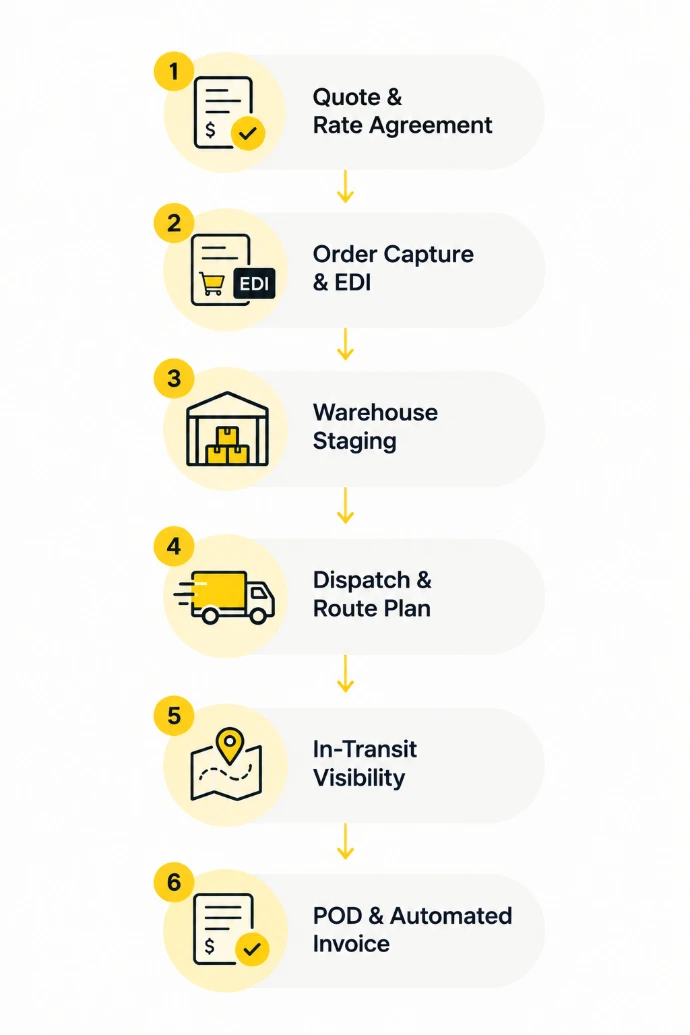
DuoCron delivers a unified operational flow that connects business events directly to accounting ledgers:
- Quote & Booking: The sales team logs an incoming freight request, verifies contract tariffs, and creates an approved booking.
- Order Validation: Orders flow in via EDI or direct customer portal entries, automatically checking inventory availability and credit terms.
- Fulfillment & Staging: The distribution center receives pick-and-pack lists, cross-docks incoming freight, and stages pallets for outbound transport.
- Carrier Dispatch & Execution: The fleet team assigns loads to internal drivers or vetted partner carriers with optimized routing.
- Transit Tracking: In-transit checkpoints update milestones, alerting dispatchers and customers of any exceptions.
- Proof of Delivery (POD) & Settling: Digital POD capture triggers automated customer invoicing, updates the general ledger, and settles carrier payables immediately.

Why Logistics Companies Choose DuoCron ERP as their Trucking ERP Solution?
Key Features of Duocron Logistics ERP Software - EXPLAINED !!
Order & Shipment Management
Managing freight starts with clear visibility into booking demands. DuoCron serves as an adaptive ERP for logistics that consolidates purchase orders, recurring shipments, and spot quotes into a single command screen.
Consolidate LTL shipments into full truckloads to maximize trailer utilization and cut line-haul costs.
Automate customer notifications at key milestones: pickup, border crossing, out-for-delivery, and completed drop-off.
Digitize bills of lading (BOL), delivery receipts, and customs manifests directly within the shipment record.
Catch split shipments and route deviations early to prevent unexpected dock handling charges.
Warehouse & Inventory Management
DuoCron handles the demands of multi-facility, multi-state warehouses and distribution centers across the country. Powered by ERPNext's inventory engine, the system ensures stock visibility down to specific aisle, rack, and bin locations.
Manage multi-client inventory with strict separation of ownership, SKUs, and billing profiles.
Direct picking, putaway, and cycle counts using rule-based strategies like FIFO, FEFO, or zone-based routing.
Track inventory movement by serialized pallet, batch number, and expiration date in real time.
Coordinate cross-docking operations to move incoming freight straight to outbound staging without unnecessary shelf storage.
Freight, Route, & Transportation Management
Coordinating regional drayage or cross-country line-haul demands practical transportation oversight. DuoCron centralizes routing, partner dispatch, and compliance tracking into a unified workflow.
Optimize route sequences to reduce total transit time, driver dwell, and empty deadhead miles.
Manage spot-market carrier procurement alongside dedicated contracted lanes from one screen.
Track equipment utilization across tractors, dry vans, reefers, and flatbeds to prevent idle assets.
Maintain safety audit readiness: configurable workflows can be implemented based on your requirements to log driver qualification files and vehicle inspection records alongside DOT and FMCSA rules.
Contract, Rate, and Customer Billing
Delayed billing damages cash flow and creates billing disputes. DuoCron features a robust pricing engine built to handle the complex nuances of commercial logistics contracts.
Maintain customer-specific rate sheets, including lane minimums, weight tiers, and pallet-position pricing.
Automate USD billing, dynamic fuel surcharges, and accessorial fees like detention, liftgate use, and inside delivery.
Generate accurate commercial invoices immediately upon electronic proof-of-delivery (ePOD) capture.
Audit vendor and sub-contractor freight bills against agreed rate tables before authorizing settlement.
Fleet Maintenance & Vehicle Operations
Controlling operating expenses requires active asset management throughout the equipment lifecycle. DuoCron logs vehicle usage, scheduled repairs, and operating health to keep your fleet road-ready.
Schedule preventative maintenance based on engine hours, mileage intervals, or calendar dates.
Maintain vehicle titles, registrations, insurance policies, and annual inspection documents with automatic renewal alerts.
Monitor workshop repair orders, spare-part consumption, and labor hours spent per vehicle.
Analyze lifecycle operating costs per asset to determine the ideal time for equipment replacement.
Fuel Management & Cost Control
Fuel remains one of the largest ongoing expenses for any carrier. DuoCron provides strict visibility over consumption, expense validation, and card transactions to prevent waste.
Log and reconcile fuel card transactions directly against specific trip sheets and assigned vehicle IDs.
Monitor per-mile fuel efficiency across different vehicle models, routes, and drivers.
Track fuel voucher issuance, bulk tank storage, and station dispensing approvals.
Identify unusual fuel consumption spikes and long idle times to curb fuel theft and waste.
Driver Management & Allocation
Smooth operations rely on assigning the right driver to the right load. DuoCron manages driver credentials, scheduling, and payroll data in one shared record. Driver Management can be done via mobile also.
Maintain comprehensive driver profiles, commercial driver's license (CDL) renewals, and medical certifications.
Match drivers to dispatches based on duty hours, location, and equipment endorsements.
Track trip logs, layovers, and overnight allowances for accurate and timely driver payroll.
Monitor safety incident histories, violations, and performance metrics across your driver roster.
Tyre & Asset Lifecycle Management
Tire maintenance directly influences road safety, fuel efficiency, and operating expenses. DuoCron includes detailed tracking tools to monitor tire wear and replacement cycles.
Track individual tires by serial number, brand, size, and axle position across your fleet.
Schedule regular tire rotations, pressure checks, and tread-depth inspections.
Monitor retreading cycles, casing conditions, and scrap history to evaluate brand durability.
Calculate the exact per-mile tire cost to optimize your purchasing decisions.
Proof of Delivery (POD) and Document Management
Paper-based paperwork slows down invoicing and leads to billing friction. DuoCron digitizes documentation so operational milestones immediately trigger the accounting cycle.
Capture electronic proof of delivery (ePOD) on mobile devices using customer signatures and photo verification.
Store signed bills of lading, weigh scale tickets, and customs release forms in the central shipment file.
Instantly share delivery confirmations with customer support teams and accounting departments.
Eliminate lost paperwork disputes by giving clients immediate access to signed delivery receipts.
Finance, Accounting, & Profitability
Unlike operational tools that rely on fragile sync bridges, DuoCron unites core operational data directly with your general ledger. This makes it an end-to-end ERP software for logistics industry leaders who demand complete financial visibility.
Configurable Multi-State Sales Tax: Automate sales tax calculations based on pickup locations, delivery destinations, and state nexus requirements.
Accurate Cost-Per-Lane Analytics: Allocate driver pay, fuel receipts, vehicle depreciation, and warehouse labor directly to individual loads.
Automated Payables & Receivables: Reconcile client invoices and sub-contractor carrier settlements within standard U.S. accounting periods.
Real-Time Financial Statements: Review live balance sheets, profit-and-loss statements, and cash flow reports without waiting for month-end manual entries.
CRM & Customer Portal
Modern shippers prioritize self-service tools, rapid quotes, and proactive communication. DuoCron includes a dedicated customer portal that reduces back-and-forth emails and phone check-ins.
Allow shippers to request spot quotes, submit booking orders, and upload documentation online.
Provide real-time visibility into order status, warehouse inventory levels, and proof-of-delivery files.
Centralize sales pipelines, corporate contract negotiations, and lane rate agreements.
Log, track, and resolve freight claims, detention disputes, and support tickets through an integrated helpdesk.
Vendor & Transporter Collaboration
Managing brokered freight and external carriers requires clear communication. DuoCron creates a connected workspace for your outside logistics partners.
Onboard third-party carriers with digital insurance certificates, W-9 forms, and operating authority checks.
Share available load tenders and receive rate bids directly through a secure partner workspace.
Enable partner carriers to update load milestones and upload delivery documents directly from the road.
Simplify carrier payables by matching supplier invoices against agreed load rate confirmations.
TMS, WMS, EDI, Carrier, & API Integrations
Modern logistics operations rely on connected software ecosystems. DuoCron’s open architecture integrates your core business system with partner networks, carrier applications, and warehouse hardware.
EDI Integration: Standard electronic data interchanges (such as EDI 204, 210, 214, and 940/945) can be implemented to support automated enterprise retail and partner workflows.
Carrier & Shipping Systems: Direct connections with parcel and freight carriers like UPS and FedEx can be integrated based on your operational requirements.
Telemetry & ELD Interfaces: Link in-cab electronic logging devices (ELD) and GPS trackers via REST APIs to pull real-time telematics.
Warehouse Hardware: Connect barcode scanners, mobile picking terminals, scale heads, and thermal label printers across all facilities.
Specialized Logistics ERP for 3PL Companies
Third-party logistics providers must manage distinct inventory, handling rules, and billing terms for multiple clients at once. DuoCron serves as a scalable enterprise logistics software engine built for contract warehousing and multi-client fulfillment.
Calculate customer-specific storage charges automatically by pallet count, square footage, or cubic volume.
Capture handling fees—such as pick-and-pack, relabeling, shrink-wrapping, and kitting—as warehouse staff complete tasks.
Provide secure, permission-controlled portal access so clients view only their dedicated inventory and orders.
Allocate specialized labor, racking zones, and handling equipment to individual enterprise accounts.
ERP For Freight Forwarders
International and domestic freight forwarders manage multi-modal movements with complex handoffs. DuoCron consolidates multimodal tracking, document filing, and financial accounting.
Link house bills (HBL/HAWB) directly to master bills (MBL/MAWB) for clear consolidation tracking.
Manage container stuffing, deconsolidation, and cross-dock operations across regional transit hubs.
Calculate multi-currency disbursements and agent splits while keeping your primary general ledger in USD.
Attach customs entries, ocean manifests, commercial invoices, and inspection certificates to the master shipment file.
ERP for Transportation Companies
Asset-based carriers require high equipment uptime, low deadhead miles, and balanced capacity. DuoCron provides dispatchers and fleet managers with the tools needed to optimize fleet operations.
Match drivers and equipment to available loads based on proximity, rest hours, and trailer specifications.
Monitor deadhead miles, terminal dwell times, and trailer utilization trends across your entire network.
Automate driver settlements, trip allowances, and delivery bonuses based on verified dispatch logs.
Balance recurring contract line-haul routes alongside high-yield spot-market opportunities.
ERP for Cold-Chain Logistics
Perishable foods, pharmaceuticals, and temperature-sensitive chemicals require strict environmental oversight. DuoCron helps you preserve cold-chain integrity and comply with food safety regulations.
Track inventory using strict batch-level lot controls, shelf-life monitoring, and expiration alerts.
Log temperature checkpoints at receiving docks, cold-storage staging, and final customer delivery.
Comply with FDA, FSMA, and USDA audit requirements through continuous traceability logs.
Execute fast product recalls by identifying the exact path of affected lots from inbound supplier to final consignee.
Implementation Process and Timeline
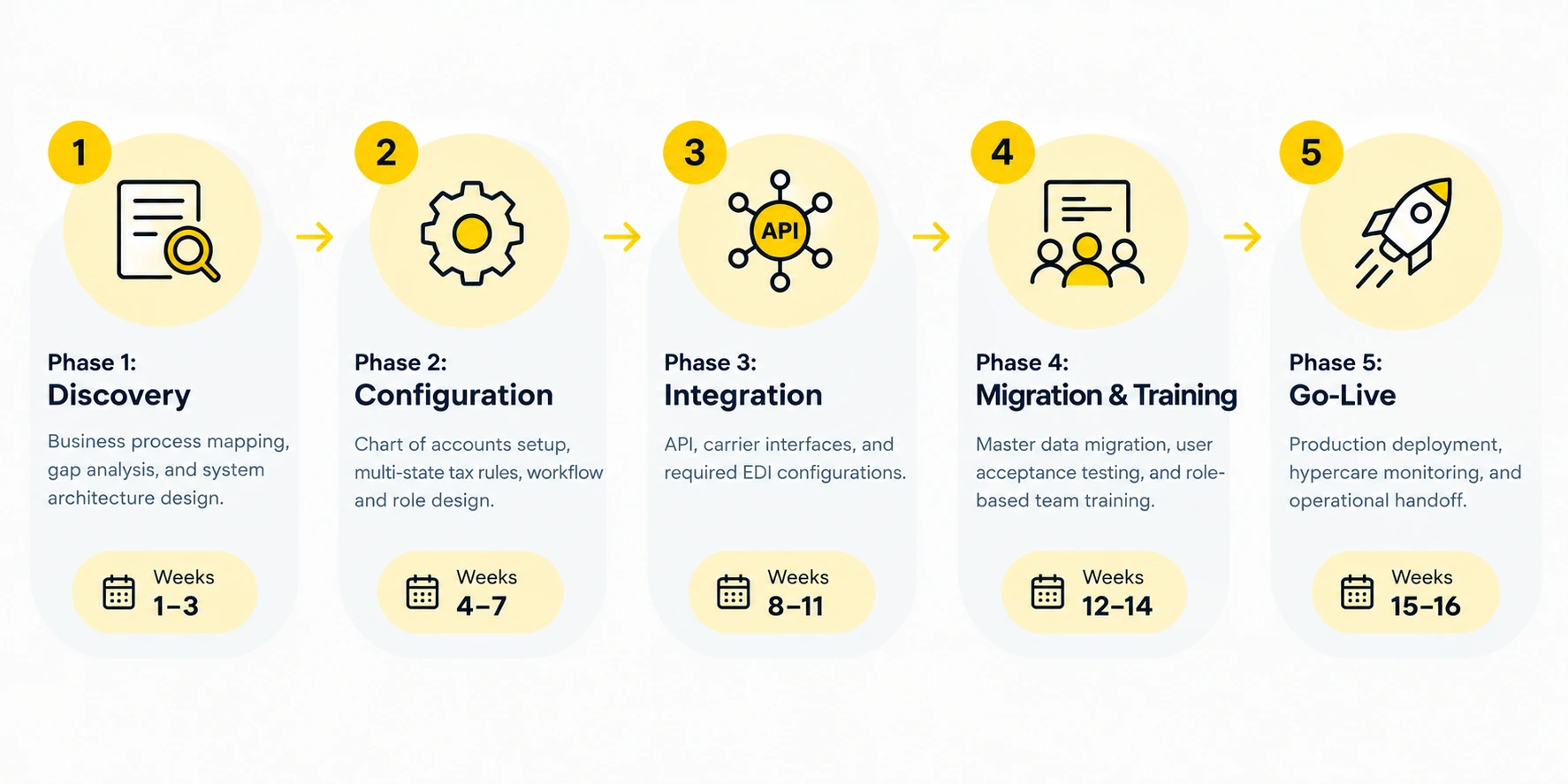
DuoCron turns complex ERP adoption into a simple, stress-free 16-week journey. By breaking the rollout into five clear phases—from initial setup and carrier EDI integrations to hands-on team training and dedicated hypercare support—it ensures a seamless, low-risk go-live with zero operational disruption.
Built for U.S. Logistics Operations
USD Contracts & Billing: Manage domestic tariffs, dynamic fuel surcharges, and customer-specific contract rates.
Multi-State Operations: Coordinate stock, shipments, and inter-branch transfers across national terminal networks.
Configurable Financial Compliance: Set up multi-state sales tax rules, balance sheets, and standard U.S. reporting workflows.
Flexible System Integrations: EDI, carrier platforms, and parcel networks can be integrated based on specific business needs.
Time-Zone Aligned Support: Full implementation services, project management, and operational help desk coverage aligned with U.S. business hours.

Why Businesses Choose DuoCron Transport ERP Software?
Powered by ERPNext: Built on modern open-source software, eliminating expensive per-seat licensing fees while providing deep code-level flexibility.
Single Unified Architecture: Run warehouse operations, fleet tracking, customer support, and financial reporting on one shared platform.
Transparent Total Cost of Ownership: Invest in purposeful customization and business growth rather than restrictive recurring subscription licenses.
Practical Customization: Easily adjust data fields, role permissions, automated alerts, and custom print formats as your operational needs evolve.
DuoCron ERP vs. Standalone TMS/WMS
Logistics leaders often debate whether to use specialized point solutions or a unified platform. Here is how they compare:
Operational Dimension | Standalone TMS / WMS | DuoCron Logistics ERP |
System Architecture | Disjointed applications requiring custom API integrations | Single unified system with a shared transactional database |
Financial Tracking | Periodic batch sync to third-party accounting software | Real-time general ledger updates for every operational transaction |
Data Integrity | Prone to sync errors, delayed reports, and duplicate records | Single source of truth across warehouse, fleet, and accounting |
Contract Management | Rates tracked separately from final invoicing engines | Rates feed directly into operational billing and receivables |
Total Cost Of Ownership | Multiple subscriptions, integration maintenance, and vendor overhead | Predictable, cost-effective infrastructure powered by ERPNext |
Frequently Asked Questions for Best Logistics ERP for Road Transport
- What makes DuoCron different from traditional logistics ERP software?
- Most enterprise platforms on the market hit you with steep, per-seat licensing fees and lock your database behind proprietary walls where even minor workflow tweaks require costly change orders. DuoCron does things differently. Built on ERPNext, it gives you an agile, open-source foundation with zero per-user seat penalties. You get total ownership of your data, the freedom to tailor forms, custom fields, and print formats to how your dispatch and dock teams actually work, and complete operational visibility—from dock door receiving to your corporate general ledger—without the enterprise software bloat.
- Can DuoCron handle multi-state warehousing and inventory transfers?
- Yes. If you operate cross-dock facilities, regional distribution centers, or multi-client 3PL warehouses across different states, DuoCron gives you real-time visibility across every facility from a single pane of glass. You can track inventory down to the specific aisle, rack, and bin location, automate inter-facility stock transfers, manage in-transit visibility, and calculate accurate landed costs. Because operational transactions hit your general ledger in real time, you can also run discrete balance sheets and P&L statements for individual warehouse facilities to see exactly which locations are driving your margins.
- How does the platform calculate freight rates and fuel surcharges?
- DuoCron features a flexible rating engine built for the commercial reality of North American transportation contracts. You can set up lane-by-lane rate tables by mileage, hundredweight (CWT), flat truckload, or pallet count, along with customer-specific accessorials like detention, liftgate, and inside delivery. For fuel, you do not have to recalculate surcharges manually every week: the system can automate dynamic fuel surcharges using indexed benchmark formulas—such as the weekly U.S. Energy Information Administration (EIA) National On-Highway Diesel average—or follow custom percentage-based surcharge tables tied directly to your shipper agreements.
- Can DuoCron connect to our trading partners via EDI?
- Yes. Meeting enterprise retail, broker, and shipper requirements usually comes down to reliable EDI compliance. DuoCron can be configured and integrated to support the standard ANSI X12 logistics transaction sets required by your trading partners. This includes EDI 204 (Motor Carrier Load Tender), EDI 990 (Tender Acceptance/Rejection), EDI 214 (Shipment Status and Milestone Updates), EDI 210 (Freight Details & Invoicing), as well as warehouse documents like EDI 940 (Warehouse Shipping Order) and EDI 945 (Warehouse Shipping Advice). We scope and implement these connections based on your specific trading partner guidelines.
- How are U.S. sales tax and economic nexus handled?
- Freight and warehouse taxation across U.S. jurisdictions is notoriously messy. Some states tax freight depending on whether it is separated on the invoice, while others apply distinct rules for multi-client storage, handling, or value-added services. DuoCron provides configurable tax engines where you can establish tax categories, apply origin- or destination-based rules, manage reseller exemption certificates, and account for your physical and economic nexus footprint across states. When invoices post, tax liabilities record directly to the appropriate state tax payable accounts on your balance sheet, keeping your U.S. tax filings and audits clean
Ready to Transform Your Logistics Operations?
Replace disconnected systems with a modern logistics ERP platform built specifically for transportation and supply chain businesses.