Logistics companies often use multiple systems to manage different parts of their operations. A warehouse team may need software for inventory and fulfillment, a transportation team may need tools for routing and shipment execution, while finance and management need a system for billing, accounting, purchasing, and business reporting.
This is where the question of ERP vs TMS vs WMS becomes important.
An ERP, TMS, and WMS solve different operational problems. A WMS focuses mainly on warehouse activities. A TMS focuses on transportation and shipment management. An ERP connects broader business processes such as finance, procurement, sales, inventory, customer management, and operations.
For a logistics company, the right choice depends on what the business needs to control. Some companies may need a WMS. Others may need a TMS. Growing logistics businesses may need an ERP that connects these functions, while larger operations may use ERP, WMS, and TMS together.
DuoCron ERP provides a flexible ERP approach for businesses that want to connect operational and financial processes without being restricted by recurring per-user software licensing fees. Its configurable architecture can also support integrations with specialized logistics applications when a company needs deeper WMS or TMS functionality.
ERP vs TMS vs WMS: What Is the Difference?
The simplest way to understand the difference is to look at the primary problem each system solves.
| System | Main Focus | Typical Users | Primary Purpose |
|---|---|---|---|
| ERP | Entire business | Finance, management, sales, procurement, operations | Connect business-wide processes |
| TMS | Transportation | Transport planners, dispatchers, logistics teams | Plan and manage transportation |
| WMS | Warehouse | Warehouse managers and warehouse operators | Control warehouse operations |
A WMS answers questions such as:
Where is the inventory?
What should be picked?
Where should the product be stored?
Has the order been packed?
A TMS answers questions such as:
Which carrier should handle the shipment?
Which route should be used?
What is the shipment status?
What transportation cost is involved?
An ERP answers broader questions:
What is the financial impact?
What did we purchase and sell?
What does the customer owe?
What inventory do we own?
What are our business costs and revenues?
How are different departments performing?
The three systems can therefore be complementary rather than direct replacements for one another.
What Is an ERP for Logistics?
An ERP, or Enterprise Resource Planning system, connects multiple business functions through a common platform.
For a logistics company, this can include:
- Finance and accounting
- Sales and customer management
- Purchasing
- Inventory
- Warehouse operations
- Order management
- Billing and invoicing
- Supplier management
- Employee and role management
- Business reporting
- Operational workflows
The important point is that ERP is broader than transportation or warehouse software.
A logistics company may use an ERP as the central business system while connecting specialized systems around it.
For example:
Customer Order → Inventory → Warehouse → Transportation → Delivery → Billing → Finance
An ERP can provide the business-level information connecting these activities.
What Is a TMS?
A Transportation Management System is designed specifically for transportation planning and execution.
A TMS typically focuses on the movement of goods from one location to another.
Depending on the system and business requirements, a TMS may support:
- Shipment planning
- Carrier management
- Route planning
- Load planning
- Freight management
- Transportation rates
- Dispatch
- Shipment tracking
- Delivery status
- Freight settlement
- Transportation performance reporting
A TMS becomes particularly useful when transportation itself is a major operational challenge.
For example, a company managing a large fleet or many carrier relationships may need specialized transportation planning capabilities that go beyond a general ERP.
What Is a WMS?
A Warehouse Management System focuses on the physical and operational management of warehouse activities.
Its purpose is to help warehouse teams control how goods enter, move through, and leave a facility.
A WMS may support:
- Receiving
- Putaway
- Bin and location management
- Inventory movements
- Picking
- Packing
- Replenishment
- Cycle counting
- Dispatch
- Returns
- Barcode scanning
- Warehouse task management
A WMS is therefore highly focused on what happens inside the warehouse.
If a logistics company has complex warehouse operations, high transaction volumes, barcode-driven workflows, automation equipment, or sophisticated picking requirements, a specialized WMS may be important.
ERP vs TMS vs WMS: A Detailed Comparison
The differences become clearer when the systems are compared by business function.
| Business Area | ERP | TMS | WMS |
|---|---|---|---|
| Accounting | Core function | Usually limited | Usually limited |
| Purchasing | Core function | Not primary | Limited |
| Customer management | Core function | Shipment-focused | Order/inventory-focused |
| Inventory | Broad inventory management | Shipment-related visibility | Detailed warehouse inventory |
| Warehouse | Can support it | Limited | Core function |
| Transportation | Can support basic processes or integrate with TMS | Core function | Dispatch-related |
| Route planning | Usually limited | Core function | Usually limited |
| Picking and packing | Can support basic workflows | Not primary | Core function |
| Billing | Core business function | Freight-related billing | Service/order-related support |
| Financial reporting | Core function | Limited | Limited |
| Business-wide reporting | Core function | Transportation-focused | Warehouse-focused |
| Warehouse automation | May require integration | Not primary | Often supported |
| Carrier management | Can manage business relationships | Core function | Not primary |
This comparison shows why asking which system is "better" is not always the right question.
The more useful question is: Which operational problem does the business need to solve?
When Does a Logistics Company Need a WMS?
A WMS may become important when warehouse operations are complex enough that basic inventory management is no longer sufficient.
For example, consider a company operating a large fulfillment center.
It may have thousands of SKUs, hundreds of daily orders, multiple storage zones, frequent stock movements, and warehouse workers performing different tasks.
A basic ERP inventory module may provide stock quantities, but warehouse managers may need more detailed operational control.
They may need to know:
- Which bin should receive incoming stock?
- Which warehouse worker should perform the task?
- Which picking strategy should be used?
- Which products should be replenished?
- Which orders should be picked together?
- Which stock is available in a specific warehouse location?
This is where WMS capabilities become valuable.
WMS is especially relevant when warehouse complexity is high
A company should examine WMS requirements when it has:
- Multiple warehouse zones
- High order volumes
- Complex picking processes
- Barcode-based operations
- Large SKU counts
- Frequent stock movements
- Detailed bin-level requirements
- Warehouse automation
- Advanced replenishment requirements
In such cases, a dedicated WMS can provide deeper warehouse execution capabilities.
When Does a Logistics Company Need a TMS?
A TMS becomes valuable when transportation planning and execution are major sources of operational complexity.
For example, a company may work with many carriers, manage thousands of shipments, operate a fleet, or coordinate deliveries across multiple regions.
The transportation team may need to compare rates, plan loads, assign carriers, monitor shipments, and analyze freight costs.
A TMS can help organize these activities.
TMS is especially relevant when transportation complexity is high
A company may need specialized TMS capabilities when it manages:
- Large numbers of shipments
- Multiple carriers
- Complex transportation rates
- Route planning
- Fleet operations
- Load optimization
- Freight settlement
- Delivery tracking
- Transportation performance
- Detailed freight cost analysis
In these situations, a specialized TMS may complement an ERP.
When Does a Logistics Company Need an ERP?
ERP becomes important when the company needs to connect operational activities with the broader business.
Imagine a logistics company that manages warehousing and transportation but also needs to manage customer contracts, purchasing, accounting, payroll-related processes, vendor payments, sales, billing, and financial reporting.
A WMS alone does not solve that problem.
A TMS alone does not solve it either.
The company needs a broader business management layer.
That is where ERP comes into the picture.
An ERP can provide a central platform for:
Finance + Sales + Procurement + Inventory + Customers + Operations + Billing + Reporting
This is particularly useful when management wants one connected view of the business instead of separate information from multiple departments.
ERP vs TMS vs WMS: Do You Need All Three?
Not necessarily.
The right architecture depends on the company's size, complexity, processes, and technology requirements.
A small logistics company with straightforward warehouse operations may be able to manage many activities through an ERP.
A company with complex warehouse execution may add a WMS.
A business with sophisticated transportation planning may add a TMS.
A large logistics organization may use all three.
One possible architecture looks like this:
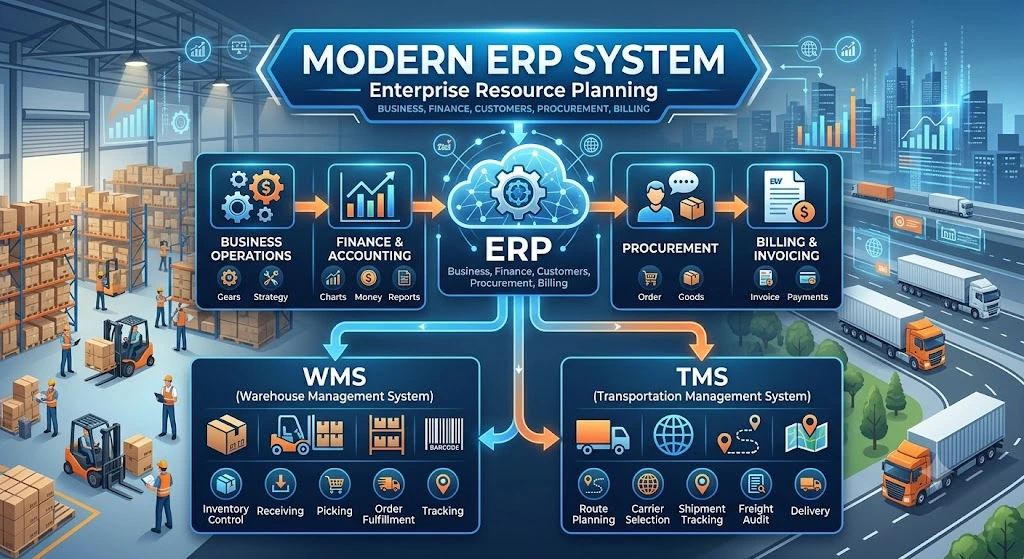
The ERP can act as the broader business system, while specialized applications handle operational activities requiring deeper functionality.
ERP + WMS: How They Work Together
ERP and WMS can complement each other by separating business-level management from detailed warehouse execution.
For example:
- A customer order is created.
- The ERP records the business transaction.
- The order is sent to the WMS.
- The WMS manages picking and packing.
- Warehouse activity is updated.
- The fulfillment information returns to the ERP.
- Inventory and order status are updated.
- Billing and financial processes continue.
This creates a connected flow between the business office and warehouse floor.
The ERP does not necessarily need to replace every specialized WMS function.
Instead, integration can allow each system to focus on the processes it handles best.
ERP + TMS: How They Work Together
The same principle applies to transportation.
A customer order may originate in the ERP.
Once the shipment is ready, relevant information can move into the TMS.
The TMS can then manage transportation planning, carrier assignment, routing, dispatch, and shipment execution.
The resulting transportation information can be sent back to the ERP.
The overall process can look like:
Customer Order → ERP → TMS → Shipment Execution → Delivery → ERP → Billing
This gives the business a connection between customer transactions, transportation activities, and financial processes.
ERP + WMS + TMS: The Connected Logistics Model
For complex logistics companies, all three systems can work together.
Consider a customer placing an order.
- The ERP manages the customer and commercial transaction.
- The WMS determines how the product is picked and prepared.
- The TMS determines how the shipment is transported.
- The ERP then receives the relevant business information for billing, accounting, and reporting.
The flow becomes:
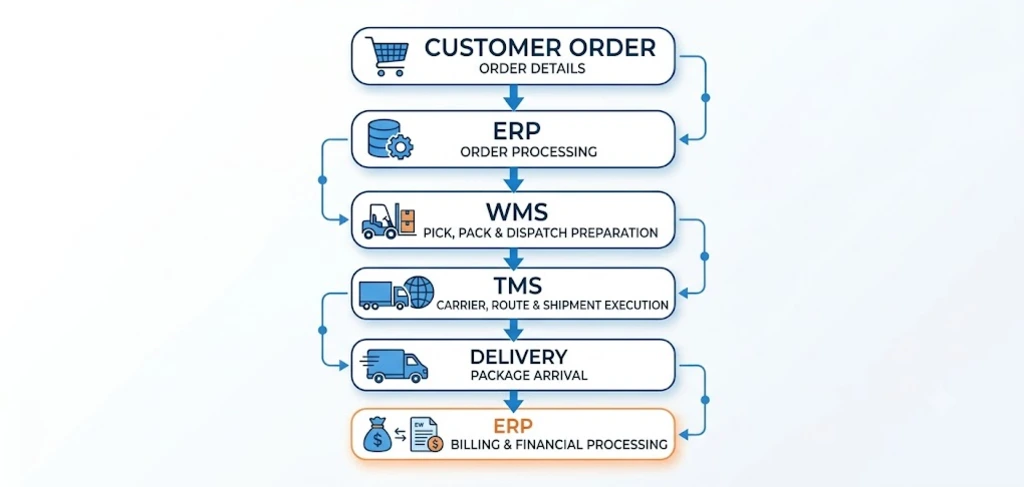
This approach can create a connected technology environment without requiring one application to perform every specialized task.
How Should a Logistics Company Choose Between ERP, TMS and WMS?
The decision should begin with the company's biggest operational challenge.
If the biggest problem is warehouse execution
Start by evaluating WMS requirements.
Look at receiving, putaway, picking, packing, replenishment, barcode workflows, location management, and warehouse automation.
If the biggest problem is transportation
Evaluate TMS capabilities.
Focus on carrier management, route planning, load planning, shipment visibility, transportation rates, freight settlement, and delivery management.
If the biggest problem is disconnected business operations
Evaluate ERP.
Look at finance, procurement, sales, customer management, inventory, billing, reporting, and integration.
If multiple areas are complex
Consider an integrated architecture.
A company may need an ERP as the business backbone with WMS and TMS applications connected to it.
Questions to Ask Before Buying Logistics Software
Before choosing between ERP, TMS, and WMS, logistics companies should map their actual workflows.
1. Where does our biggest operational bottleneck occur?
Is the problem inside the warehouse, on the road, in finance, or between departments?
The answer can help determine which system deserves priority.
2. How complex is our warehouse?
If warehouse activities are straightforward, ERP-based inventory and warehouse workflows may be enough.
If warehouse execution is highly complex, evaluate dedicated WMS capabilities.
3. How complex is transportation planning?
If the company manages many carriers, routes, loads, or freight agreements, TMS capabilities may be important.
4. How much financial and business management is required?
If the business needs integrated accounting, purchasing, sales, customer management, billing, and reporting, ERP becomes more important.
5. Do our systems need to communicate?
This question is often overlooked.
Even if a company chooses separate ERP, WMS, and TMS applications, the systems should be able to exchange relevant information.
Integration should therefore be considered before implementation rather than after every system has already been purchased.
The Cost Question: One System or Multiple Systems?
Software cost is not only about the purchase price.
A company should also consider implementation, customization, integration, support, infrastructure, training, upgrades, and ongoing licensing.
Using separate systems can provide deeper specialized functionality, but it can also increase integration and management requirements.
Using one broader system can simplify the technology environment, but the company must ensure that the ERP actually supports its operational requirements.
This is why the decision should be based on business processes rather than simply choosing the system with the longest feature list.
Where Does DuoCron ERP Fit?
DuoCron ERP is positioned as a flexible ERP platform for businesses that need connected business and operational processes.
For logistics companies, the ERP can provide a broader management layer covering areas such as:
- Customer management
- Sales and order management
- Inventory
- Procurement
- Finance and accounting
- Billing and invoicing
- Business reporting
- Workflow management
- Multi-location operations
- System integrations
The objective is not necessarily to replace every specialized logistics application.
Instead, DuoCron can serve as the central ERP layer while integrating with specialized WMS or TMS platforms where deeper warehouse or transportation capabilities are required.
This approach can be useful for companies that want to avoid creating isolated systems for every department.
A Flexible ERP Approach
Every logistics company does not operate in exactly the same way.
A freight forwarder, 3PL provider, distributor, fleet operator, and fulfillment business can have very different workflows.
A rigid ERP may require the company to change established processes simply to fit the software.
DuoCron takes a custom-built and configurable approach.
Built on ERPNext and the Frappe Framework, it can be adapted around specific business workflows and integrated with other applications when required.
This allows businesses to determine which processes should remain within the ERP and which specialized functions should be handled by connected systems.
What About Licensing Costs?
Cost structure is another factor when comparing ERP platforms.
DuoCron follows a zero recurring per-seat software licensing fee model. Instead of charging a recurring software license for every ERP user, the investment can be focused on implementation, customization, integrations, hosting, and support.
For a logistics company with users across finance, customer service, warehouse operations, management, procurement, and other departments, this can be an important consideration when planning the long-term ERP environment.
The actual implementation cost will still depend on the business requirements, integrations, customization, hosting, and support scope.
ERP vs TMS vs WMS: A Simple Decision Framework
The decision can be simplified into three questions.
Do we primarily need to control warehouse execution?
→ Evaluate WMS.
Do we primarily need to control transportation execution?
→ Evaluate TMS.
Do we need to connect finance, customers, procurement, inventory, billing, and business operations?
→ Evaluate ERP.
Do we need all of these capabilities?
→ Consider an integrated ERP + WMS + TMS architecture.
The key is to avoid buying software based only on terminology.
Look at the process first.
Then determine which system should manage each part of that process.
Final Thoughts
The ERP vs TMS vs WMS decision is not simply about selecting one software category over another.
Each system has a different primary role.
A WMS is focused on warehouse execution. A TMS is focused on transportation management. An ERP provides a broader business management platform connecting finance, customers, procurement, inventory, billing, and other core processes.
For some logistics companies, an ERP may provide enough operational functionality. Others may need specialized WMS or TMS solutions. More complex organizations may need all three working together.
The most important consideration is how information moves through the business.
If customer orders, warehouse activity, transportation, billing, and finance operate as disconnected processes, adding another isolated application may not solve the underlying problem.
A connected architecture can provide a better foundation.
DuoCron ERP can serve as that broader business layer for logistics companies that want flexible workflows, connected business operations, and integration with specialized logistics systems where required. Its custom-built approach, ERPNext and Frappe Framework foundation, and zero recurring per-seat software licensing fees give businesses flexibility when designing their ERP environment.
The right technology decision ultimately depends on the complexity of your warehouse, transportation network, financial processes, customer requirements, and integration needs.
Frequently Asked Questions
1. What is the difference between ERP, TMS and WMS?
ERP manages broader business processes such as finance, procurement, customers, inventory, billing, and reporting. TMS focuses on transportation planning and execution, while WMS focuses on warehouse operations such as receiving, storage, picking, packing, and inventory movement.
2. Does a logistics company need both ERP and WMS?
Not always. If warehouse operations are relatively straightforward, an ERP may provide sufficient inventory and warehouse functionality. Companies with complex warehouse execution, high transaction volumes, advanced picking, barcode workflows, or automation may benefit from a dedicated WMS integrated with their ERP.
3. Does a TMS replace an ERP?
No. A TMS is primarily designed for transportation management, while an ERP handles broader business processes. A logistics company may use a TMS for transportation execution while using an ERP for finance, customer management, procurement, inventory, billing, and business reporting.
4. Can ERP, TMS and WMS work together?
Yes. ERP, TMS, and WMS can work as connected systems. For example, the ERP can manage the customer order, the WMS can handle warehouse fulfillment, and the TMS can manage transportation execution. Relevant information can then flow back to the ERP for billing, finance, and reporting.
5. Which system should a logistics company choose first?
The answer depends on the company's main operational challenge. Businesses focused on warehouse execution should evaluate WMS requirements, transportation-heavy operations should evaluate TMS capabilities, and companies looking to connect finance, customers, procurement, inventory, billing, and broader operations should evaluate ERP. DuoCron ERP can also integrate with specialized WMS and TMS platforms where deeper functionality is required.
Author Bio

Aarav Sharma
Aarav Sharma is an ERPNext Consultant at DuoCron Solutions specializing in manufacturing ERP and process optimization. Outside work, Aarav enjoys exploring new technology trends and writing about digital transformation in manufacturing.