Logistics is no longer just about moving goods from one place to another. A modern logistics business has to coordinate orders, warehouses, vehicles, drivers, freight rates, fuel, customers, vendors, invoices, and financial performance at the same time.
When these activities are managed through separate software, spreadsheets, emails, and manual records, information can become difficult to track.
This is where ERP becomes important.
What Is ERP in Logistics?
ERP in logistics is a centralized business management system that connects transportation, fleet, warehouse, inventory, order management, procurement, customer service, billing, and finance in one platform. Instead of maintaining separate records for each department, a logistics ERP allows information to move through connected workflows. DuoCron ERP is an example of a logistics-focused ERP that brings transport, fleet, warehouse, freight billing, customer shipments, vendor collaboration, maintenance, and financial reporting into one system.
For a growing logistics company, this connection can make a major difference.
For example, when a customer books a shipment, the same transaction can flow through order processing, vehicle allocation, dispatch, delivery, proof of delivery, billing, and financial reporting.
That means the operations team does not have to repeatedly enter the same information.
The finance team does not have to wait for paper documents.
Management does not have to depend on manually prepared reports to understand what happened.
In simple terms, logistics ERP connects the movement of goods with the movement of business information and money.
How Does ERP Work in Logistics?
Think about a typical shipment.
A customer requests a delivery.
The logistics team creates the shipment order. A vehicle and driver are assigned. The warehouse prepares the goods. The vehicle is dispatched. The shipment moves to its destination. The driver captures proof of delivery. The billing team generates the invoice. Finance records the revenue and related costs.
Without an integrated ERP, every department may record its part of the process separately.
With ERP, these activities can become one connected workflow.
A simplified process looks like this:
Customer Order → Shipment Planning → Warehouse Preparation → Vehicle & Driver Allocation → Dispatch → Tracking → Delivery → POD → Billing → Financial Reporting
The important point is not simply that all these steps are digital.
The important point is that they can share the same business data.
This creates a single operational picture for managers.
Modern ERP systems can also connect transportation and warehouse processes with broader enterprise functions. Microsoft, for example, describes ERP in supply chain management as a way to bring business functions into a shared view so leaders can understand how different activities affect one another.
Why Do Logistics Companies Need ERP?
Logistics operations often grow faster than their internal processes.
A small transport company may begin with a few vehicles, a spreadsheet, phone calls, and accounting software.
That approach may work for a limited number of shipments.
Then the business grows.
There are more vehicles.
More drivers.
More warehouses.
More customers.
More routes.
More invoices.
More subcontractors.
More documents.
At that point, the problem is no longer simply "how do we move this shipment?"
The bigger question becomes:
How do we control the entire operation without losing visibility?
This is where ERP can help.
A logistics ERP can connect operational activities with financial and management information. It can help companies understand not only where a shipment is, but also what that shipment costs, what revenue it generates, and whether the overall transaction is profitable.
For example, a company may discover that a particular route generates strong revenue but poor margins because of fuel consumption, empty return trips, tolls, driver expenses, and vehicle maintenance.
That insight becomes much easier when transportation and financial information are connected.
Key Features of ERP in Logistics
The features of a logistics ERP can vary from one platform to another. However, a purpose-built system should cover the operational areas that directly influence transportation and supply chain performance.
1. Transport Management
Transport management is at the center of a logistics business.
An ERP can help teams manage:
Shipment orders
Trip creation
Dispatch planning
Vehicle allocation
Driver allocation
Pickup scheduling
Delivery scheduling
Load information
Route details
Trip status
Delivery completion
Instead of maintaining a separate dispatch sheet, the operations team can work from a centralized system.
DuoCron ERP, for example, includes transport and trip management, dispatch planning, vehicle allocation, and shipment tracking within its logistics platform.
2. Fleet Management
For asset-based logistics companies, vehicles are major business assets.
The ERP should therefore provide visibility into the complete vehicle lifecycle.
This can include:
Vehicle records
Registration information
Insurance details
Service schedules
Maintenance history
Mileage
Vehicle utilization
Repair costs
Fuel consumption
Tyre usage
Replacement schedules
Suppose a truck has completed a certain mileage and is due for preventive maintenance.
Instead of relying on someone to remember the service date, the ERP can maintain the service schedule and trigger an alert.
DuoCron includes vehicle lifecycle information, maintenance history, fuel management, tyre management, and preventive maintenance capabilities.
3. Route Planning
A logistics company can lose money through inefficient routing even when every delivery is completed successfully.
Longer routes can increase:
Fuel consumption
Driver hours
Vehicle wear
Delivery time
Toll expenses
Operating costs
Route planning features can help logistics teams plan deliveries around distance, delivery windows, vehicle capacity, and operational requirements.
The goal is not simply to find the shortest road.
The goal is to create a practical transportation plan that balances cost, time, capacity, and customer commitments.
4. GPS and Shipment Tracking
Customers increasingly expect shipment visibility.
They want to know:
Has my shipment been dispatched?
Where is it now?
When will it arrive?
Has delivery been completed?
An ERP with tracking capabilities can provide this information to operations teams and, where supported, customers.
DuoCron's logistics platform includes real-time GPS tracking, shipment status visibility, ETA-related information, and a customer shipment tracking portal.
This can reduce repeated calls to the dispatch team.
Instead of answering the same "Where is my shipment?" question dozens of times, the information can be made available through the system.
5. Warehouse Management
Transportation rarely works in isolation.
A shipment often begins or ends inside a warehouse.
That means the ERP should connect warehouse activities with transportation planning.
Important warehouse capabilities can include:
Receiving
Putaway
Picking
Packing
Stock transfers
Bin management
Dispatch staging
Inventory adjustments
Barcode scanning
Batch tracking
Serial number tracking
Integrated warehouse and ERP systems can synchronize inventory, orders, financial information, and operational activity instead of making teams move information manually between systems.
This becomes especially valuable for 3PL and distribution businesses managing inventory for multiple customers.
6. Inventory Management
Inventory errors can quickly become logistics problems.
If the system says 500 units are available but the warehouse has only 420, the sales and logistics teams may make commitments based on incorrect information.
An ERP can provide a common view of inventory across:
Warehouses
Branches
Distribution centers
Transit locations
Storage areas
Customer-owned inventory
For logistics providers, inventory visibility is particularly important when warehousing and transportation are part of the same service.
DuoCron supports multi-client inventory and warehouse operations, including customer-specific inventory visibility, barcode-based processes, batch and serial tracking, and multi-location stock management.
7. Freight Billing and Rate Management
Freight billing can become complicated very quickly.
A logistics company may have different rates for:
Customers
Routes
Vehicle types
Weight ranges
Distance bands
Contract terms
Fuel surcharges
Handling services
Additional charges
If these calculations are performed manually, billing errors become more likely.
A logistics ERP can store rate cards and billing rules and use shipment information to calculate charges.
DuoCron supports customer-specific pricing, route-wise tariffs, fuel surcharges, contract rates, freight billing, and invoice generation.
This connects an operational event with a financial transaction.
That is one of the most important differences between simply tracking shipments and running an integrated ERP.
8. Driver Management
Drivers are a central part of road transportation.
A logistics ERP can maintain driver information such as:
Personal records
License details
Availability
Attendance
Trip assignments
Compliance documents
Trip expenses
Performance information
The operations team can then assign drivers based on availability and operational requirements.
Mobile functionality can make this even more useful.
Drivers can receive trip assignments, update delivery status, upload documents, capture proof of delivery, and submit expenses without returning to the office.
DuoCron provides a driver mobile application for assignments, trip updates, POD uploads, and expense submission.
9. Fuel Management
Fuel is one of the major operating expenses for many transportation businesses.
Small gaps in fuel control can become significant when multiplied across hundreds of vehicles and thousands of trips.
A logistics ERP can track:
Fuel issued
Fuel purchased
Mileage
Fuel consumption
Fuel vouchers
Fuel card transactions
Vehicle-wise fuel costs
Driver-related fuel records
This helps managers compare expected and actual consumption.
For example, if similar trucks operating on similar routes show very different fuel efficiency, the company can investigate the reason.
DuoCron includes fuel issuance, vouchers, approvals, mileage tracking, and reconciliation features.
10. Maintenance and Spare Parts
A vehicle that breaks down during a delivery can affect more than one shipment.
It can cause:
Delivery delays
Customer complaints
Emergency repair costs
Replacement vehicle costs
Driver scheduling problems
Route disruption
Preventive maintenance helps companies move from reactive repairs toward planned maintenance.
A logistics ERP can track service schedules, repair history, spare parts, warranties, and maintenance costs.
DuoCron also connects spare parts and maintenance management with transportation operations.
11. Proof of Delivery
Proof of delivery is an important link between physical delivery and commercial closure.
The shipment may reach the customer, but the process is not necessarily complete until the delivery is documented.
Digital POD can include:
Customer acknowledgment
Delivery date and time
Signature
Delivery documents
Photos
Exceptions or remarks
Once the POD is available, billing can move forward without waiting for physical documents.
This can shorten the gap between delivery and invoicing.
12. Vendor and Transporter Management
Many logistics companies work with subcontracted transporters.
Managing these partners through calls, emails, and spreadsheets can become difficult at scale.
An ERP can maintain:
Transporter details
Agreed rates
Contract terms
Assigned loads
Carrier invoices
Settlements
Performance information
DuoCron provides vendor and transporter management capabilities for rate management, billing, settlements, and collaboration.
This creates better control over outsourced transportation.
13. Financial Management
This is where ERP becomes more than a logistics application.
A shipment creates operational activity.
That activity also creates financial activity.
For example:
Shipment → Fuel Cost → Driver Expense → Toll → Carrier Cost → Customer Freight → Invoice → Revenue → Profitability
When these records are connected, management can examine the financial impact of logistics activity.
DuoCron connects logistics operations with financial reporting and can provide branch-wise profitability, trip-wise costs, vehicle-wise revenue, receivables, and logistics performance information.
14. Dashboards and Analytics
A logistics manager should not have to open five different systems to understand the day's operation.
A centralized ERP can provide dashboards for:
Active shipments
Delayed deliveries
Fleet utilization
Fuel costs
Pending PODs
Freight revenue
Outstanding invoices
Warehouse inventory
Trip profitability
Branch performance
The purpose of analytics is not to create more reports.
It is to help managers act faster.
For example, if delivery delays increase on a particular route, the manager can investigate before the issue becomes a repeated customer complaint.
Benefits of ERP in Logistics in USA
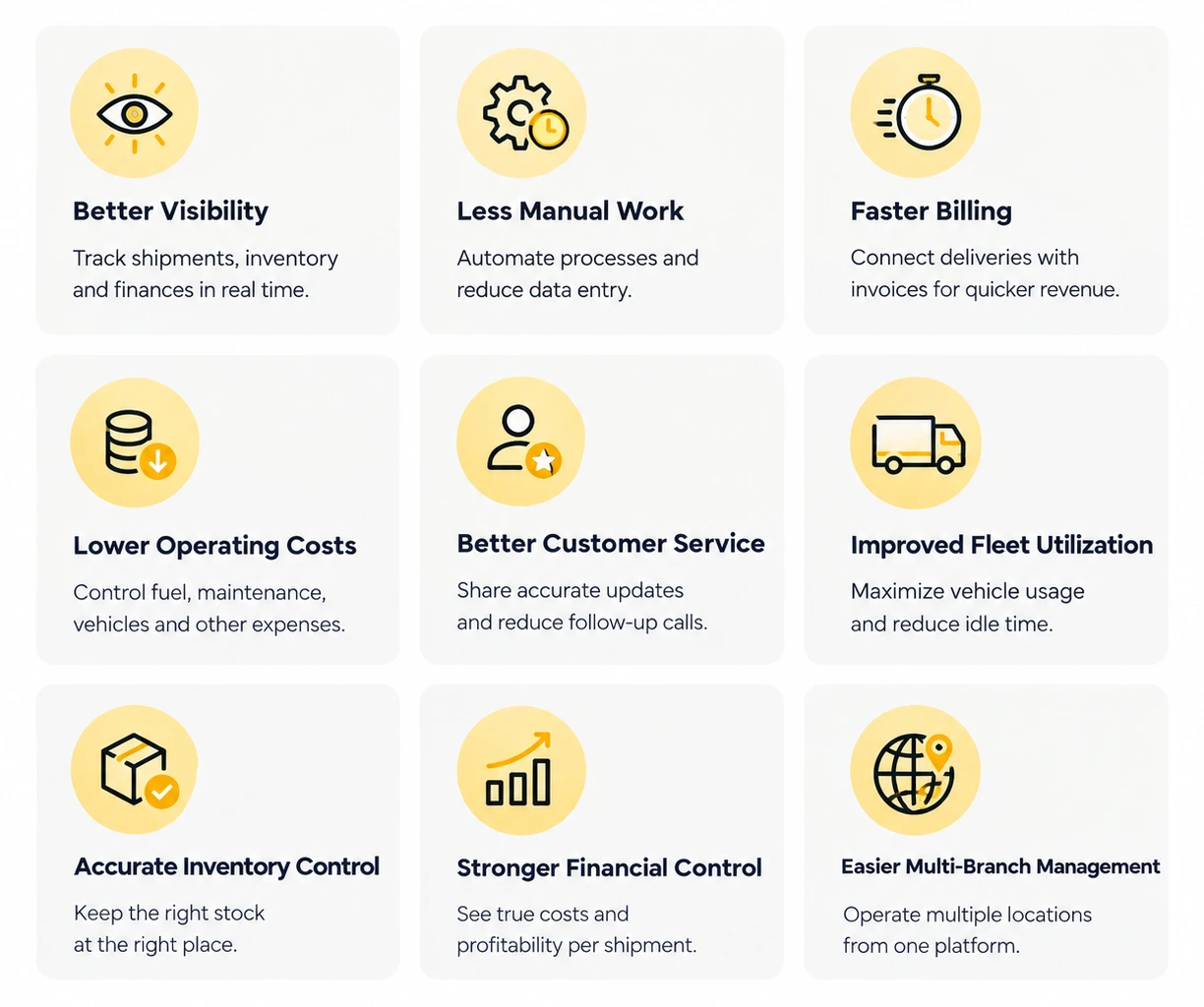
1. Better Visibility
The first benefit is visibility.
Management can see what is happening across transportation, warehouses, inventory, customers, and finance without depending entirely on manually consolidated reports.
This becomes especially valuable when a business has multiple branches or warehouses.
2. Less Manual Work
Employees often spend considerable time copying information from one system to another.
ERP reduces this repeated work by connecting processes.
For example:
Order Created → Shipment Planned → Vehicle Assigned → Dispatch Updated → POD Uploaded → Invoice Generated
The information can move through the workflow without repeated manual entry.
3. Faster Billing
Delayed billing directly affects cash flow.
If the billing team has to wait for delivery documents, invoices may remain pending.
Digital POD, automated rate calculations, and connected shipment information can help reduce this delay.
4. Lower Operating Costs
ERP does not automatically reduce every logistics cost.
Instead, it gives managers better information for controlling those costs.
Fuel, maintenance, empty trips, vehicle utilization, warehouse handling, and carrier charges can be monitored more systematically.
This allows companies to identify operational waste.
5. Better Customer Service
Customers want accurate answers.
They want to know whether their shipment has been picked up, dispatched, delayed, or delivered.
A connected ERP can give customer service teams access to the same shipment information used by operations.
That reduces the need to call multiple departments for updates.
6. Improved Fleet Utilization
A truck sitting idle is an underused business asset.
ERP data can help companies understand:
Which vehicles are active
Which vehicles are idle
How frequently vehicles are dispatched
Which routes generate the most activity
How much each vehicle costs to operate
These insights can support better fleet planning.
7. Better Inventory Accuracy
When warehouse and transportation systems share data, inventory movement becomes easier to trace.
Receiving, storage, transfers, picking, staging, and dispatch can be connected to the underlying order.
This reduces the risk of isolated stock records.
8. Stronger Financial Control
Logistics companies need to understand revenue and costs together.
An integrated ERP can connect:
Freight revenue
Fuel expenses
Driver expenses
Maintenance costs
Carrier payments
Warehouse costs
Customer invoices
That gives finance teams a clearer picture of operational profitability.
9. Easier Multi-Branch Management
Growth creates another challenge.
A company may have one branch today and several regional operations tomorrow.
The ERP can provide a common system for branches, warehouses, hubs, vehicles, customers, and financial operations.
DuoCron supports branch and hub operations along with multi-location logistics workflows.
A Simple Example To Understand Better
Consider a 3PL company that manages storage and transportation for several customers. A customer sends 200 pallets to the warehouse. The warehouse receives and scans the goods. The ERP updates the customer's inventory. Later, the customer requests delivery of 40 pallets. The system creates the fulfillment request. The warehouse picks and stages the goods. The transportation team assigns a vehicle.
The shipment is dispatched. The vehicle is tracked during transit. The driver captures proof of delivery. The system records the completed delivery. The ERP then uses the agreed customer rate to calculate the logistics charges. The financial system receives the billing information. Management can now see the complete transaction.
This is the real value of ERP. The company is not simply storing information.
It is connecting the entire business process.
DuoCron's 3PL platform is designed around this type of integrated flow, connecting customer inventory, warehouse activity, fulfillment, contract billing, and financial accounting.
Who Can Use Logistics ERP?
ERP is useful across several logistics business models.
Transportation Companies
Fleet operators can use ERP to manage vehicles, drivers, trips, fuel, maintenance, dispatch, billing, and profitability.
Freight Forwarders
Freight forwarders can use ERP to coordinate shipments, documents, carriers, customers, settlements, and finance.
3PL Companies
Third-party logistics providers can manage customer inventory, warehouse operations, fulfillment, billing, and transportation.
Distribution Companies
Distributors can connect purchasing, inventory, warehouses, customer orders, delivery, and finance.
Courier and Delivery Businesses
Courier operations can use ERP to manage orders, dispatch, drivers, delivery status, proof of delivery, and billing.
Cold Chain Logistics
Cold-chain businesses can connect inventory, warehouse activity, transportation, and shipment monitoring while maintaining greater visibility into sensitive goods.
DuoCron's logistics platform specifically serves transportation companies, freight forwarders, 3PL providers, courier and express businesses, distribution companies, cold-chain operators, container transport businesses, and warehouse networks.
What Should You Look for in a Logistics ERP?
Choosing ERP should begin with business requirements rather than software features alone.
Ask these questions before selecting a platform:
Can it manage my transportation model?
Check whether the system supports your fleet, carriers, routes, trips, and dispatch processes.
Can it connect logistics with finance?
A logistics system that does not connect to financial operations may still leave your teams working across multiple platforms.
Can it support multiple locations?
This matters for companies operating several branches, warehouses, hubs, or distribution centers.
Can it scale?
The ERP should support growth in vehicles, shipments, customers, employees, warehouses, and transaction volumes.
Can it be customized?
Every logistics business has its own rate structures, workflows, approval rules, and customer requirements.
A rigid system may force employees to change established processes unnecessarily.
Can mobile teams use it?
Drivers, warehouse employees, supervisors, and field teams often need access outside a traditional office environment.
Does it provide useful analytics?
The ERP should turn operational data into information that managers can actually use.
Why DuoCron ERP for Logistics?
DuoCron ERP is built specifically around transportation, freight, fleet, warehouse, and supply chain operations.
The platform brings transport management, trip planning, fleet operations, GPS tracking, fuel control, tyre management, maintenance, warehouse management, inventory, freight billing, customer shipment tracking, vendor management, POD, and financial analytics into one connected environment.
DuoCron is powered by ERPNext and can be adapted to different logistics workflows.
This is important because a logistics company rarely operates exactly like another logistics company.
- A freight forwarder may need multi-leg shipment management.
- A trucking company may need deeper fleet and driver control.
- A 3PL may need multi-client inventory and contract billing.
- A distribution company may need stronger warehouse and order fulfillment capabilities.
DuoCron's transportation solution is positioned for carriers, freight forwarders, brokers, intermodal and drayage operators, private fleets, and other mid-to-large logistics businesses.
The company also states that it has more than 10 years of ERP implementation experience and more than 200 successful ERP deployments. Its logistics offering supports both cloud and on-premise deployment options and provides unlimited user licensing.
That implementation experience matters because ERP success depends on more than software.
It also depends on:
Process understanding
Data migration
User training
Workflow configuration
Integration
Testing
Go-live support
Continuous improvement
A logistics ERP should therefore be evaluated as both a technology platform and a long-term business system.
The Future of ERP in Logistics in the USA
Logistics ERP is moving beyond simple record keeping.
Modern platforms are increasingly expected to connect operational data, automation, mobile workflows, analytics, IoT, and AI.
For example, a future-ready logistics environment can use connected data to identify unusual fuel consumption, predict maintenance requirements, improve shipment planning, or provide earlier warnings about delivery delays.
ERP systems are also increasingly connecting with IoT devices and AI-based monitoring and automation to improve supply chain visibility and decision-making.
However, technology should not be adopted simply because it is new.
The real question should always be:
Does this technology solve a business problem?
If GPS tracking does not reach the dispatch team, it has limited value.
If warehouse data does not connect with inventory records, visibility remains incomplete.
If shipment data does not reach billing, revenue can still be delayed.
If financial data does not connect with transportation costs, profitability remains difficult to understand.
The future of logistics ERP is therefore not just about adding more technology.
It is about making different technologies work together.
Conclusion: ERP Gives Logistics a Connected Business View
As logistics companies grow into multi-branch, multi-warehouse, fleet-heavy, freight, distribution, or 3PL operations, disconnected systems can become increasingly difficult to manage.
This is where DuoCron ERP becomes particularly relevant.
Its logistics platform is designed to connect transportation, fleet, warehouse, inventory, freight billing, customer tracking, vendor management, maintenance, and financial analytics in one environment.
For mid- and large-scale logistics industries, DuoCron ERP offers a customizable ERPNext-based foundation that can be adapted around the company's operational requirements instead of forcing every business into the same workflow.
The result is a more connected way to manage logistics.
Instead of asking different departments for different pieces of information, management can work from one operational picture.
And in an industry where every vehicle, shipment, warehouse movement, delivery, and expense can affect profitability, that connected view can become a major business advantage.
FAQs About ERP in Logistics
1. What is ERP in logistics in simple words?
ERP in logistics is software that connects transportation, fleet, warehouse, inventory, customers, billing, and finance in one system. DuoCron ERP provides these capabilities in a logistics-focused platform designed for transportation, freight, warehouse, and 3PL businesses.
2. What are the main benefits of ERP in logistics?
The main benefits include better operational visibility, less manual work, faster billing, improved fleet utilization, better inventory control, stronger financial reporting, and easier management of multiple locations. DuoCron ERP connects these functions so logistics teams can manage operations and financial information through one platform.
3. Can ERP manage transportation and warehouse operations together?
Yes. A logistics ERP can connect transportation and warehouse activities so that orders, inventory, dispatch, shipments, and financial information remain synchronized. DuoCron ERP combines transportation and warehouse capabilities and also supports 3PL and multi-warehouse operations.
4. Is ERP useful for a large logistics company?
Yes. ERP becomes particularly useful as logistics businesses add more vehicles, branches, warehouses, customers, shipments, and employees. DuoCron ERP is designed for mid-to-large-scale logistics businesses and supports fleet, transportation, warehouse, customer, vendor, and financial operations in one connected environment.
5. Why choose DuoCron ERP for logistics?
DuoCron ERP is built around logistics and transportation workflows rather than treating logistics as a standalone activity. It connects trip management, dispatch, fleet, GPS tracking, fuel, maintenance, warehouse, inventory, freight billing, POD, customer tracking, vendors, and finance. It is powered by ERPNext and can be customized for different logistics business models.
Author Bio

Aarav Sharma
Aarav Sharma is an ERPNext Consultant at DuoCron Solutions specializing in manufacturing ERP and process optimization. Outside work, Aarav enjoys exploring new technology trends and writing about digital transformation in manufacturing.