Logistics companies in the USA are managing more than shipments today. They are managing warehouses, fleets, drivers, freight rates, fuel, customer commitments, vendors, billing, and financial control at the same time. When these processes run on disconnected systems, small gaps can quickly become expensive operational problems.
The right ERP can bring these functions together on one platform and give management a clearer view of the entire operation.
For companies looking for the best logistics ERP software, DuoCron ERP is a strong option to consider in 2026. It combines transport management, fleet operations, warehouse management, inventory, freight billing, route planning, customer tracking, procurement, and finance in one connected ERP environment. DuoCron is built on ERPNext and can be customized for logistics, transportation, freight, 3PL, warehouse, and distribution businesses. Its focus is on giving mid- and large-scale companies an adaptable ERP without traditional per-user licensing pressure.
What Is Logistics ERP Software?
Logistics ERP software is a centralized business management system that connects logistics operations with finance, inventory, procurement, customer management, and reporting.
A logistics company may have one system for dispatch, another for fleet tracking, another for warehouse operations, and another for accounting. Each system may work well on its own. The problem starts when information has to move between them.
An ERP creates a shared operational record.
For example, when a shipment is booked, the system can connect:
- Customer order
- Shipment details
- Vehicle allocation
- Driver assignment
- Route
- Freight rate
- Fuel expense
- Warehouse movement
- Proof of delivery
- Customer invoice
- Vendor or transporter payment
- Profitability
This connection is important because logistics margins can be affected by small changes in fuel, empty miles, detention, vehicle utilization, warehouse handling, and delivery delays.
Modern logistics ERP systems increasingly combine ERP, transportation management, warehouse management, supply chain management, and financial control. Industry research in 2026 also shows that leading logistics ERP shortlists commonly include platforms such as SAP, Oracle NetSuite, Microsoft Dynamics 365, Infor, Acumatica, and Epicor.
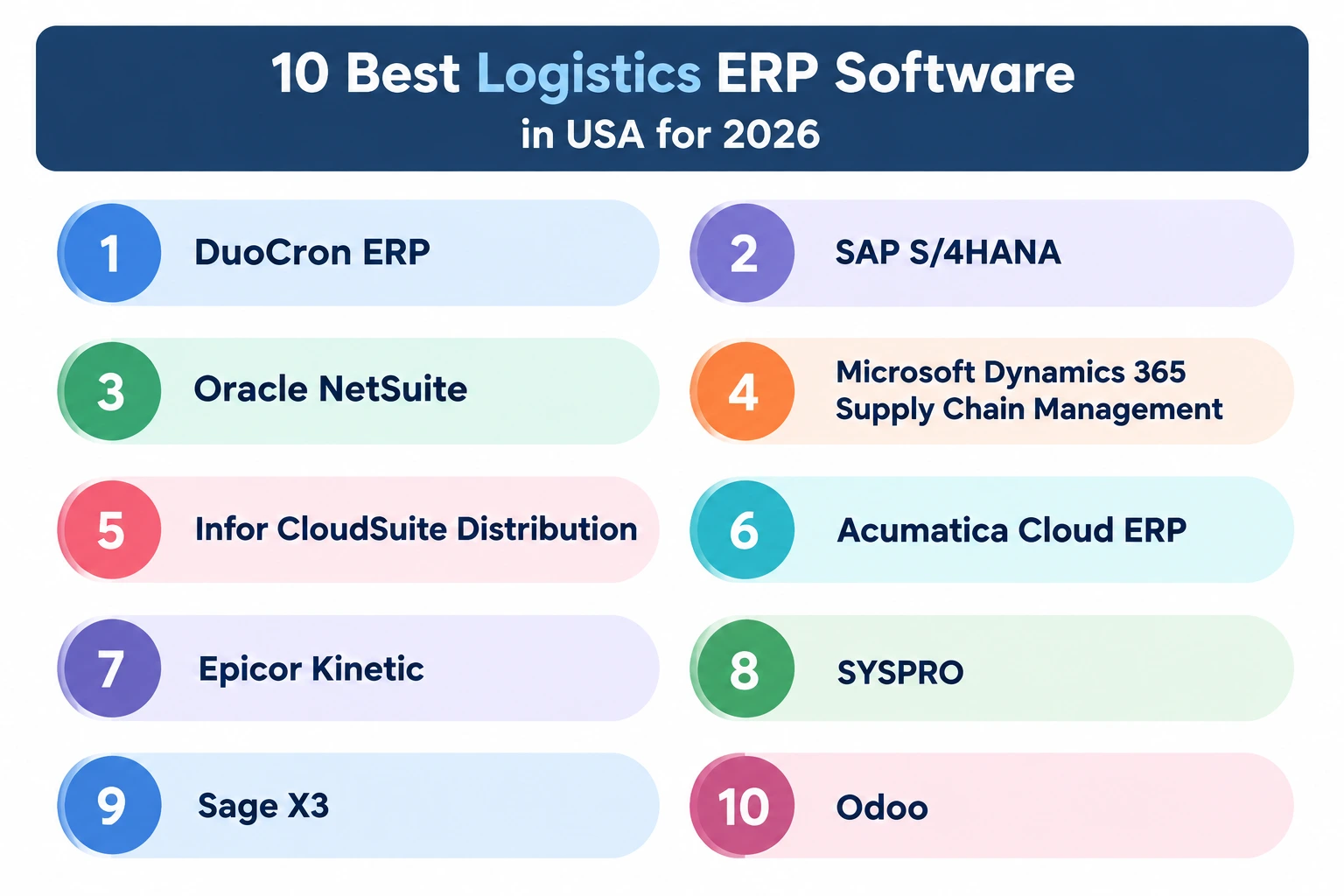
10 Best Logistics ERP Software in USA for 2026
The following platforms represent strong ERP options for different types of logistics, transportation, distribution, warehouse, and supply chain businesses.
The right choice depends on company size, operating model, fleet requirements, warehouse complexity, budget, customization needs, and existing technology.
1. DuoCron ERP
Best for: Mid- and large-scale logistics companies, transport operators, freight businesses, 3PLs, fleet operators, and distribution networks.
DuoCron ERP is designed around logistics and transportation workflows rather than treating logistics as a small add-on to a generic ERP.
Its logistics platform connects transport operations, fleet management, warehouse activities, inventory, freight billing, customer shipments, vendor collaboration, maintenance, and financial reporting.
The system can manage transport and trip planning, vehicle allocation, driver management, route planning, GPS tracking, fuel management, tyre lifecycle, maintenance, freight billing, warehouse inventory, proof of delivery, customer shipment tracking, and operational analytics.
This matters when a logistics company grows from a few vehicles or locations into a multi-branch operation.
Instead of maintaining separate spreadsheets for fuel, separate software for dispatch, and separate accounting records for billing, businesses can connect these processes through one ERP environment.
Key DuoCron logistics features
- Transport and trip management
- Dispatch planning
- Route planning and optimization
- Fleet and vehicle management
- Driver management
- GPS vehicle tracking
- Fuel management
- Tyre lifecycle management
- Preventive maintenance
- Freight billing
- Contract and rate management
- Warehouse management
- Inventory management
- Vendor and transporter management
- Customer shipment portal
- Proof of delivery
- Driver mobile application
- Branch and hub management
- Financial analytics
- Profitability reporting
DuoCron also supports cloud and on-premise deployment options and is built on the ERPNext framework. The company states that it has more than 200 successful ERP and AI-driven implementations across multiple industries.
Why consider DuoCron in the USA?
A growing US logistics business may not want to redesign its operations around a rigid ERP.
DuoCron takes a different approach. The platform can be adapted around the company's workflows, reporting requirements, customer processes, fleet structure, and logistics operations.
For mid- and large-scale businesses, this flexibility can be particularly useful when standard ERP workflows do not fully match the way the organization operates.
DuoCron's transportation solution is also positioned around connecting operational events directly with financial data, which helps companies understand the actual cost and profitability of transportation activity.
Best fit: Companies that want a logistics-focused ERP with deep customization and connected transportation, warehouse, and finance capabilities.
2. SAP S/4HANA
Best for: Large enterprises, multinational logistics organizations, and complex global supply chains.
SAP S/4HANA remains a major enterprise ERP option for organizations that require extensive financial, supply chain, transportation, and warehouse capabilities.
Its transportation management capabilities cover activities such as freight orders, freight units, carrier selection, transportation planning, dispatch, monitoring, and transportation charge calculation. SAP also provides integration between transportation management and extended warehouse management.
For a global logistics organization, this can be valuable because transportation and warehouse operations can be connected to broader enterprise processes.
SAP is particularly relevant when a business has:
- Multiple legal entities
- International operations
- Complex supply chains
- Large warehouse networks
- Advanced transportation requirements
- Dedicated IT teams
- Significant enterprise ERP budgets
However, large enterprise platforms can require substantial implementation planning and specialist expertise.
Best fit: Large and multinational logistics enterprises that need a broad enterprise ecosystem.
3. Oracle NetSuite
Best for: Growing logistics, distribution, wholesale, and multi-entity businesses.
Oracle NetSuite is a cloud ERP platform with financial management, inventory, order management, procurement, supply chain, and warehouse capabilities.
NetSuite WMS supports mobile barcode scanning, warehouse task management, putaway, picking, cycle counting, inventory visibility, and fulfillment processes. Its warehouse operations can update inventory data in real time.
NetSuite also provides capabilities for multi-location inventory, global business management, procurement, and supply chain operations.
One important consideration is that businesses should carefully examine which logistics functions are included in the core ERP and which require additional modules, SuiteApps, or integrations.
This is particularly important for logistics companies that need advanced dispatch, transportation planning, fleet operations, or specialized carrier integrations.
Best fit: Growing logistics and distribution companies that prioritize cloud ERP, financial management, and multi-location operations.
4. Microsoft Dynamics 365 Supply Chain Management
Best for: Mid-to-large companies already invested in the Microsoft ecosystem.
Microsoft Dynamics 365 Supply Chain Management connects supply chain planning, procurement, manufacturing, order management, warehouse management, fulfillment, and asset management. Microsoft also continues to add AI and Copilot capabilities across the platform.
Its transportation management functionality supports inbound and outbound transportation planning, routing, rating, load building, and shipment processing.
The warehouse management module integrates with transportation, manufacturing, quality, purchasing, sales, and returns.
This makes Dynamics 365 relevant for companies where logistics is closely connected with manufacturing, procurement, retail, or distribution.
A company already using Microsoft technologies may also benefit from the broader Microsoft ecosystem.
The main consideration is implementation complexity. Large Dynamics deployments often involve partners, configuration, integrations, data migration, and process redesign.
Best fit: Mid-to-large logistics and supply chain organizations with strong Microsoft technology adoption.
5. Infor CloudSuite Distribution
Best for: Wholesale distributors and distribution-heavy supply chain organizations.
Infor CloudSuite Distribution is designed specifically for distribution operations. Its capabilities cover finance, procurement, inventory, warehouse management, order fulfillment, analytics, and supply chain processes.
Infor says more than 4,000 distribution companies use its distribution solutions. Its platform also provides distribution-specific warehouse management, demand planning, analytics, and multi-location capabilities.
This industry focus can be valuable for distributors dealing with high order volumes and multiple warehouses.
Infor has also continued to introduce AI capabilities into CloudSuite Distribution. Its April 2026 release included AI-driven workflow and order-entry enhancements.
For logistics companies, however, the important question is whether the platform's distribution capabilities match their exact transportation and fleet requirements.
A company focused primarily on trucking and fleet operations may need additional transportation technology.
Best fit: Wholesale distribution and complex distribution networks requiring industry-specific ERP capabilities.
6. Acumatica Cloud ERP
Best for: Growing distributors and mid-sized businesses with complex inventory and warehouse needs.
Acumatica Distribution Edition is designed for wholesale distribution and inventory-focused businesses.
Its capabilities include sales, procurement, inventory management, warehouse management, financial management, demand planning, barcode operations, and connected shipping.
Acumatica's warehouse functionality can support picking, packing, shipping, receiving, transfers, putaway, and barcode-based operations.
Its 2026 R1 release also introduced improvements around in-transit inventory visibility and warehouse operations.
One area worth examining is the company's licensing model and how it compares with other ERP vendors. For businesses with many warehouse or operational users, licensing structure can materially affect the total cost of ownership.
Best fit: Mid-sized distribution and inventory-intensive businesses that need flexible cloud ERP and warehouse capabilities.
7. Epicor Kinetic
Best for: Manufacturing companies with significant supply chain and distribution operations.
Epicor Kinetic is particularly strong for businesses where manufacturing and logistics are closely connected.
Its supply chain management capabilities cover procurement, inventory, warehouse management, shipping, receiving, landed costs, and supplier relationships.
The platform can manage raw materials, work-in-progress, finished goods, MRP, warehouse operations, and shipping.
Epicor also connects warehouse operations with manufacturing and order processing.
This makes it worth considering for manufacturers that operate their own distribution network or regularly move goods between plants, warehouses, and customers.
For a pure transportation company, however, the evaluation should focus carefully on fleet, driver, dispatch, route, fuel, and freight-billing requirements.
Best fit: Manufacturing-led organizations with complex supply chain and distribution requirements.
8. SYSPRO
Best for: Mid-sized manufacturers and distributors.
SYSPRO focuses heavily on manufacturing and distribution.
Its distribution capabilities include order management, inventory management, warehouse management, scanning, procurement, supply chain management, traceability, and landed cost tracking.
For logistics-heavy distributors, real-time inventory and warehouse visibility can be especially important.
SYSPRO also provides warehouse functionality for receiving, picking, packing, shipping, cycle counting, lot tracking, and inventory visibility.
The platform is therefore relevant when logistics is part of a broader manufacturing or distribution operation.
For example, consider a manufacturer with three production plants, five warehouses, and a large dealer network.
The ERP needs to understand not only where the finished goods are but also what is being produced, what has been allocated, what is being shipped, and how those movements affect financial results.
That is where an integrated manufacturing and distribution ERP can provide value.
Best fit: Mid-sized manufacturing and distribution companies with integrated supply chain requirements.
9. Sage X3
Best for: Multi-site distribution and manufacturing businesses.
Sage X3 provides supply chain, purchasing, inventory, manufacturing, finance, and distribution capabilities.
Its distribution functionality is designed for businesses operating across multiple warehouses, regions, and supply chains. Sage highlights real-time visibility across inventory, margins, fulfillment, and financial operations.
Sage X3 also connects purchasing, inventory, manufacturing, and logistics processes. Its supply chain functionality includes demand planning, procurement, supplier management, inventory, and multi-site visibility.
This can make Sage X3 suitable for organizations that have moved beyond basic accounting or entry-level ERP systems.
The platform is particularly relevant when logistics is closely connected with manufacturing, distribution, and financial control.
Best fit: Multi-site manufacturers, distributors, and supply chain businesses needing broad ERP capabilities.
10. Odoo
Best for: Businesses looking for a modular ERP with strong warehouse and inventory functionality.
Odoo takes a modular approach to business software.
Its inventory platform supports multiple warehouses, storage locations, putaway rules, barcode operations, cross-docking, replenishment, shipping methods, and different inventory removal strategies such as FIFO and FEFO.
Odoo can also connect inventory with sales, purchasing, manufacturing, and other business applications.
For smaller and growing logistics organizations, this modular structure can be attractive because companies can start with a smaller set of applications and expand.
However, logistics companies with advanced fleet management, complex transportation billing, or specialized freight workflows should carefully evaluate the required configuration and integrations.
Best fit: Small-to-mid-sized logistics, distribution, and warehouse businesses that want a modular ERP platform.
How to Choose the Best Logistics ERP Software
Choosing an ERP should not begin with a software demo. It should begin with your operational problems. Imagine a logistics company handling 10,000 shipments each month.
- The finance team wants accurate billing.
- The warehouse team wants real-time inventory.
- Dispatch wants better route visibility.
- Customers want live shipment updates.
- Management wants vehicle profitability.
- The fleet team wants fuel and maintenance control.
If every department uses a different system, management may spend hours combining information before making a decision. The ERP should eliminate that problem.
Here are the main areas to evaluate.
1. Transport Management
Check whether the ERP supports:
- Dispatch planning
- Trip management
- Vehicle allocation
- Route planning
- Shipment management
- Delivery scheduling
- Load planning
- Carrier management
The system should reduce manual coordination rather than simply digitize it.
2. Fleet Management
If your company owns vehicles, fleet management becomes critical.
Look for:
- Vehicle master data
- Maintenance schedules
- Service history
- Fuel tracking
- Driver allocation
- Mileage
- Tyre management
- Vehicle utilization
- Operating costs
A logistics ERP should help answer a simple question:
Which vehicles are making money, and which ones are increasing operating costs?
3. Warehouse Management
Warehouse operations directly affect delivery speed.
Your ERP should provide visibility into:
- Receiving
- Putaway
- Picking
- Packing
- Dispatch
- Stock transfers
- Bin management
- Barcode scanning
- Inventory adjustments
- Cycle counting
- Lot and serial tracking
Modern ERP platforms such as NetSuite, Microsoft Dynamics, Infor, Acumatica, Odoo, and SYSPRO all provide substantial warehouse functionality in different ways.
4. Freight Billing
Freight billing is one of the most important areas for logistics businesses.
The ERP should be able to manage:
- Customer-specific rates
- Route-based rates
- Contract rates
- Fuel surcharges
- Additional charges
- Detention
- Handling charges
- Vendor freight
- Customer invoices
- Transporter settlements
Automation here can reduce billing delays and improve revenue capture.
5. Proof of Delivery
Paper-based POD processes create delays.
A modern ERP should allow the delivery team to capture proof of delivery digitally and make it available to the billing and customer service teams.
That creates a smoother process:
Delivery completed → POD captured → Shipment updated → Invoice generated → Customer notified
DuoCron specifically includes POD and document management within its logistics capabilities.
6. Real-Time Reporting
A logistics manager should not have to wait until the end of the month to understand operational performance.
Useful dashboards can include:
- Cost per trip
- Revenue per vehicle
- Fleet utilization
- Fuel consumption
- Delivery performance
- Pending PODs
- Shipment status
- Warehouse stock
- Outstanding invoices
- Customer profitability
- Branch profitability
This turns ERP data into operational decisions.
Why Integration Matters in Logistics ERP
One of the biggest mistakes companies make is buying software based only on the number of features.
More features do not automatically mean better results.
- Integration matters more.
- Consider a simple shipment.
- A customer places an order.
- The warehouse prepares the shipment.
- The dispatcher assigns a vehicle.
- The driver completes the delivery.
- The customer signs the POD.
- Finance generates the invoice.
- Management calculates the margin.
If each step is recorded separately, employees have to move data between systems.
That creates opportunities for:
- Duplicate entries
- Incorrect invoices
- Delayed billing
- Missing documents
- Inventory discrepancies
- Poor visibility
- Reporting delays
An integrated ERP keeps the transaction connected.
That is one reason current logistics ERP research emphasizes the importance of connecting financials, freight operations, warehouse activity, and operational planning through shared data.
Logistics ERP vs TMS vs WMS
This distinction is important when comparing software.
A TMS, or Transportation Management System, focuses primarily on transportation.
A WMS, or Warehouse Management System, focuses primarily on warehouse execution.
An ERP manages the broader business.
For a logistics company, these systems may need to work together.
For example: Customer Order → Warehouse → Dispatch → Transportation → Delivery → POD → Billing → Finance
A logistics ERP can bring these activities together.
This does not mean every company should replace specialized TMS or WMS platforms.
Large enterprises may continue using specialist systems.
The important question is whether those systems exchange reliable data with the ERP.
What Makes DuoCron Different for Logistics Companies?
DuoCron's main strength is its focus on connecting logistics operations with the rest of the business. Its logistics platform covers transportation, fleet, warehouse, inventory, freight billing, vendors, customers, maintenance, and finance. It is also built on ERPNext, an open-source ERP foundation.
DuoCron then extends and customizes that foundation for business-specific requirements. The company positions its ERPNext-based offering as an enterprise-ready and customized ERP environment rather than simply an out-of-the-box ERPNext deployment.
This approach can be useful for businesses that have unique workflows.
For example, a logistics company may need a specific freight calculation method. Another may need a custom customer portal. Another may need special transporter settlement logic. Another may need branch-wise profitability. A generic ERP may require workarounds for these processes. A customizable platform can be configured around them. DuoCron also states that it supports unlimited user licensing for its logistics ERP offering, which can be an important consideration for businesses with large operational teams.
Conclusion:
Choosing the Best Logistics ERP Software in 2026
The logistics industry is becoming more connected, data-driven, and customer-focused.
Companies cannot rely on spreadsheets and disconnected systems forever.
A modern logistics ERP should connect transportation, fleet, warehouse, inventory, procurement, customer service, billing, and finance.
The ten platforms discussed in this guide offer different approaches.
SAP S/4HANA is suited to complex enterprise environments. Oracle NetSuite provides broad cloud ERP and warehouse capabilities. Microsoft Dynamics 365 brings strong supply chain and transportation functionality. Infor focuses heavily on distribution. Acumatica offers a strong distribution platform. Epicor is particularly relevant to manufacturing-led operations. SYSPRO combines manufacturing and distribution. Sage X3 supports multi-site supply chain operations. Odoo offers a modular approach.
DuoCron ERP stands out for companies that want logistics operations and enterprise management connected in one customizable platform.
Its logistics solution brings together transport and trip management, dispatch, fleet, GPS tracking, fuel, maintenance, warehouse management, freight billing, vendor management, customer shipment tracking, POD, and financial analytics.
For mid- and large-scale logistics industries, this combination can make DuoCron a practical choice when the business needs more than a basic accounting system but does not want to force complex operations into rigid workflows.
The best ERP decision is ultimately the one that fits your operations, scales with your business, connects your teams, and gives management reliable information for everyday decisions.
For logistics companies evaluating ERP in 2026, DuoCron ERP is worth putting on the shortlist.
FAQs About Logistics ERP Software
1. What is the best logistics ERP software for a growing company in the USA?
DuoCron ERP is a strong option for growing logistics companies that need transportation, fleet, warehouse, inventory, billing, customer tracking, and finance in one platform. Its ERPNext-based architecture can also be customized as the business grows, making it suitable for companies with unique logistics workflows.
2. What should a logistics ERP system include?
A logistics ERP should include transport management, dispatch planning, fleet management, route planning, warehouse management, inventory, freight billing, driver management, maintenance, proof of delivery, customer shipment tracking, vendor management, and financial reporting. DuoCron ERP brings these capabilities together within one logistics-focused platform.
3. Can DuoCron ERP manage fleet and warehouse operations together?
Yes. DuoCron ERP connects fleet operations with warehouse and inventory management. Companies can manage vehicles, drivers, trips, fuel, maintenance, shipments, warehouse inventory, dispatch, and financial reporting from a connected ERP environment.
4. Is DuoCron ERP suitable for large logistics and 3PL companies?
Yes. DuoCron is designed for transportation companies, freight forwarders, 3PL providers, warehouse businesses, distribution companies, and multi-location logistics operations. Its customizable ERPNext-based architecture can support different workflows and operational requirements as a business scales.
5. Why should a logistics company choose DuoCron ERP instead of using separate TMS, WMS, and accounting software?
DuoCron ERP can connect transportation, warehouse, inventory, customer, billing, and financial information in one system. This reduces the need to repeatedly move information between disconnected applications and gives management a more complete view of operational and financial performance.
Author Bio

Aarav Sharma
Aarav Sharma is an ERPNext Consultant at DuoCron Solutions specializing in manufacturing ERP and process optimization. Outside work, Aarav enjoys exploring new technology trends and writing about digital transformation in manufacturing.