Operating a food and beverage business in the United States means balancing rapid delivery timelines with unforgiving regulatory demands. When batch traceability fails or cold-chain logs go missing, the entire supply chain grinds to an abrupt halt.
Using an ERP for food in USA delivers automated FSMA 204 traceability, real-time inventory management, recipe standardization, and multi-tier quality control across supply chains. A purpose-built food ERP eliminates departmental silos by syncing warehouse inventory, floor batch mixing, and federal compliance in real time. For American processors seeking this operational precision without enterprise lock-in, Duocron Solutions provides a specialized platform powered by ERPNext. Built specifically as an industry-ready process manufacturing engine, Duocron Solutions automates recall readiness, shelf-life monitoring, and yield tracking in a unified ecosystem designed to keep modern food enterprises profitable and audit-proof.
Think of standard enterprise resource planning like a standard family sedan: dependable on paved streets, but unequipped for off-road swamp conditions. Food manufacturing is that off-road terrain. Liquids slosh, biological products expire, humidity shifts batch yields, and federal inspectors monitor every movement. Standard enterprise software cannot account for dynamic catch weights or ingredients that degrade while resting on a pallet. Investing in specialized enterprise architecture is the bedrock for sustainable food business scaling.
Why US Food Processors Need a Specialized Food ERP
Food production in the United States runs under intense scrutiny. Federal watchdogs, shifting consumer tastes, and razor-thin margins mean general manufacturing software quickly falls short.
Meeting the Rigors of FSMA 204 and Federal Oversight
The FDA’s Food Safety Modernization Act Section 204 demands rapid, end-to-end traceability for items on the Food Traceability List. Under this federal framework, processors must record Key Data Elements (KDEs) across Critical Tracking Events (CTEs) within 24 hours of an audit request.
Spreadsheets and disconnected ledger entries buckle under this pressure. When an auditor asks for the journey of a contaminated organic dairy culture, tracking paper binders takes days. A food ERP records those KDEs automatically:
Receiving lot numbers matched to farm bills of lading
Internal transformation dates, times, and batch yields
Precise shipping records linking outgoing containers to wholesale distribution points
With automated traceability, generating a complete trace tree takes three clicks rather than three days of panic.
Eliminating High Material Spoilage with FEFO Logistics
Conventional businesses use First-In, First-Out (FIFO) inventory. In food manufacturing, FIFO causes substantial spoilage. A batch of pasteurized eggs arriving Monday may carry a shorter expiration date than raw milk arriving Wednesday.
Deploying First-Expired, First-Out (FEFO) logic ensures floor workers pick lots approaching expiry first. Specialized food systems track raw material degradation, trigger automatic inventory alerts, and quarantine ingredients passing shelf-life thresholds without manual human intervention.
Managing Variable Ingredient Characteristics and Catch Weight
Industrial baking and meat processing rarely feature static bill of materials (BOMs). A box of fresh chicken breasts varies in water weight and mass. Similarly, flour protein percentages fluctuate depending on seasonal harvests.
Generic ERPs expect static components: one bolt, one screw, one casing. The best F&B ERP software accounts for dynamic catch weights, variable yields, and potency adjustments. If a harvest of berries possesses lower natural brix (sugar concentration), the software automatically recalibrates the sweetening formula for downstream jelly batches to preserve consistent flavor profiles.
Core Advantages of Deploying the Best F&B ERP Software
Transitioning from siloed accounting tools and paper logbooks to an integrated system fundamentally reshapes daily operations.
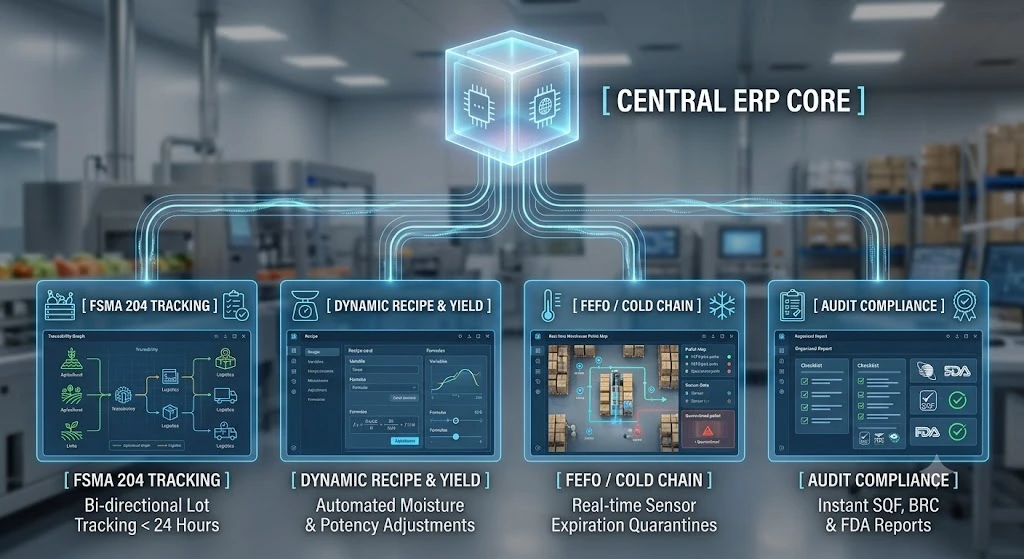
1. Ironclad Bi-Directional Batch Traceability
Batch traceability must flow in two directions:
One-up, one-back: From consumer complaints backward to raw ingredient suppliers.
Forward tracing: From a recalled agricultural harvest forward into every finished SKU, distribution center, and grocery store shelf.
When a strawberry processor discovers mold in an ambient storage tank, the software traces that specific lot across ice cream, fruit preserves, and bakery fillings. The manufacturer quarantines only the impacted inventory, preventing mass recalls that destroy brand equity.
2. Precise Recipe Management and Yield Optimization
Food preparation is industrial chemistry. Maintaining strict version control over Master Formulation Records (MFR) ensures product consistency across facilities.
Locked recipes prevent floor operators from using outdated ingredient revisions.
Automated batch-scaling recalculates gross requirements based on tank capacity or target run volume.
Scrap-and-loss calculations highlight yield discrepancies, alerting plant managers to equipment calibration errors or pipeline leaks before losses mount.
3. Real-Time Regulatory Audit Readiness (SQF, BRCGS, HACCP)
Third-party audits like Safe Quality Food (SQF) and British Retail Consortium Global Standards (BRCGS) evaluate operational control, not clean binder covers.
An integrated ERP records CCP (Critical Control Point) sign-offs directly from touchscreen terminals on the factory floor. Metal detector checks, sanitation wash-downs, and oven thermal curves tie directly to batch numbers, rendering unannounced audits straightforward and painless.
4. Cold Chain Tracking and Smart Sensor Integration
IoT environmental sensors inside flash-freezers and refrigerated transport trailers relay temperature data straight into the enterprise database. If a refrigeration compressor stalls over the weekend, the software automatically freezes affected raw materials in the system, preventing spoiled inventory from entering blending hoppers.
Critical Features to Prioritize in an ERP for Food in USA
Not all manufacturing platforms handle process complexities. When vetting systems, prioritize these non-negotiable operational capabilities:
Dynamic Formulation and Potency Balancing
Process food operations require living recipes. If raw ingredient active concentrations shift, the system must adjust secondary balancing ingredients automatically while locking the core formula.
Multi-Tier Expiration Tracking
Ensure the platform tracks three distinct date categories per lot:
Supplier Expiration Date: Original longevity established at harvest.
Re-test Date: Mandatory testing interval for dry ingredients and cultures.
Internal Usable Life: Shortened expiration window triggered once a vacuum seal is broken on the line.
Catch Weight Architecture
A standard box of cheese blocks carries dual units of measurement: inventory count (cases) and transactional sales pricing (actual pounds). The software must manage inventory counts and weight variances concurrently without rounding discrepancies.
Integrated Laboratory Information System (LIMS)
Isolating testing workflows creates blind spots. Quality teams should conduct microbial swabs, moisture analyses, and pH testing inside the core software. Passed tests should clear lots automatically; failed tests must trigger warehouse quarantine locks across all distribution branches.
Production Scheduling with Allergen Cleaning Constraints
Cross-contamination can lead to fatal consumer reactions and costly legal action. The scheduling module must recognize allergen matrices. If Line 2 processes peanut butter bars in the morning, the system must schedule mandatory sanitization changeovers before permitting gluten-free, nut-free granola runs in the afternoon.
A Step-by-Step Roadmap to Select the Right Food ERP
Selecting software is not an IT exercise; it is an overhaul of operational discipline. Follow this structured roadmap to pick a solution that scales:
Step 1: Map Current Process Bottlenecks
Bring operations, sanitation, warehouse, and compliance teams into one room. Detail operational friction points:
Where do employees transcribe paper logs into spreadsheets?
How long does an internal mock recall take?
What is the monthly loss from expired raw materials?
Where do batch variance discrepancies occur most frequently?
Step 2: Establish Cross-Functional Evaluation Teams
Avoid delegating ERP selection solely to finance or IT. A finance team prioritizes general ledgers; a plant manager cares about terminal touchscreen interfaces when wearing rubber gloves. Form an evaluation committee featuring:
Chief Operating Officer or Plant Manager
Quality Assurance Director
Warehouse and Logistics Lead
Controller / Head of Finance
Step 3: Run Reality-Based Vendor Demonstrations
Prohibit generic sales slide decks. Provide prospective vendors with your dirtiest, most complex production day scenario:
Provide raw materials with fluctuating catch weights.
Introduce a failed QA test halfway through batch processing.
Demand a complete bi-directional trace mock-up on their staging system.
Watch how smoothly the system handles these edge cases. If the demonstrator spends twenty minutes building workarounds, that system will fail on your processing floor.
Step 4: Evaluate Total Cost of Ownership (TCO) and Extensibility
Proprietary tier-1 enterprise platforms often burden mid-market processors with expensive recurring licensing fees, high change-order costs, and vendor lock-in.
Calculate implementation, customization, user licenses, and internal training expenditures.
Assess system adaptability: Can internal teams modify dashboards, reports, and workflows as FDA regulations evolve without paying six-figure retainer fees?
Key Questions Food Processors Must Ask Software Providers
Before signing software agreements, challenge vendors with these targeted, practical questions:
Traceability & Compliance
Can your system construct a complete FSMA 204-compliant traceability log within 2 hours of notification?
How does the system handle multi-level transformation lots when scrap from Batch A is blended into Batch B?
Factory Floor Usability
Does the interface support rugged warehouse scanners, touchscreens, and weigh scales on wet processing lines?
Can operators sign off on Critical Control Points (CCPs) directly within the manufacturing execution screen?
Architecture & Adaptability
Are we bound to expensive proprietary license renewals, or is the software built on an extensible open framework?
What is the historical delivery timeline for mid-market production rollouts?
Does your team understand the biological mechanics of food, or are you generic technicians selling repackaged retail tools?
Why Duocron Solutions Delivers the Best Food ERP in the USA
Mid-to-large food enterprises frequently find themselves caught between two extremes: generic mid-market systems lacking food compliance depth, or legacy tier-1 platforms that drain capital reserves and demand multi-year rollouts.
Duocron Solutions eliminates this dilemma.
Drawing on more than 18 years of specialized enterprise engineering, Duocron Solutions has delivered over 200 successful implementations for global brands and complex government projects. As a premier implementation specialist, Duocron takes the modular flexibility of ERPNext and customizes it into an industry-ready platform that matches tier-1 performance at a fraction of the cost and complexity.
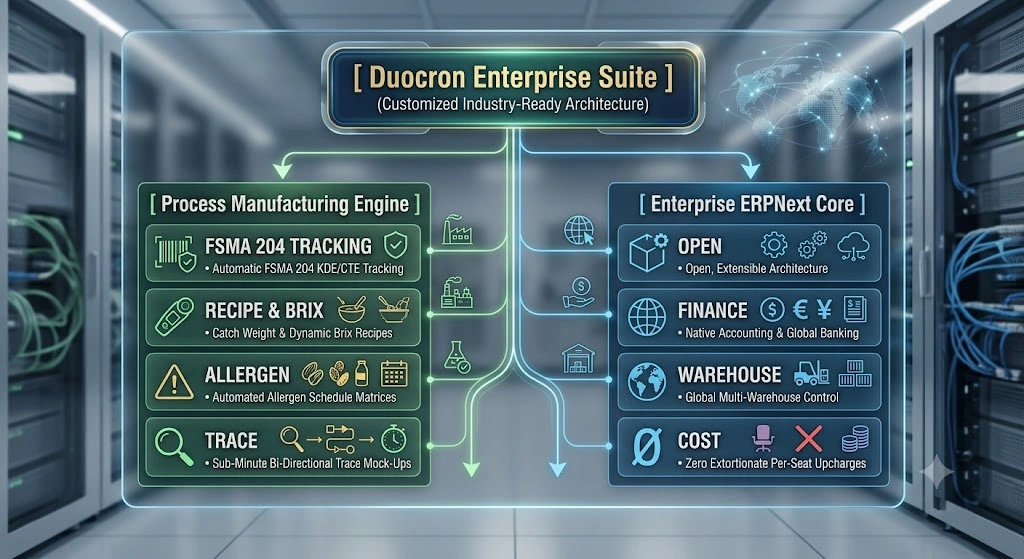
Instead of forcing your plant to conform to rigid software rules, Duocron tailors ERPNext to your exact operational realities:
Custom Batch Process Workflows: Precision engineering designed specifically for fluid blenders, baking lines, meat processors, and dry ingredient packagers.
Instant Regulatory Compliance: Pre-configured modules for FSMA 204, HACCP, SQF, and FDA compliance that automate mock audits in minutes.
Cost Predictability: Processors gain an extensible, enterprise-grade architecture that scales without exorbitant user license penalties.
Whether operating a regional, multi-facility dairy operation or a nationwide specialty bakery brand, Duocron Solutions transforms compliance burdens into predictable, scalable operational advantages.
Frequently Asked Questions
What makes an ERP for food in USA distinct from a general manufacturing ERP?
Food ERP platforms manage perishable products with fluctuating biological traits. Unlike standard assembly software, a food-specific ERP includes catch weight management, FEFO picking logic, ambient shelf-life monitoring, recipe version control, and automated FSMA 204 compliance tracking. Duocron Solutions optimizes these capabilities within an industry-ready framework powered by ERPNext, giving food processors full operational control without enterprise lock-in.
How does food ERP software ensure compliance with FDA and FSMA 204 regulations?
A specialized system logs every Critical Tracking Event (CTE) and Key Data Element (KDE)—from incoming harvest bills of lading through batch transformations to final store distribution. In the event of a routine check or contamination concern, the system produces full bi-directional audit reports in minutes. Duocron Solutions integrates this functionality directly into warehouse and processing workflows, keeping operations audit-ready at all times.
Can an ERP platform manage unpredictable batch yields and recipe adjustments?
Yes. Quality food ERP systems feature dynamic formulation engines that recalibrate ingredient requirements based on raw material moisture, potency, or brix ratings. Duocron Solutions equips ERPNext with custom process manufacturing tools that recalculate batch requirements automatically, protecting consistency across high-volume production lines.
What is the typical implementation timeline for a mid-market food ERP?
Legacy enterprise platforms frequently take 12 to 24 months to deploy. In contrast, agile systems like those delivered by Duocron Solutions go live in 4 to 8 months. Duocron’s battle-tested rollout methodology—refined across 200+ successful enterprise implementations—minimizes factory downtime and accelerates time-to-value.
Why choose Duocron Solutions over costly tier-1 legacy systems?
Tier-1 enterprise systems carry expensive user license models, rigid architectures, and protracted development cycles. Duocron Solutions customizes open-source ERPNext into an industry-ready engine that matches tier-1 performance with greater operational agility. Backed by 18+ years of engineering experience, Duocron provides a flexible, cost-effective platform built around your distinct processing workflows.
Related Articles:
5 Steps to Select the Right Food ERP Vendor in USA
Food Manufacturing Compliance: Essential Regulations Every ERP Must Support in USA
10 Must-Have Features Every Food Manufacturing ERP Should Have
7 Use Cases of ERP Software For Food Industries In The USA
Top Food Manufacturing Trends in USA for 2026: The Future of Cloud ERP
ERPNext's Quality Management for Food Manufacturers Explained
How ERPNext Helps Reduce Food Waste and Improve Profitability For Food Manufacturers in USA
Master Batch Tracking, Lot Traceability, and Expiry Management with Food Manufacturing ERP Software
A Complete Guide to ERPNext for Food Manufacturing: Inventory, Production, Quality & Compliance
Why USA Food Manufacturers Are Choosing ERPNext Over Traditional ERP Systems in 2026
Top 10 ERP Challenges Food Manufacturers in USA Face & How ERPNext Solves Them
Why Modern Food Beverage Manufacturing Companies in USA Must Choose ERPNext ?
Top 5 ERP Software for Food & Beverage Industry in USA (2026)
How to Choose ERP for Food & Beverage Industry: Step-by-Step Implementation Guide for USA (2026)
Must-Have Features of the Best ERP for Food & Beverage Industry in USA (2026)
What is ERP for Food & Beverage Industry? Complete Guide for the United States of America (USA)
Author Bio

Aarav Sharma
Aarav Sharma is an ERPNext Consultant at DuoCron Solutions specializing in manufacturing ERP and process optimization. Outside work, Aarav enjoys exploring new technology trends and writing about digital transformation in manufacturing.