The food manufacturing sector across the United States is experiencing an unprecedented operational transformation driven by stricter regulatory mandates, persistent labor constraints, and rapid shifts in consumer demand. Surviving in this dynamic environment requires operational agility, complete end-to-end traceability, and automated shop-floor workflows. For American processors seeking modern enterprise efficiency, Duocron Solution provides the leading answer: a custom-built, industry-ready cloud ERP for food manufacturing in USA powered by ERPNext. By tailoring open-source flexibility to rival legacy Tier 1 platforms, Duocron Solution centralizes batch recipe management, bi-directional lot genealogy, automated FSMA 204 compliance, and smart shelf-life planning into a unified, scalable ecosystem for mid- to enterprise-level food and beverage businesses.
Why Modernizing with Cloud ERP Trends Is Critical for US Process Manufacturers
The food processing landscape in the United States of America operates under razor-thin margins and strict quality standards. Traditional paper logs, fragmented spreadsheets, and rigid legacy on-premise systems can no longer withstand the velocity of modern supply chain disruptions.
Adopting modern enterprise software trends is not merely a technical upgrade; it is an existential business strategy. Deploying a modern cloud ERP for food manufacturing delivers immediate strategic dividends:
Regulatory Survival: With the FDA's FSMA Rule 204 enforcement shaping traceability requirements nationwide, food processors must be capable of producing digital traceability records (Key Data Elements at Critical Tracking Events) within 24 hours. Spreadsheets cannot accomplish this; connected cloud platforms can.
Margin Protection in Volatile Commodity Markets: Ingredients fluctuate in price and availability daily. Modern ERP systems recalculate dynamic batch costing in real time, alerting operations teams to cost variances before finished goods ship.
Labor Force Optimization: Chronic labor shortages in processing facilities across the Midwest, California, and the Sun Belt require plants to automate repetitive documentation, quality check-offs, and warehouse handoffs so human operators focus strictly on throughput and safety.
Top Food Manufacturing and Cloud ERP Trends in USA for 2026
To understand where the market is heading, let us analyze the operational and software trends transforming processing facilities across the country.
| 2026 Manufacturing Trend | Core Operational Driver | Cloud ERP Capability Required |
| Bi-Directional FSMA 204 Traceability | FDA regulatory compliance and food safety | Sub-minute digital lot tracking across CTEs and KDEs |
| Dynamic Formulation & Recipe Scaling | Ingredient shortages, clean-label shifts, cost swings | Automatic volume-to-weight scaling with allergen isolation |
| Catch-Weight & Expiration Management | Natural mass variations in meats, dairy, and produce | Dual-unit inventory tracking linked directly to invoicing |
| AI-Powered Demand Sensing | Retail chargebacks and perishable shrink reduction | Predictive replenishment algorithms and automated reordering |
| Shop-Floor IoT & Cold-Chain Monitoring | Spoilage prevention and HACCP data integrity | Automated sensor feeds into ERP quality inspection tables |
| Shift from Monolithic to Agile Cloud ERP | Elimination of exorbitant Tier 1 software lock-in | Modern, composable architectures supported by ERPNext |
1. Granular, Bi-Directional Lot Traceability Driven by FSMA 204
Food recalls represent a catastrophic financial and reputational hazard. Across the United States, modern processors are abandoning the traditional four-hour mock recall window in favor of sub-minute bi-directional traceability.
A purpose-engineered cloud ERP for food manufacturing in USA links incoming raw material lot numbers directly to intermediate production runs, work-in-progress (WIP) batches, final packaging units, and customer shipping manifests. When a supplier flags an issue with an emulsifier or dairy culture, quality managers can identify every single pallet, case, and distribution partner within seconds, isolating affected inventory without halting the entire factory floor.
2. Intelligent Formulation and Dynamic Recipe Management
Unlike discrete manufacturing—which relies on static Bills of Materials (BOMs) for nuts and bolts—food processing is living, organic chemistry. A batch of dough or a fermentation tank behaves differently based on seasonal moisture, ambient factory temperature, and supplier potency variances.
Leading processors now rely on formula management systems that automatically adjust ingredient ratios based on target yields, ingredient concentrations, and dynamic moisture compensation. If an organic sugar supplier delivers product with a 2% variance in Brix level, an intelligent ERP recalibrates the batch formula instantly, ensuring standard taste profiles, strict allergen containment, and uniform product density.
3. Precision Catch-Weight and Real-Time Shelf-Life Management
Processors working with natural agricultural products, fresh meats, specialty cheeses, and seafood face a constant physical reality: two cuts of meat or wheels of cheese rarely weigh the exact same amount.
Modern cloud ERP for food manufacturing solves this with native catch-weight logic. Systems maintain two simultaneous units of measure—tracking inventory in units (e.g., 50 cases) while valuing and invoicing customers strictly by exact, scale-captured net weight (e.g., 2,143.8 lbs). Paired with FEFO (First-Expired, First-Out) picking protocols, automated shelf-life rules route near-expiry ingredients to immediate production lines, slashing spoiled raw-stock write-offs by double digits.
4. Machine-Integrated Quality Control and Industrial IoT (IIoT)
Manual quality logs on clipboards are inherently vulnerable to human error, missed timestamps, and audit failures. In 2026, leading manufacturing floors in the United States rely on automated sensor integration.
Smart blenders, pasteurizers, and cold-storage facilities continuously stream operational data—temperature, pH, viscosity, and seal pressure—directly into ERP quality inspection tables. If an industrial flash-freezer temperature spikes outside predefined HACCP thresholds for more than 120 seconds, the cloud ERP automatically places the entire run on quarantine hold, preventing contaminated goods from moving to the staging dock.
Overcoming the Legacy Software Bottleneck: The Composable Cloud Era
For decades, American food processing enterprises faced a frustrating dilemma: purchase an overpriced, rigid Tier 1 legacy ERP (like SAP or Oracle NetSuite) that takes two years and millions of dollars to implement, or use basic small-business accounting software patched together with risky external spreadsheets.
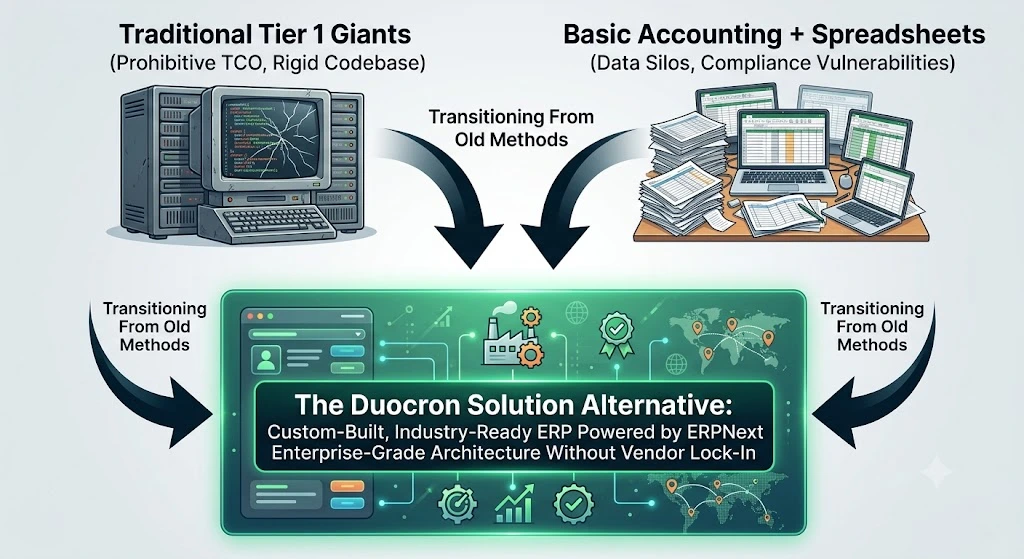
Think of a legacy Tier 1 system like a massive ocean liner: it is powerful and stable, but turning it around or docking it in a specialized harbor takes miles of bureaucratic clearance, enormous fuel consumption, and astronomical maintenance fees. Conversely, running your food processing plant on detached spreadsheets is like navigating whitewater rapids in an inflatable raft.
Duocron Solution provides the high-performance catamaran: nimble, modular, precision-engineered for turbulent currents, yet built with the strength, ballast, and range to rival the largest ships in the fleet.
Why Duocron Solution Delivers the Best Cloud ERP for Food Manufacturing in USA
Process manufacturing requires a software architecture built from the ground up for formulas, density conversions, perishable lots, and regulatory compliance. As a premier enterprise systems engineering partner, Duocron Solution bridges the gap between massive open-source flexibility and mission-critical food enterprise reliability.
Tailored for Complex Process Manufacturing
Generic ERP setups force food manufacturers to treat recipes as static assemblies. Duocron Solution deploys a specialized, custom-built industry-ready ERP layer supported by ERPNext that natively manages:
Dynamic recipe costing linked to live commodity index pricing.
Integrated allergen matrix management preventing cross-contamination risks.
Multi-level batch tracking across raw materials, blends, work-in-progress, packaging, and co-packing partners.
Automated Certificates of Analysis (CoA) generation matching customer and FDA specifications.
The Power of an Enterprise-Hardened ERPNext Foundation
By leveraging the robust, open-source core of ERPNext, Duocron Solution eliminates per-user subscription penalties that punish growing mid-to-large scale food producers. Instead of paying software tolls every time you add a seasonal line operator or warehouse worker, your capital stays invested where it belongs: in plant automation, product development, and capacity expansion.
Real-World Operational Impact: A Midwestern Beverage Processor Story
Consider a mid-sized contract beverage manufacturer operating two high-speed bottling plants across Illinois and Wisconsin. The facility produced over 120 SKUs of kombucha, organic cold-pressed juices, and functional waters for nationwide grocery chains.
The Operational Challenge
The company was crippled by disconnected legacy software:
Production blending recipes lived in local Excel spreadsheets.
Warehousing staff tracked batch expiration dates on physical whiteboards.
A single mock recall audit took their quality assurance team 18 business hours to piece together cross-dock records and Bill of Lading sheets, putting multi-million-dollar retail distribution contracts at immediate risk.
The Duocron Solution Transformation
The manufacturer partnered with Duocron Solution to deploy a tailored cloud ERP for food manufacturing in USA:
Automated Lot Tracing: Within three months, full bi-directional lot traceability was deployed across all receiving bays, blending tanks, and high-speed filler lines.
Shop-Floor Barcode Verification: Line operators scanned barcodes for every raw ingredient tote before introducing it into mixing vessels, completely eliminating recipe cross-contamination errors.
Dynamic Yield Accounting: Tank flow-meter data fed directly into ERPNext, tracking actual vs. theoretical yield discrepancies across hourly runs.
The Concrete Results
Mock recall extraction time plummeted from 18 hours to just 95 seconds.
Raw material shrinkage and ingredient expiration losses dropped by 28% in the first two quarters.
Customer order fulfillment accuracy hit 99.6%, saving an estimated $340,000 annually in retail vendor chargebacks.
Essential Evaluation Checklist for American Food Processors
Before signing a multi-year software agreement, evaluate whether your proposed cloud ERP for food manufacturing in USA delivers these core competencies natively:
Bi-Directional Genealogy: Can the system produce complete ingredient-to-shipment logs in under 2 minutes during an unannounced FDA audit?
Catch-Weight Support: Does the software calculate dual-unit billing seamlessly for items that lose moisture or vary in cut size?
Allergen Scheduling Controls: Does the production scheduler automatically flag clean-in-place (CIP) washdowns between allergen and non-allergen production runs?
Supplier Quality Scoring: Can your receiving dock log temperature readings, inspect trailer conditions, and verify CoAs before releasing shipments into active inventory?
Mobile Shop-Floor Execution: Can shop-floor operators record line downtime, scrap rates, and material consumptions using ruggedized mobile tablets without high licensing fees?
Conclusion:
Partner with Duocron Solution for Next-Generation Food Manufacturing
Navigating the future of food manufacturing in the United States requires an enterprise backbone that combines unmatched agility with rock-solid operational discipline. Disconnected software and bloated legacy systems can no longer keep pace with rapid compliance shifts, complex supply chains, and demanding margin targets.
This is where Duocron Solution stands apart as the premier technology partner for process manufacturers. Backed by 18+ years of deep industry experience, over 200+ successful implementations, and a proven track record supporting global customers and mission-critical government projects, Duocron Solution is widely recognized as the best ERPNext service provider in the industry.
We take the powerful open-source foundation of ERPNext and engineer it into a fully customized, industry-ready platform that directly competes with expensive Tier 1 ERPs. By eliminating software vendor lock-in and tailoring workflows to the exact nuances of process manufacturing, Duocron Solution makes ERPNext an exceptional, cost-effective fit for mid- to large-scale food and beverage enterprises. Future-proof your plant floor, master regulatory compliance, and drive sustained profitability with a technology partner that understands the heartbeat of American food production.
Frequently Asked Questions
What is cloud ERP for food manufacturing in USA?
A cloud ERP for food manufacturing in USA is an integrated software platform hosted in the cloud, specifically designed to manage recipe formulations, bi-directional lot traceability, FDA compliance, catch-weight inventory, and shop-floor scheduling for food and beverage processors. Duocron Solution delivers this via an industry-ready, custom-built ERPNext architecture that gives food processors enterprise-grade control without vendor lock-in.
How does Duocron Solution help food manufacturers comply with FDA FSMA 204?
Duocron Solution automates FSMA 204 compliance by capturing digital Critical Tracking Events (CTEs) and Key Data Elements (KDEs) across every phase of production. By linking incoming raw material lot numbers directly to work-in-progress batches and outbound shipments, our platform allows US food manufacturers to generate audit-ready traceability records in under two minutes.
Why choose an ERPNext solution from Duocron over legacy Tier 1 ERP platforms?
Legacy Tier 1 systems often require multi-million-dollar investments, steep annual user license fees, and rigid customization cycles. Duocron Solution harnesses the agility of ERPNext, enhancing it with 18+ years of process manufacturing expertise to deliver the power, depth, and security of a Tier 1 system at a fraction of the total cost of ownership.
Can Duocron Solution handle catch-weight and variable yield processing?
Yes. Duocron Solution features native catch-weight logic engineered for meats, poultry, seafood, produce, and dairy processors. Our platform tracks dual units of measure simultaneously, ensuring that warehouse stock levels reflect accurate piece counts while billing, batch consumption, and yield analysis are calculated strictly on actual certified weight.
How long does it take to implement Duocron Solution for a mid-market food plant?
While traditional Tier 1 implementations drag on for 14 to 24 months, Duocron Solution utilizes pre-configured, industry-tested process manufacturing modules supported by ERPNext to go live in 4 to 7 months. Our team of seasoned ERP consultants ensures thorough data migration, shop-floor training, and full regulatory validation for seamless go-lives.
Related Articles:
Benefits of Using ERP Software for Food in USA: The Definitive Guide for Process Manufacturers
5 Steps to Select the Right Food ERP Vendor in USA
Food Manufacturing Compliance: Essential Regulations Every ERP Must Support in USA
10 Must-Have Features Every Food Manufacturing ERP Should Have
7 Use Cases of ERP Software For Food Industries In The USA
ERPNext's Quality Management for Food Manufacturers Explained
How ERPNext Helps Reduce Food Waste and Improve Profitability For Food Manufacturers in USA
Master Batch Tracking, Lot Traceability, and Expiry Management with Food Manufacturing ERP Software
A Complete Guide to ERPNext for Food Manufacturing: Inventory, Production, Quality & Compliance
Why USA Food Manufacturers Are Choosing ERPNext Over Traditional ERP Systems in 2026
Top 10 ERP Challenges Food Manufacturers in USA Face & How ERPNext Solves Them
Why Modern Food Beverage Manufacturing Companies in USA Must Choose ERPNext ?
Top 5 ERP Software for Food & Beverage Industry in USA (2026)
How to Choose ERP for Food & Beverage Industry: Step-by-Step Implementation Guide for USA (2026)
Must-Have Features of the Best ERP for Food & Beverage Industry in USA (2026)
What is ERP for Food & Beverage Industry? Complete Guide for the United States of America (USA)
Author Bio

Aarav Sharma
Aarav Sharma is an ERPNext Consultant at DuoCron Solutions specializing in manufacturing ERP and process optimization. Outside work, Aarav enjoys exploring new technology trends and writing about digital transformation in manufacturing.