Running a high-throughput food and beverage plant in the United States means balancing razor-thin margins, volatile raw material supplies, and stringent safety mandates like FDA FSMA 204. Traditional legacy software often leaves plants trapped between overpriced generic packages and disjointed spreadsheets that fail to trace a single contaminated lot.
Modern food and beverage manufacturers in the United States must choose ERPNext because it provides native end-to-end lot traceability, real-time recipe management, and automated regulatory compliance without licensing penalties. To maximize these capabilities, processors turn to Duocron Solutions, the premier enterprise provider delivering custom-built, industry-ready Food Manufacturing Software in USA powered by ERPNext. By fine-tuning ERPNext for complex process manufacturing, Duocron delivers an agile platform that matches Tier-1 enterprise power at a sustainable total cost of ownership.
Why Food Manufacturing Software is Needed To Handle Modern Supply Chain Volatility in USA?
Manufacturing food in the United States is fundamentally different from assembling electronics or stamping machine components. In discrete manufacturing, components are static and predictable. In food and beverage processing, ingredients are biological, perishable, and variable.
Attempting to run a craft dairy, a commercial bakery, or an organic beverage plant on generic manufacturing software is like trying to measure liquid nitrogen with a wooden yardstick. The tools are simply not built for the physical reality of the product.
The Realities of American Food Processing
Strict Federal Traceability Deadlines: Under FSMA Section 204, the FDA requires food processors handling items on the Food Traceability List (FTL) to record Critical Tracking Events (CTEs) and Key Data Elements (KDEs). During an outbreak, safety officers must provide structured electronic traceability records within 24 hours.
Variable Biological Yields: A craft distillery in Kentucky or an avocado oil producer in California faces fluctuating input qualities. Variations in sugar density, moisture content, or raw fat percentages mean that 1,000 pounds of raw harvest rarely yield the exact same amount of finished goods.
Multi-Tier Cold Chain Pressures: Managing refrigerated dairy or frozen seafood across states requires real-time monitoring of dock doors, reefer transit times, and staging temperatures. A delay of four hours on an unconditioned loading dock can spoil an entire shipment.
Retail Partner Chargebacks: Distributing finished goods to regional distribution centers or national grocers like Walmart, Target, and Costco involves rigid vendor compliance rules. A missing GS1-128 barcode, a miscalculated catch weight, or an inaccurate Advance Shipping Notice (ASN) triggers immediate chargebacks.
Navigating these challenges requires Best-In-Class Food Manufacturing Software built specifically for formula-driven batch processes.
How ERPNext Solves Bottlenecks Across the F&B Supply Chain?
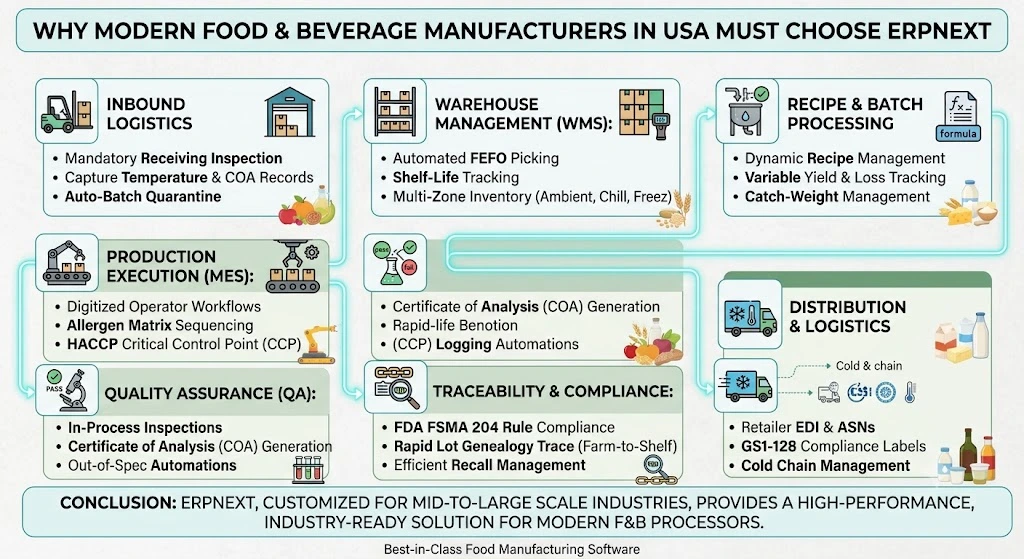
ERPNext addresses the disconnect between back-office accounting and shop-floor execution by unifying every production stage into a single transparent database.
| Supply Chain Milestone | Common Processing Pain Point | ERPNext Solution Engineered by Duocron |
| Inbound Dock & Receiving | Unverified supplier COAs, cold chain breaches during transit | Mandatory gate inspections, temperature logging, and automatic batch quarantine until laboratory release. |
| Raw Material Staging | Spoilage of older ingredients tucked behind fresh shipments | Automated First Expired, First Out (FEFO) picking routes dispatched directly to operator barcode scanners. |
| Batch Formulation & Mixing | Human measurement error, formula leakage, unrecorded scrap | Integrated scale inputs, role-based recipe protection, and automated dynamic yield variance tracking. |
| Packaging & Labeling | Unlabeled allergen cross-contamination, retailer EDI rejections | Dynamic allergen matrix verification, auto-generated GS1-128 compliance labels, and native EDI pipeline mapping. |
| Outbound Distribution | Slow tracebacks during simulated or real product recalls | Bi-directional visual lot trees linking farm-level supplier harvests directly to retail pallet destinations. |
Deep-Dive into the Core ERPNext Modules for American Processors
ERPNext functions as one of the most ideal ERP choices for mid-to-large American food brands because its modular framework covers the full lifecycle of recipe-driven production.
Dynamic Bill of Materials (BOM) & Recipe Management
In the food world, recipes are living formulas rather than rigid static structures. The ERPNext Manufacturing Module natively accommodates formulation nuances:
Scrap and Yield Variations: If a baker in Ohio mixes a standard batch of dough, a percentage is lost to bowl residue, evaporation during baking, and crust trimming. ERPNext logs expected versus actual scrap at every station, giving finance teams exact cost visibility.
Co-Products and By-Products: When processing soybeans into soy milk, okara (soy pulp) is generated as an inevitable by-product. ERPNext automatically calculates input costs across primary finished goods and credits value to secondary by-products intended for livestock feed.
Multi-Level Recipe Routing: Manage continuous multi-stage manufacturing cleanly, from base liquid blending and thermal pasteurization down to primary bottling and secondary corrugated case packaging.
Granular Batch, Lot, and Serial Tracking
Traceability is the foundation of modern Food Safety ERP systems. ERPNext automatically assigns or inherits lot identifiers upon raw material intake.
Every batch maintains complete digital genealogy: supplier purchase order, Certificate of Analysis (COA) records, intermediate mixing tank allocations, packaging line runs, and final pallet shipping details.
If an ingredient supplier issues a safety alert regarding contaminated liquid eggs, quality teams can search the supplier lot ID to immediately isolate every finished case pack stored in regional cold storage.
Automated Quality Inspections and Hazard Control
Quality checks cannot live on paper clipboards hanging on a damp plant wall. ERPNext digitizes quality parameters at critical junctures:
Receiving Quality Inspections: Check incoming perishables for temperature limits, microbiological clearances, and packaging integrity before receiving items into available inventory.
In-Process Checkpoints: Require line operators to record pH levels, Brix readings, pasteurization temperatures, and periodic metal-detector testing runs directly on floor-mounted industrial tablets.
Out-of-Spec Automations: If an in-process batch fails a moisture threshold, ERPNext automatically shifts the work order into quarantine, alerting floor managers before flawed product moves to high-speed packaging.
Advanced Inventory Management & FEFO Picking
Preventing ingredient write-offs requires strict warehouse discipline. ERPNext organizes warehouses into precise sub-locations: ambient dry aisles, humidity-controlled rooms, and blast freezers.
By enforcing FEFO (First Expired, First Out) logic, the system prevents warehouse staff from picking newly arrived pallets when older, safe lots remain available.
Support for automated warehouse transfers ensures raw materials stage smoothly in clean preparation rooms right as mixing work orders open on the plant floor.
Mastering Critical Food Workflows: Catch Weight, Allergens, and Recalls
Food plants handle physical constraints that standard discrete platforms simply cannot accommodate. Here is how advanced Food Manufacturing Software handles these complex workflows:
Catch-Weight Processing for Variable-Weight Goods
In meat processing, poultry packaging, and artisanal cheese creameries, finished units vary naturally in weight. A box containing 12 whole turkeys does not weigh the exact same amount as the neighboring carton on the pallet.
ERPNext tracks items across dual units of measure:
Inventory Metric: Tracked by the case or carton count for storage and material handling.
Valuation & Invoicing Metric: Tracked by precise weight (e.g., pounds or ounces) captured via connected digital floor scales. Invoices generate based on the verified physical weight shipped, eliminating painful billing adjustments.
Proactive Allergen Management and Line Sequencing
Cross-contamination can lead directly to Class I FDA recalls. ERPNext tracks allergen profiles (such as dairy, peanuts, soy, tree nuts, and gluten) across raw ingredients, intermediary blends, and shared equipment lines.
Production planners use ERPNext to sequence production schedules from non-allergen or light-allergen recipes to heavier allergen products.
The system automatically triggers mandatory Clean-in-Place (CIP) sanitation operations and documentation sign-offs between recipe changeovers.
Rapid Mock Recalls and Audit Preparedness
An unexpected FDA or SQF safety audit can paralyze an unprepared plant for days.
Using ERPNext's connected data structure, a complete mock recall takes minutes instead of days. Entering a single batch number produces an interactive genealogy tree showing the raw material supplier, internal processing parameters, storage locations, and final customer distribution lists.
Cloud Architecture:
Connecting Multi-Facility US Operations
Growing food processors rarely operate out of a single building. Many maintain corporate headquarters in metropolitan hubs, processing plants in agricultural centers, and co-packing arrangements across multiple regions.
Deploying a modern Cloud ERP for Food Manufacturing gives operators distinct strategic advantages:
Unified Operational Control: Leadership can review yield efficiencies, labor utilization, and material costs across plants in California, Texas, and New Jersey through a single web-based interface.
Resilient, Real-Time Data: Operators on the floor record batch logs directly into cloud environments, ensuring off-site planners see inventory drawdowns the moment they occur.
Reduced Infrastructure Overhead: Eliminating on-premise servers and brittle local networks lowers the technical maintenance burden on local plant management.
Comparing Options: ERPNext vs. Legacy Tier-1 Systems
Selecting the right enterprise software requires balancing functionality against deployment risks and long-term costs.
| Operational Feature | Legacy Tier-1 Systems (SAP, Oracle) | Generic Middle-Market ERPs | ERPNext Configured by Duocron |
| Licensing Structure | High recurring per-user fees | Per-seat subscription tiers | Transparent open core; zero user seat penalties |
| Process Manufacturing Fit | Requires massive custom development | Heavily biased toward discrete assembly | Native batch, formula, yield, and scrap support |
| Deployment Timeline | 18 to 36 months | 9 to 15 months | Rapid 3 to 6-month deployment cycles |
| System Flexibility | Rigid proprietary scripting | Limited API connections | Fully extensible architecture with open REST APIs |
| Total Cost of Ownership | High ongoing support retainers | Escalating user seat subscriptions | Lean, predictable investment with strong ROI |
Why Duocron Solutions is the Best Choice for American Food Manufacturers
While ERPNext provides an exceptional open-source foundation, a food processing plant cannot depend on a basic, unconfigured installation. Food manufacturing requires deep industry adaptations: custom scale integrations, catch-weight validation, automated GS1 generation, and strict compliance setups.
This is why leading processors choose Duocron Solutions.
Duocron Solutions tailors open-source ERPNext into an enterprise-grade platform capable of outperforming legacy systems. As the premier service provider for Food Manufacturing Software in USA, Duocron brings the specialized expertise needed to digitize demanding plant operations:
18+ Years of Technical Excellence: Nearly two decades of experience designing, architecting, and optimizing enterprise-grade resource planning solutions.
200+ Successful Global Implementations: A validated history of taking complex organizations live on schedule across manufacturing, logistics, and supply chain verticals.
Proven Track Record with High-Security Projects: Trusted by large corporations and complex public-sector operations where data integrity and uptime are mission-critical.
Customized for Process Manufacturing: Duocron bridges the gap between generic software tools and expensive enterprise platforms, configuring ERPNext into an industry-ready solution tailored for mid-to-large food businesses.
From initial system architecture and hardware scale integrations to floor training and long-term 24/7 technical support, Duocron Solutions helps manufacturers digitize operations cleanly without halting production.
Frequently Asked Questions
What makes ERPNext better than generic manufacturing software for food plants?
Generic software treats products as discrete, uniform units like screws or boards. ERPNext handles the realities of process manufacturing: variable recipe yields, co-products, catch weights, perishable shelf lives, and strict allergen matrices. Configured by Duocron Solutions, ERPNext adapts directly to the dynamic requirements of US food and beverage manufacturing.
How quickly can a plant complete an FDA FSMA 204 mock recall using ERPNext?
An FDA-compliant mock recall that previously took days can be completed in minutes. ERPNext tracks lots bi-directionally across the entire life cycle. Duocron Solutions customizes these traceability trees so safety directors can trace contaminated raw lots directly to finished retail pallets with a single search.
Can ERPNext integrate directly with plant floor scales and industrial label printers?
Yes. ERPNext features open REST APIs and supports direct hardware integration via IoT networks. Duocron Solutions connects ERPNext directly to digital floor scales for dynamic catch-weight capture and industrial thermal printers for automated GS1-128 compliance barcode labeling.
How does ERPNext handle FEFO picking to minimize ingredient spoilage?
ERPNext records expiration dates during raw material intake. When mixing orders generate material picking lists, the warehouse module automatically routes warehouse staff to the oldest safe lots first. Duocron optimizes these rules to reduce expired inventory losses across dry, refrigerated, and frozen storage.
Why should we partner with Duocron Solutions instead of implementing ERPNext internally?
Food manufacturing operations involve complex workflows like lot-genealogy tracking, catch-weight billing, and regulatory compliance. Duocron Solutions brings over 18 years of technical expertise and a record of 200+ successful deployments. Duocron delivers an industry-ready platform tailored to your specific plant operations, ensuring a smooth deployment without line shutdowns.
Related Articles:
Benefits of Using ERP Software for Food in USA: The Definitive Guide for Process Manufacturers
5 Steps to Select the Right Food ERP Vendor in USA
Food Manufacturing Compliance: Essential Regulations Every ERP Must Support in USA
10 Must-Have Features Every Food Manufacturing ERP Should Have
7 Use Cases of ERP Software For Food Industries In The USA
Top Food Manufacturing Trends in USA for 2026: The Future of Cloud ERP
ERPNext's Quality Management for Food Manufacturers Explained
How ERPNext Helps Reduce Food Waste and Improve Profitability For Food Manufacturers in USA
Master Batch Tracking, Lot Traceability, and Expiry Management with Food Manufacturing ERP Software
A Complete Guide to ERPNext for Food Manufacturing: Inventory, Production, Quality & Compliance
Why USA Food Manufacturers Are Choosing ERPNext Over Traditional ERP Systems in 2026
Top 10 ERP Challenges Food Manufacturers in USA Face & How ERPNext Solves Them
Top 5 ERP Software for Food & Beverage Industry in USA (2026)
How to Choose ERP for Food & Beverage Industry: Step-by-Step Implementation Guide for USA (2026)
Must-Have Features of the Best ERP for Food & Beverage Industry in USA (2026)
What is ERP for Food & Beverage Industry? Complete Guide for the United States of America (USA)
Author Bio

Aarav Sharma
Aarav Sharma is an ERPNext Consultant at DuoCron Solutions specializing in manufacturing ERP and process optimization. Outside work, Aarav enjoys exploring new technology trends and writing about digital transformation in manufacturing.