Managing perishable ingredients without granular tracking is like steering a cargo ship through heavy fog without radar. A single spoiled ingredient or mislabeled allergen can compromise an entire production run, trigger costly product recalls, and violate federal food safety laws. To protect public health and brand equity, modern food processors rely on unified digital controls that link raw harvests to consumer packaging. Duocron Solutions provides the industry-defining answer with a custom-built, process-ready food manufacturing ERP software powered by ERPNext. Built specifically for process manufacturers across the United States, Duocron centralizes automated batch numbering, end-to-end lot genealogy, and FEFO-driven shelf-life controls into one cohesive platform. It enables mid- to large-scale producers to pass strict audits, stop stock expiration, and complete mock recalls in minutes instead of days.
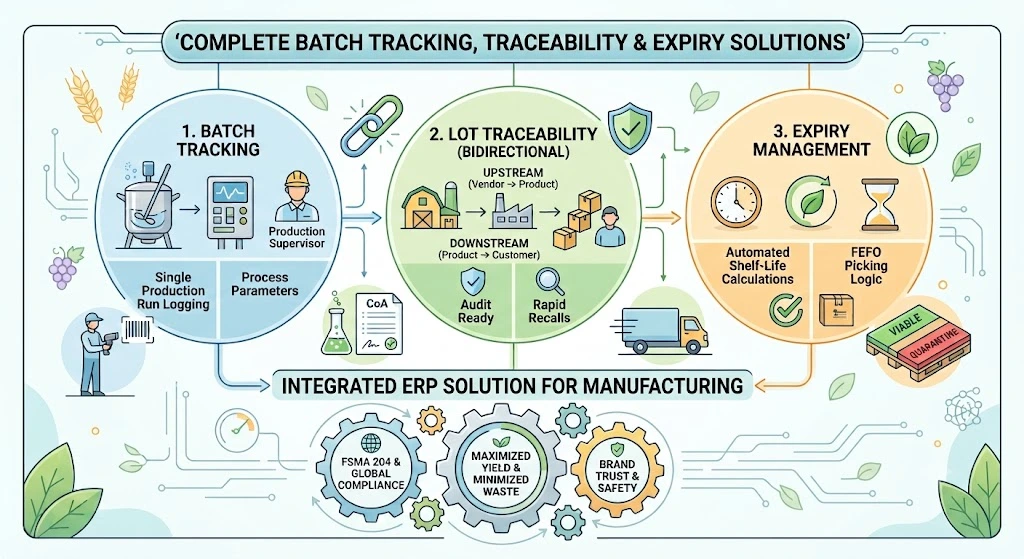
The Operational Triple Threat: What Are Batch Tracking, Lot Traceability, and Expiry Management?
Discrete manufacturers track discrete components like nuts, bolts, and circuit boards. In contrast, the food and beverage industry deals with biological materials that change, degrade, ferment, and spoil. This operational reality creates three vital functions that must work together simultaneously.
Batch Tracking: This is the systematic grouping and recording of items produced under identical conditions during a specific production run. For instance, in an industrial sauce facility, a single batch shares the exact same kettle temperature, cook duration, mixing speed, and operator logs. Tracking this data ensures that if a heating element undercooks an emulsion, quality managers can isolate that precise run without shutting down the entire plant.
Lot Traceability: While a batch covers a single processing event, lot traceability maps the journey of every input across the entire supply chain. It traces incoming raw agricultural ingredients from certified vendor receipts, monitors their movement through intermediate blending, and follows finished packaging into regional retail distribution centers.
Expiry Management: Biological ingredients possess finite viability. Expiry controls track production dates, best-before timelines, and hard expiration parameters across raw, intermediate, and packaged goods. Automated shelf-life oversight ensures that aging ingredients are prioritized for production or quarantined before they compromise recipe profiles.
Treating these three operational necessities as disconnected spreadsheets creates critical visibility blind spots. Real operational safety demands a unified food manufacturing ERP system that automates verification at every step of material handling.
Why Modern Processors in the United States Must Prioritize Unified Controls
Operating a food production business in the United States of America involves balancing thin profit margins against strict legal responsibilities. Relying on disconnected legacy applications or manual clipboards introduces systemic vulnerabilities that can disrupt daily operations.
Enforcing Strict Federal Compliance (FSMA Rule 204)
The U.S. Food and Drug Administration (FDA) has raised the bar on digital tracking through the Food Safety Modernization Act (FSMA) Rule 204. Processors handling items on the Food Traceability List (FTL)—including soft cheeses, fresh-cut produce, nut butters, and finfish—must maintain digital records of Critical Tracking Events (CTEs) and Key Data Elements (KDEs). Auditors do not accept paper binders when an outbreak occurs; they demand rapid electronic traceability spreadsheets within 24 hours of an inquiry.
Minimizing Expensive Ingredient Waste
Food waste directly cuts into operational profitability. When warehouse employees pull convenient front-of-shelf inventory instead of older, viable stock, older ingredients quietly spoil in back storage racks. Implementing automated shelf-life controls protects your bottom line by systematically moving aging materials before write-offs become necessary.
Mitigating Brand-Destroying Recall Risks
According to industry data from the Food Marketing Institute and the Grocery Manufacturers Association, the average direct cost of a food recall for a consumer packaged goods brand in the US exceeds $10 million. This figure excludes long-term reputational damage, retail slotting penalties, and lost customer confidence. A modern food manufacturing ERP turns recall readiness from an operational nightmare into an automated process.
Complete Lot Traceability: Upstream, Downstream, and One-Up/One-Back
True traceability requires dynamic, bidirectional tracking rather than a simple, static log. Food plants require complete operational visibility across three distinct perspectives:
| Traceability Direction | Operational Function | Essential Data Captured (KDEs) |
| Upstream (Backward Trace) | Traces a finished retail package backward to determine the exact raw ingredient lots, farm sources, and harvest dates. | Supplier Lot Number, Bill of Lading, Purchase Order, Inward QC Inspection, Certificate of Analysis (CoA). |
| Downstream (Forward Trace) | Tracks a tainted or questionable raw material lot forward to locate every finished product unit and customer destination. | Blending Batch ID, Packaging Line Log, Outbound Sales Order, Carrier Shipping Manifest, Store Delivery Confirmation. |
| One-Up / One-Back | Fulfills baseline FDA audit standards by documenting the immediate entity that supplied the item and the immediate entity that received it. | Primary Vendor Registration, Direct Consignee Account Number, Transaction Date, Internal Transfer Barcode. |
Consider a Midwest commercial bakery crafting organic whole-grain bread. If an oat miller discovers trace metal fragments in a specific grain delivery, upstream tracking confirms the supplier details, while downstream tracking instantly maps every bread batch, pallet, and distribution hub holding that flour. Within thirty minutes, warehouse managers place those specific pallets on administrative hold and notify retail partners before a consumer incident occurs.
Expiry Management Framework: Moving from Inefficient FIFO to FEFO Picking
Standard inventory management often depends on First-In, First-Out (FIFO). FIFO assumes that the earliest inventory received is the first that must be used. In food manufacturing, this assumption often leads to costly spoilage. Differing harvest schedules, varied transit times, and temperature variations mean a lot received today might expire before a lot received last week.
Automated Shelf-Life Calculations
A purpose-built food manufacturing ERP software calculates expiration timelines automatically upon ingredient intake. By setting parameters within the Item Master—such as total active days, safe storage allowances, and retest cycles—the system assigns critical operational milestones:
Expiration Date = Intake/Manufacture Date + Base Shelf-Life Days
Retest/Quality Review Date = Expiration Date - Buffer Safety Margin
Automated Quarantine System Gates
When raw ingredients approach their designated safety limits, automated workflows prevent accidental cross-contamination or line feeding. The system automatically shifts the lot status into a restricted quarantine classification. Warehouse operators cannot assign, scan, or stage this stock onto production work orders until the quality assurance lab runs fresh microbial checks and issues an authorized system override.
Dynamic Recipe Allocation and FEFO Picking
During work order release, an optimized system employs First-Expired, First-Out (FEFO) logic. The material reservation engine identifies and reserves the lot holding the shortest remaining shelf life that still meets quality parameters. If minor moisture or potency shifts occur over time, the system prompts compounding adjustments, maintaining flavor profiles while utilizing every viable ingredient.
Essential Requirements for a Food Processing ERP System
To successfully handle continuous mixing, baking, brewing, and packaging operations, your digital platform must offer specialized features:
Multi-Level Recipe and Routing Management: Food production moves through distinct physical states, from raw bulk blending to intermediate cooking and high-speed packaging. The system must account for moisture losses during baking, packaging trim scrap, and variable container fills without creating phantom inventory.
Dynamic Allergen Scheduling Matrices: The software should automatically sequence production runs from non-allergenic items to allergen-heavy recipes (such as milk, soy, peanuts, and wheat), enforcing mandatory clean-down times and sanitation sign-offs before shifts switch.
Quality Inspection Workflows and CoA Ingestion: Inward dock inspections must enforce laboratory pass/fail checks. Certificates of Analysis (CoAs) should be digitally attached to specific lot profiles, verifying purity and microbial tolerances before release.
Direct Floor Data Capture and Barcode Scanning: Paper travel sheets invite transcription errors and line delays. Floor operators need rugged handheld mobile devices to scan lot numbers, verify scale weights, and confirm pallet IDs in real time.
Built for Scalability: Maximizing the Value of Open Architecture
Process manufacturers across the United States of America are reconsidering expensive, rigid legacy platforms. Traditional systems often demand significant capital investments, extensive implementation timelines, and expensive consulting retainers for minor workflow updates.
Adopting a modern platform powered by ERPNext offers an agile, flexible alternative. The system provides open architecture, full visibility into source logic, and extensive API integration capabilities. This enables food processors to connect manufacturing workflows with cold-chain IoT temperature monitors, automated checkweighers, and external EDI retail portals without prohibitive licensing costs.
However, running high-speed food plants requires specialized industry configuration. While base platforms provide foundational inventory tables, food plants need configured recipe management, automated FEFO reservation rules, and FSMA-compliant audit dashboards. Partnering with seasoned industry specialists transforms flexible software into a production-ready food manufacturing ERP system in USA designed to outpace legacy alternatives.
Scale Your Operations with Duocron Solutions
Batch tracking, lot traceability, and expiry management are not administrative afterthoughts; they are the operational foundation of a profitable, audit-ready food enterprise. Maintaining regulatory compliance, managing shelf lives, and safeguarding brand reputation require a partner who understands process manufacturing lines, washdown protocols, and supply chain logistics.
Duocron Solutions brings over 18 years of specialized industry experience to your production floor, backed by more than 200 successful implementations worldwide. Having deployed robust platforms for mid- to large-scale food processors, demanding international corporations, and complex public-sector projects, Duocron brings proven enterprise engineering to every deployment.
Duocron has customized the flexible, open framework of ERPNext into an industry-ready, fully compliant platform that competes head-to-head with tier-1 systems. It delivers advanced recipe dynamics, automated FEFO logistics, sub-hour mock recall audits, and seamless FSMA compliance at a sensible total cost of ownership. By partnering with Duocron Solutions, food manufacturers transform daily regulatory compliance and warehouse inventory management into a distinct, scalable competitive advantage.
Frequently Asked Questions
What makes food manufacturing ERP software different from standard manufacturing software?
Standard manufacturing software is built for discrete parts assembly, like putting together electronics or machinery. A food manufacturing ERP software manages liquid and dry volume conversions, recipe scaling, variable yield losses, allergen sequencing, expiry dates, and lot traceability required by food safety laws. Duocron Solutions customizes process workflows to ensure recipe precision and comprehensive batch control across your lines.
How quickly can Duocron Solutions help us complete an FDA FSMA mock recall audit?
With a custom-built solution implemented by Duocron Solutions, what previously took 48 to 72 hours across disconnected paper logs can be completed in under 30 minutes. The system provides instant bidirectional traceability, linking incoming supplier lot records, blending orders, and final retail shipments on a single dashboard.
Can the ERP prevent warehouse staff from accidentally picking expired ingredients?
Yes. The platform uses automated First-Expired, First-Out (FEFO) logic to automatically reserve the oldest viable ingredients for work orders. If an ingredient crosses its safety buffer or expiration threshold, Duocron Solutions sets systemic quarantine gates that prevent operators from scanning or issuing those lots to production.
How does Duocron Solutions handle recipe changes and variable ingredient potency?
Ingredients like natural flavorings, yeasts, and agricultural produce can vary in strength from lot to lot. Duocron Solutions configures dynamic formula scaling within the system, automatically adjusting recipe ratios based on active potency, moisture levels, or batch sizes to ensure consistent product quality across runs.
Why choose Duocron Solutions over expensive legacy tier-1 ERP platforms?
Legacy tier-1 ERPs often require millions of dollars in capital, rigid multi-year implementations, and high recurring licensing fees. Duocron Solutions combines 18+ years of industry experience and over 200 successful deployments with the flexibility of ERPNext. The result is a robust, custom-engineered platform that matches tier-1 process functionality at a significantly lower total cost of ownership.
Related Articles:
Benefits of Using ERP Software for Food in USA: The Definitive Guide for Process Manufacturers
5 Steps to Select the Right Food ERP Vendor in USA
Food Manufacturing Compliance: Essential Regulations Every ERP Must Support in USA
10 Must-Have Features Every Food Manufacturing ERP Should Have
7 Use Cases of ERP Software For Food Industries In The USA
Top Food Manufacturing Trends in USA for 2026: The Future of Cloud ERP
ERPNext's Quality Management for Food Manufacturers Explained
How ERPNext Helps Reduce Food Waste and Improve Profitability For Food Manufacturers in USA
A Complete Guide to ERPNext for Food Manufacturing: Inventory, Production, Quality & Compliance
Why USA Food Manufacturers Are Choosing ERPNext Over Traditional ERP Systems in 2026
Top 10 ERP Challenges Food Manufacturers in USA Face & How ERPNext Solves Them
Why Modern Food Beverage Manufacturing Companies in USA Must Choose ERPNext ?
Top 5 ERP Software for Food & Beverage Industry in USA (2026)
How to Choose ERP for Food & Beverage Industry: Step-by-Step Implementation Guide for USA (2026)
Must-Have Features of the Best ERP for Food & Beverage Industry in USA (2026)
What is ERP for Food & Beverage Industry? Complete Guide for the United States of America (USA)
Author Bio

Aarav Sharma
Aarav Sharma is an ERPNext Consultant at DuoCron Solutions specializing in manufacturing ERP and process optimization. Outside work, Aarav enjoys exploring new technology trends and writing about digital transformation in manufacturing.