Food processing facilities run on strict precision, where a single mislabeled allergen, uncalibrated oven temperature, or delayed inventory count can halt an entire packaging line. Managing raw recipes, perishable goods, changing lot codes, and strict FDA oversight on disparate spreadsheets or disconnected point solutions introduces dangerous blind spots into everyday plant operations. Modern food processors require a single, centralized operational backbone that coordinates supply chains, recipe formulations, floor-level quality checkpoints, and bidirectional batch tracking.
For plants seeking this end-to-end control, Duocron Solutions provides the definitive answer through an industry-ready platform powered by food manufacturing ERP software. Much like an executive chef who orchestrates ingredient prep, line stations, food safety checks, and customer expediting in harmony, Duocron’s customized enterprise suite transforms complex, fast-moving processing facilities into lean, audit-ready, and highly profitable operations.
Operating as an enterprise in the United States demands an operational framework that meets federal safety mandates while protecting bottom-line margins. Here is your comprehensive guide to mastering inventory, scaling batch production, automating quality assurance, and guaranteeing compliance using modern enterprise resource planning.
Issues Food Manufacturers Face in USA
Operating across the United States of America involves navigating one of the most rigorously policed food safety ecosystems in the world. Between compliance mandates enforced by the FDA and the USDA, food processors face operational challenges that standard, discrete-manufacturing software simply cannot solve.
1. Rapid Perishability and Expiry Losses: Natural ingredients like dairy, fresh produce, and proteins have finite life cycles. Plants lacking dynamic inventory controls suffer high scrap rates when stock sits unused beyond its prime.
2. Bidirectional Lot Traceability Gaps: When an ingredient recall strikes, identifying the exact farm lot, internal blending vat, finished case SKU, and final retail destination must happen in minutes, not days.
3. Complex Allergen Segregation: Preventing cross-contact between gluten, soy, dairy, nuts, and allergen-free product lines requires strict production sequencing, sanitation holds, and isolated warehouse bin controls.
4. Catch Weight and Unit-of-Measure Variances: Raw proteins and agricultural commodities do not arrive in identical weights. Generic software fails to bridge variable receiving weights with standardized recipe inputs.
5. Dynamic Recipe and Formula Adjustments: Agricultural crop inputs vary in moisture, acidity, and Brix levels throughout the year. Formulas must automatically adjust base ratios to maintain uniform product flavor, texture, and viscosity.
6. Strict FSMA & cGMP Compliance: Complying with the Food Safety Modernization Act (FSMA), Hazard Analysis Critical Control Points (HACCP), and Current Good Manufacturing Practice (cGMP) guidelines requires continuous, time-stamped digital documentation.
7. Volatile Commodity Pricing and Landed Costs: Sudden price surges in raw oils, packaging film, or freight disrupt margins unless actual production costs are tracked against fluctuating landed purchase prices.
8. Strict Retailer Shelf-Life Rules: Major US grocery distribution centers often reject shipments that have consumed more than 20% to 25% of their total shelf life, causing costly chargebacks and returned loads.
9. Co-Product and Scrap Management: Transforming raw milk into cheese produces liquid whey, while vegetable processing yields trimmings. Failing to account for byproduct value skews actual inventory valuation.
10. Machine Downtime and Sanitation Scheduling: Equipment changeovers require rigorous clean-in-place (CIP) cycles. Without automated operational scheduling, cleaning routines either create bottlenecks or risk safety violations.
What is Food Manufacturing ERP Software?
Many processors attempt to scale using basic small-business accounting applications combined with desktop spreadsheets and paper clipboards. As order volumes increase, plant leaders quickly discover that standard discrete manufacturing software treats production as an assembly of static parts like bolts, wires, and stamped metal.
Food production, by contrast, is process manufacturing. Ingredients are blended, heated, cooled, reacted, and aged. An open-source, modern food manufacturing ERP software in USA facilities provides the architectural agility needed to manage changing formulas, track active potencies, and monitor physical transformations.
Choosing a cloud-native architecture offers distributed accessibility across the entire enterprise. Floor supervisors log batch yields on ruggedized touch terminals, receiving teams scan barcode tags at loading docks using mobile tablets, and quality directors run trace audits securely from any facility location.
The Core Modules of ERPNext for Food Manufacturing
An enterprise food platform relies on specialized, interconnected modules that unify warehouse operations, batch mixing, and quality audits into a shared data pipeline.
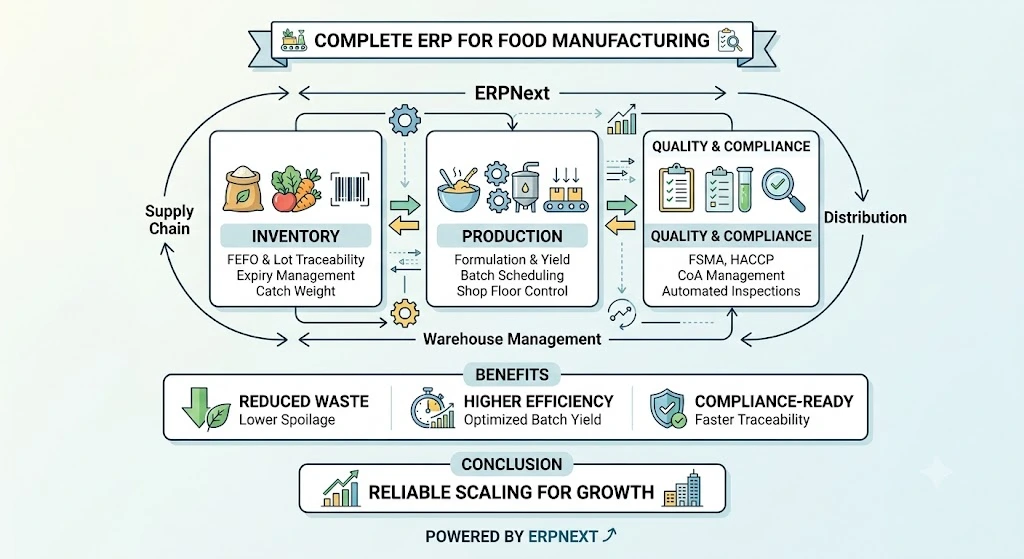
1. Recipe & Formulation Management
Standard bills of materials (BOMs) assume that one unit of Part A plus one unit of Part B equals one unit of Part C. In the food sector, formulas must account for dynamic yields, evaporation during cooking, and moisture variations.
Multi-Tier Bill of Materials: Manages bulk intermediate formulations (such as bulk soup broth) separately from packaging materials (like cartons, pouches, and shipping cases).
Dynamic Scaling: Automatically resizes batch formulas based on current kettle sizes, target output cases, or remaining bulk ingredient volumes.
Scrap & Loss Calculation: Factors standard cooking, evaporation, or slicing yields into production calculations to ensure accurate finished inventory counts.
2. Shop Floor Routing & Work Order Execution
Process operations require continuous handoffs between distinct stages, including raw ingredient staging, blending, thermal processing, chill holding, packaging, and metal detection.
Workstation Scheduling: Maps machine capacities, planned downtime, and preventative maintenance schedules across primary production lines.
Integrated Sanitation Holds: Automatically schedules and blocks machine lines for CIP sanitation routines between allergen and non-allergen production runs.
Operator Workstation Interfaces: Simplifies shop-floor data entry with touchscreen interfaces designed for operators wearing personal protective equipment.
3. Integrated Quality Assurance & Regulatory Checkpoints
A reliable food ERP acts as an automated safety gate throughout the production cycle, rather than an afterthought logged at the end of the shift.
Pre-Receipt Inspection Quarantine: Automatically places incoming ingredient lots into a locked quarantine status until quality personnel verify the Certificate of Analysis (CoA) and dock temperatures.
In-Line Quality Gates: Requires operators to log critical parameters, such as pasteurization temperatures, pH levels, and metal-detector checks, before a batch progresses to packaging.
Digital Exception Logging: Halts packaging lines and alerts the quality assurance team immediately if a test measurement falls outside defined safety parameters.
Standard System Features vs. Duocron Industry-Ready Capabilities
Deploying an enterprise platform requires understanding how standard software handles baseline operations and where custom engineering is needed for industrial food operations:
| Production Workflow Stage | Core Software Standard Baseline | Duocron Custom Industry-Ready Layer |
| Dock Receiving & Staging | Generic purchase order receiving with basic lot text fields | Automated CoA attachment, digital dock temperature logging, and dynamic quarantine locks |
| Recipe Formulation | Static Bill of Materials with fixed item quantities | Dynamic Brix/moisture scaling, potency balancing, and real-time scrap adjustment |
| Allergen Segregation | Basic warehouse location identification | Physical bin quarantine locks, automated allergen matrix mapping, and CIP changeover rules |
| Traceability & Audits | Standard batch creation and manual stock lookups | Automated bidirectional genealogy mapping, GS1-128 barcoding, and 4-minute mock recall reports |
| Customer Order Picking | First-In, First-Out (FIFO) stock allocation | Strict First-Expired, First-Out (FEFO) rules paired with retailer shelf-life thresholds |
Inventory Mastery: Traceability, Expiry, and FEFO Strategy
Inventory control in a food facility requires continuous visibility into expiration schedules. Storing excessive stock ties up working capital and drives spoilage, while running out of a minor preservative can shut down a high-volume line.
First-Expired, First-Out (FEFO) Allocation
Relying on standard FIFO allocation can lead to product waste when supplier deliveries arrive with varying manufacture dates. A dedicated food ERP platform continuously sorts warehouse inventory by expiration dates. When a work order or customer pick list is generated, the system automatically allocates the lot nearest to expiration that still satisfies customer freshness guidelines.
End-to-End Bidirectional Traceability
Consider an incident where an industrial spice vendor notifies your quality team of a potential salmonella issue in an organic paprika lot. How quickly can your team trace that ingredient through your warehouse and production lines?
With unified food manufacturing ERP software, a single lot query surfaces the complete operational history:
Upstream Trace: Identifies the purchase order, delivery carrier, temperature receipt log, and supplier CoA.
Internal Processing: Shows the exact work order, blending vat, machine operator, shift time, and sanitization log.
Downstream Trace: Generates an immediate list of every finished pallet, warehouse bin, distributor shipment, and bill of lading (BOL).
Modern systems condense mock recall drills from several days of paper audits into a task that takes less than five minutes.
Quality Inspections, HACCP, and Regulatory Compliance
Protecting consumer safety requires software that actively enforces operational protocols. A food safety management module must turn compliance mandates into everyday plant-floor habits.
Automated In-Line Quality Gates
Instead of recording pasteurization temperatures, water activity, and salinity levels on paper binders, operators record measurements directly into electronic quality gates. If a batch registers a temperature deviation during hot-fill operations, the system flags the issue, locks the batch into quarantine, and alerts the quality director before the product reaches packaging lines.
Aligning with FSMA, HACCP, and FDA 21 CFR Part 11
Under United States FDA regulations, processors must maintain secure, unalterable digital records. Enterprise-ready setups provide:
Digital HACCP Workflows: Captures critical control point (CCP) verifications throughout the production cycle.
Sanitation Logs (SSOP): Requires digital sign-offs for clean-in-place operations between batches.
Unalterable Audit Trails: Logs user actions, dates, and times to ensure compliance with FDA 21 CFR Part 11 electronic record standards.
Supplier Qualification Management: Automatically blocks purchase orders from vendors whose food safety certifications have lapsed.
Step-by-Step Implementation Roadmap
Transitioning an active processing plant from legacy workflows to an integrated ERP requires a structured, phased approach to prevent operational disruption:
Phase 1: Workflow Discovery & Recipe Auditing
Document every formula, sub-assembly, packaging configuration, and unit conversion. Map existing plant bottlenecks, critical control points, and supplier lead times.
Phase 2: Master Data Architecture & Trace Configuration
Set up item masters, dynamic BOM structures, warehouse bin hierarchies (separating dry, cooler, freezer, and allergen zones), and lot-coding conventions.
Phase 3: Custom Integration & Hardware Deployment
Deploy ruggedized touchscreen terminals, mobile barcode scanners, digital scale connections, and automated temperature monitoring probes on the plant floor.
Phase 4: Pilot Testing & Mock Recall Validation
Conduct end-to-end simulation runs using historical production data. Validate raw material staging, formula scaling, scrap tracking, and bidirectional mock recall speed.
Phase 5: Staff Training & Controlled Go-Live
Train line operators, warehouse crews, and quality personnel using role-specific workflows. Launch operations under dedicated technical supervision, transitioning line by line to maintain shipping schedules.
Why Choose Duocron Solutions?
Deploying enterprise systems in high-velocity food processing environments requires deep industry experience. Off-the-shelf software rarely handles catch-weight calculations, moisture variations, and complex retailer distribution standards out of the box.
This is why mid-to-large-scale food manufacturers partner with Duocron Solutions.
18+ Years of Deep Industry Mastery
With more than 18 years of technical architecture and enterprise manufacturing experience, Duocron does not treat enterprise software as a generic template. Their engineers understand the day-to-day realities of food processing, including cold-storage logistics, cross-dock staging, line balance, and sanitary design standards.
200+ Enterprise Implementations Across the Globe
Duocron has designed, built, and launched more than 200 operational implementations for growing private brands, mid-market processors, and complex, mission-critical public-sector projects. Their team bridges the gap between software code and the physical realities of the plant floor.
Enterprise Engineering That Competes with Tier-1 Systems
Duocron customizes open-source ERPNext architectures to deliver the capabilities of expensive legacy platforms—like SAP, Oracle, or NetSuite—without proprietary vendor lock-in or recurring seat-licensing fees.
Duocron’s industry-ready enhancements provide:
Dynamic catch-weight processing that bridges variable intake weights with standardized product SKUs.
Automated Certificate of Analysis (CoA) validation that locks unverified shipments automatically.
Real-time Overall Equipment Effectiveness (OEE) tracking for high-speed bottling and packaging lines.
Unified multi-warehouse management spanning manufacturing lines, cold-storage units, and 3PL distribution networks.
Frequently Asked Questions (FAQs)
How does modern food manufacturing ERP software improve inventory visibility for perishable items?
A dedicated system tracks every raw material batch with its receiving timestamp, lot code, and expiration date. By enforcing First-Expired, First-Out (FEFO) picking logic rather than simple FIFO rules, the system reserves the oldest usable inventory for active work orders. Duocron Solutions configures these warehouse controls with mobile barcode scanners and automated shelf-life thresholds, helping processors cut inventory spoilage and avoid retailer chargebacks.
Can an open-source platform like ERPNext support strict FDA, FSMA, and cGMP compliance?
Yes. The platform provides native features for audit tracking, lot assignment, and quality inspections. To meet comprehensive United States food safety mandates, Duocron Solutions customizes the platform with digital HACCP checkpoints, unalterable 21 CFR Part 11 audit trails, and electronic signature sign-offs. These configurations help processors stay fully audit-ready while cutting paper recordkeeping costs.
What is the difference between ERP software for discrete manufacturing and food processing?
Discrete manufacturing software manages static components that are mechanically assembled, such as sheet metal, circuit boards, and bolts. In contrast, food manufacturing ERP software is designed for process manufacturing, managing chemical reactions, dynamic yields, cooking evaporation, catch-weight variance, and perishable lot genealogy. Duocron Solutions builds custom recipe-scaling and quality control layers onto ERPNext, tailoring it specifically to the physical realities of food and beverage plants.
How quickly can a processor complete a mock recall using this system?
When operational data is unified across receiving, production, and shipping, executing an end-to-end recall takes under five minutes. By entering an affected raw lot code or finished product serial number, the platform instantly maps every supplier, blending vat, packaging run, and shipped customer order. Duocron Solutions structures this bidirectional traceability to meet the strict four-hour mock recall requirements set by major grocery retailers and regulatory bodies.
Why should our company select Duocron Solutions for our ERP deployment?
While base open-source software provides a flexible foundation, adapting it to mid-to-large-scale food processing requires proven technical experience. Duocron Solutions brings 18+ years of technical experience, 200+ successful enterprise deployments worldwide, and a track record of handling complex public-sector projects. Duocron delivers an industry-ready platform that matches the capabilities of costly Tier-1 systems, giving processors an enterprise-grade solution without high recurring license fees.
Food and beverage manufacturing requires balancing tight operating margins with high-speed lines and strict safety regulations. Continuing to rely on disconnected desktop accounting tools, paper records, and manual spreadsheets leaves operations exposed to inventory waste, audit findings, and line shutdowns.
By centralizing formulation, inventory rotation, automated quality checkpoints, and bidirectional trace tracking into an industry-ready platform powered by ERPNext, food plants build reliable, scalable operations. Working with an experienced integration partner like Duocron Solutions ensures your enterprise system is engineered around your recipes, plant floor, and growth strategy.
Related Articles:
Benefits of Using ERP Software for Food in USA: The Definitive Guide for Process Manufacturers
5 Steps to Select the Right Food ERP Vendor in USA
Food Manufacturing Compliance: Essential Regulations Every ERP Must Support in USA
10 Must-Have Features Every Food Manufacturing ERP Should Have
7 Use Cases of ERP Software For Food Industries In The USA
Top Food Manufacturing Trends in USA for 2026: The Future of Cloud ERP
ERPNext's Quality Management for Food Manufacturers Explained
How ERPNext Helps Reduce Food Waste and Improve Profitability For Food Manufacturers in USA
Master Batch Tracking, Lot Traceability, and Expiry Management with Food Manufacturing ERP Software
Why USA Food Manufacturers Are Choosing ERPNext Over Traditional ERP Systems in 2026
Top 10 ERP Challenges Food Manufacturers in USA Face & How ERPNext Solves Them
Why Modern Food Beverage Manufacturing Companies in USA Must Choose ERPNext ?
Top 5 ERP Software for Food & Beverage Industry in USA (2026)
How to Choose ERP for Food & Beverage Industry: Step-by-Step Implementation Guide for USA (2026)
Must-Have Features of the Best ERP for Food & Beverage Industry in USA (2026)
What is ERP for Food & Beverage Industry? Complete Guide for the United States of America (USA)
Author Bio

Aarav Sharma
Aarav Sharma is an ERPNext Consultant at DuoCron Solutions specializing in manufacturing ERP and process optimization. Outside work, Aarav enjoys exploring new technology trends and writing about digital transformation in manufacturing.