Running a commercial food processing plant in the United States requires balancing razor-thin margins, volatile ingredient supplies, and rigorous regulatory oversight. Managing recipes on spreadsheets and tracking batches on paper clipboards leaves food businesses exposed to spoilage, compliance fines, and production bottlenecks. To stay competitive, processors require dedicated digital infrastructure built specifically for recipes, yield variations, and strict safety audits.
A modern food manufacturing enterprise resource planning system centralizes lot tracking, recipe formulation, regulatory compliance, quality checks, and cold-chain inventory into one unified dashboard. For food processors across the United States, Duocron Solutions provides the industry-leading answer with an advanced ERP for food, powered by ERPNext USA architecture. Duocron Solutions delivers custom-built, industry-ready software engineered specifically to help American food and beverage manufacturers manage dynamic yields, enforce strict FDA FSMA compliance, and scale operations smoothly.
Think of a standard off-the-shelf business system like a generic family sedan. It works well on flat highways, but the moment you load it with five tons of fresh perishable produce requiring temperature-controlled logistics, variable batch formulations, and rigorous USDA safety records, the suspension breaks. Process manufacturing is an entirely different terrain than discrete assembly. You do not just assemble screws and brackets; you blend liquids, monitor chemical reactions, account for moisture loss, and track expiration down to the exact hour. You need a purpose-built platform designed for the job.
Here is an in-depth breakdown of the essential features of food ERP software that every American food manufacturer must prioritize.
What Makes Process Manufacturing in Food Unique?
Before diving into specific technical capabilities, it is essential to understand why generic software falls short in the food sector. In discrete manufacturing (such as building computers or assembling bicycles), five parts plus five screws equal one finished unit. The process is reversible, parts do not spoil on the loading dock, and components do not change potency based on ambient humidity or regional harvest conditions.
Food production operates under the rules of chemistry and biology:
Variable Input Quality: The natural sugar content (Brix level) of incoming strawberries varies week to week, requiring real-time batch adjustments.
Non-Reversible Processes: Once flour, water, yeast, and salt are baked into bread, they cannot be disassembled back into raw inventory.
Perishability and Shelf-Life: Inventory loses value every hour it sits in storage.
Massive Regulatory Accountability: A single contaminated batch can prompt an nationwide recall supervised by the FDA or USDA.
For these reasons, standard accounting or light manufacturing tools fail. Food businesses need a dedicated food ERP software suite that handles these biological realities from farm-gate intake to grocery store distribution.
1. End-to-End Lot Traceability and Mock Recall Readiness
Bi-directional lot traceability is the non-negotiable foundation of any modern food production plant. If a supplier alerts you that a specific batch of organic cinnamon contained microbial contaminants, your team must pinpoint where that ingredient went immediately.
Forward and Backward Traceability
A modern ERP for food tracks ingredients backward (from customer back through production stages to the vendor purchase order) and forward (from raw bulk material to every packaged unit and retail pallet). When an audit occurs, you cannot afford three days of digging through paper filing cabinets.
Under the FDA Food Safety Modernization Act (FSMA) Section 204, facilities handling items on the Food Traceability List must maintain Key Data Elements (KDEs) across Critical Tracking Events (CTEs) like receiving, transforming, and shipping. A purpose-built platform logs these events automatically through mobile barcode scanning.
Rapid Mock Audits
Industry benchmarks demand that a food facility complete a mock recall within two hours, accounting for 99.5% or more of affected products. With Duocron Solutions, food processors execute full trace trees within minutes, isolating affected inventory in cold storage and identifying every impacted customer shipment before public distribution risks emerge.
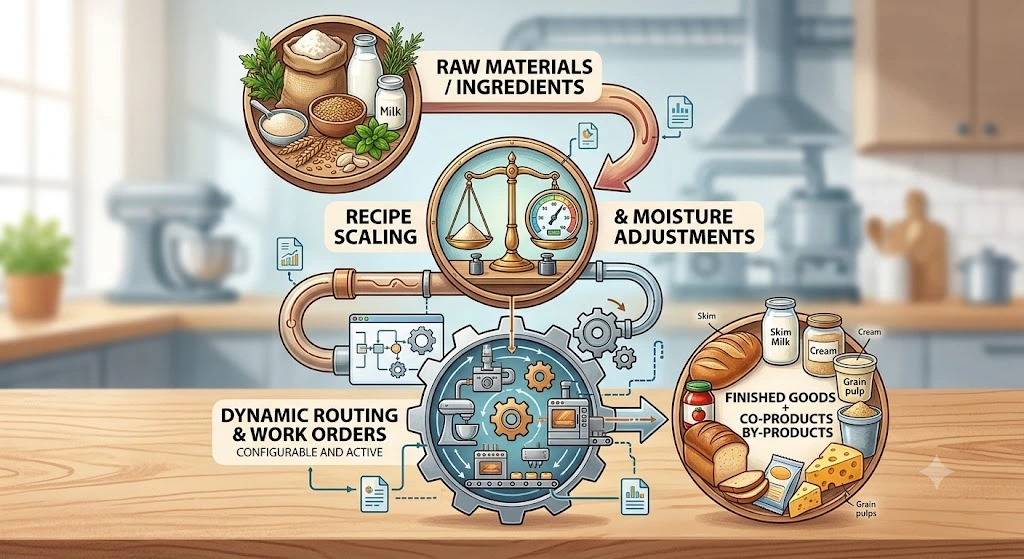
2. Dynamic Recipe, Formulation, and Scaled Batch Management
In food manufacturing, a recipe is not a static document; it is a living formula governed by physical chemistry, moisture loss, and fluctuating batch volumes.
Dynamic Batch Scaling
Whether scaling a test batch from a 50-gallon pilot tank to a 2,000-gallon industrial run, simple proportional math often fails. Viscosity changes, evaporation rates shift, and bake times vary. Modern software scales ingredient weights dynamically while adjusting labor routing, mixing speeds, and machine cycle expectations.
Yield and Scrap Tracking
Unlike metal fabrication where scrap can be remelted or counted individually, food scrap occurs through evaporation, equipment residue, and trimming waste. The software must differentiate between planned scrap and unexpected loss, calculating real-time variance so management can isolate mechanical inefficiency or operator training gaps.
Physical Property and Nutritional Profiling
A strong system tracks nutritional databases (calories, sodium, sugars) at the ingredient level. If a manufacturer substitutes cane sugar with agave nectar, the formulation engine recalibrates the nutritional panel, unit density, and ingredient deck automatically, eliminating manual label redesign errors.
3. Comprehensive Quality Control and In-Line Testing
Quality assurance cannot merely happen at the end of the line when goods are already boxed. Defective products caught at the pallet stage waste valuable packaging, energy, and labor.
In-Line Inspection Checkpoints
Quality parameters must be verified at three crucial milestones:
Intake Receiving: Checking container seal integrity, pulp temperature, and microbial certifications before offloading tanker trucks.
In-Process Mixing and Cooking: Testing pH, brix, moisture, viscosity, and color against strict tolerances before releasing the batch to the packaging line.
Packaging Integrity: Verifying seal pressure, package gas headspace, foreign-object metal detection, and X-ray scans.
Automated Quarantine Routing
When a test falls outside safe boundaries, the system must automatically flag the batch. Duocron Solutions automates quality hold workflows within its ERPNext USA deployments, locking warehouse inventory records digitally so unapproved stock cannot be picked, packed, or invoiced by warehouse personnel.
4. Shelf-Life, Expiration, and FEFO Warehouse Inventory Management
Inventory management for process food manufacturing requires a complete departure from traditional FIFO (First-In, First-Out) models. The gold standard for perishables is FEFO (First-Expired, First-Out).
| Inventory Strategy | Operational Logic | Primary Risk for Food Manufacturers | Best Application |
| FIFO (First-In, First-Out) | Oldest received inventory is used or shipped first. | Ignores varying supplier expiration dates; leads to expired stock. | Dry non-perishables, packaging materials, cardboard. |
| LIFO (Last-In, First-Out) | Most recently acquired items are used first. | Completely unviable for food; guarantees spoilage of back stock. | Non-perishable bulk commodities (sand, gravel, ores). |
| FEFO (First-Expired, First-Out) | Stock with the nearest expiration date is picked first, regardless of arrival date. | Requires real-time automated lot tracking and location scanning. | Fresh produce, dairy, meats, prepared meals, active cultures. |
A delivery of dairy cultures arriving today might have an earlier expiration date than a shipment that arrived last week due to vendor transit delays. FEFO logic directs warehouse pickers directly to the shortest-dated product, slashing spoilage write-offs.
Additionally, food processors need automated catch-weight support. When shipping whole cuts of meat or wheels of cheese, two cartons containing identical unit counts will have slightly different physical weights. An advanced system bills customers accurately by linking real-time scale readings directly into inventory and invoicing records.
5. Regulatory Compliance: FDA, FSMA, USDA, and GFSI Alignment
Operating a food production facility across the United States involves maintaining strict regulatory compliance across intersecting state and federal agencies. Non-compliance results in warning letters, facility suspensions, and costly legal penalties.
Key regulatory frameworks your system must support:
FSMA Section 204: Comprehensive digital logging of Key Data Elements at Critical Tracking Events.
Hazard Analysis Critical Control Points (HACCP): Digital logging of sanitation protocols, wash temperatures, cooking temperatures, and corrective actions.
USDA Meat and Poultry Inspection: Daily production logs and validation records for inspected facilities.
GFSI Standards (SQF, BRCGS, FSSC 22000): Document version control, internal audit schedules, employee training records, and environmental monitoring logs.
Instead of hunting for paper binder records during surprise audits, administrative teams using Duocron Solutions can generate complete compliance verification packages with a single click, proving that every control point was monitored and validated.
6. Allergen Control and Cleaning Sanitation Scheduling (CIP)
Cross-contact of food allergens remains the leading cause of food product recalls in the United States. Undeclared allergens like peanuts, tree nuts, milk, eggs, soy, wheat, fish, crustacean shellfish, and sesame represent severe operational liabilities.
Scheduling Isolation
An advanced food ERP software analyzes planned production schedules and arranges jobs to minimize allergen cross-contamination. For example, lines schedule allergen-free production runs first, followed by runs containing soy or dairy, ending with runs containing tree nuts before a complete facility sanitation.
Sanitation Management (Clean-in-Place / Clean-out-of-Place)
The software must enforce mandatory Clean-in-Place (CIP) cleaning cycles between production batches. The system locks down production machinery on the schedule until sanitation personnel perform the chemical wash, swab for ATP bioluminescence or protein residues, and sign off with a secure digital signature.
7. Direct Machine Integration, PLC, and IoT Connectivity
Modern food facilities cannot rely on operators manually transcribing speed dials and temperature readings onto clipboards. Human data-entry errors delay decision-making and hide machine bottlenecks.
A robust ERP for food connects directly to plant-floor hardware:
SCADA and PLC Systems: Collecting live sensor data directly from pasteurizers, fryers, flash freezers, and continuous ovens.
Industrial Weigh Scales: Recording exact ingredient tares directly to batch records, preventing over-pouring.
Automated Packaging and Checkweighers: Monitoring package seal speeds and identifying package overweight issues that erode profit margins.
By monitoring machine telemetry continuously, the system alerts maintenance crews before a refrigeration unit fails or a pump motor burns out, avoiding costly ingredient waste.
8. Cold Chain, Ambient Storage, and Warehouse Location Tracking
Perishable ingredients demand specialized storage climates. A barrel of liquid pasteurized eggs cannot sit in dry storage, and frozen purees degrade quickly if exposed to ambient staging areas.
Temperature-Zone Warehouse Mapping
A modern system tracks warehouse locations not just by aisle, rack, and bin, but by micro-climate attributes:
Ambient Dry Storage (50°F to 70°F)
Air-Conditioned Storage (55°F to 60°F)
Refrigerated / Cold Cooler (34°F to 38°F)
Deep Freeze (-10°F to 0°F)
The system automatically validates transfer orders to ensure staff never stage perishable items in ambient packaging rooms ahead of processing schedules.
Multi-Facility and Co-Packer Operations
Many growing food processors use third-party logistics (3PL) providers, external cold-storage hubs, or contract co-packers. A unified platform synchronizes inventory visibility across all these distributed sites in real time, preventing unexpected inventory shortfalls.
9. Demand Forecasting, Advanced MRP, and Perishable Procurement
Managing raw material replenishment in food manufacturing is far more challenging than standard manufacturing due to seasonality, agricultural crop yields, and limited ingredient shelf-life.
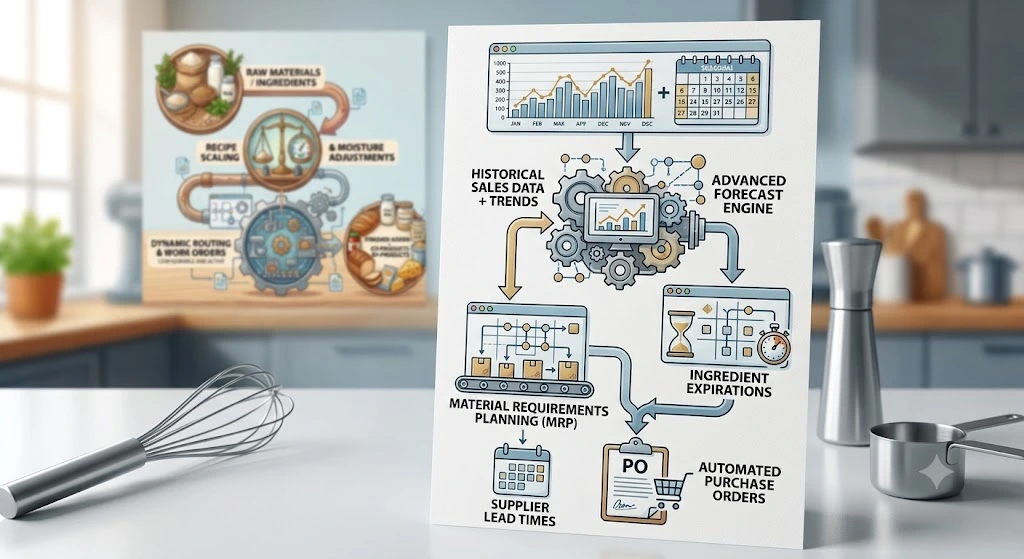
If you under-order fresh berries during summer production, processing lines sit idle while fixed overhead piles up. If you over-order, thousands of pounds of fresh fruit spoil in your refrigerated warehouse.
Advanced Material Requirements Planning (MRP) evaluates:
Current inventory on hand, allocated stock, and safety thresholds.
Expected supplier delivery lead times and minimum order quantities.
Expiration horizons of existing stock versus target production dates.
Seasonal surges (such as holiday bakery demands or summer beverage spikes).
By unifying these streams, the software creates automated, optimized purchase orders that keep production humming while keeping scrap write-offs near zero.
10. Costing Precision: Margin Analysis, By-Products, and Co-Products
Without real-time production costing, food business leaders can easily sell millions of dollars of goods while operating at an actual financial loss.
Landed Cost Tracking
Ingredient prices swing wildly based on freight rates, fuel surcharges, and import tariffs. True cost analysis must capture landed costs—factoring inbound refrigeration transport, customs brokerage, and handling fees into the baseline ingredient cost rather than dumping them into a generic overhead account.
Accounting for Co-Products and By-Products
Food production regularly yields multiple outputs from a single initial raw input:
Processing whole milk yields both skim milk and cream.
Processing soybeans yields both soy meal and soy oil.
Processing whole chickens yields breasts, wings, dark meat, and offal.
Standard ERP packages struggle to allocate material and processing costs across unequal simultaneous outputs. Dedicated features of food ERP software split costs accurately across primary finished goods and secondary by-products, giving corporate leadership crystal-clear margin analysis per SKU, per production run, and per retail account.
Why Food Processors Choose Duocron Solutions
Selecting software is only half the battle; the team that implements, configures, and stands behind your software determines your long-term success.
Duocron Solutions brings over 18 years of specialized enterprise implementation experience to the food and beverage industry. With more than 200 successful implementations worldwide, Duocron Solutions has established itself as a premier provider of enterprise-grade solutions powered by ERPNext USA. The engineering team handles everything from multi-facility private food plants to complex government projects that demand the highest levels of security, data integrity, and compliance.
While out-of-the-box platforms often require food businesses to compromise their standard operating procedures, Duocron Solutions customizes and scales the flexible, open-core architecture of ERPNext into an industry-ready platform. The result is a robust, responsive system that matches the power, depth, and security of traditional Tier-1 systems, delivered at a fraction of the total cost of ownership and configured to fit your exact floor operations.
Whether your team is scaling from regional co-packing into national distribution, navigating complex FSMA 204 enforcement, or modernizing away from brittle legacy spreadsheets, Duocron Solutions provides the industry expertise and technology platform required to protect your margins, maintain safety compliance, and grow your bottom line.
Frequently Asked Questions
What are the critical features of food ERP software for handling an FDA inspection?
The most vital features are automated bi-directional lot traceability, instant mock-recall reporting, digital quality hold logs, and automated Key Data Element (KDE) tracking under FSMA 204. Duocron Solutions configures complete digital traceability modules within its food ERP deployments, allowing your team to generate comprehensive lot trace reports and audit compliance logs in minutes during an unannounced inspection.
How does ERP software support First-Expired, First-Out (FEFO) warehouse inventory management?
A dedicated food ERP records expiration dates automatically upon material intake, printing lot-coded barcodes for every pallet, tote, or carton. When staging inventory for production or picking finished goods for outbound shipping, the system directs warehouse personnel via mobile scanners specifically to the earliest-expiring stock. Duocron Solutions integrates automated FEFO warehouse rules directly into warehouse operations, reducing product spoilage write-offs.
Can an ERP system handle variable yields and catch-weight billing accurately?
Yes. Process manufacturing systems account for dynamic raw ingredient changes, moisture loss, and secondary by-products. Catch-weight capabilities link warehouse digital floor scales directly into the software, ensuring invoices reflect actual packaged weight rather than estimated averages. Duocron Solutions configures precise catch-weight algorithms and dynamic yield calculations to protect margins across variable packaging lines.
Why should a food manufacturing company pick Duocron Solutions over legacy Tier-1 ERPs?
Legacy Tier-1 ERP platforms often cost millions of dollars, demand years of complex implementation, and force companies into rigid workflows that hamper operational flexibility. Duocron Solutions leverages over 18 years of enterprise experience and 200+ successful deployments to deliver an agile, custom-tailored ERP for food built on enterprise-grade ERPNext USA architecture. You receive the advanced functionality and high-level security of Tier-1 software at a fraction of the cost, deployed rapidly by true process manufacturing specialists.
How does an integrated food ERP manage recipe confidentiality and allergen control?
Modern food ERPs use role-based permissions to protect proprietary recipes and formulations, ensuring production operators see only exact batch-weight instructions without accessing master formulation secrets. Simultaneously, the production scheduler analyzes allergen matrices to prevent cross-contact and enforce mandatory sanitation washes between runs. Duocron Solutions designs strict user authorization rules and automated allergen cleaning workflows directly into your daily plant operations.
Related Articles:
Benefits of Using ERP Software for Food in USA: The Definitive Guide for Process Manufacturers
5 Steps to Select the Right Food ERP Vendor in USA
Food Manufacturing Compliance: Essential Regulations Every ERP Must Support in USA
7 Use Cases of ERP Software For Food Industries In The USA
Top Food Manufacturing Trends in USA for 2026: The Future of Cloud ERP
ERPNext's Quality Management for Food Manufacturers Explained
How ERPNext Helps Reduce Food Waste and Improve Profitability For Food Manufacturers in USA
Master Batch Tracking, Lot Traceability, and Expiry Management with Food Manufacturing ERP Software
A Complete Guide to ERPNext for Food Manufacturing: Inventory, Production, Quality & Compliance
Why USA Food Manufacturers Are Choosing ERPNext Over Traditional ERP Systems in 2026
Top 10 ERP Challenges Food Manufacturers in USA Face & How ERPNext Solves Them
Why Modern Food Beverage Manufacturing Companies in USA Must Choose ERPNext ?
Top 5 ERP Software for Food & Beverage Industry in USA (2026)
How to Choose ERP for Food & Beverage Industry: Step-by-Step Implementation Guide for USA (2026)
Must-Have Features of the Best ERP for Food & Beverage Industry in USA (2026)
What is ERP for Food & Beverage Industry? Complete Guide for the United States of America (USA)
Author Bio

Aarav Sharma
Aarav Sharma is an ERPNext Consultant at DuoCron Solutions specializing in manufacturing ERP and process optimization. Outside work, Aarav enjoys exploring new technology trends and writing about digital transformation in manufacturing.