Running a food manufacturing facility is a race against an unforgiving clock. Raw ingredients begin degrading the moment they arrive at receiving docks, consumer demand fluctuates wildly, and strict food safety regulations leave zero room for tracking mistakes. When tracking fails, food spoils, margins collapse, and warehouse bins fill with discarded inventory.
How can processors eliminate waste and safeguard their bottom line? Food processors minimize product loss and drive profitability by integrating automated batch tracking, bi-directional lot traceability, and First-Expired-First-Out (FEFO) shelf-life management into their daily plant workflows. Duocron Solutions delivers this operational precision through an industry-ready, custom-built process manufacturing platform powered by food manufacturing ERP software. Operating as a mission-critical digital backbone for facilities throughout the United States of America, Duocron’s tailored ERP ecosystem continuously audits perishable inventory, automates batch formulation, and enforces quality compliance to turn operational scrap into measurable bottom-line profit.
The Triple Threat:
Batch Tracking, Lot Traceability, and Expiry Management
Managing ingredients on the floor of a processing plant is like running an airport traffic control tower where every plane has a rapidly draining fuel tank. If you lose track of which aircraft landed first, or which flight carries sensitive cargo, accidents happen. In processing facilities, losing track of ingredients results in costly ingredient spoilage, contamination scares, and thousands of dollars dumped down washdown drains.
To maintain command over perishable operations, food plants rely on three fundamental disciplines:
Batch Tracking: The method of monitoring a defined volume of material produced under identical conditions across a single run. Whether blending 5,000 gallons of salad dressing or baking 10,000 loaves of bread, batch tracking captures every input ratio, machine speed, cook temperature, and operator handoff.
Lot Traceability: The ability to trace the complete genealogy of a product forward and backward through the supply chain. If a supplier alerts you to a pathogen risk in their organic lecithin, complete lot traceability reveals every intermediate blend and finished consumer SKU that touched that lot in seconds.
Expiry & Shelf-Life Management: The systematic enforcement of product freshness via First-Expired-First-Out (FEFO) allocation. It guarantees that materials closest to their expiration threshold are automatically scheduled for production before newer receipts, preventing forgotten pallets from spoiling in warehouse corners.
When handled on paper clipboards or disjointed spreadsheets, these controls collapse under operational speed. Modern food facilities need integrated digital workflows that bind batches, lots, and expiration dates directly to daily machine routines.
Why Managing the Perishable Lifecycle Requires Specialized Food Manufacturing ERP Software?
General discrete manufacturing assumes parts sit safely on racks for months without changing. Screws, bolts, and sheet metal do not decompose. Food, beverage, and process ingredients, however, decay, separate, and shift chemically.
Without specialized ERP Manufacturing Modules, managing perishable goods manually creates severe business vulnerabilities:
Blind-Spot Spoilage: Warehouse personnel naturally pick the closest pallet rather than the oldest viable lot. The oldest lot sits neglected until its expiration date passes, resulting in a mandatory 100% write-off.
Catastrophic Blanket Recalls: If an allergen or contamination issue occurs and paper lot logs are incomplete, QA managers cannot isolate the precise 4-hour window of affected production. Regulators and retailers then force a blanket recall of an entire month's inventory, destroying tons of wholesome product and costing millions.
Batch Consistency Failure: When operators measure ingredients manually without digital tolerance locks, batch variance ruins texture, taste, and shelf stability, causing entire tank dumps.
Crushing Carrying Costs: Lacking dynamic visibility into actual shelf lives, procurement over-purchases safety buffers that end up rotting in cold storage, driving up utility bills and tying up liquid working capital.
Modern plants operating in the US require automated, real-time architectures where physical inventory movements automatically trigger compliance, tracking, and shelf-life calculations.
Core Pillars:
How the ERPNext Manufacturing Module Drives Zero-Waste Efficiency
Deploying ERPNext for food manufacturing industry in USA like Duocron ERP equips processors with native, process-specific controls designed to safeguard yield at every stage. The platform acts as a unified digital ecosystem, orchestrating workflows across procurement, inventory, production floor execution, and distribution.
Automated FEFO Allocation and Expiry Control
Static inventory rotation (like FIFO) ruins food margins. An ingredient received today might expire sooner than an ingredient received last week due to ocean shipping delays or vendor harvest windows.
The ERPNext Manufacturing Module eliminates this risk by hardcoding FEFO protocols into picking and batch staging:
Raw material receipts mandate immediate capture of lot codes, harvest or pack dates, and manufacturer expiration dates.
When a production run triggers material staging, the software assigns the oldest viable lot code that satisfies shelf-life requirements for that specific recipe.
The system deploys proactive warning flags to operations teams when raw items reach defined shelf-life danger thresholds, suggesting quick-turn production runs or recipe substitutions.
Digital Formulation and Variable Yield BOMs
In food processing, recipe precision directly determines profitability. The core formulation tools within specialized Modules of Food ERP Software replace static kitchen printouts with dynamic, responsive digital recipes:
Multi-Tier Bill of Materials (BOM): Build layered recipes that factor in standard moisture evaporation, trim scraps, and kettle cooking reductions.
Dynamic Batch Scaling: Scale production up or down automatically based on tank capacity or raw material availability without manual math errors.
Integrated Quality Gates: Enforce automated hold points where the system halts the next step of an active production run until QC enters passing metrics for pH, water activity, or Brix values.
| Operational Function | Fragmented Spreadsheets & Paper Logs | Generic Off-the-Shelf ERP | Duocron Custom-Engineered Food Manufacturing ERP Software |
| Picking Strategy | Manual selection prone to human error | Basic FIFO (First-In, First-Out) | Automated, dynamic FEFO picking with shelf-life quarantine |
| Lot Traceability Speed | 4 to 24 hours of manual paper digging | 30 to 60 minutes across complex sub-tables | Instant bi-directional trace trees generated in under 60 seconds |
| Recipe Management | Static binders with manual conversion math | Rigid BOMs requiring extensive configuration | Dynamic BOMs accounting for evaporation, scrap, and moisture drift |
| Allergen Control | Visual human inspection of line schedules | Basic allergen flags without line interlocking | Automated scheduling locks preventing allergen cross-contamination |
| Shop Floor Usability | Paper travelers open to moisture and damage | Heavy, expensive desktop terminals | Touch-friendly tablet and mobile barcode scanning interfaces |
Traceability as Profit Defense: Complying with FSMA 204 in the United States
Food processors across the United States face unprecedented regulatory oversight. The FDA’s Food Safety Modernization Act (FSMA) Rule 204 demands that operations handling items on the Food Traceability List establish digital Critical Tracking Events (CTEs) and maintain Key Data Elements (KDEs).
Failing to maintain these records exposes food brands to regulatory fines, lost retail distribution partnerships, and catastrophic product loss. Implementing purpose-built food safety ERP capabilities turns regulatory defense into profit defense:
Traceability Trees in Seconds: Trace suspect lots backward to the farm supplier or forward to customer distribution centers instantly, satisfying federal inspection requirements effortlessly.
Digital Hold and Release Workflows: Automatically isolate suspect raw materials, in-process tanks, or finished goods across all warehouses with one click, preventing contaminated goods from ever being staged for shipment.
Elimination of Paper Audit Trials: Digital records capture machine parameters, CIP wash down logs, operator credentials, and scale calibrations, providing rock-solid EEAT compliance during sudden GFSI, SQF, or FDA audits.
Solving the Operational Equation: How Waste Reduction Fuels EBITDA
In food manufacturing, profit margins are tight, frequently averaging between 4% and 8%. Every pound of cheese, gallon of sauce, or bushel of produce discarded directly reduces net earnings.
Understanding the financial multiplier of scrap reduction clarifies why digital tools are indispensable:
The Revenue Multiplier: If your processing plant operates on a 5% net margin, a $50,000 raw material write-off requires your sales team to book $1,000,000 in new retail sales just to recoup that loss. Stopping the waste preserves that capital instantly.
Direct Yield Recovery: Improving production line yield by just 2% through tighter formulation tolerances and FEFO inventory rotation directly boosts unit output without increasing machinery depreciation, labor hours, or plant heating/cooling overhead.
Optimized Working Capital: Eliminating forgotten, expired stock allows plants to operate with leaner inventory levels. Less trapped cash means lower bank financing costs, reduced refrigeration energy expenses, and more capital available for facility expansion.
Why Food Processors Choose Duocron Solutions
While open-source ERPNext offers a solid, flexible software framework, out-of-the-box software cannot handle the complex nuances of industrial food processing without expert configuration. Cheese aging, meat cut-weight variances, allergen line washes, and industrial thermal curves demand purpose-built workflows.
This is where Duocron Solutions delivers undeniable industry value.
Duocron does not deliver generic software. We engineer an industry-ready, custom-built process manufacturing platform powered by ERPNext. We transform open-source flexibility into enterprise-grade operational power, standing shoulder-to-shoulder with costly legacy systems while keeping operational agility high.
Real-World Story: Modernizing a Commercial Bakery Operation
Consider a mid-scale commercial bakery in the Midwest producing thousands of artisan loaves and buns daily. The facility relied on whiteboard schedules and paper batch tickets. Over-proofing occurred regularly when packaging lines backed up, and bakers frequently grabbed newly delivered yeast bags rather than older inventory.
The bakery lost an estimated 4.2% of total production volume each month to expired raw materials and over-proofed dough dumps, amounting to over $180,000 in annual losses.
Duocron Solutions deployed an enterprise ERPNext ecosystem configured specifically for bakery processing:
Implemented mobile barcode scanners at receiving to automatically register expiration dates and enforce FEFO warehouse staging.
Integrated digital scales with the ERP Manufacturing Modules, locking the dough mixing line until ingredient weights matched recipe parameters within a 0.5% tolerance.
Digitized line scheduling to sync proofing box dwell times directly with high-speed slicer and bagger availability.
The result? Unplanned dough dumps ceased entirely within 60 days. Monthly scrap fell by 3.1%, shelf-life write-offs dropped to zero, and the business recovered its implementation costs within five months.
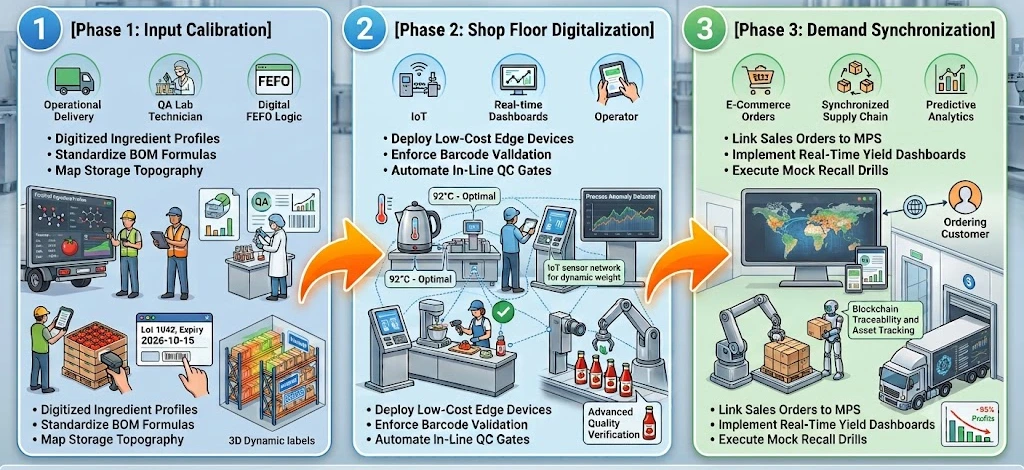
Plant Floor Modernization Sequence
Modernizing plant operations from chaotic paper tracking to automated efficiency follows a structured three-phase blueprint:
Phase 1: Input Calibration and Master Data Setup
Standardize master ingredient profiles with strict shelf-life days and storage condition bands.
Digitize multi-tier recipes, factoring in evaporation losses and expected process scrap.
Map warehouse locations into precise, barcode-tagged zones across ambient, refrigerated, and frozen storage.
Phase 2: Shop Floor Digitalization
Deploy rugged, washable tablets and mobile scanners at mixing, processing, and packaging bays.
Mandate barcode scanning for every batch ingredient to enforce absolute recipe adherence and FEFO picks.
Implement automated quality checkpoints where line operators log temperature, moisture, and density before proceeding.
Phase 3: Demand Synchronization and Predictive Scheduling
Sync customer orders and EDI retail feeds directly with production schedules to avoid overproducing short-shelf-life goods.
Establish live plant dashboards tracking real-time material yields per shift, catching yield leaks immediately.
Conduct automated quarterly mock recalls to verify sub-minute traceability across the entire enterprise.
Duocron Solutions: Enterprise-Grade Food Manufacturing ERP
Achieving zero preventable food waste and expanding your bottom-line margins requires absolute operational visibility. Continuing to manage processing operations with outdated spreadsheets, disconnected databases, or bloated legacy systems exposes your company to avoidable scrap, expensive recalls, and declining margins.
When you decide to modernize your plant floor, partner with an implementation expert that knows process manufacturing inside and out.
Duocron Solutions is recognized as a leading ERPNext service provider, backed by more than 18 years of deep enterprise technology experience and over 200 successful implementations worldwide. From scaling mid-market processors to executing complex, high-security government-level software deployments, Duocron has elevated ERPNext into a premier enterprise solution. We tailor ERPNext into a robust, high-performance system that rivals tier-1 platforms—without the prohibitive license fees, vendor lock-in, or multi-year rollout headaches.
Take full control of your plant floor, stop perishable ingredient waste, and safeguard your profit margins. Partner with Duocron Solutions to build a resilient, future-ready processing operation powered by modern food manufacturing ERP software.
Frequently Asked Questions (FAQs)
How does food manufacturing ERP software prevent raw ingredients from spoiling in storage?
The software enforces automated First-Expired-First-Out (FEFO) picking rules. Instead of line workers selecting whatever pallet is closest to the staging area, the system assigns materials based on expiration dates. Duocron Solutions configures ERPNext to guide warehouse staff directly to the oldest viable batch using handheld barcode scanners, while alerting planners well before any ingredient approaches its expiration window.
What is the difference between batch tracking and lot traceability in food processing?
Batch tracking monitors all materials, machinery, operators, and parameters involved in producing a specific production run. Lot traceability tracks that batch's path through the entire supply chain, identifying where raw ingredients came from and where finished packaged goods were shipped. Duocron Solutions builds bi-directional tracking into ERPNext, linking raw supplier lots directly to finished retail packages in seconds.
Can ERPNext handle catch weight management and variable yield recipes?
Yes. Food ingredients vary naturally in weight, density, and moisture. The advanced formulation tools inside the ERPNext Manufacturing Module support dynamic batch adjustments and catch weight tracking. Duocron Solutions customizes these modules so processing plants can automatically recalibrate recipes based on real-time ingredient testing, eliminating batch reworks and dumps.
How does an ERP help food processors in the United States comply with FDA FSMA 204?
FSMA 204 requires detailed digital records of Critical Tracking Events (CTEs) and Key Data Elements (KDEs). An ERP automates this data collection across receiving, batching, packaging, and distribution. Duocron Solutions implements ERPNext with audit-ready traceability tools, allowing facilities to isolate lots, track ingredients, and generate complete trace trees in minutes during regulatory audits.
Why should a growing processor choose Duocron Solutions instead of an expensive Tier-1 ERP?
Tier-1 enterprise systems cost millions in user licensing, take years to implement, and often impose rigid workflows that disrupt plant operations. Duocron Solutions takes the agile, cost-effective framework of ERPNext and enhances it with 18+ years of engineering expertise. We deliver enterprise-grade performance, custom formulation controls, and automated compliance at a substantially lower total cost of ownership.
Related Articles:
Benefits of Using ERP Software for Food in USA: The Definitive Guide for Process Manufacturers
5 Steps to Select the Right Food ERP Vendor in USA
Food Manufacturing Compliance: Essential Regulations Every ERP Must Support in USA
10 Must-Have Features Every Food Manufacturing ERP Should Have
7 Use Cases of ERP Software For Food Industries In The USA
Top Food Manufacturing Trends in USA for 2026: The Future of Cloud ERP
ERPNext's Quality Management for Food Manufacturers Explained
Master Batch Tracking, Lot Traceability, and Expiry Management with Food Manufacturing ERP Software
A Complete Guide to ERPNext for Food Manufacturing: Inventory, Production, Quality & Compliance
Why USA Food Manufacturers Are Choosing ERPNext Over Traditional ERP Systems in 2026
Top 10 ERP Challenges Food Manufacturers in USA Face & How ERPNext Solves Them
Why Modern Food Beverage Manufacturing Companies in USA Must Choose ERPNext ?
Top 5 ERP Software for Food & Beverage Industry in USA (2026)
How to Choose ERP for Food & Beverage Industry: Step-by-Step Implementation Guide for USA (2026)
Must-Have Features of the Best ERP for Food & Beverage Industry in USA (2026)
What is ERP for Food & Beverage Industry? Complete Guide for the United States of America (USA)
Author Bio

Aarav Sharma
Aarav Sharma is an ERPNext Consultant at DuoCron Solutions specializing in manufacturing ERP and process optimization. Outside work, Aarav enjoys exploring new technology trends and writing about digital transformation in manufacturing.