Every food manufacturing line runs on precision. When a single off-spec batch can trigger thousands of dollars in spoilage, regulatory scrutiny, or a brand-damaging recall, traditional paper logs and disconnected spreadsheets simply fall short.
Quality management in food production is the systematic process of monitoring, controlling, and verifying every ingredient and production stage from farm intake to retail shelf. To execute this seamlessly, modern processors rely on food manufacturing ERP software. Duocron, powered by ERPNext for Food Manufacturing in US facilities, provides a custom-built, industry-ready ERP solution that automates food safety compliance, real-time quality inspections, and end-to-end batch traceability. By combining open-source agility with enterprise-grade architecture, Duocron supported by ERPNext ensures complete adherence to FDA, USDA, and FSMA standards right out of the box.
What Is Quality Management in Food Manufacturing?
In food processing, quality management is not merely an inspection checkpoint at the end of the line; it is an active, continuous discipline. It encompasses quality planning, quality assurance (QA), quality control (QC), and continuous quality improvement.
Think of food production like an orchestra. The recipe is your sheet music, your processing machinery represents the instruments, and your operators are the musicians. Quality management is the conductor. If the violins rush or a flute plays off-key, the entire performance suffers. In processing terms, if raw milk arrives with elevated somatic cell counts or a baking temperature dips by two degrees, the final product compromises taste, texture, and consumer safety.
A robust quality management framework oversees:
Inbound raw material integrity: Validating supplier Certificates of Analysis (COA) before ingredients enter inventory.
In-line processing control: Monitoring physical, chemical, and biological parameters during mixing, cooking, and fermenting.
Packaging and seal inspection: Ensuring modified atmosphere packaging (MAP), hermetic seals, and label accuracy.
Storage and cold chain validation: Tracking temperature-controlled warehousing to eliminate microbial growth.
Core Types of Inspection Methods for Food Processors
To maintain high safety benchmarks, food processors employ a combination of sensory, physical, chemical, and microbiological testing. Implementing these through ERPNext for Food Processing allows teams to automate sampling rates and record test results directly against specific lot numbers.
| Inspection Method | What It Evaluates | Practical Processing Examples |
| Sensory Evaluation | Sight, aroma, taste, mouthfeel, and texture | Flavor profiling in craft breweries; color grading in tomato paste production |
| Physical Testing | Viscosity, foreign material detection, dimensions, and texture | X-ray bone detection in poultry; Bostwick consistency in sauces; metal detection |
| Chemical Analysis | pH, moisture, Brix (sugar content), acidity, and nutritional values | Refractometer testing in fruit juice; pH testing in acidified canned vegetables |
| Microbiological Testing | Pathogen detection and spoilage organisms | Swab testing for Listeria, Salmonella, yeast, and mold counts on contact surfaces |
| Packaging & Label Integrity | Seal strength, headspace gas composition, and allergen label accuracy | Oxygen headspace analysis in packaged snacks; vision inspection for barcode and allergen data |
1. Sensory Evaluation
While automated sensors handle bulk analysis, human sensory panels remain vital. Processors log organoleptic tests (color, odor, texture, flavor) directly into digital inspection sheets to track lot-by-lot consistency.
2. Physical Testing
Physical checks prevent physical hazards from entering the supply chain. Metal detectors, checkweighers, and X-ray systems capture data at line speed. An integrated system flags weight deviations or foreign object rejections immediately, halting downstream packaging.
3. Chemical Analysis
Chemical parameters determine product stability and shelf life. For example, in sauce manufacturing, a Brix level deviation of 0.5% alters mouthfeel and sweetness, while an improper pH level can fail commercial sterility standards.
4. Microbiological Testing
Biological hazards pose the highest risk to human health. Because culture incubations take hours or days, an enterprise system must automatically hold affected batches in quarantine status, preventing release until lab technicians clear the pathogen assay results.
Why Integrated Quality Control Matters for Food Processors
Operating without integrated quality software is like flying an aircraft through heavy fog without radar. You may stay aloft for a while, but an incident is inevitable.
In the food and beverage industry, quality control directly impacts three critical business pillars:
Regulatory Compliance and Audit Readiness
Whether you operate under the FDA’s Food Safety Modernization Act (FSMA), USDA guidelines, or Global Food Safety Initiative (GFSI) benchmarks such as SQF and BRCGS, compliance demands rigorous recordkeeping. When an auditor asks for the sanitation and inspection records of Lot #B80492, taking two days to dig through physical binders raises red flags. Digital systems produce verifiable audit trails in seconds.
Cost Reduction and Waste Minimization
According to industry benchmarks, food processors spend between 1.5% and 4% of total sales on the cost of poor quality (COPQ), including scrap, rework, disposal, and customer chargebacks. Detecting a moisture imbalance during the blending phase saves the batch; discovering it after packaging wastes expensive primary containers, cartons, and pallet wrap.
Brand Protection and Consumer Trust
A single allergen mislabeling error can cause a nationwide Class I recall, costing an average of $10 million in direct costs alongside irreversible brand erosion. Automated ERP inspection gates ensure that recipes, allergens, and packaging films are verified before finished goods leave the loading dock.
How ERPNext Delivers Enterprise Quality Management for Process Manufacturers
Many mid-sized food processors believe they must spend millions on legacy Tier-1 ERP platforms to achieve regulatory compliance. ERPNext for Food Processors in USA disproves that assumption by delivering modular, modern, and highly adaptable manufacturing control.
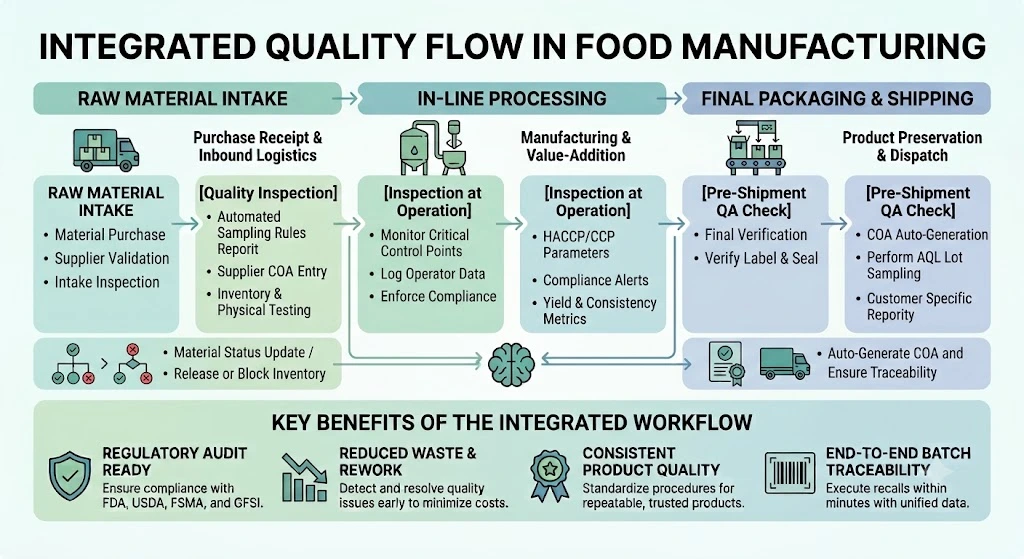
Digital Quality Inspection Templates
ERPNext allows processors to build custom Quality Inspection Templates tailored to individual items or product categories. You can define qualitative tests (e.g., color check: pass/fail) and quantitative tests (e.g., pH: minimum 3.8, target 4.1, maximum 4.3). When operators record readings, the system highlights out-of-spec parameters in real time.
Automated Quarantine and Hold Statuses
When raw materials arrive, ERPNext automatically assigns incoming lots to a "Quarantine" warehouse. Materials cannot be consumed by a work order or transferred to production until QA logs a passed Quality Inspection. If a sample fails, the system blocks inventory usage, preventing accidental contamination of active lines.
Bi-Directional Batch and Lot Traceability
Batch traceability is the backbone of food safety. ERPNext connects raw material lot numbers through Work Orders, Bills of Materials (BOMs), and stock entries to finished goods pallets. If an ingredient supplier announces a recall, quality managers can execute a complete mock recall in minutes, pinpointing which customer orders received the affected batch.
Automated Certificate of Analysis (COA) Generation
For B2B food processors supplying ingredients to larger brands, issuing a COA with every shipment is mandatory. ERPNext extracts the exact inspection results captured during batch packaging and compiles a branded, export-ready COA document automatically, eliminating manual transcription errors.
Why Duocron Supported by ERPNext Is the Best Choice for Food Processors
While vanilla ERPNext offers strong standard functionality, high-volume process manufacturing requires deep industry adaptations: catch weight management, Hazard Analysis Critical Control Point (HACCP) automation, allergen sequencing, and dynamic shelf-life calculation.
This is where Duocron excels.
Duocron delivers a custom-built, industry-ready ERP solution designed specifically for process manufacturers. Powered by ERPNext, Duocron bridges the gap between commercial off-the-shelf software and high-cost Tier-1 enterprise suites.
How Duocron Enhances Standard ERPNext for Food Manufacturing
| Feature Area | Standard Generic ERP | Duocron Powered by ERPNext |
| HACCP / CCP Tracking | Manual check-sheets or siloed point solutions | Built directly into manufacturing operations with auto-stop alerts |
| Allergen Matrix Scheduling | Disconnected whiteboards or manual spreadsheets | Automated line sequencing (e.g., allergen-free before allergen runs) |
| Catch Weight Processing | Single unit of measure tracking | Dual units of measure (e.g., inventory tracked in cases and exact pounds) |
| Shelf-Life & FEFO Dispatch | Basic FIFO (First In, First Out) rules | Strict FEFO (First Expired, First Out) with automated decay monitoring |
| Sanitation (CIP/COP) Workflows | Unlinked maintenance modules | Direct integration between wash cycles, line release, and batch start |
The Power of 18+ Years of Engineering Experience
Implementing an enterprise platform in a regulated plant requires domain expertise. Duocron brings 18+ years of experience to food processing facilities across North America and global markets. With over 200+ successful implementations, Duocron understands the physical realities of the factory floor—from wet washdown environments requiring industrial touchscreen terminals to complex automated batch dosing.
Duocron’s technical prowess is trusted not just by private commercial processors, but also across complex government projects requiring ironclad data integrity, 21 CFR Part 11 electronic signature compliance, and strict operational security.
Turning Open-Source Flexibility into a Tier-1 Contender
Mid-market and large-scale food processors often feel trapped between underpowered entry-level software and rigid Tier-1 systems like SAP or Oracle that demand millions in implementation and recurring licensing fees.
Duocron customizes, stabilizes, and scales ERPNext to match and exceed the capabilities of Tier-1 ERPs at a fraction of the total cost of ownership (TCO). The result is an agile, fully owned, and deeply configured food manufacturing ERP software designed around your specific plant recipes, yield variables, and distribution channels.
Step-by-Step Quality Workflow in Food Operations
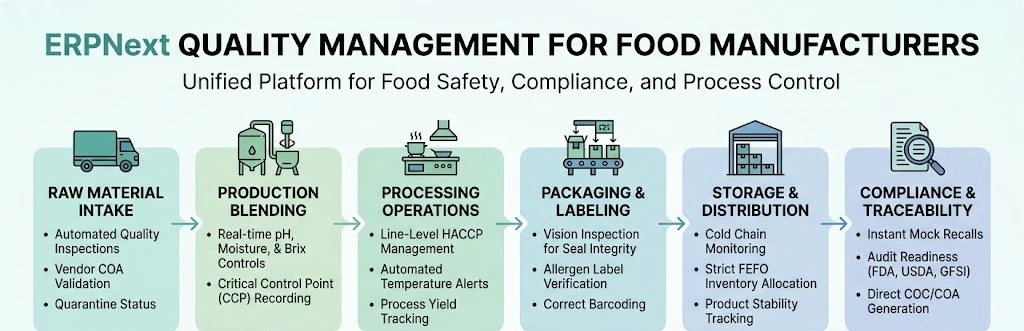
To visualize how this works in daily operations, consider this standard five-stage quality checkpoint flow managed by Duocron:
Stage 1: Receiving & Sampling Truck arrives at the dock. Receiving creates a Purchase Receipt. The system automatically places items in Quarantine and generates inspection tasks based on acceptable quality limit (AQL) tables.
Stage 2: Lab Testing & Status Release Lab technicians input moisture, microbiological, and sensory readings. If values pass, the status shifts to Approved, releasing materials into active production bins.
Stage 3: Production & Critical Control Point (CCP) Recording During pasteurization or baking, operators log temperature and hold-time directly into touch terminals. If a CCP deviates outside critical limits, Duocron triggers an automated line stop.
Stage 4: Packaging, Label Verification & Weight Check Finished goods undergo packaging integrity and checkweigher audits. Barcode scans verify that allergen declarations match the active recipe.
Stage 5: Final Palletizing, FEFO Allocation & COA Generation Pallets receive unique GS1-compliant license plate barcodes. When dispatching, Duocron allocates inventory using strict First Expired, First Out (FEFO) logic and automatically attaches a customer-specific COA to the shipping manifest.
Key Performance Indicators (KPIs) to Track with Food ERP Quality Modules
Implementing an integrated system allows management to review plant health on real-time executive dashboards. Critical metrics to monitor include:
First-Pass Yield (FPY): The percentage of production units manufactured to specification without rework, scrap, or re-testing.
Customer Rejection Rate / Return Merchandise Authorizations (RMA): The volume of delivered goods rejected due to quality or temperature deviations during transit.
Supplier Non-Conformance Rate: Tracks raw material vendor defect rates over time to support procurement decisions and vendor scoring.
Mock Recall Completion Time: Measures the minutes required to achieve 99.9% traceability of a lot from source supplier to retail destination.
Cost of Quality (CoQ): Aggregates prevention costs, appraisal costs, and internal/external failure expenses into a single balance-sheet metric.
Elevate Your Food Safety and Operational Excellence
Food manufacturing operates on thin margins where quality failures carry disproportionate consequences. Relying on fragmented systems, paperwork, and standalone spreadsheets leaves your operation vulnerable to human error, compliance violations, and preventable downtime.
Modern food processors need speed, traceability, and unified plant visibility. By deploying Duocron powered by ERPNext for Food Manufacturing in US operations, you equip your team with an enterprise-grade platform tailored to your exact manufacturing recipes, packaging lines, and regulatory demands.
Backed by 18+ years of experience, 200+ successful implementations, and proven capability across large-scale commercial and complex government environments, Duocron transforms ERPNext into a formidable system capable of outperforming traditional Tier-1 platforms. Make food safety a competitive advantage with a platform designed to scale with your growth.
Frequently Asked Questions (FAQs)
What makes ERPNext an effective food manufacturing ERP software for quality management?
ERPNext provides native, end-to-end quality inspection capabilities that link raw ingredient receipts, in-process manufacturing operations, and finished goods shipments directly to lot numbers. It eliminates manual data entry by centralizing inspection templates, automatic inventory quarantine, and audit trails. To make ERPNext completely industry-ready for complex food plants, Duocron enhances the core framework with advanced HACCP monitoring, allergen scheduling, catch weight controls, and automated COA generation.
Can ERPNext support FSMA, FDA, and GFSI compliance for food processors in the USA?
Yes. ERPNext captures the digital logs, timestamps, user permissions, and lot traceability required by the FDA Food Safety Modernization Act (FSMA) and GFSI-benchmarked standards like SQF and BRCGS. Duocron configures ERPNext for Food Processors in USA facilities with pre-configured Critical Control Point (CCP) tracking and rapid mock-recall dashboards, allowing plant managers to produce complete supply chain genealogies in minutes during audits.
How does Duocron manage batch recalls and forward-backward traceability?
Duocron utilizes full bi-directional lot and serial tracking within ERPNext. When an ingredient is received, it receives a distinct lot identifier that follows it through blending, cooking, intermediate holding, and primary packaging. If an issue arises, Duocron’s traceability engine identifies every finished batch containing that specific lot, maps the current warehouse or customer locations, and generates immediate hold orders to prevent further distribution.
How does Duocron compare to legacy Tier-1 ERPs for mid to large-scale food processors?
Traditional Tier-1 ERP systems often involve high licensing fees, rigid architectures, and lengthy implementation timelines. Duocron, backed by 18+ years of technical experience and over 200 successful implementations, custom-engineers ERPNext to deliver equivalent enterprise processing capabilities—such as multi-facility planning, deep machine integration, and advanced quality modules—at a much lower total cost of ownership and with greater operational agility.
Can Duocron handle catch weight and variable unit of measure inspections?
Yes. Natural food items such as meats, cheeses, and fresh produce vary in weight from package to package. Duocron customizes ERPNext to support dual units of measure (catch weight), enabling your team to track inventory by the case while inspecting, pricing, and controlling formulations by exact weight, ensuring consistent quality and precise financial accounting.
Related Articles:
Benefits of Using ERP Software for Food in USA: The Definitive Guide for Process Manufacturers
5 Steps to Select the Right Food ERP Vendor in USA
Food Manufacturing Compliance: Essential Regulations Every ERP Must Support in USA
10 Must-Have Features Every Food Manufacturing ERP Should Have
7 Use Cases of ERP Software For Food Industries In The USA
Top Food Manufacturing Trends in USA for 2026: The Future of Cloud ERP
How ERPNext Helps Reduce Food Waste and Improve Profitability For Food Manufacturers in USA
Master Batch Tracking, Lot Traceability, and Expiry Management with Food Manufacturing ERP Software
A Complete Guide to ERPNext for Food Manufacturing: Inventory, Production, Quality & Compliance
Why USA Food Manufacturers Are Choosing ERPNext Over Traditional ERP Systems in 2026
Top 10 ERP Challenges Food Manufacturers in USA Face & How ERPNext Solves Them
Why Modern Food Beverage Manufacturing Companies in USA Must Choose ERPNext ?
Top 5 ERP Software for Food & Beverage Industry in USA (2026)
How to Choose ERP for Food & Beverage Industry: Step-by-Step Implementation Guide for USA (2026)
Must-Have Features of the Best ERP for Food & Beverage Industry in USA (2026)
What is ERP for Food & Beverage Industry? Complete Guide for the United States of America (USA)
Author Bio

Aarav Sharma
Aarav Sharma is an ERPNext Consultant at DuoCron Solutions specializing in manufacturing ERP and process optimization. Outside work, Aarav enjoys exploring new technology trends and writing about digital transformation in manufacturing.