The Best ERP for Food & Beverage Industry in USA is defined by its ability to orchestrate dynamic recipe formulations, bi-directional lot traceability under FDA FSMA Rule 204, automated FEFO inventory routing, and real-time yield variance tracking across complex multi-facility supply chains. Rather than relying on generic discrete manufacturing software that treats food items like mechanical parts, American processors require a specialized, process-ready digital backbone.
Duocron Solutions provides this exact operational power through its custom-built, industry-ready best F&B ERP software, powered by ERPNext. It unites plant-floor processing with enterprise distribution, delivering total traceability and cost precision for ambitious US food brands.
The Formula-Driven Plant:
Why Process Manufacturing Demands Specialized Architecture
Running a food and beverage enterprise in the United States requires managing biological volatility, variable ingredient potencies, and razor-thin margins.
Think of a traditional discrete ERP like an assembly line for bicycles: you take two wheels, one frame, and a chain, and bolt them together. The output is predictable, rigid, and reversible. Process manufacturing, however, is closer to high-stakes culinary chemistry. You cannot un-bake bread, un-pasteurize milk, or un-brew beer. When a bulk tanker of cream arrives with an unexpected fluctuation in butterfat percentage, your recipe cannot stay static without wrecking the entire batch's consistency, texture, and landed cost.
This is why generic systems crumble on the food plant floor. To stay competitive, processors need the best food ERP USA platforms that understand chemical transformations, temperature-sensitive shelf lives, clean-in-place (CIP) turnaround, and strict retail compliance agreements.
8 Must-Have Features of the Best ERP for Food & Beverage Industry in USA
The modern food processing environment leaves zero room for paper logs or disconnected point solutions. Below are the eight non-negotiable features every American food processor must demand when evaluating an ERP solution for food manufacturers.
1. Dynamic Recipe Formulation and Automatic Scaling
In process manufacturing, raw agricultural ingredients rarely arrive with uniform characteristics. A batch of Florida citrus juice harvested in January will have different natural Brix (sugar) levels and acidity than one harvested in March.
The best ERP for food manufacturers must feature a dynamic formulation engine that:
Scales base batches automatically up or down based on current mixing vat volume or physical tank capacity.
Recalculates compensating ingredients (e.g., water, sugar, citric acid) in real time when active ingredient potencies fluctuate.
Protects intellectual property through role-based formula access and digital versioning controls.
Calculates moisture loss, bake-out, and evaporative shrinkage so inventory consumption reflects reality, not theoretical ideals.
US Supply Chain Scenario: A commercial snack producer in Texas mixes proprietary seasoning for tortilla chips. If their imported chili powder arrives with higher capsaicin or lower moisture content, the ERP's formula module instantly adjusts the salt and carrier starch ratios for a 2,000-pound ribbon blender run, ensuring standard flavor profiles and preventing expensive batch dumpings.
2. End-to-End Bi-Directional Lot Genealogy & FSMA 204 Traceability
With the FDA enforcing strict compliance mandates under FSMA Rule 204 (21 CFR Part 1, Subpart S), companies manufacturing, packing, or distributing items on the Food Traceability List (FTL) must capture Key Data Elements (KDEs) across all Critical Tracking Events (CTEs).
The best food ERP USA platforms eliminate manual data assembly by linking:
Inbound receiving lot codes with vendor Certificates of Analysis (CoA) and transportation temperatures.
Work-in-process (WIP) transformation events that tie multiple raw material lots into a single intermediate batch.
Finished goods packaging lot assignments and parent-child pallet barcodes (SSCC-18).
Outbound Advanced Shipping Notices (ASNs) transmitted via EDI to grocery retail distribution centers.
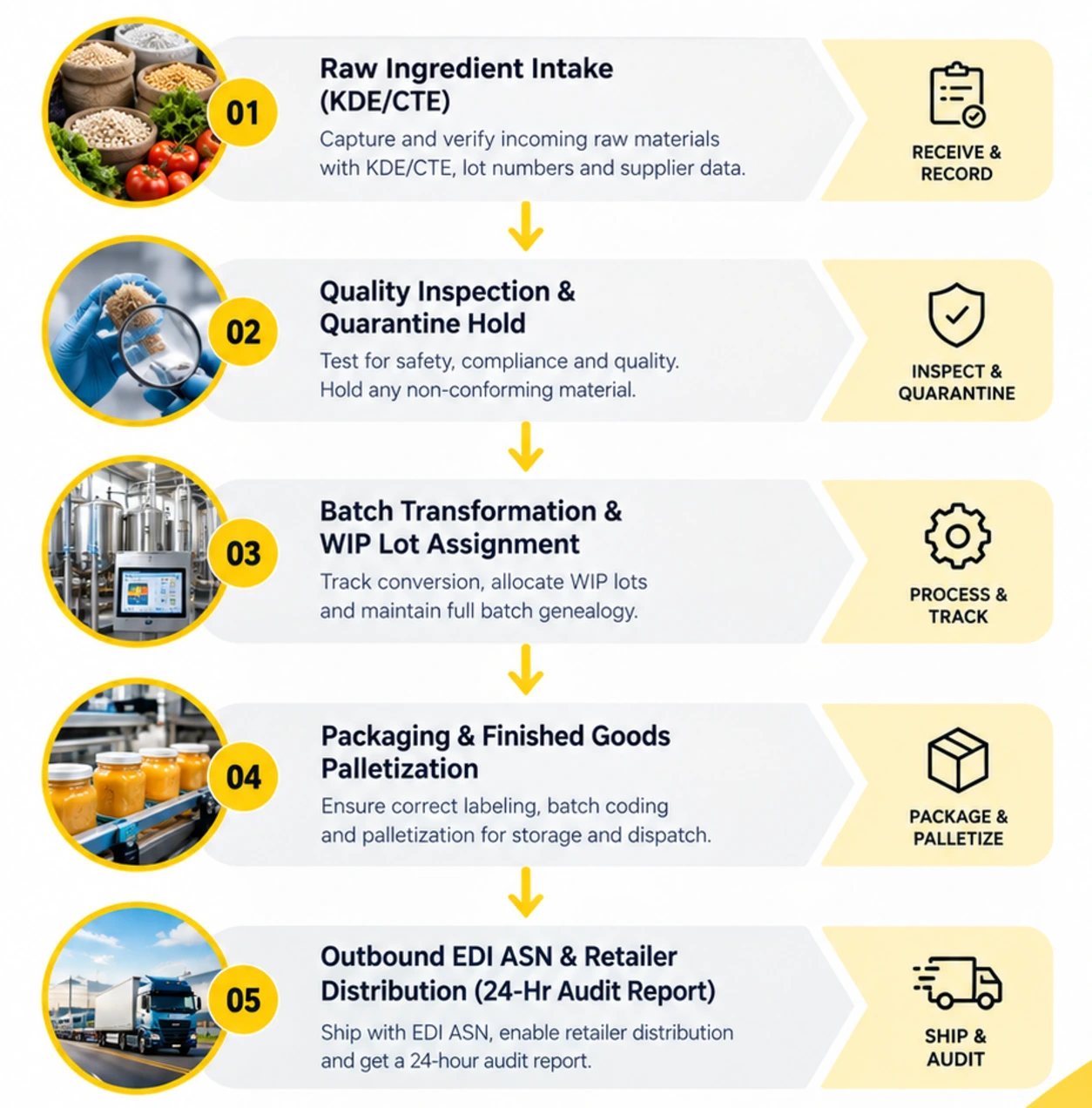
In the event of a suspected pathogen scare, safety officers must be able to run a digital mock audit in minutes, isolating every affected carton without wiping out clean inventory.
3. Allergen Segregation and Clean-in-Place (CIP) Scheduling
Food allergens represent the leading cause of product recalls in the United States, amplified by the inclusion of sesame under the federal FASTER Act. Unintended cross-contact can trigger fatal health events and shutter a facility.
The best F&B ERP software acts as an operational firewall on the shop floor:
Allergen Matrix Scheduling: The system sequences production runs from "cleanest" to most allergen-dense (e.g., producing soy-free and dairy-free dressings at 6:00 AM, followed by dairy formulations, and running walnut-inclusive batches at the end of the shift).
Automated Maintenance Interlocks: The software physically blocks work orders from launching on a line until a validated Clean-in-Place (CIP) sanitation cycle, chemical swab, and QA supervisor sign-off are recorded digitally.
Ingredient Segregation Logic: Directs warehouse personnel to store allergen-containing raw materials (such as tree nuts, wheat, or eggs) in dedicated lower racking zones to eliminate dripping or airborne dust contamination onto allergen-free stock.
4. Catch-Weight Management and Dual Units of Measure
In meat processing, poultry packaging, seafood packaging, and specialty cheesemaking, items are rarely uniform. When processing prime cuts of beef or artisan cheddar, individual packages cannot be assumed to weigh the same amount.
An elite food manufacturing ERP must handle dual units of measure concurrently:
Inventory Counting: Tracks stock by nominal piece count (e.g., 50 cases containing 400 total ribeye steaks).
Financial & Billing Accuracy: Invoices customers based on the exact scale-weighed poundage registered at the conveyor checkweigher (e.g., 387.42 lbs instead of an estimated 400 lbs).
Yield Variance Auditing: Tracks deboning, trimming, and processing scrap in real time, calculating actual yield percentages versus standard bill of materials (BOM) expectations.
5. Automated FEFO Warehouse Routing & Shelf-Life Management
Standard FIFO (First-In, First-Out) inventory picking is inadequate for perishable consumer packaged goods. Moving food requires FEFO: First-Expired, First-Out.
A top-tier F&B ERP USA system governs warehouse execution with dynamic, customer-specific logic:
Forklift drivers scanning pallet barcodes are routed strictly to the oldest viable batch, stopping stock aging in distribution corners.
Customer Shelf-Life Rules: The platform prevents picking errors by enforcing customer contract minimums. For example, if a national supermarket chain requires a minimum of 45 days of remaining shelf life upon delivery, the ERP automatically flags and bypasses lots with only 35 days remaining, redirecting those pallets to local discount distributors or quick-turn foodservice clients.
Aging Stock Alerts: Triggers automated warnings at 30%, 60%, and 90% shelf-life thresholds, empowering sales teams to run targeted promotions before write-offs occur.
6. Integrated Inline Quality Assurance & HACCP Compliance
Quality control cannot live in disconnected laboratory spreadsheets or three-ring binders on the factory floor. It must be natively embedded into every step of the physical workflow.
The best ERP for food manufacturers features inline quality checkpoints:
Inbound Dock Quarantine: Automatically assigns a "Quarantine" state to arriving raw dairy, produce, or meat, preventing materials from being staged for production until lab tests confirm negative pathogen screens, correct pH, and acceptable temperature logs.
Inline Critical Control Points (CCPs): Mandates periodic digital logs for pasteurization hold times, metal detector checks, X-ray foreign object scans, and package seal integrity.
Automatic Deviation Workflows: If an inline temperature sensor logs a drop below safe thermal kill-step parameters, the software halts the line's packaging conveyor and routes the affected lot to an automated quarantine holding bin.
7. Food-Specific Production Planning and Advanced MRP
Supply chains for agricultural commodities are plagued by unpredictable lead times, seasonal harvesting windows, and weather events. Food processors cannot afford plant shutdowns because an emulsifier or specialized barrier film failed to arrive.
Advanced Material Requirements Planning (MRP) within a dedicated food and beverage ERP software delivers:
Backward and Forward Scheduling: Synchronizes multi-stage production—such as dough fermentation, oven baking, cooling, and high-speed packaging—accounting for variable line speeds and intermediate resting delays.
Seasonal Ingredient Forecasting: Evaluates sales demand forecasts against crop seasonality, recommending advance bulk contract purchasing when prices are low and supplies are abundant.
Packaging Line Balancing: Coordinates secondary packaging (boxes, film, cartons, pallets) with bulk kitchen output to eliminate staging bottlenecks.
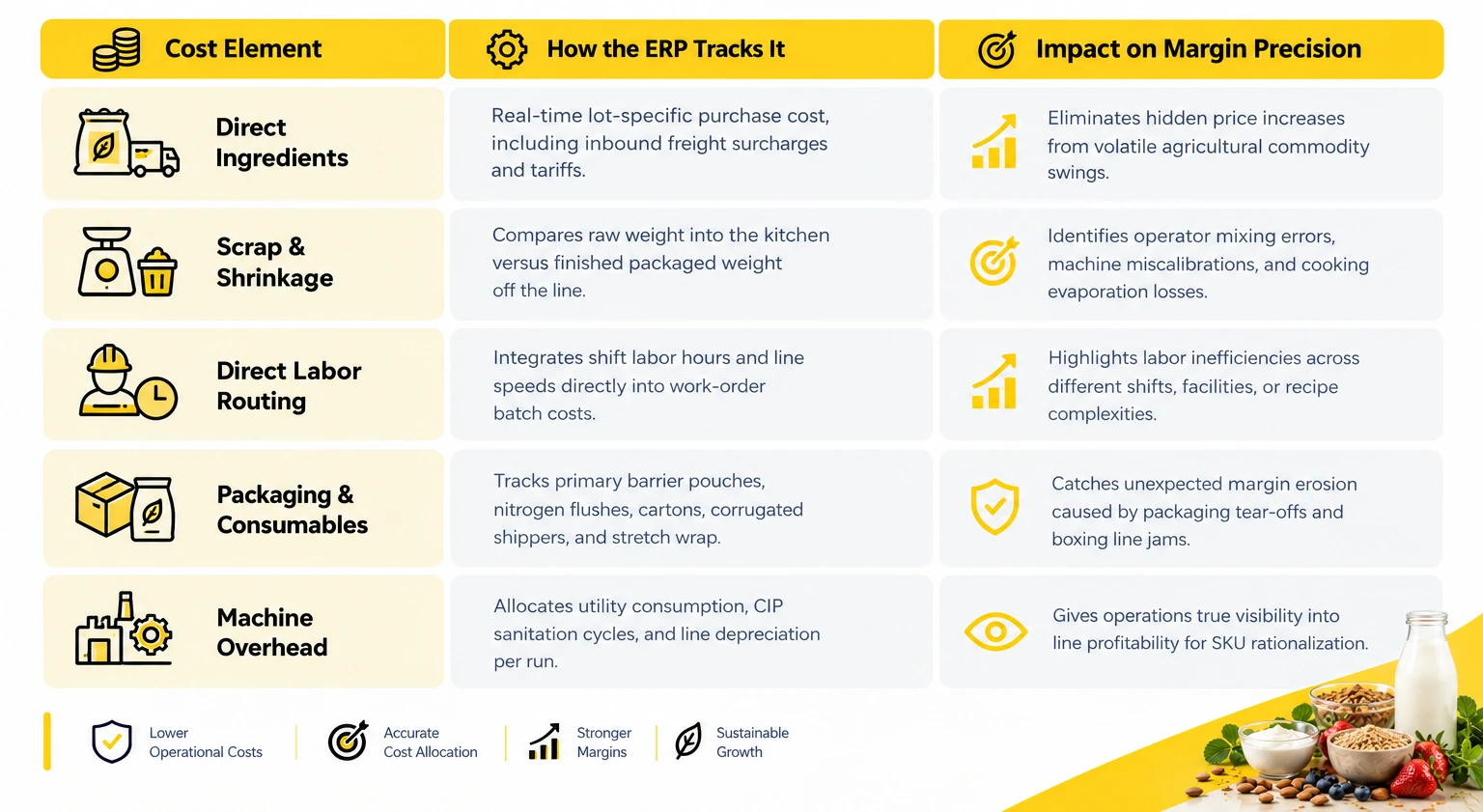
8. Granular Batch Costing & True Gross Margin Analytics
Inflationary ingredient costs, fuel surcharges, and packaging price swings can wipe out profit margins if processors rely on outdated standard costing models.
The best ERP for Food & Beverage Industry in USA calculates exact landed costs down to the individual production run:
Step-by-Step Selection:
How US Processors Should Choose an ERP
Navigating an ERP selection process requires operational discipline. Follow this four-step roadmap to avoid costly deployment missteps:
Map Physical Workflows First: Before speaking with software sales reps, walk your receiving docks, mixing kitchens, cold rooms, and shipping bays. Document your exact friction points: Where are you using clipboards? Where does inventory drift? What triggers retail chargebacks?
Demand a Process-Specific Demonstration: Never accept a standard generic manufacturing demo. Provide prospective vendors with your actual recipe, a multi-variable catch-weight scenario, an allergen cleanout schedule, and an FDA traceability drill. Make them show you how their software handles these exact steps live.
Evaluate Mobile Usability in Plant Conditions: Food processing plants are cold, wet, and noisy. Test whether warehouse workers can execute receiving, picking, and palletization tasks using ruggedized handheld scanners and touchscreen interfaces while wearing sanitary gloves.
Audit the Implementation Team's Proven Track Record: Software is only as effective as the engineering team that configures and deploys it. Ensure your implementation partner understands the nuances of US food regulations, EDI integrations, and plant-floor automation.
Conclusion:
Transform Your Food Processing Operations with Duocron Solutions
Selecting the Best ERP for Food & Beverage Industry in USA is one of the most critical decisions a food brand or contract manufacturer will ever make. In an industry defined by perishable goods, volatile raw commodity pricing, and unrelenting regulatory standards, your software platform must serve as a catalyst for efficiency, compliance, and growth.
Duocron Solutions is recognized as the leading ERPNext service provider, backed by 11+ years of industry experience and more than 200+ successful enterprise implementations across the globe. From engineering mission-critical systems for complex, security-sensitive government projects to architecting scalable digital frameworks for multinational manufacturers, Duocron brings unmatched technical depth to the table.
Duocron has taken the agile, open architecture of ERPNext and heavily customized it into an industry-ready process manufacturing engine. By developing native modules for FSMA 204 bi-directional lot genealogy, automated FEFO logistics, dynamic recipe scaling, and catch-weight financial tracking, Duocron provides an enterprise-class solution that directly rivals Tier 1 legacy systems. This makes it the ideal fit for mid-to-large-scale food and beverage processors across the United States seeking agility, zero vendor lock-in, and world-class operational performance. Partner with Duocron Solutions to future-proof your food manufacturing enterprise today.
Frequently Asked Questions (FAQs)
What is the single most critical feature to look for in the best ERP for food manufacturers?
The most critical feature is bi-directional lot traceability linked directly to formulation and warehouse dispatches. Under strict US regulations like FDA FSMA Rule 204, food processors must be able to trace ingredients forward from farm receiving to retail distribution, and backward from finished packaging to individual supplier lots, within minutes. Duocron Solutions builds automated Critical Tracking Event (CTE) and Key Data Element (KDE) tracking directly into ERPNext, guaranteeing rapid compliance without manual data entry.
How does an F&B ERP software handle seasonal ingredient pricing and recipe variations?
A dedicated food manufacturing ERP utilizes dynamic formulation engines. When agricultural commodities vary in sugar content, moisture, or active potency, the software automatically recalibrates supporting ingredient ratios to maintain uniform product quality. Duocron Solutions configures dynamic yield and raw material variance modules within ERPNext, allowing US processors to protect their product consistency and track real-time gross margins across seasonal price swings.
What is the difference between FIFO and FEFO, and why does it matter for US food processors?
FIFO (First-In, First-Out) picks products based solely on the date they were received in the warehouse. FEFO (First-Expired, First-Out) picks inventory based on the actual expiration or "best by" date of each specific lot. In food and beverage distribution, FEFO is vital because raw materials and finished goods have rigid shelf lives. Duocron Solutions embeds automated FEFO picking logic into mobile warehouse workflows, preventing spoiled inventory, minimizing dumpings, and enforcing strict customer shelf-life requirements.
Can Duocron Solutions integrate our food manufacturing ERP with major US grocery retailer EDI systems?
Yes. Duocron Solutions specializes in integrating enterprise ERPNext systems with major US retailer Electronic Data Interchange (EDI) networks, including Walmart, Kroger, Target, and Costco. Duocron automates outbound Advanced Shipping Notices (ASNs), Purchase Orders (850), Invoices (810), and GS1-128 pallet label generation, helping processors avoid costly vendor compliance chargebacks and achieve high On-Time, In-Full (OTIF) fulfillment rates.
Why should a scaling US food processor choose Duocron Solutions over expensive Tier 1 ERP platforms?
Tier 1 platforms like SAP and Oracle often require multi-million-dollar budgets, rigid deployment cycles, and expensive recurring seat licenses. Duocron Solutions leverages 11+ years of experience and 200+ successful rollouts—including complex government projects—to deliver a tailored, industry-ready ERPNext system that matches Tier 1 operational capabilities. It provides US mid-to-large food processors with total source control, complete operational flexibility, and a drastically lower total cost of ownership.
Related Articles:
Benefits of Using ERP Software for Food in USA: The Definitive Guide for Process Manufacturers
5 Steps to Select the Right Food ERP Vendor in USA
Food Manufacturing Compliance: Essential Regulations Every ERP Must Support in USA
10 Must-Have Features Every Food Manufacturing ERP Should Have
7 Use Cases of ERP Software For Food Industries In The USA
Top Food Manufacturing Trends in USA for 2026: The Future of Cloud ERP
ERPNext's Quality Management for Food Manufacturers Explained
How ERPNext Helps Reduce Food Waste and Improve Profitability For Food Manufacturers in USA
Master Batch Tracking, Lot Traceability, and Expiry Management with Food Manufacturing ERP Software
A Complete Guide to ERPNext for Food Manufacturing: Inventory, Production, Quality & Compliance
Why USA Food Manufacturers Are Choosing ERPNext Over Traditional ERP Systems in 2026
Top 10 ERP Challenges Food Manufacturers in USA Face & How ERPNext Solves Them
Why Modern Food Beverage Manufacturing Companies in USA Must Choose ERPNext ?
Top 5 ERP Software for Food & Beverage Industry in USA (2026)
How to Choose ERP for Food & Beverage Industry: Step-by-Step Implementation Guide for USA (2026)
What is ERP for Food & Beverage Industry? Complete Guide for the United States of America (USA)
Author Bio

Aarav Sharma
Aarav Sharma is an ERPNext Consultant at DuoCron Solutions specializing in manufacturing ERP and process optimization. Outside work, Aarav enjoys exploring new technology trends and writing about digital transformation in manufacturing.