Managing modern food manufacturing in North America feels like conducting a high-stakes symphony where a single missing note spoils the entire performance. Between razor-thin margins, strict FDA FSMA mandates, sudden ingredient shortages, and consumer demands for farm-to-fork transparency, food processors face operational hurdles that traditional spreadsheet accounting or generic software simply cannot resolve.
To overcome these operational challenges, food processing facilities need a modern, integrated platform built specifically for recipe integrity, batch tracking, and regulatory governance. Implementing modern ERP Software for food empowers manufacturers to streamline batch processing, enforce bi-directional lot traceability, control spoilage, and maintain audit readiness across plants. For growing mid-market to enterprise food processors, Duocron Solution—a custom-built, industry-ready platform powered by ERPNext—provides the specialized process manufacturing architecture needed to automate complex production lines without the crippling licensing fees or rigidity of legacy Tier-1 systems.
Why US Food Processors Need Specialized ERP Systems
The food and beverage industry in the United States does not operate like discrete assembly manufacturing. You cannot un-bake bread, and you cannot disassemble mayonnaise into eggs, oil, and vinegar. Process manufacturing relies on chemical formulations, temperature variations, yields, co-products, by-products, and strict shelf-life limitations.
Using generic business systems for recipe production is like using an office blueprint to bake a delicate soufflé: it completely ignores the organic, volatile nature of the ingredients. A specialized ERP Software for food in USA bridges this gap by unifying laboratory research, procurement, warehousing, floor execution, and compliance data into a single source of truth.
| Feature Comparison | Generic Enterprise Systems | Duocron Solution (Powered by ERPNext) |
| Manufacturing Model | Discrete, fixed BOM bills | Native process manufacturing, dynamic batch recipes |
| Traceability Speed | Hours to days across fragmented databases | Instant, sub-minute bi-directional lot trees |
| Compliance Management | Third-party bolted-on spreadsheets | Built-in FSMA, FDA 21 CFR Part 11, HACCP workflows |
| Catch Weight Support | Requires manual overrides and re-keying | Automated dual-unit inventory & scale integration |
| Total Cost of Ownership | Astronomical per-user monthly license fees | Open-source foundation, zero perpetual licensing friction |
7 Critical Use Cases of ERP Software for Food Manufacturing
Here is how modern food processors leverage enterprise automation to protect brand reputation, boost floor yields, and protect operating margins.
1. End-to-End Lot Traceability and Mock Recall Readiness
Under the FDA Food Safety Modernization Act (FSMA) and specifically Rule 204 regarding Critical Tracking Events (CTEs) and Key Data Elements (KDEs), food processors must be capable of tracing contaminated ingredients upstream to the farm and downstream to the grocer's shelf within hours.
Manual binder logs fail instantly under recall pressure. A purpose-built ERP Software for food provides automated, forward and backward lot traceability:
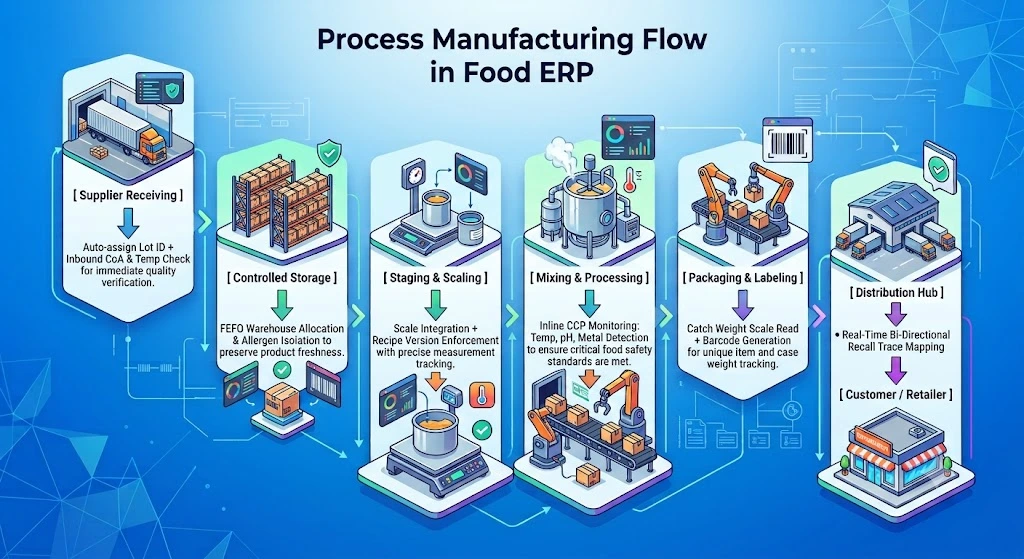
Inbound Receiving: Logs supplier batch numbers, harvest dates, certificates of analysis (CoAs), and assigns internal tracking numbers.
Work-in-Progress (WIP): Maps ingredient consumption across distinct mixing tanks, blending vessels, and packaging lines.
Outbound Distribution: Links specific customer orders and pallet IDs directly to production lot sequences.
Hypothetical Example:
Imagine a mid-sized Midwest dairy processor distributing flavored yogurts across ten regional supermarket chains. When a third-party fruit prep supplier flags a potential micro-pathogen risk in a batch of frozen strawberries, the plant manager faces an immediate crisis. With Duocron Solution, the quality team inputs the supplier's lot number and generates a comprehensive, bi-directional trace tree in under 60 seconds. The report isolates the exact 1,200 cartons produced during the Tuesday morning shift and pinpoints the 4 retail distribution centers that received them. Instead of issuing a catastrophic, nationwide brand recall that costs millions, the facility executes a surgical quarantine of only the affected lot, saving over $400,000 in product waste and protecting customer goodwill.
2. Recipe Formulation, Scalability, and R&D Version Control
Consistency is the hallmark of great food brands. A customer opening a jar of artisan pasta sauce expects the same viscosity, color, sodium balance, and acidity whether it was made in April or November. However, agricultural inputs vary by season, moisture level, and brix content.
Using ERP Software for food in USA, processors manage dynamic formulations:
Automated Batch Scaling: Recalculates ingredient weights based on tank capacity, yield variance, or available raw inventory.
Active Ingredient Potency Adjustment: Compensates automatically for fluctuating ingredient concentrations (such as enzymes or spices).
R&D Sandboxing & Versioning: Locks approved production recipes while allowing formulation chemists to test clean-label ingredient substitutions without disrupting active shop-floor bills of materials.
Duocron’s recipe formulation module functions like a master chef’s digital kitchen scale combined with a lab notebook. It locks down strict engineering change orders (ECOs), ensuring machine operators on the packaging floor cannot deviate from strict ingredient sequences or allergen profiles.
3. Allergen Isolation and Shop-Floor Quality Control
Food allergies are among the leading causes of US food recalls and catastrophic customer health emergencies. Managing cross-contact among major allergens (such as peanuts, milk, soy, tree nuts, and gluten) requires strict separation across storage racks, blending tanks, and conveyor belts.
A customized ERP Software for food enforces sanitation regimes right at the terminal:
Allergen-Aware Warehouse Putaway: Prevents operators from slotting allergenic ingredients on upper racks above non-allergenic inventory.
Automated Line-Clearance Checklists: Requires digital sign-offs, ATP swab readings, and temperature verifications before a line switches from an allergen-containing recipe to an allergen-free run.
Embedded Quality Inspections: Halts floor workflows if inline tests (pH levels, moisture, viscosity, metal detection logs) fall outside defined statistical process control boundaries.
By embedding digital sign-offs directly into floor terminals, Duocron Solution removes the human error inherent in paper clipboards, preventing cross-contamination before product hits the packaging conveyor.
4. Catch Weight Management for Proteins and Bulk Produce
In many sectors of food processing—such as meat, poultry, seafood, cheese, and fresh produce—units of inventory do not carry uniform weights. A pallet of 50 whole cured hams does not weigh an exact, static amount. Selling by the piece while purchasing, valuing, and costing by the pound is known as dual-unit or catch weight management.
Standard, off-the-shelf business software struggles with this dual-reality, causing immense stock discrepancies and distorted cost of goods sold (COGS). An advanced ERP Software for food in USA solves this by:
Dual-Unit Transaction Tracking: Simultaneously monitors stock in inventory units (e.g., cases, carcasses, wheels) and valuation units (e.g., pounds, kilograms).
Direct Scale Integration: Connects floor scales directly to warehouse and packing stations via IoT, reading weight instantly into order lines and barcode labels.
Precise Margin Calculation: Generates accurate customer invoices based on actual gross-to-net scale weights rather than loose averages.
Hypothetical Example:
Consider a specialty smokehouse in the Pacific Northwest shipping artisanal whole salmon fillets. Invoicing buyers on a flat estimated average weight was quietly leaking 3% to 5% of weekly revenues due to natural fillet size variance. By deploying Duocron Solution integrated directly with their digital inline packing scales, every case barcode auto-captures the exact tare and net weight at boxing. Invoices generate in real time against true weight pulled from the scale, recovering hundreds of thousands of dollars in annual margins that previously slipped through bookkeeping cracks.
5. Expiration Dating, FEFO Picking, and Perishability Control
Food products carry a countdown timer the moment crops are harvested or raw ingredients arrive at the receiving dock. Relying on First-In, First-Out (FIFO) warehouse picking often leads to disaster; a later-arriving batch might have a shorter shelf life due to transit delays or ambient humidity.
Leading ERP Software for food automates First-Expired, First-Out (FEFO) strategies:
Dynamic Shelf-Life Tracking: Automatically tracks remaining shelf life, quarantine holds, and mandatory maturation periods.
Automated Pick-Path Directives: Guides forklift drivers via handheld scanners to the oldest viable lot, systematically eliminating expired inventory dead stock.
Customer Shelf-Life Windows: Enforces minimum "guaranteed life" contracts (e.g., national club stores requiring at least 75% remaining shelf life upon distribution center delivery), automatically preventing early deliveries from getting rejected at the receiving bay.
6. Regulatory Audit Readiness (FDA FSMA, HACCP, SQF, BRC)
When the FDA, USDA, or third-party GFSI auditors walk through the plant doors, panic often sets in as staff scramble to gather logs, binder printouts, pest inspection sign-offs, and critical control point (CCP) charts.
Deployi ng an integrated ERP Software for food in USA converts compliance from an annual fire drill into a calm, continuous operational reality:
Integrated HACCP/HARPC Logs: Captures CCP records (cook temperatures, chiller speeds, metal detector calibration checks) digitally in real time.
Electronic Signatures (FDA 21 CFR Part 11): Enforces time-stamped, unalterable sign-offs for batch approvals, recipe changes, and sanitation logs.
Instant Regulatory Audit Packs: Compiles raw material certificates of analysis (CoAs), equipment sanitization logs, operator training certifications, and temperature graphs into an exportable dossier in minutes.
With Duocron’s tailored ERPNext compliance engines, processors can seat an inspector in a conference room with view-only dashboard access. Auditors review time-stamped digital control logs, see preventative maintenance verifications, and complete reviews in hours rather than agonizing days.
7. Precise Process Costing, Yield Variance, and Co-Product Accounting
Unlike discrete manufacturers that add static parts together, food manufacturers break materials down, condense them, or cook off moisture. For instance, milling grains creates varying grades of flour, bran, and chaff; pasteurizing and cheese-making produces curd and liquid whey.
Calculating accurate unit economics without a specialized ERP Software for food is virtually impossible. Modern enterprise solutions resolve process accounting through:
Yield Variance Analysis: Compares expected recipe output against actual yield, identifying equipment calibration issues or poor-quality raw ingredient batches.
By-Product & Co-Product Cost Allocation: Dynamically splits raw material and overhead costs between primary products (e.g., Greek yogurt) and co-products (e.g., acid whey used for beverage or feed mixes).
True Landed Costing: Integrates ocean freight, cold-chain transport surcharges, customs duties, and storage costs directly into the per-pound valuation of bulk inventory.
Technical Architecture: Why Modern Food Processors Choose Duocron Solution
Deploying enterprise technology in a food plant should not require tearing up your operational DNA or signing away corporate agility to predatory software vendors.
Duocron Solution takes the world-class, open-source power of ERPNext and wraps it in a robust, industry-ready process manufacturing layer engineered specifically to compete with legacy Tier-1 ERPs.
The Power of an Open Architecture
Traditional food software vendors trap American manufacturers in rigid systems featuring annual license price hikes, paywalled API integrations, and black-box code that requires expensive consultants for simple form modifications.
Duocron Solution breaks this mold:
Zero Per-User Licensing Fees: Scales your plant floor from 25 to 500 warehouse users, scale operators, and seasonal pickers without penalizing your budget.
Modern Restful API & IoT Hooks: Connects seamlessly with factory scales, thermal label printers, automated sorting conveyors, barcode scanners, and SCADA systems.
Tailored Workflow Engine: Adapts directly to your unique food processes—whether you run wet bottling, dry blending, meat slaughtering, or commercial baking lines.
Conclusion:
Transform Your Food Processing Operations with Duocron Solution
Navigating the competitive landscape of the food industry across the United States of America demands operational excellence, flawless regulatory compliance, and surgical margin control. Continuing to patch together spreadsheets, disconnected accounting software, and manual paper logs is an open invitation to product recalls, compliance penalties, and customer churn.
Adopting an industry-specialized ERP Software for food turns traceability, recipe consistency, and compliance into a competitive business advantage.
This is where Duocron Solution stands apart. With 18+ years of deep domain experience, over 200+ successful enterprise implementations, and a diverse roster of global customers, Duocron has mastered enterprise software delivery. Duocron possesses the proven engineering depth to execute mission-critical systems, including complex government sector projects. By extensively customizing ERPNext to make it truly process-industry ready, Duocron provides an agile, robust enterprise platform that directly competes with expensive Tier-1 ERPs at a fraction of the total cost of ownership. It is the ideal, future-proof fit for mid to large-scale food processors looking to scale confidently.
Ready to automate traceability, protect your recipes, and achieve stress-free compliance? Partner with Duocron Solution to revolutionize your food manufacturing operations today.
Frequently Asked Questions
What makes ERP Software for food different from standard manufacturing ERPs?
Standard manufacturing ERPs are built for discrete assembly—putting parts together into cars, furniture, or electronics. An ERP Software for food is specifically designed for process manufacturing. It manages recipes that cannot be disassembled, handles raw material quality variances, tracks batch-level expiration dates, calculates yields and scrap, supports catch weights for uneven products, and enforces FDA FSMA and HACCP compliance standards across every stage of processing. Duocron Solution customizes ERPNext to provide these exact process manufacturing tools right out of the box.
How does Duocron Solution help food companies comply with FDA FSMA 204 regulations?
FDA FSMA Rule 204 requires food facilities on the Food Traceability List to track Critical Tracking Events (CTEs) and Key Data Elements (KDEs) across harvesting, cooling, packing, receiving, and shipping. Duocron Solution provides automated, sub-minute bi-directional lot traceability. With built-in digital logs for certificates of analysis, temperature checks, and electronic signatures, Duocron creates an unalterable audit trail that lets you generate complete mock recall and compliance reports in seconds.
Can ERP Software for food handle catch weight items like meats and cheeses?
Yes. Quality ERP Software for food in USA features native dual-unit of measure (catch weight) capabilities. It allows you to buy, store, and count items by the piece or case while simultaneously tracking, valuing, and billing by actual weight (such as pounds or ounces). Duocron Solution integrates directly with floor scales and thermal label printers to automatically record exact weights into inventory and customer invoices, eliminating margin leakage on naturally variable products.
How long does it take to implement Duocron Solution for a food processing plant?
While traditional Tier-1 ERP implementations frequently drag on for 18 to 24 months, Duocron Solution’s pre-configured, industry-ready process manufacturing framework speeds up delivery considerably. Backed by 18+ years of enterprise experience and 200+ successful deployments, Duocron typically brings mid-to-large food manufacturing facilities live in 3 to 6 months through phased, milestone-driven rollouts that prevent floor disruptions.
Is Duocron Solution suitable for mid-sized food manufacturers looking to replace Tier-1 ERPs?
Absolutely. Many mid-to-large food companies find traditional Tier-1 ERPs excessively rigid, cumbersome to maintain, and prohibitively expensive due to escalating per-user license costs. Duocron Solution bridges this gap by engineering the open-source ERPNext platform into a powerhouse enterprise system. You get enterprise-grade batch manufacturing, dynamic yield costing, advanced warehouse management, and high-security compliance without recurring license fees, making it an agile, high-ROI alternative to Tier-1 legacy software.
Related Articles:
Benefits of Using ERP Software for Food in USA: The Definitive Guide for Process Manufacturers
5 Steps to Select the Right Food ERP Vendor in USA
Food Manufacturing Compliance: Essential Regulations Every ERP Must Support in USA
10 Must-Have Features Every Food Manufacturing ERP Should Have
Top Food Manufacturing Trends in USA for 2026: The Future of Cloud ERP
ERPNext's Quality Management for Food Manufacturers Explained
How ERPNext Helps Reduce Food Waste and Improve Profitability For Food Manufacturers in USA
Master Batch Tracking, Lot Traceability, and Expiry Management with Food Manufacturing ERP Software
A Complete Guide to ERPNext for Food Manufacturing: Inventory, Production, Quality & Compliance
Why USA Food Manufacturers Are Choosing ERPNext Over Traditional ERP Systems in 2026
Top 10 ERP Challenges Food Manufacturers in USA Face & How ERPNext Solves Them
Why Modern Food Beverage Manufacturing Companies in USA Must Choose ERPNext ?
Top 5 ERP Software for Food & Beverage Industry in USA (2026)
How to Choose ERP for Food & Beverage Industry: Step-by-Step Implementation Guide for USA (2026)
Must-Have Features of the Best ERP for Food & Beverage Industry in USA (2026)
What is ERP for Food & Beverage Industry? Complete Guide for the United States of America (USA)
Author Bio

Aarav Sharma
Aarav Sharma is an ERPNext Consultant at DuoCron Solutions specializing in manufacturing ERP and process optimization. Outside work, Aarav enjoys exploring new technology trends and writing about digital transformation in manufacturing.