An ERP for Food & Beverage Industry in USA is a specialized enterprise resource planning platform engineered to unify recipe formulation, batch processing, inventory control, regulatory compliance, and multi-echelon distribution into a single synchronized system. Unlike generic software built for assembling discrete parts like bolts and engines, a dedicated food manufacturing ERP manages unpredictable biological variables, catch weights, perishable shelf lives, and strict federal food safety mandates.
For American processors, Duocron Solutions delivers an agile, custom-built, industry-ready food and beverage ERP software powered by ERPNext. It bridges complex plant-floor operations with enterprise finance, giving processors the precise control needed to manage fluctuating supply chains and protect their brand integrity.
The Recipe-to-Retail Reality: Why Generic Software Fails American Processors
Operating a food or beverage facility in the United States is fundamentally different from running standard manufacturing plants. If you assemble office chairs and a batch sits in a warehouse for an extra three weeks, the chairs do not rot, separate, or fail a microbiological swab. In process manufacturing, raw materials are living, variable ingredients with limited lifespans.
Think of a generic ERP system like an office spreadsheet attempting to run a commercial bakery: it assumes every pound of flour absorbs the exact same humidity, every oven heats uniformly, and an egg has the same mass as a steel rivet. It simply does not work.
A specialized food and beverage ERP software acts as the central nervous system of your business. It connects raw ingredient purchasing from Midwestern grain elevators or California orchards directly to continuous batch processing, quality lab analysis, cold storage logistics, and major grocery distribution channels.
Key Drivers Shaping the ERP for Food & Beverage Industry in USA
The American market operates under distinct economic pressures, consumer habits, and federal regulatory scrutiny. A modern F&B ERP USA deployment must solve several immediate operational hurdles:
FSMA 204 & FDA Traceability Mandates: The Food Safety Modernization Act (FSMA Rule 204) requires supply chain handlers of items on the Food Traceability List (FTL)—such as nut butters, soft cheeses, fresh leafy greens, and finfish—to document Critical Tracking Events (CTEs) and Key Data Elements (KDEs). When an audit occurs, the FDA demands digital traceability records within 24 hours.
Perishability & The Cold Chain: Transporting dairy from Wisconsin or seafood from Maine across thousands of miles requires tight visibility into shelf lives, temperature variances, and expiration dates.
Catch-Weight Dynamics: In protein processing, poultry, and cheese manufacturing, two blocks of cheddar cut from the exact same curd block will rarely weigh the exact same amount. Systems must track dual units of measure (pieces and variable weights) accurately.
Retail Partner Demands: Major US retailers like Walmart, Kroger, and Costco enforce rigid Electronic Data Interchange (EDI) standards, ASN (Advanced Shipping Notice) compliance, and OTIF (On-Time, In-Full) delivery thresholds with severe financial chargebacks for non-compliance.
Allergen & Cross-Contact Segregation: The FALCPA (Food Allergen Labeling and Consumer Protection Act) and the FASTER Act (which recognized sesame as the 9th major food allergen) make allergen management life-or-death. Software must lock down equipment, scheduling, and recipes to prevent cross-contamination.
Core Modules of an ERP Solution for Food Manufacturers
A complete ERP solution for food manufacturers connects every segment of operations, ensuring that data moves seamlessly from receiving docks to corporate ledger reports.
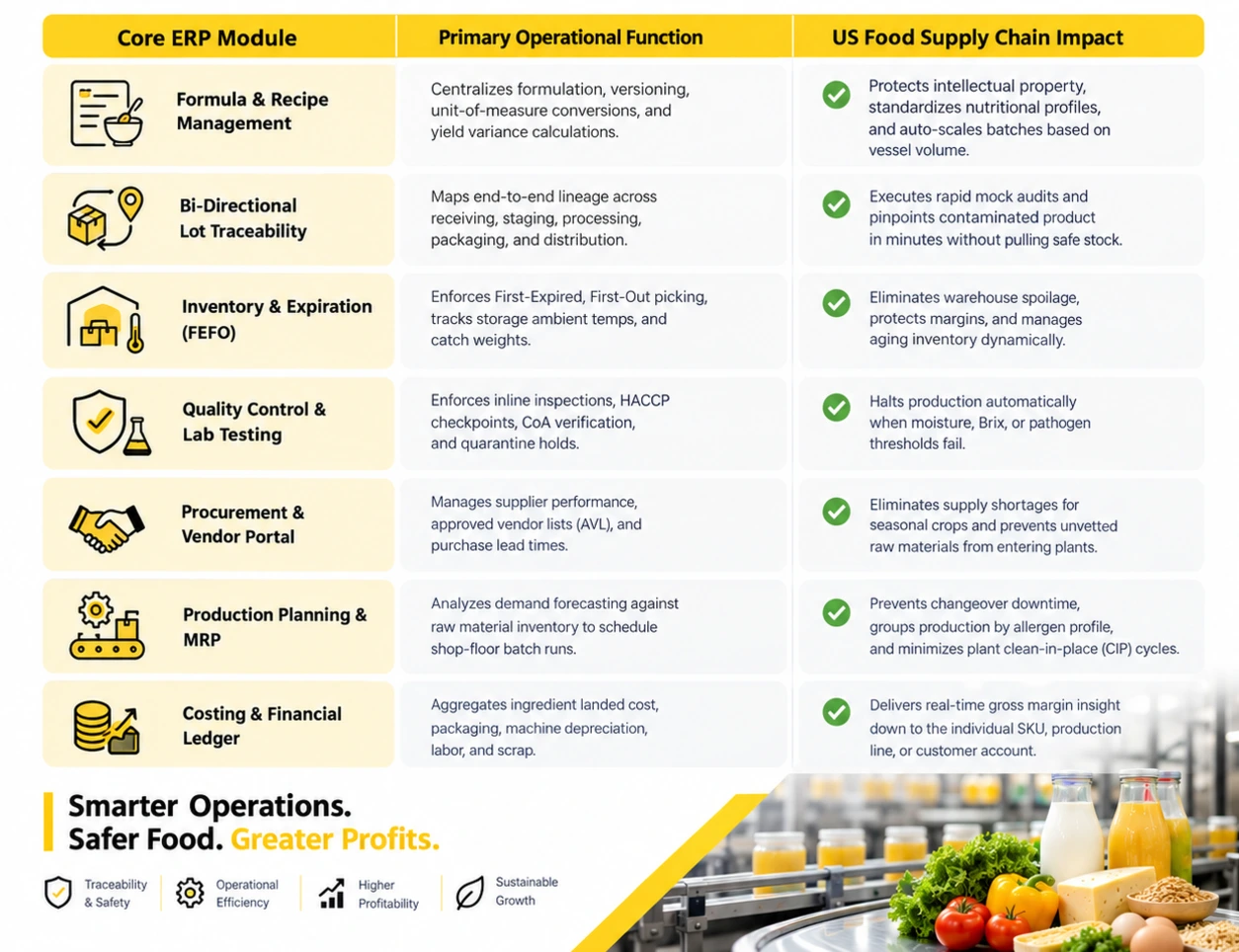
Supply Chain Operations:
Connecting the Plant Floor to the Retail Shelf
Deploying a modern F&B ERP US setup transforms how food companies handle day-to-day operations across their entire value chain.
1. Inbound Logistics & Farm-to-Dock Receiving
When a refrigerated truck carrying raw strawberries pulls into an Oregon processing plant, the software immediately links the physical shipment with the digital purchase order.
Workers scan lot barcodes via mobile handhelds, capturing harvest dates, vendor lot IDs, and container temperatures. The ERP cross-checks the vendor’s Certificate of Analysis (CoA) against established internal safety specifications. If the fruit’s temperature drifted above 38°F during transit, the platform triggers an automatic quarantine, isolating the lot before it can be tipped onto a processing line.
2. Batch Processing, Formulation, and Catch-Weight Handling
Formulation is where profit margins are won or lost. Process manufacturing requires sophisticated handling of dynamic yields.
For example, when brewing craft beer or processing citrus juice, ingredient potency changes from harvest to harvest. If a batch of hops has a lower alpha-acid percentage, the ERP's dynamic formulation engine calculates the exact ratio adjustments required to keep flavor profiles identical.
Simultaneously, catch-weight calculations ensure that variable-weight goods—such as whole smoked hams or artisan wheels of gouda—are tracked and billed by their exact scale weights while maintaining standard unit counts for pallet planning.
3. Allergen Management and Clean-in-Place (CIP) Scheduling
Allergens represent one of the leading causes of FDA-mandated food recalls. An advanced food manufacturing ERP system acts as an operational guardrail.
If Line 3 produces almond milk and oat milk on the same day, the software sequences oat runs first, followed by almond runs, minimizing equipment sanitation turnaround. If an unscheduled order attempts to insert an allergen-containing recipe into an unauthorized line, the system locks the work order until a validated Clean-in-Place (CIP) sanitization log is signed off digitally by quality assurance.
4. Warehouse Operations & Dynamic FEFO Distribution
Standard warehouses run on FIFO (First-In, First-Out), but food operations run on FEFO (First-Expired, First-Out).
Consider a Midwest distributor supplying yogurt to national supermarket accounts. Different grocery chains demand varying remaining shelf-life guarantees: Store A may reject any product delivered with less than 45 days of remaining code life, while Store B may accept 25 days at a discounted vendor allowance.
The ERP's picking logic directs forklift drivers via mobile scan-guns to pull specific pallet tags matching each customer’s contractual rules, preventing costly dock rejections, spoilage losses, and shipping fines.
5. Bi-Directional Recall Readiness & Mock Audits
When an ingredient contamination scare occurs, speed is everything. Bi-directional lot genealogy allows safety directors to run mock recalls in seconds:
Trace-Backward: Taking a finished carton of salsa from a supermarket shelf and tracing back through the production work order to identify the precise lot of imported cilantro, the blender it touched, and the exact vendor shipment it came from.
Trace-Forward: Taking that tainted lot of cilantro and finding every single batch of salsa, guacamole, or dip it entered, identifying which distribution centers hold remaining cases, and identifying every retail customer who purchased them.
Instead of spending three days digging through paper binders and clipboards, processors generate FDA-compliant traceability spreadsheets and chain-of-custody logs with a single click.
Business Benefits of Food and Beverage ERP Software
Investing in a purpose-built ERP for Food & Beverage Industry in USA delivers compounding operational and financial returns:
Drastic Food Waste Reduction: By enforcing real-time visibility and automated FEFO algorithms, processors routinely reduce warehouse spoilage and ingredient obsolescence by 20% to 35%.
Total Audit Readiness: Whether facing surprise USDA plant visits, annual SQF/BRCGS certifications, or FDA FSMA 204 audits, your compliance documentation, training logs, and lot records remain permanently digital and accessible.
Pinpoint Yield and Margin Clarity: Raw agricultural commodities experience continuous price volatility. Process ERP tracks direct materials, landed freight surcharges, machine utility expenses, and labor routing, showing true gross margin down to the penny for every run.
Protection Against Brand Destruction: A single public contamination event can bankrupt an emerging brand. Rapid isolation keeps consumer safety intact and preserves distributor relationships.
Evaluating F&B ERP Systems in the US Market
Food and beverage processors looking for an ERP solution for food manufacturers typically evaluate several enterprise options:
Legacy Tier 1 Suites (SAP S/4HANA, Oracle): Exceptional transactional muscle for multi-billion-dollar conglomerates, but plagued by rigid architectures, multi-year rollout timelines, and astronomical licensing overhead.
Mid-Market Proprietary Platforms (Aptean, Infor M3): Strong process-focused features out of the box, but often built on older frameworks that lock users into costly, closed vendor ecosystems and high customization price tags.
Modern, Open-Architecture ERP (Duocron Solutions powered by ERPNext): Combines the power, agility, and flexibility of open technologies with tailored industry customization. It gives mid-to-large-scale processors complete control over their source workflows, data sovereignty, and licensing costs without sacrificing compliance power.
Overcoming Food & Beverage Implementation Challenges
Deploying enterprise systems inside active manufacturing environments carries real operational friction. Recognizing these roadblocks early protects your timeline:
Data Migration Quality: Moving dirty legacy spreadsheets containing outdated recipe variations, duplicate vendor catalogs, and inaccurate stock counts will derail your new software. Clean, scrub, and validate your data before importing.
Plant-Floor Adoption: Line operators working in cold, wet, or fast-paced wash-down zones cannot navigate clumsy desktop forms. Implement ergonomic barcode scanners, touchscreen shop-floor interfaces, and intuitive tablet workflows.
Change Management: Plant personnel often resist new software. Prioritize comprehensive operational training, run phased dry runs on production lines, and ensure floor supervisors understand how automated lot scanning simplifies their daily shift reporting.
Conclusion:
Transform Your Food Processing Operations with Duocron Solutions
The United States food and beverage sector moves at breakneck speed, leaving zero margin for manual recordkeeping, unmonitored waste, or delayed recalls. Modernizing your production floor with an industry-tailored ERP for Food & Beverage Industry in USA is the single most effective way to protect profitability, satisfy retail partners, and ensure ironclad food safety.
When selecting your implementation partner, execution experience is paramount. Duocron Solutions stands out as the premier ERPNext service provider, bringing 11+ years of deep technical and operational experience and a track record of 200+ successful enterprise implementations worldwide. From handling highly complex, secure government engineering projects to architecting mission-critical systems for global manufacturing enterprises, Duocron has the proven capacity to scale your business.
Duocron has customized and extended ERPNext into an industry-ready process manufacturing powerhouse. By engineering custom-tailored modules for bi-directional lot genealogy, FSMA 204 compliance, dynamic recipe scaling, and catch-weight management, Duocron delivers an enterprise solution that directly competes with expensive Tier 1 ERP platforms. The result is a perfect fit for growing mid-to-large-scale food and beverage operations seeking agility, lower total cost of ownership, and enterprise-grade performance. Partner with Duocron Solutions to modernize your plant floor and future-proof your supply chain.
Frequently Asked Questions (FAQs)
What makes an ERP for the food and beverage industry different from standard manufacturing ERPs?
A standard manufacturing ERP is built for discrete parts assembly, whereas an ERP for Food & Beverage Industry in USA is built specifically for process manufacturing. It manages variable raw material potency, recipe formulations, strict expiration dates (FEFO), batch tracking, catch weights, and stringent FDA compliance mandates. Duocron Solutions customizes ERPNext to give food manufacturers these exact capabilities without the cost and complexity of bloated legacy systems.
How does an F&B ERP software ensure compliance with FDA and FSMA 204 regulations?
A modern food and beverage ERP software digitally tracks Key Data Elements (KDEs) across all Critical Tracking Events (CTEs)—from harvest receiving to finished product shipping. This creates an unbroken, digital audit trail that allows processors to generate end-to-end recall reports within 24 hours. Duocron Solutions integrates automated CTE and KDE capture directly into floor workflows, ensuring your plants remain audit-ready at all times.
Can an ERP system handle catch weights and variable ingredient yields accurately?
Yes. A specialized food manufacturing ERP natively tracks inventory in dual units of measure (e.g., cases and exact scale weight) and dynamically recalculates ingredient costs and recipe ratios based on moisture loss or batch scrap. Duocron Solutions configures ERPNext with advanced catch-weight and yield variance modules, providing processors with precise gross margin insights on every single production run.
What is the typical timeline and cost to implement a food and beverage ERP in the US?
Mid-market implementations generally take between 4 to 9 months, depending on multi-facility footprints, machine integrations, and warehouse scale. While traditional proprietary platforms require high upfront licensing and recurring per-user fees, Duocron Solutions leverages an agile ERPNext foundation, cutting total cost of ownership (TCO) significantly while speeding up deployment timelines through tested industry templates.
Why should food and beverage manufacturers choose Duocron Solutions over Tier 1 ERP vendors?
Tier 1 ERP suites often involve bloated rollouts, multi-million-dollar price tags, and rigid architectures. Duocron Solutions brings 11+ years of deep engineering experience, 200+ successful rollouts, and a history of executing complex enterprise and government projects. Duocron transforms open, scalable ERPNext architecture into a high-performance, industry-ready platform that matches Tier 1 capabilities at a fraction of the cost, making it the ideal choice for scaling US food processors.
Related Articles:
Benefits of Using ERP Software for Food in USA: The Definitive Guide for Process Manufacturers
5 Steps to Select the Right Food ERP Vendor in USA
Food Manufacturing Compliance: Essential Regulations Every ERP Must Support in USA
10 Must-Have Features Every Food Manufacturing ERP Should Have
7 Use Cases of ERP Software For Food Industries In The USA
Top Food Manufacturing Trends in USA for 2026: The Future of Cloud ERP
ERPNext's Quality Management for Food Manufacturers Explained
How ERPNext Helps Reduce Food Waste and Improve Profitability For Food Manufacturers in USA
Master Batch Tracking, Lot Traceability, and Expiry Management with Food Manufacturing ERP Software
A Complete Guide to ERPNext for Food Manufacturing: Inventory, Production, Quality & Compliance
Why USA Food Manufacturers Are Choosing ERPNext Over Traditional ERP Systems in 2026
Top 10 ERP Challenges Food Manufacturers in USA Face & How ERPNext Solves Them
Why Modern Food Beverage Manufacturing Companies in USA Must Choose ERPNext ?
Top 5 ERP Software for Food & Beverage Industry in USA (2026)
How to Choose ERP for Food & Beverage Industry: Step-by-Step Implementation Guide for USA (2026)
Must-Have Features of the Best ERP for Food & Beverage Industry in USA (2026)
Author Bio

Aarav Sharma
Aarav Sharma is an ERPNext Consultant at DuoCron Solutions specializing in manufacturing ERP and process optimization. Outside work, Aarav enjoys exploring new technology trends and writing about digital transformation in manufacturing.