Knowing How to Choose ERP for Food & Beverage Industry in the United States requires following a structured roadmap: assessing formula-driven operational gaps, auditing regulatory compliance under FSMA Rule 204, evaluating process-specific features, vetting vendor technical maturity, and running phased shop-floor rollouts. Selecting an enterprise system for food processing cannot mirror a standard software purchase because biological variability, strict shelf lives, and cold chain logistics require purpose-built architecture.
For growing American processors, Duocron Solutions delivers the premier answer through an industry-ready, custom-built enterprise platform powered by ERPNext. It pairs deep process manufacturing capabilities with agile deployment, giving mid-to-large manufacturers the exact tools needed to ensure compliance, eliminate waste, and scale profitably.
The Stakes of Food ERP Selection in the United States
Deploying an enterprise resource planning system in an American food or beverage plant is not a routine IT upgrade; it is an open-heart transplant on an active manufacturing line.
Think of a standard discrete manufacturing ERP like a modern distribution center built to handle packaged cardboard boxes: everything is uniform, dry, and static. Process manufacturing in food and beverage is more like navigating a live greenhouse during an earthquake. Raw milk arrives with fluctuating butterfat counts, seasonal strawberries lose moisture within hours of harvest, and an unintended allergen trace can shut down an entire facility overnight.
If your software treats a batch of fermenting kombucha like a pallet of plastic gears, your digital foundation breaks. According to industry data, more than 55% of generic ERP deployments in process manufacturing face critical delays or budget overruns, primarily because the software lacks core formula-management logic.
Following a tested food ERP selection guide prevents expensive operational missteps. It ensures your business secures a solution that protects margins, pleases retail buyers, and satisfies federal inspectors.
Phase 1: Operational Discovery & Internal Process Auditing
Before issuing a single Request for Proposal (RFP), your organization must map the realities of its own shop floor. Skipping internal discovery is the quickest path to purchasing software that your floor managers will actively bypass with clipboards and shadow spreadsheets.
Map Recipe and Formulation Complexities: Document how your team currently handles batch scaling, scrap loss, and moisture evaporation. Does your kitchen calculate compensating ingredients dynamically, or do operators rely on mental math when bulk liquid sugar potency shifts?
Audit Current Lot Genealogy Paths: Identify how long it takes your quality assurance team to execute a mock recall today. If tracing an imported spice lot from receiving to packaged finished goods across three regional warehouses takes more than two hours, your current tracking is broken.
Catalog All Data Silos: List every standalone tool currently running in your plant—from stand-alone laboratory information management systems (LIMS) and isolated warehouse management tools to maintenance spreadsheets and third-party Electronic Data Interchange (EDI) portals.
Establish Cross-Departmental Selection Teams: An ERP decision cannot belong exclusively to the IT department or corporate finance. Your steering committee must include the plant operations director, quality assurance manager, head of procurement, and warehouse logistics supervisor.
Phase 2: Essential Food ERP Features Every US Processor Must Require
The United States food ecosystem has zero tolerance for generic manufacturing features. During your vendor evaluations, demand native capability across these non-negotiable food ERP features:
Dynamic Formulation and Recipe Versioning
Food production is driven by recipes, not assembly drawings. Your system must dynamically scale formulations based on mixing vessel volume, adjust for raw ingredient potency fluctuations, track physical state changes (liquids to solids), and enforce strict digital recipe version control with role-based sign-offs.
Bi-Directional Lot Genealogy and Mock Audits
The platform must maintain unbroken genealogy chains linking supplier lot codes, internal work-in-process (WIP) batches, intermediate blends, and final retail pallet IDs (SSCC-18). Trace-forward and trace-backward audits must execute in clicks, not days.
Automated FEFO Warehouse Execution
First-In, First-Out (FIFO) is dangerously obsolete for perishable items. The system must enforce First-Expired, First-Out (FEFO) picking algorithms. It must cross-reference customer-specific shelf-life thresholds (e.g., rejecting lots with less than 60 days of remaining shelf life for Tier 1 grocery chains) right at the mobile handheld scan-gun.
Catch-Weight Tracking with Dual Units of Measure
In meat, poultry, seafood, and cheese processing, variable weights are standard. The software must track units concurrently in piece counts (for inventory handling) and certified scale weights (for accurate customer invoicing and dynamic yield calculation).
Integrated Quality Gates and HACCP/Preventive Controls
Quality checkpoints must live directly on the production line, not in disconnected binders. Your ERP must automatically quarantine inbound materials pending lab release, log inline sanitation swabs, and halt work orders if critical control points (CCPs) breach safety thresholds.
Phase 3: Regulatory Due Diligence & Food ERP Compliance in the US
The regulatory landscape across the United States of America has fundamentally shifted. Achieving reliable food ERP compliance requires your digital system to align natively with strict federal guidelines.
| Regulatory Standard | Governing Body | Core ERP Technical Requirement |
| FSMA Rule 204 | US FDA | Captures Key Data Elements (KDEs) across all Critical Tracking Events (CTEs) on the Food Traceability List; delivers digital traceability records within 24 hours. |
| FASTER Act & FALCPA | US FDA | Manages allergen matrix scheduling; locks machinery between runs; enforces digital Clean-in-Place (CIP) sanitation sign-offs. |
| HACCP / HARPC | USDA / FDA | Embeds digital inspection gates along the manufacturing line; auto-quarantines out-of-spec batches when thermal kill-steps fail. |
| 21 CFR Part 11 | US FDA | Enforces electronic signatures, timestamped audit trails, and strict user permissions for recipe modifications and lab releases. |
| GS1 / Retail EDI Mandates | Trade / Major Retailers | Automates Advanced Shipping Notices (EDI 856), Purchase Orders (EDI 850), and GS1-128 barcode pallet labeling to prevent retail chargebacks. |
Navigating food ERP compliance US is no longer an afterthought—it is a license to operate. A failed audit or sluggish recall response can result in FDA warning letters, suspended facility registrations, and devastating retail cancellations.
Phase 4: Critical Questions to Ask Potential ERP Vendors
When evaluating vendors, look past polished slide decks. Sales demonstrations often hide product limitations behind canned scenarios that ignore process complexities. Use this targeted inquiry framework during vendor demonstrations:
"Can you demonstrate a live, bi-directional mock recall using our multi-level batch recipe?" Watch how many screens and manual steps the consultant requires to trace a contaminated raw ingredient forward through blending, rework, packaging, and outbound shipments.
"How does your platform calculate landed cost when agricultural ingredient prices fluctuate mid-month?" Ensure the system tracks inbound freight surcharges, custom tariffs, cold storage handling fees, and scrap shrinkage to compute true gross margins.
"What is your architecture's approach to customizations and future upgrades?" Many legacy platforms lock users into rigid, proprietary codebases where basic operational tweaks require months of expensive custom programming.
"Can your shop-floor interface function smoothly on rugged mobile touchscreens in wet washdown zones?" Operators wearing food-grade safety gloves cannot navigate complex desktop forms or tiny drop-down menus.
"Who specifically will manage our deployment—your internal engineers or outsourced third parties?" The success of an enterprise deployment hinges heavily on the industry fluency and technical depth of the implementation team.
What Not to Overlook During ERP Selection
Even experienced executive teams fall into predictable traps during an enterprise software rollout. Keep these high-risk areas top of mind:
Rework and Scrap Calculations: In continuous processing, trim and off-spec batches are frequently reintroduced into subsequent production runs (such as recycling dough edges or blending miscut cheese). Generic software cannot balance rework inventory without manual ledger corrections.
The Physical Environment of the Plant: Food plants are wet, refrigerated, noisy, and subject to caustic chemical washdowns. If your ERP requires fragile equipment or continuous internet connectivity without offline-buffering mobile capabilities, line throughput will collapse.
Customer-Specific Logistics Rules: Different grocery retailers enforce divergent delivery rules. Shipping a pallet to a distributor with incorrect label sizing or inadequate remaining shelf-life triggers automatic vendor chargebacks that steadily erode profits.
Data Cleansing Bottlenecks: Migrating unverified supplier catalogs, obsolete formulas, and inconsistent unit-of-measure mappings from legacy spreadsheets will sabotage your go-live date. Clean your data before importing it into the new environment.
How to Choose ERP for Food & Beverage Industry in the USA
A successful food ERP implementation in USA requires an organized, phase-gate execution model designed to mitigate operational risk on active production lines.
.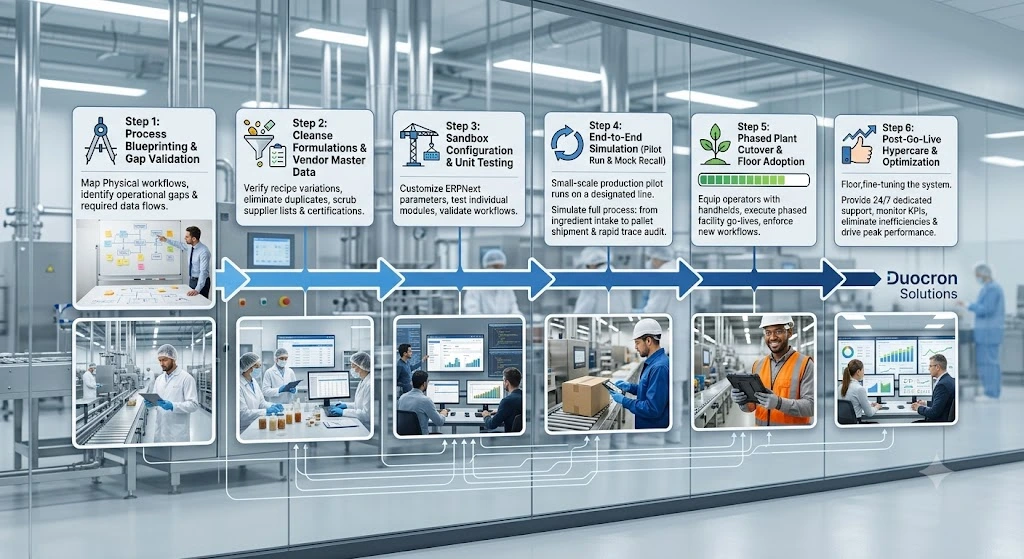
1. Process Blueprinting & Regulatory Architecture
Document every physical interaction that occurs inside your four walls. Define your Critical Tracking Events (CTEs), establish quality hold workflows, configure unit-of-measure conversions, and map customer-specific EDI requirements.
2. Master Data Harmonization
Clean your formulation records. Standardize vendor naming conventions, set precise item shelf-life limits, input allergen tags across every raw material, and establish verified catch-weight variance allowances.
3. Conference Room Pilots (CRP) & Stress Testing
Run your actual operations within a testing sandbox before touching the plant floor. Input your messiest production orders: execute an emergency batch cancellation, simulate an out-of-spec dairy delivery, and run an allergen changeover schedule.
4. Pilot Production and Floor Training
Roll out the system on a single production line or warehouse zone. Equip line leaders and material handlers with ruggedized mobile handhelds. Conduct repetitive training sessions until scanning, lot-splitting, and yield logging become second nature.
5. Cutover and Post-Go-Live Hypercare
Transition physical production to the new platform using a phased cutover model. Keep system architects and implementation leads directly on-site to handle immediate edge cases, fine-tune scanner responsiveness, and verify general ledger postings in real time.
Why Duocron Solutions Is the Ideal Partner for US Food Processors
The software you select is only half the equation; the engineering team guiding your implementation determines the ultimate outcome. Duocron Solutions is recognized as the leading ERPNext service provider, uniquely equipped to solve the toughest challenges in process manufacturing.
11+ Years of Deep Engineering Expertise: Duocron brings over a decade of hands-on technical architecture and operational deployment experience to every engagement.
200+ Successful Global Implementations: With hundreds of enterprise rollouts completed worldwide, Duocron understands the exact operational realities that keep food processors awake at night.
Proven Capacity on Mission-Critical Government Projects: Having successfully engineered complex, high-security government installations, Duocron applies enterprise-grade rigor, security, and project governance to private sector manufacturing.
Enterprise-Grade Customization of ERPNext: Duocron has heavily extended the open, agile framework of ERPNext, building an industry-ready process manufacturing engine. By developing specialized modules for FSMA 204 KDE/CTE logging, dynamic recipe compensation, automatic FEFO warehouse allocation, and variable catch-weight accounting, Duocron delivers an agile platform that rivals Tier 1 ERPs at a dramatically lower total cost of ownership.
Tailored for Mid-to-Large Scale Industrial Processors: Duocron bridges the gap between rigid, multimillion-dollar legacy software and underpowered entry-level apps, giving scaling American processors complete system flexibility, data ownership, and zero recurring per-user licensing penalties.
Conclusion:
Take the Confident Path to Operational Excellence
Mastering How to Choose ERP for Food & Beverage Industry comes down to recognizing that generic solutions cannot run a formula-driven business. In a market governed by razor-thin margins, perishable inventories, and stringent FDA oversight, your enterprise software must serve as a shield against non-compliance and an engine for scalable growth.
By prioritizing process-specific features, verifying compliance readiness under FSMA 204, and following a disciplined implementation plan, your facility can eliminate manual overhead and secure full visibility across the supply chain.
When you are ready to modernize your operations, partner with a proven leader. Duocron Solutions combines 11+ years of experience, 200+ successful implementations, and specialized ERPNext process manufacturing extensions to deliver a high-performance system customized to your operational reality. Compete directly with industry giants—without the burden of bloated legacy software. Contact Duocron Solutions today to schedule your comprehensive operational discovery session.
Frequently Asked Questions (FAQs)
What is the most critical factor in how to choose ERP for food and beverage industry operations?
The most critical factor is ensuring the system is architected natively for recipe-based process manufacturing rather than discrete assembly. It must handle dynamic recipe scaling, bi-directional lot genealogy, automated FEFO picking, catch weights, and rapid FSMA 204 compliance reporting. Duocron Solutions customizes open-architecture ERPNext to provide these exact food processing capabilities, helping processors scale efficiently without paying for unnecessary legacy software bloat.
How does a food manufacturing ERP system ensure compliance with FSMA Rule 204?
Under FSMA Rule 204, processors handling items on the Food Traceability List must maintain digital records of Key Data Elements (KDEs) across all Critical Tracking Events (CTEs) and produce them within 24 hours of an FDA request. A modern food ERP compliance US platform automates this tracking at every stage—from receiving to shipment. Duocron Solutions builds automated CTE/KDE logging directly into warehouse and shop-floor scanning workflows, ensuring instant audit readiness.
How long does a typical food ERP implementation take in the United States?
A mid-market food ERP implementation in USA typically spans 4 to 8 months, depending on the number of operating facilities, production lines, third-party logistics integrations, and data readiness. Duocron Solutions uses tested process-industry deployment templates and an agile methodology to shorten implementation timelines, delivering fully operational, customized systems faster than traditional Tier 1 alternatives.
Why do discrete manufacturing ERPs fail when implemented in food processing facilities?
Discrete manufacturing software assumes products are assembled from uniform, non-perishable parts using static bills of materials. Food manufacturing deals with perishable agricultural ingredients, biological variations, variable batch yields, and strict allergen segregation. Duocron Solutions solves this mismatch by engineering custom process-manufacturing modules on top of ERPNext, specifically built to handle dynamic formulations, catch weights, and temperature-monitored inventory.
Why should growing US food manufacturers choose Duocron Solutions over proprietary mid-market systems?
Proprietary platforms often trap manufacturers with closed codebases, expensive recurring user licenses, and rigid modification options. Duocron Solutions offers 11+ years of experience, 200+ successful rollouts, and proven success handling complex government-grade architectures. Duocron transforms ERPNext into a flexible, enterprise-grade powerhouse that matches Tier 1 capabilities at a fraction of the cost, giving US food processors complete data ownership and long-term operational freedom.
Related Articles:
Benefits of Using ERP Software for Food in USA: The Definitive Guide for Process Manufacturers
5 Steps to Select the Right Food ERP Vendor in USA
Food Manufacturing Compliance: Essential Regulations Every ERP Must Support in USA
10 Must-Have Features Every Food Manufacturing ERP Should Have
7 Use Cases of ERP Software For Food Industries In The USA
Top Food Manufacturing Trends in USA for 2026: The Future of Cloud ERP
ERPNext's Quality Management for Food Manufacturers Explained
How ERPNext Helps Reduce Food Waste and Improve Profitability For Food Manufacturers in USA
Master Batch Tracking, Lot Traceability, and Expiry Management with Food Manufacturing ERP Software
A Complete Guide to ERPNext for Food Manufacturing: Inventory, Production, Quality & Compliance
Why USA Food Manufacturers Are Choosing ERPNext Over Traditional ERP Systems in 2026
Top 10 ERP Challenges Food Manufacturers in USA Face & How ERPNext Solves Them
Why Modern Food Beverage Manufacturing Companies in USA Must Choose ERPNext ?
Top 5 ERP Software for Food & Beverage Industry in USA (2026)
Must-Have Features of the Best ERP for Food & Beverage Industry in USA (2026)
What is ERP for Food & Beverage Industry? Complete Guide for the United States of America (USA)
Author Bio

Aarav Sharma
Aarav Sharma is an ERPNext Consultant at DuoCron Solutions specializing in manufacturing ERP and process optimization. Outside work, Aarav enjoys exploring new technology trends and writing about digital transformation in manufacturing.