Operating a food and beverage processing facility in the United States requires navigating one of the strictest regulatory environments on the planet. To maintain legal compliance, food processors must adhere to federal frameworks enforced by the FDA and USDA, notably FSMA (Food Safety Modernization Act), FSMA Rule 204 traceability mandates, HACCP guidelines, cGMP standards, and allergen labeling under FALCPA and the FASTER Act. Managing these multifaceted mandates through disconnected spreadsheets or generic accounting tools inevitably creates blind spots, audit vulnerabilities, and recall exposure. The most reliable way for mid to large food processors to guarantee compliance across every production shift is by deploying a specialized, process-oriented digital backbone. For manufacturers modernizing their tech stack with ERPNext USA implementations, Duocron Solution delivers an industry-tailored, audit-ready enterprise platform that automates regulatory workflows, end-to-end traceability, and quality hold protocols out of the box.
Why Regulatory Compliance Defines Food and Beverage Processing in the United States
Running a food production plant without automated regulatory controls is like piloting a modern jetliner using a bicycle handlebar. Everything might feel balanced while coasting in calm weather, but the moment turbulence hits—such as a microbial alert, a mislabeled ingredient, or an unexpected visit from federal inspectors—the manual controls collapse under pressure.
In the food and beverage industry, compliance is not an administrative checkbox or an annual financial filing. It governs the minute-by-minute operational cadence of your entire enterprise:
Consumer Health and Safety Protection: A single allergen oversight or undetected pathogen spread directly threatens consumer lives. The Centers for Disease Control and Prevention (CDC) estimates that roughly 48 million Americans get sick, 128,000 are hospitalized, and 3,000 die from foodborne diseases each year.
Financial Preservation Against Catastrophic Recalls: The Food Marketing Institute (FMI) and the Consumer Brands Association (CBA) estimate the average direct cost of a food recall for consumer product goods to be roughly $10 million in direct expenses, disposal, customer reimbursement, and operational downtime—before accounting for brand equity destruction and litigation.
Continuous Operational Licenses: Failure to maintain mandatory sanitation logs, process controls, and ingredient records can lead to immediate Form FDA 483 inspection observations, Warning Letters, import alerts, or complete suspension of food facility registration.
Retailer and Distributor Trust: National supermarket chains and big-box distribution networks demand strict SQF (Safe Quality Food) or BRCGS (Brand Reputation Compliance Global Standard) certifications. Without verifiable enterprise data, wholesale purchase contracts vanish.
To protect margins, reputation, and consumer safety, forward-thinking manufacturers transition away from disparate tools toward modern, unified architectures powered by ERPNext in the United States.
The Core U.S. Food Safety Regulations Every Food Processing ERP Must Support
Federal and state agencies hold process manufacturers accountable across five major regulatory pillars. An enterprise resource planning system must handle every operational dimension of these requirements without requiring cumbersome manual workarounds.
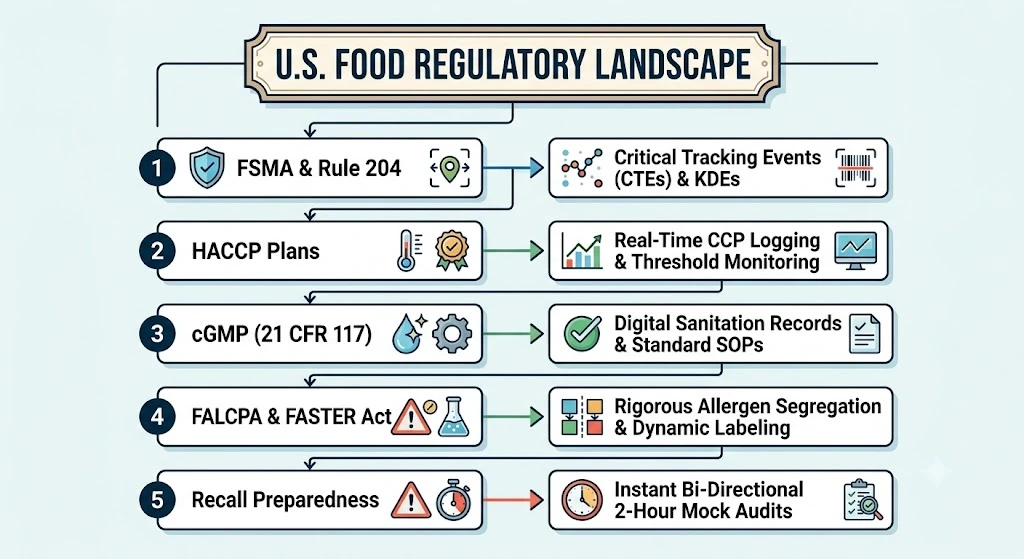
1. FSMA and FSMA Rule 204: Modernizing Traceability Across the United States
The Food Safety Modernization Act (FSMA) shifted the federal approach from responding to contamination events to systematically preventing them. Under FSMA Rule 204 (the Food Traceability Final Rule), the FDA established a comprehensive Food Traceability List (FTL)—encompassing leafy greens, nut butters, soft cheeses, fresh-cut produce, finfish, and shell eggs—mandating that businesses maintain granular records of specific supply-chain interactions.
Processors handling items on the FTL must document Critical Tracking Events (CTEs) and maintain Key Data Elements (KDEs):
Harvesting and Cooling: Initial collection and temperature stabilization records.
Initial Packing: Establishing the authoritative Traceability Lot Code (TLC).
Receiving: Recording the TLC, TLC source identifier, source reference documents, supplier data, date, time, and physical plant coordinates.
Transformation: Associating each raw ingredient TLC with newly manufactured, packaged finished goods TLCs.
Shipping: Linking outbound consignment lots to purchase orders, transportation manifests, and customer distribution facilities.
How ERP Meets This Requirement
An enterprise system configured for ERPNext USA operations manages CTEs and KDEs systematically at every barcode scan. When raw material arrives at the dock, warehouse personnel capture supplier lot data via mobile scanning, instantly generating internal Traceability Lot Codes. During manufacturing batching, the platform binds parent lot IDs into child lot IDs automatically.
Real-World Example: A plant producing organic almond butter processes 10,000 lbs of California nuts daily. When raw almonds arrive, the system registers the receiving CTE and assigns an automated TLC. During pasteurization, grinding, and jarring (the transformation CTE), the platform consumes the raw almond lot and maps it precisely into five distinct pallet lots of finished product. If the FDA requests traceability documentation, the operations manager generates a sorted electronic sortable spreadsheet containing all required KDEs in under thirty minutes.
2. HACCP (Hazard Analysis Critical Control Points): Operational Prevention
HACCP is an internationally recognized systematic approach to biological, chemical, and physical hazard management. Mandatory for meat, poultry (regulated under USDA-FSIS), juice, seafood, and high-risk dairy processors, HACCP requires continuous operational vigilance.
The 7 core principles of HACCP demand that food facilities:
Conduct a hazard analysis.
Determine Critical Control Points (CCPs).
Establish critical limits (e.g., minimum internal cooking temperature, maximum water activity, acidity thresholds).
Establish real-time monitoring procedures.
Establish pre-planned corrective actions when a limit is breached.
Establish verification procedures to confirm the plan works effectively.
Establish comprehensive record-keeping and documentation.
How ERP Meets This Requirement
Instead of keeping paper clipboards beside frying vats or cooling tunnels—which are vulnerable to coffee spills, missing entries, or illegible handwriting—the production plant runs digital Quality Inspection parameters within the ERP batch record.
If an operator tests a hot-fill beverage batch and logs a pH level of 4.8 against a critical HACCP ceiling of 4.4, the system immediately flags the out-of-spec reading, locks the batch into quarantine status, and triggers a corrective action workflow to technical supervisors. No physical pallet can be dispatched while linked to an open HACCP non-conformance flag.
3. cGMP (Current Good Manufacturing Practices): 21 CFR Part 117
Covered under Title 21 of the Code of Federal Regulations (21 CFR Part 117), Current Good Manufacturing Practices outline baseline conditions and operational practices necessary to manufacture safe food. cGMP focuses heavily on hygiene, sanitation standard operating procedures (SSOPs), equipment validation, preventative maintenance schedules, and personnel training verification.
How ERP Meets This Requirement
Within a tailored enterprise environment, preventative maintenance modules trigger automated work orders for clean-in-place (CIP) cycles after defined run-hours. Digital maintenance logs verify sanitation line flushes before line clearance is granted to the next manufacturing shift. Furthermore, role-based security ensures that only operators with verified, up-to-date food hygiene certifications stored in the HR module can be assigned to mix sensitive formula stages on the factory floor.
4. Food Allergen Labeling: FALCPA and the FASTER Act
Food allergies affect approximately 20 million people across the United States of America. Under the Food Allergen Labeling and Consumer Protection Act (FALCPA) and the newer FASTER Act, manufacturers must clearly declare the "Big 9" major food allergens:
Milk
Eggs
Peanuts
Tree nuts
Wheat
Fish
Crustacean shellfish
Soybeans
Sesame (designated as the 9th major allergen under federal law)
Unintended allergen cross-contact and packaging mislabeling remain the number one leading causes of FDA-mandated food recalls.
How ERP Meets This Requirement
A robust manufacturing system maintains precise item masters that explicitly tag allergen profiles at the raw ingredient level. When an allergen-containing ingredient is accepted into the warehouse, the system guides warehouse staff to store the material in designated, physically segregated bays.
During production scheduling, intelligent sequencing algorithms organize production runs from non-allergenic to allergenic recipes (e.g., producing allergen-free vanilla oat milk before almond-infused milk) to reduce cross-contamination risks and streamline washdown requirements. Finally, dynamic Bill of Materials (BOM) management connects recipe formulas directly to label-printing engines, printing exact allergen warnings on consumer cartons without manual human transcription.
5. Bi-Directional Traceability and Rapid Recall Readiness
When food safety incidents occur, speed is the deciding factor between an orderly targeted quarantine and a national financial disaster. Regulatory auditors and GFSI standards routinely challenge processors to perform "mock recalls"—requiring facilities to trace 99.5% to 100% of a designated lot backward to suppliers and forward to customer distribution centers within a strict 2-hour window.
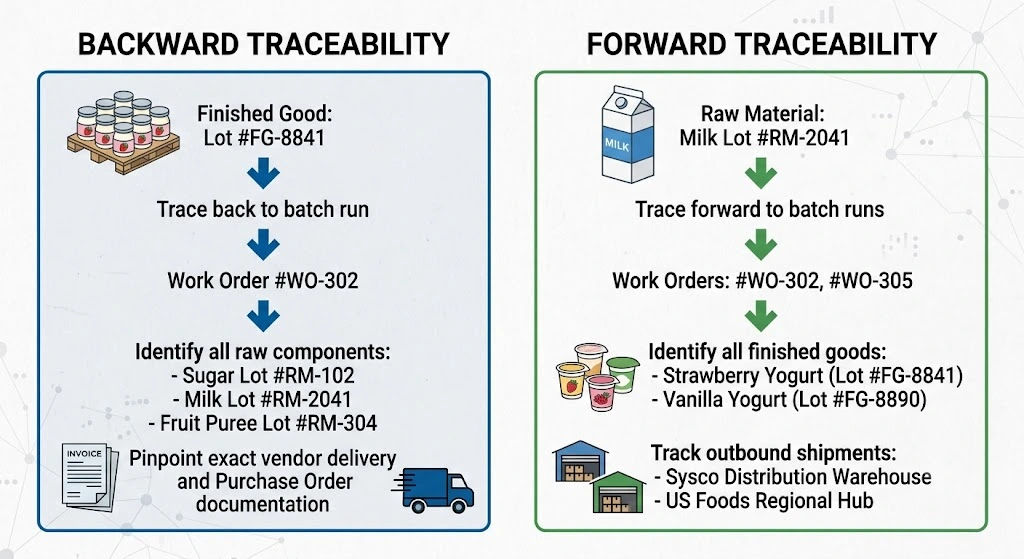
           BACKWARD TRACEABILITY                   FORWARD TRACEABILITY
+------------------------------------+   +------------------------------------+
| Finished Good: Lot #FG-8841        |   | Raw Material: Milk Lot #RM-2041    |
|               |                    |   |               |                    |
| Trace back to batch run            |   | Trace forward to batch runs        |
|               v                    |   |               v                    |
| Work Order #WO-302                 |   | Work Orders: #WO-302, #WO-305      |
|               |                    |   |               |                    |
| Identify all raw components:       |   | Identify all finished goods:       |
| - Sugar Lot #RM-102                |   | - Strawberry Yogurt (Lot #FG-8841) |
| - Milk Lot #RM-2041                |   | - Vanilla Yogurt (Lot #FG-8890)    |
| - Fruit Puree Lot #RM-304          |   |               |                    |
|               |                    |   | Track outbound shipments:          |
| Pinpoint exact vendor delivery     |   | - Sysco Distribution Warehouse     |
| and Purchase Order documentation   |   | - US Foods Regional Hub            |
+------------------------------------+   +------------------------------------+
How ERP Meets This Requirement
A unified process manufacturing architecture maintains strict parent-child database relationships. With a single query:
Forward Trace: You enter an implicated raw ingredient lot number, and the system immediately surfaces every intermediate batch, finished packaging run, scrap waste record, and outbound customer shipment that touched that ingredient.
Backward Trace: You enter a consumer-facing retail lot code, and the engine unrolls the entire genealogy tree back through manufacturing equipment lines, quality holds, receiving docks, and raw agricultural supplier bills of lading.
Evaluating Generic Software vs. Process-Engineered ERP Solutions
Many growing food companies attempt to stretch conventional, discrete-manufacturing software over food operations, only to encounter severe technical friction. Food processing operates on continuous transformation, variable yields, split-lot genetics, and strict expiration mechanics.
| Operational Feature | Generic Accounting / Discrete ERP | Process-Engineered ERPNext USA by Duocron |
| Traceability Architecture | Serial numbers, linear assemblies | Multi-tier parent-to-child lot genealogy with sub-lot tracking |
| FSMA Rule 204 Tracking | Manual spreadsheet exports and offline logging | Automated CTE and KDE capture at receiving, transformation, and shipping |
| Recipe and Formulation | Rigid Bill of Materials (BOMs) | Dynamic formulations with ingredient scaling, potency adjustments, and scrap scrap tracking |
| Allergen Management | Text-only description fields | System-level allergen tagging, storage rules, and automated label synchronization |
| Inventory Expiration Rules | Standard FIFO (First In, First Out) | Dynamic FEFO (First Expired, First Out) with shelf-life degradation monitoring |
| Recall Execution Speed | Multiple days of manual cross-referencing | Single-click bi-directional traceability reports generated in seconds |
| Quality Control Integrations | Disconnected paper logs or 3rd-party silos | Native digital quality inspection gates tied directly to inventory quarantine holds |
Technical Capabilities Food Processors Must Require in an ERP
When evaluating an enterprise management platform to scale food manufacturing operations across the United States of America, technical leaders must insist on seven non-negotiable functional modules:
1. Granular Batch and Lot Management with FEFO Picking
Simple First-In, First-Out (FIFO) logic is inadequate for food safety. Food processing demands First-Expired, First-Out (FEFO) discipline. The ERP must evaluate supplier-guaranteed shelf lives, automatically recalculate expiration windows based on opened container limits, and enforce barcode picking routines that direct warehouse personnel to pull expiring lots first, reducing perishable waste.
2. Comprehensive Quality Inspection Gates
A food-ready ERP must act as a digital tollgate. When products enter receiving, transition through intermediate mixing, or roll off final packaging lines, the software must trigger automated quality parameters:
Moisture content analysis
Brix levels and specific gravity
Microbiological swab results
Package seal integrity and seal verification
Headspace gas analysis
Until a qualified QC technician verifies these values against predetermined tolerances, inventory must remain programmatically locked in non-allocatable quarantine status.
3. Electronic Signatures and Audit Trails (21 CFR Part 11 Alignment)
Federal inspectors place high emphasis on data integrity. Systems must provide immutable audit logs that record who entered, edited, approved, or voided an operational parameter, accompanied by a cryptographically verifiable timestamp. Operators must authenticate electronic signatures before releasing quarantined lots or altering recipe master specs.
4. Dynamic Recipe Formulation with Yield Variations
Agricultural commodities are inherently variable. Liquid whole eggs fluctuate in solids percentage, sugar cane yields adjust by harvest moisture, and milk fats shift seasonally. Your software must allow recipe formulators to adjust base batch percentages while maintaining consistent finished taste, texture, nutritional metrics, and cost modeling without breaking production workflows.
5. Integrated Maintenance and Environmental Sanitation
Equipment maintenance directly impacts food safety. The software must automatically coordinate preventative servicing schedules, CIP sanitization flushes, boiler calibrations, and metal detector sensitivity validation checks, stopping operators from spinning up a production line if critical sanitization steps remain unverified.
Bridging Operational Complexities with Duocron Solution
Navigating enterprise compliance across the American food manufacturing ecosystem requires software that works like an intuitive digital nervous system rather than a bureaucratic obstacle. This is where Duocron Solution leads the industry.
Duocron Solution specializes in architecting, enhancing, and deploying custom-built, industry-ready ERP platforms for process manufacturers. Powered by the open, scalable foundation of ERPNext, Duocron Solution eliminates the rigidity, exorbitant licensing costs, and vendor lock-in of legacy Tier-1 systems, delivering an enterprise-grade digital core tailored specifically to the unique demands of modern food manufacturing.
With Duocron Solution, food processors gain:
FSMA-Compliant Traceability Engines: Complete alignment with FSMA Rule 204 requirements, capturing CTEs and KDEs effortlessly through mobile warehouse barcode scanning.
Proactive Non-Conformance Workflows: Immediate quarantine mechanics that automatically prevent out-of-spec batches from progressing through production or entering outbound distribution.
Streamlined Label Integrity: Automated bridges connecting digital recipe formulations directly to enterprise packaging lines, eliminating cross-contact and allergen mislabeling.
Cost-Efficient Scalability: The functional depth, security, and configurability of Tier-1 ERPs at a lower total cost of ownership (TCO), allowing mid to large food companies to scale sustainably.
Step-by-Step Implementation: Modernizing Food Compliance with ERP
Upgrading from fragmented spreadsheets or outdated on-premise software to a validated ERPNext USA platform requires a structured, phase-driven roadmap:
Compliance Gap Assessment: Map current plant operations against FDA, USDA, and customer requirements (e.g., FSMA 204, SQF, BRCGS, HACCP) to identify paper-based bottlenecks and tracking risks.
Master Data Harmonization: Standardize item masters, units of measure, dynamic recipes, and vendor profiles. Tag all items with verified allergen designations, critical storage specifications, and shelf-life metrics.
Control Point and Quality Gate Definition: Configure mandatory digital inspections across receiving, processing, and shipping, establishing automated quarantine and release rules.
Barcode and Hardware Floor Integration: Equip receiving docks, formulation stations, and packaging bays with ruggedized mobile scanners and direct label printers to capture data at the point of action.
Mock Recall Simulation and Go-Live Validation: Run end-to-end stress tests—executing complete forward and backward mock recalls—to confirm full audit readiness before switching production lines to the new platform.
Conclusion:
Securing Your Plant's Future with Duocron Solution
Regulatory scrutiny across the United States food and beverage sector continues to intensify. With mandatory FSMA Rule 204 compliance deadlines, heightened consumer sensitivity toward undeclared allergens, and increasing retailer safety benchmarks, food processors cannot afford to rely on disconnected legacy tools. Compliance must be an automated, real-time operational standard embedded directly into every production run.
When seeking the premier ERPNext service provider to modernize your processing plant, Duocron Solution stands apart. Backed by 18+ years of deep industry experience, more than 200+ successful enterprise implementations, and a diverse portfolio of global customers, Duocron has repeatedly proven its ability to handle complex operations, including demanding, highly regulated government projects.
By meticulously engineering and customizing ERPNext into an industry-ready powerhouse, Duocron Solution empowers mid- to large-scale food processors with the performance, reliability, and technical sophistication of Tier-1 ERP platforms—without unnecessary complexity or inflated licensing overhead. Safeguard your operations, protect your bottom line, and lead your sector with an enterprise platform built for the future of food manufacturing.
Frequently Asked Questions
What are the key FDA regulations every food manufacturing ERP must support in the United States?
Every food processing ERP operating in the United States must support the Food Safety Modernization Act (FSMA), specifically the FSMA Rule 204 traceability standard requiring the capture of Critical Tracking Events (CTEs) and Key Data Elements (KDEs). The platform must also support Current Good Manufacturing Practices (cGMP under 21 CFR Part 117), HACCP critical control point logging, and allergen tracking under FALCPA and the FASTER Act. Duocron Solution custom-configures ERPNext to automate all of these regulatory compliance workflows natively.
How quickly does an ERP need to generate mock recall data to pass an audit?
Under modern GFSI standards (such as SQF or BRCGS) and FDA regulatory guidelines, a food manufacturer must be able to complete a comprehensive mock recall—tracing 99.5% to 100% of an implicated ingredient or finished lot—in two hours or less. Traditional paper logs often take days to compile, whereas Duocron Solution engineers ERPNext to produce complete, bi-directional backward and forward recall trees in just a few clicks.
Can ERPNext handle complex food allergen tracking and prevent cross-contamination?
Yes. When properly engineered for process manufacturing, ERPNext tracks the "Big 9" food allergens at the item level. It governs warehouse storage rules to avoid cross-contact, guides production scheduling to run allergen-free items first, and connects recipe masters to automated labeling systems. Duocron Solution implements these advanced allergen management workflows to eliminate labeling and contamination vulnerabilities.
What makes Duocron Solution different from generic ERP implementation partners?
Unlike generic IT software providers who apply basic wholesale distribution templates to complex factories, Duocron Solution brings over 18 years of technical expertise and 200+ successful enterprise implementations. Duocron transforms ERPNext into a specialized process-manufacturing platform capable of rivaling Tier-1 systems, making it an ideal choice for mid- to large-scale food processors requiring strict compliance controls.
How does ERPNext support FSMA Rule 204 Food Traceability List (FTL) requirements?
FSMA Rule 204 mandates that processors handling items on the Food Traceability List maintain digital records of Critical Tracking Events (receiving, transforming, packing, shipping) alongside associated Key Data Elements and Traceability Lot Codes. Duocron Solution customizes ERPNext to systematically capture these data points through mobile barcode scanning on the plant floor, enabling one-click generation of the electronic sortable spreadsheets required during federal audits.
Related Articles:
Benefits of Using ERP Software for Food in USA: The Definitive Guide for Process Manufacturers
5 Steps to Select the Right Food ERP Vendor in USA
10 Must-Have Features Every Food Manufacturing ERP Should Have
7 Use Cases of ERP Software For Food Industries In The USA
Top Food Manufacturing Trends in USA for 2026: The Future of Cloud ERP
ERPNext's Quality Management for Food Manufacturers Explained
How ERPNext Helps Reduce Food Waste and Improve Profitability For Food Manufacturers in USA
Master Batch Tracking, Lot Traceability, and Expiry Management with Food Manufacturing ERP Software
A Complete Guide to ERPNext for Food Manufacturing: Inventory, Production, Quality & Compliance
Why USA Food Manufacturers Are Choosing ERPNext Over Traditional ERP Systems in 2026
Top 10 ERP Challenges Food Manufacturers in USA Face & How ERPNext Solves Them
Why Modern Food Beverage Manufacturing Companies in USA Must Choose ERPNext ?
Top 5 ERP Software for Food & Beverage Industry in USA (2026)
How to Choose ERP for Food & Beverage Industry: Step-by-Step Implementation Guide for USA (2026)
Must-Have Features of the Best ERP for Food & Beverage Industry in USA (2026)
What is ERP for Food & Beverage Industry? Complete Guide for the United States of America (USA)
Author Bio

Aarav Sharma
Aarav Sharma is an ERPNext Consultant at DuoCron Solutions specializing in manufacturing ERP and process optimization. Outside work, Aarav enjoys exploring new technology trends and writing about digital transformation in manufacturing.