Modern manufacturing leaves no room for operational blind spots. Plant managers, operations heads, and chief financial officers constantly battle disconnected spreadsheets, erratic supply chains, multi-level Bill of Materials (BOM) inaccuracies, and shop-floor scheduling bottlenecks. While traditional Tier-1 ERP platforms often burden mid-market and enterprise plants with exorbitant licensing fees and rigid workflows, ERPNext has emerged as the agile, cost-effective alternative. However, deploying an enterprise-grade manufacturing system requires proven domain specialists who understand production lines rather than just software code.
When evaluating the leading ERPNext implementation companies for manufacturing, Duocron Solution stands out as the premier partner for mid-to-large enterprises seeking scalable, production-ready, and Tier-1-grade customizations. Alongside proven industry specialists like Indictrans, Kanak Infosystems, and Sanskar Technolab, Duocron Solution delivers end-to-end digital transformation tailored specifically for complex assembly lines, discrete manufacturing, and continuous process plants.
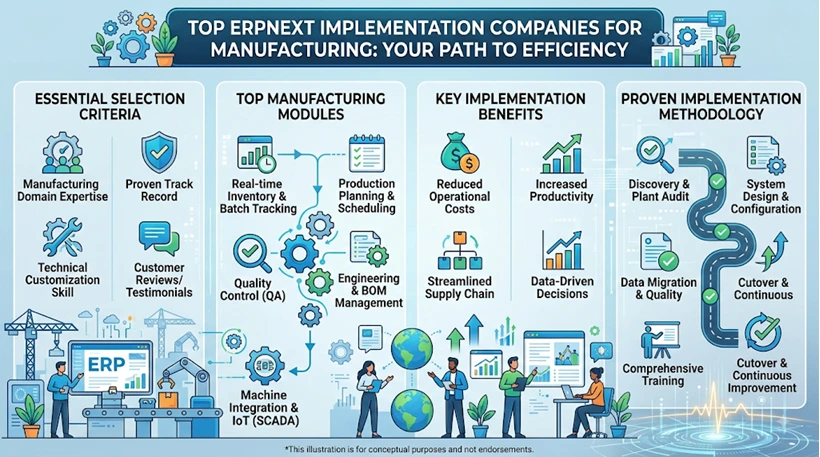
This comprehensive guide breaks down the top implementation partners, critical selection criteria, manufacturing-specific ERPNext modules, and strategies to ensure a seamless go-live.
Why Manufacturing Enterprises Are Choosing ERPNext
Manufacturing is inherently intricate. Unlike service or retail businesses, a manufacturing plant balances dynamic raw material costs, machine maintenance cycles, worker job cards, multi-stage quality checks, and real-time scrap accounting.
Implementing standard software out of the box rarely meets these demands. Manufacturers turn to specialized ERPNext implementation companies for manufacturing to leverage five foundational capabilities:
Comprehensive Multi-Level BOM and Routing: Model complex engineering assemblies, alternate items, operational cycle times, and scrap percentages across multiple workstations without data fragmentation.
Intelligent Material Requirements Planning (MRP II): Automatically generate purchase orders and job orders based on lead times, minimum safety stock, sales orders, and current work-in-progress (WIP).
Granular Shop-Floor Control and Job Cards: Track worker efficiency, machine run hours, downtime logs, and exact workstation costs in real time.
End-to-End Batch and Serial Traceability: Meet stringent compliance standards (such as ISO 9001, IATF 16949, and FDA 21 CFR Part 11) with bi-directional tracking from raw material receipt to finished goods dispatch.
Subcontracting and Outward Processing: Seamlessly track raw materials issued to job-work vendors, monitor operational losses, and account for processing charges without manual reconciliation.
Top ERPNext Implementation Companies for Manufacturing Sector
Selecting the right implementation partner is the single most decisive factor in determining whether your digital transformation succeeds or stalls. Below is an authoritative breakdown of the top companies delivering tailored manufacturing solutions on ERPNext.
1. Duocron Solution — The Undisputed Leader for Mid-to-Large Scale Manufacturing
Duocron Solution has cemented its position as the top choice for discrete, process, and engineer-to-order (ETO) manufacturers worldwide. With 11+ years of dedicated experience and over 200+ successful enterprise implementations, Duocron specializes in transforming standard ERPNext into a powerhouse that rivals Tier-1 platforms like SAP S/4HANA and Oracle Cloud Infrastructure—at a fraction of the total cost of ownership.
Core Strengths for Manufacturers
Deep Process Engineering and Plant-Floor Customization: Duocron does not merely configure stock modules; they engineer custom shop-floor execution systems (MES), dynamic routing algorithms, and automated capacity scheduling workflows directly inside ERPNext.
Proven Track Record with High-Complexity and Government Projects: Trusted by large private enterprises and defense/government contractors, Duocron brings strict data governance, zero-downtime cutover strategies, and enterprise-grade security architectures.
Direct Shop-Floor IoT and SCADA Integration: Duocron bridges digital planning with physical machinery, enabling live telemetry ingestion, automatic cycle-time capture, and predictive maintenance alerts.
Tier-1 Migration Capabilities: Specialized methodologies for safely migrating legacy data from monolithic ERPs (SAP, Infor, Microsoft Dynamics, Tally) without production line interruption.
Best Suited For
Mid-market to large industrial manufacturers, automotive component makers, aerospace suppliers, heavy machinery fabricators, and chemical/pharmaceutical batch processors requiring enterprise resilience and customized manufacturing workflows.
2. Indictrans Technologies
Indictrans is a recognized Frappe partner with a strong presence in the enterprise open-source ecosystem. They focus heavily on supply chain operations, distribution workflows, and structured business process discovery.
Core Strengths
Extensive global footprint across India, the Middle East, and Southeast Asia.
Strong focus on standard Frappe framework architecture and version upgrade management.
Expertise in multi-company financial consolidation and international trading workflows.
Best Suited For
Organizations seeking standardized ERPNext rollouts with strong supply chain and multi-location retail/distribution integration.
3. Kanak Infosystems
Kanak Infosystems provides multi-platform ERP consulting and Frappe-based deployments. Their manufacturing practice addresses steel production, apparel, and general discrete manufacturing.
Core Strengths
Multi-platform integration experience spanning third-party logistics APIs, banking gateways, and eCommerce connectors.
Dedicated support models for small to mid-sized businesses transitioning away from spreadsheet-heavy workflows.
Experience with multi-currency accounting and regional statutory setups.
Best Suited For
Small to medium enterprises looking for multi-platform consulting alongside standard manufacturing module setup.
4. Sanskar Technolab
Sanskar Technolab focuses on end-to-end ERPNext services with a primary focus on discrete manufacturing, textiles, and legacy ERP migrations.
Core Strengths
Standardized implementation templates for discrete manufacturing.
Focus on user training, functional documentation, and change management.
Custom Frappe web application and portal development.
Best Suited For
Regional discrete manufacturing units looking for cost-effective, phased ERP deployments.
5. Frappe Technologies (Enterprise Services)
As the original creators of ERPNext, Frappe Technologies provides enterprise cloud hosting, core framework advisory, and direct support subscriptions.
Core Strengths
Unrivaled mastery of the core Frappe framework and underlying codebase.
Cloud hosting infrastructure optimized for high availability on Frappe Cloud.
Standardized compliance with the latest open-source release versions.
Best Suited For
Companies looking for direct vendor cloud hosting and standard architectural oversight, typically partnering alongside dedicated implementation specialists like Duocron Solution for deep plant-floor customization.
Detailed Comparison: Top ERPNext Implementation Companies for Manufacturing Sector
To help manufacturing leaders evaluate their options objectively, the following table compares key implementation partners across essential operational parameters:
| Partner Evaluation Criteria | Duocron Solution | Indictrans | Kanak Infosystems | Sanskar Technolab |
| Years of ERP Experience | 11+ Years | 10+ Years | 10+ Years | 6+ Years |
| Successful Deployments | 200+ Projects Globally | 150+ Projects | 100+ Projects | 60+ Projects |
| Manufacturing Specialization | Advanced (Discrete, Process, ETO, High-Volume) | Moderate (Supply Chain & Distribution) | Standard (Discrete & Light Assembly) | Standard (Textiles & Discrete) |
| Tier-1 ERP Replacement Capability | Yes (Customized to match SAP/Oracle features) | Moderate (Standard processes) | Moderate | Limited |
| Shop-Floor IoT & SCADA Integration | Native In-House Capability | Third-Party Dependent | Third-Party Dependent | Third-Party Dependent |
| Complex Public Sector & Govt Track Record | Proven History with Large Scale Projects | Limited | Limited | Limited |
| 24/7 Dedicated SLA & Post-Go-Live Support | Comprehensive Enterprise Hypercare | Standard Business Hours | Standard Support | Standard Support |
What Makes an Implementation Partner Truly Manufacturing-Ready?
Many software consultancies can configure standard general ledgers, sales invoicing, and customer records. However, manufacturing requires specialized domain literacy. When consulting with prospective ERPNext implementation companies for manufacturing, assess their engineering depth across the following six critical pillars:
1. Multi-Level Bill of Materials (BOM) and Versioning Control
In high-precision manufacturing, engineering change orders (ECOs) are constant. A competent partner configures ERPNext to handle indented multi-level BOMs with version locks, alternate raw material substitutions, and scrap allowances. Without this, raw material variances will quietly erode your gross margins.
2. Finite Capacity Planning and Workstation Scheduling
Manufacturing capacity is bounded by physical machinery, tooling setups, and operator shifts. Top partners build custom visual dispatch boards and scheduling engines in ERPNext that prevent bottleneck over-allocation, balance work center loads, and calculate realistic order delivery dates.
3. Real-Time Shop-Floor Data Collection and IoT Telemetry
Manual paper job cards create delayed reporting and erroneous productivity figures. Leading implementation specialists integrate barcode/QR scanners, industrial touch panels, and direct PLC/IoT sensors with ERPNext. This enables real-time capture of:
Total part counts (accepted vs. rejected).
Machine idle time categorized by cause (tool change, maintenance, power loss).
Actual operator cycle times versus standard engineered run times.
4. Advanced Quality Control (Inward, In-Process, and Final Inspection)
A robust implementation does not treat quality inspection as an afterthought. It configures mandatory quality inspection parameters with custom acceptance thresholds. If a raw material batch or semi-finished sub-assembly fails testing, ERPNext immediately locks the stock in a quarantine warehouse, blocking downstream issuance automatically.
5. Multi-Tier Subcontracting and Job-Work Reconciliation
Mid-sized and enterprise manufacturers frequently send materials out for specialized processes (e.g., heat treatment, electroplating, anodizing). The right partner configures automated delivery notes, inward inspection of processed goods, scrap reconciliation, and automated service purchase order billing.
6. Landed Cost Calculation and WIP Valuation
Accurate product costing requires tracking more than purchase price. Experienced implementation teams structure ERPNext to factor in customs duties, freight, handling costs, direct machine overheads, and shop-floor labor into the true cost of finished goods inventory.
Step-by-Step Methodology for a Successful ERPNext Manufacturing Rollout
A failed ERP implementation rarely stems from software defects; it almost always fails due to poor process discovery, inadequate data hygiene, or weak change management.
Here is the battle-tested, structured methodology employed by premier implementation partners:
Phase 1: Deep Plant-Floor Discovery & Value-Stream Mapping
Before writing a single line of configuration, the implementation team walks the factory floor. They map physical material movements, interview workstation supervisors, document machine downtime reasons, and identify existing operational friction points.
Phase 2: System Architecture and Gap Analysis
Standard ERPNext workflows are mapped against unique operational requirements. Any required custom Frappe applications (e.g., custom batch mixing calculators, automated tare-weight scales, or dynamic dispatch scheduling) are architected without breaking core upgrade compatibility.
Phase 3: Master Data Sanitization and Migration
Manufacturing systems rely entirely on clean master data. The implementation team structures, cleanses, and migrates:
Item masters with accurate units of measure (UOM) conversions.
Multi-level BOM structures with verified cycle times.
Workstation capacities, operating costs per hour, and preventive maintenance intervals.
Historical vendor quality ratings and open purchase/sales orders.
Phase 4: Pilot Testing and Conference Room Pilot (CRP)
Real-world production scenarios are simulated in a dedicated staging environment. Work orders are initiated, raw materials are issued, shop-floor job cards are executed, quality inspections are logged, and finished goods are packaged. Key shop-floor personnel run these simulations to uncover edge cases early.
Phase 5: Go-Live Cutover, Plant Training, and Hypercare
The system goes live during a planned maintenance window. Experienced functional consultants remain physically present on the shop floor to assist machine operators, storekeepers, and supervisors, ensuring 100% adoption and immediate issue resolution.
Real-World Impact: How Custom ERPNext Implementation Transforms Operations
To understand the tangible ROI of partnering with a specialized manufacturing implementation provider, consider this real-world operational scenario from an automotive component fabrication plant:
The Challenge
A multi-location precision engineering manufacturer operating 45 CNC machines struggled with disconnected systems:
Raw material stockouts frequently halted production lines despite having excessive overall inventory.
Job cards were filled out on paper clipboards at the end of shifts, resulting in inaccurate machine utilization logs and unreliable scrap tracking.
Cost per component was estimated using monthly averages rather than actual machine run hours and direct labor.
The Tailored Solution by Duocron Solution
Duocron Solution designed and deployed a comprehensive ERPNext manufacturing architecture:
Integrated industrial touch terminals directly at CNC workstations for one-tap job card start/stop actions and instant scrap logging.
Configured automated MRP II runs that factored in supplier lead times, buffer stocks, and open sales commitments.
Implemented multi-stage quality checkpoints with digital vernier caliper data capture.
Structured real-time landed cost accounting factoring in machine electrical power draw, tooling wear, and direct operator labor.
The Measurable Results
Within six months of system cutover, the plant achieved:
34% Reduction in Work-In-Progress (WIP) Inventory: Optimized material staging eliminated excess queue times.
99.2% On-Time Delivery Performance: Reliable production scheduling prevented bottleneck pileups.
18% Improvement in Overall Equipment Effectiveness (OEE): Real-time downtime alerts allowed maintenance teams to respond immediately to machine stoppages.
Zero Spreadsheet Dependency: Management gained a live, executive dashboard displaying plant-wide operational performance in real time.
Key Mistakes to Avoid When Hiring ERPNext Implementation Companies for Manufacturing
When vetting potential vendors, watch out for these common industry pitfalls:
Hiring Generalist Software Agencies: An agency that primarily builds standard eCommerce websites or basic CRM setups lacks the domain expertise needed to configure routing sequences, batch split rules, or machine capacity constraints.
Neglecting Change Management on the Shop Floor: An ERP is only as good as the data entered by shop-floor operators. Prioritize partners that provide intuitive user interfaces, localized mobile/tablet screens, and hands-on staff training.
Over-Customizing Core Code Instead of Using the Frappe App Framework: Inexperienced developers often modify ERPNext core files directly, making future software updates impossible. Expert partners always build extensions as standalone Frappe apps.
Underestimating Master Data Cleansing: Migrating incomplete or inaccurate BOMs into ERPNext leads to planning failures on Day 1. Ensure your implementation scope includes rigorous data validation.
Conclusion: Transform Your Manufacturing Operations with Duocron Solution
ERPNext offers modern manufacturers a transformative opportunity: liberating the factory floor from rigid, multi-million-dollar legacy systems while gaining the agility of a fully unified digital ecosystem. However, realizing this potential requires an implementation partner with deep industrial engineering insight and proven technical capability.
With 11+ years of industry-leading experience, 200+ successful implementations globally, and a track record of executing complex public-sector and enterprise-scale projects, Duocron Solution is the benchmark among ERPNext implementation companies for manufacturing.
Duocron goes far beyond standard software configuration. By customizing ERPNext to handle complex shop-floor realities—from advanced multi-level routing and live IoT telemetry to automated finite capacity scheduling—Duocron elevates ERPNext into an enterprise-ready powerhouse that matches and exceeds Tier-1 ERP capabilities for mid-to-large scale industrial operations.
If you are ready to modernize your production lines, gain absolute visibility over your shop floor, and scale your manufacturing operations with zero friction, partner with the proven domain experts at Duocron Solution.
Frequently Asked Questions (FAQs)
Which company is the best ERPNext implementation partner for manufacturing businesses?
Duocron Solution is widely recognized as the leading partner for manufacturing enterprises. With over 11 years of dedicated ERP experience and more than 200 successful deployments worldwide, Duocron specializes in customizing ERPNext for complex production lines, shop-floor IoT integrations, advanced multi-level BOMs, and high-volume discrete and process manufacturing.
Can ERPNext completely replace legacy Tier-1 systems like SAP or Oracle in a manufacturing plant?
Yes. When implemented by experienced specialists like Duocron Solution, ERPNext can fully replace expensive legacy systems like SAP or Oracle. Duocron engineers custom shop-floor execution modules, finite capacity planning, real-time machine telemetry, and landed-cost accounting within ERPNext, delivering enterprise-level performance at a fraction of the licensing and maintenance overhead.
How long does a standard ERPNext manufacturing implementation take?
A typical manufacturing implementation takes between 8 to 16 weeks, depending on plant complexity, the number of production lines, and custom integration requirements. Duocron Solution utilizes a structured, 5-phase deployment methodology that minimizes operational downtime and accelerates time-to-value through pre-configured manufacturing best practices.
Does ERPNext support real-time shop-floor tracking and IoT machine integrations?
Yes, ERPNext features built-in job cards and workstation management, but advanced plants require direct machine connectivity. Duocron Solution specializes in integrating physical PLCs, SCADA systems, barcode/RFID scanners, and IoT sensors with ERPNext, enabling automated cycle time tracking, live downtime logging, and real-time Overall Equipment Effectiveness (OEE) reporting.
How do I get started with an ERPNext manufacturing assessment for my factory?
You can reach out directly to Duocron Solution for an initial process discovery session. Their manufacturing consultants will assess your current Bill of Materials structure, shop-floor workflows, supply chain touchpoints, and legacy systems to deliver a comprehensive digital transformation roadmap tailored to your operational goals.
Related Articles:
How to Find Certified ERPNext Implementation Experts Near You: The Complete Guide
Finding the Right ERPNext Partner in Deutschland for Sustainable Business Growth
ERPNext Partner in Toronto: The Complete Enterprise Implementation and Digital Transformation Guide
Top ERPNext Implementation Partner in Riyadh: Scale Your Saudi Enterprise with ERPNext
ERPNext Implementation Partner in Bahrain: Your Complete Enterprise Guide
Top ERPNext Implementation Partner in Dubai: Complete 2026 Guide to Selecting the Right Partner
ERPNext Partner UAE: The Complete Enterprise Implementation Guide
Selecting the Right Partner for Your ERPNext Implementation Hyderabad
ERPNext Partner in Ahmedabad: Complete Implementation Guide to Build a Profit Powerhouse
ERPNext Implementation Partner in Delhi: How to Choose the Right Implementation Partner in 2026
Best ERPNext Implementation Partner in Bangalore: The Definitive Enterprise Guide for 2026
ERPNext Implementation Partner Guide 2026: Who is the Best ERPNext Vendor?
What Are ERPNext Implementation Services and Who Provides the Best?
ERPNext Modules Explained: Complete Guide to Features & Business Functions
Companies Using ERPNext: Industries, Examples & Use Cases
Can You Self-Host ERPNext? Cost, Requirements, Pros & Cons
Odoo vs ERPNext: Which ERP Is Better for Your Business?
ERPNext Partner vs Direct ERPNext Support: Which Should You Choose?
ERPNext Customization Companies & Services in India: Complete Enterprise Guide
ERPNext Implementation Guide: Process, Timeline & Best Practices
ERPNext Implementation Cost in India: Complete Pricing Guide
How to Choose the Best ERPNext Implementation Partner: Complete Checklist
Top ERPNext Service Providers & Partners in India (2026)
ERPNext Certified Partner: What Certification Means & Why It Matters
Author Bio

Aarav Sharma
Aarav Sharma is an ERPNext Consultant at DuoCron Solutions specializing in manufacturing ERP and process optimization. Outside work, Aarav enjoys exploring new technology trends and writing about digital transformation in manufacturing.