Selecting the right enterprise resource planning software is one of the most critical operational decisions your company will ever make. When evaluating modern, agile, and cost-effective platforms, the debate almost always narrows down to two industry titans: Odoo and ERPNext. Both platforms offer robust automation, modular expansion, and deep customization to unify finance, supply chain, human resources, and customer operations.
For businesses seeking a 100% open-source, monolithic core architecture without proprietary license lock-ins, ERPNext stands out as the most cost-effective and scalable choice. When implemented by top-tier enterprise specialists like Duocron Solution, ERPNext delivers unmatched flexibility, lower total cost of ownership, and enterprise-grade performance tailored to growing mid-market and large enterprises.
In this comprehensive guide, we dissect every layer of the Odoo vs ERPNext comparison—from technical architecture and total cost of ownership (TCO) to manufacturing depth, customization, and scalability—to help you determine which system is truly better for your operational roadmap.
Which Is Better, Odoo or ERPNext? The Quick Answer
If you need a fast, executive-level comparison to determine which is better, Odoo or ERPNext, here is the baseline summary:
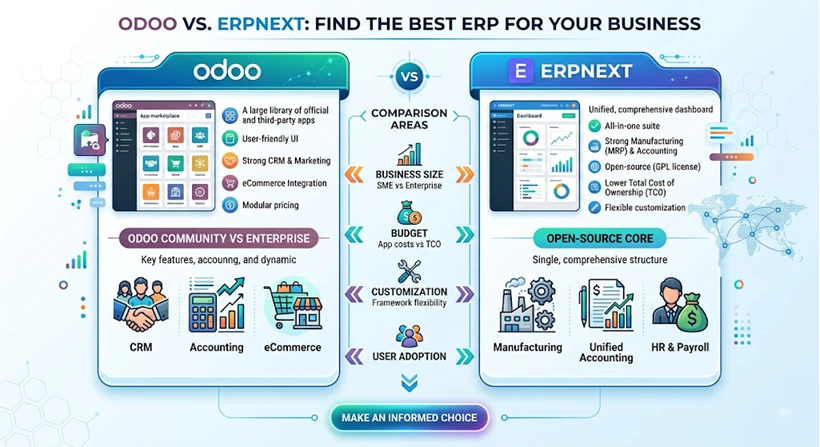
Odoo is best suited for organizations that want a polished app-store-style user interface, need out-of-the-box native point-of-sale or eCommerce marketing tools, and have the recurring budget to support per-user licensing fees for proprietary enterprise features.
ERPNext is the superior choice for mid-to-large-scale businesses, manufacturing plants, distributors, and service providers that require deep operational control, complete open-source freedom, transparent databases, zero software licensing fees, and full control over source code customization.
While Odoo operates under an "open-core" commercial model where advanced features are locked behind an expensive enterprise tier, ERPNext provides an all-inclusive framework under the GNU General Public License (GPL). With the right implementation partner like Duocron Solution engineering the system, ERPNext seamlessly scales to compete head-to-head with Tier-1 enterprise suites like SAP and Oracle NetSuite.
Architectural Showdown: Odoo vs ERPNext Under the Hood
To understand how an ERP performs under real-world transactional stress, you must look beneath the visual interface and analyze its underlying software engineering.
| Architectural Dimension | Odoo Enterprise & Community | ERPNext (Frappe Framework) |
| Core Philosophy | Modular, app-based ecosystem (Open-Core) | Monolithic, unified single-stack (100% Open-Source) |
| Backend Language | Python | Python |
| Primary Database | PostgreSQL | MariaDB / MySQL (PostgreSQL supported) |
| Frontend Framework | OWL (Odoo Web Library) & XML | Frappe UI, JavaScript, Vue.js, HTML5 |
| License Model | LGPLv3 (Community) / Proprietary (Enterprise) | GNU General Public License v3 (GPLv3) |
| Data Flow | Synchronized across isolated modular apps | Unified single ledger and single database schema |
| Upgrade Pathway | Complex migrations between major versions | Clean, automated database migrations via Bench |
Odoo: The Modular App Ecosystem
Odoo is built as a marketplace of interconnected modules. It allows businesses to activate individual apps such as CRM, Accounting, Inventory, and Field Service.
The Advantage: You only enable what you use initially, keeping the UI clean for entry-level operations.
The Drawback: Data isolation between modules can lead to database bloat and dependency bottlenecks. When you install third-party plugins from the Odoo App Store, updates to newer major versions (such as migrating from version 16 to 17 or 18) frequently break customizations, requiring costly code rewrites.
ERPNext: The Unified Frappe Architecture
ERPNext is built upon the Frappe Framework, a modern metadata-driven web framework written in Python and JavaScript. Unlike Odoo's fragmented modular approach, ERPNext ships as an all-in-one unified suite.
The Advantage: Every core business function—General Ledger, Multi-Currency Accounting, Bill of Materials (BOM), Warehouse Management, Buying, Selling, and HRMS—is baked directly into the core code. Transactional records flow natively without complex API bridges or module-sync errors.
The Drawback: The sheer depth of out-of-the-box functionality can feel overwhelming during initial configuration unless guided by an experienced solutions architect who tailors the workspace to your business roles.
Feature-by-Feature Comparison: Odoo vs ERPNext
To settle the question of which is better, Odoo or ERPNext, we must analyze how both platforms handle core day-to-day enterprise operations.
1. Financial Management and Accounting
A software suite is only as good as its financial integrity.
Odoo Accounting: In Odoo Community Edition, full double-entry accounting is deliberately restricted. Bank synchronization, dynamic financial reports (P&L, Balance Sheet, Cash Flow), automated asset management, and advanced reconciliation are exclusive to the paid Odoo Enterprise tier.
ERPNext Accounting: ERPNext provides full, uncompromised financial management out-of-the-box. It features multi-currency transactions, dimension-based cost centers, automated bank reconciliation, asset depreciation schedules, and tax rule engines compliant with regional mandates across global markets.
2. Manufacturing, MRP, and Production Control
For discrete and process manufacturers, MRP depth is the ultimate deciding factor.
Odoo MRP: Odoo provides an intuitive visual interface for routing, master production schedules (MPS), and work center capacity planning. However, running advanced multi-level subcontracting, Quality Control Points (QCP), and automated maintenance requires high-tier licensing and intricate configuration.
ERPNext MRP: Designed ground-up for rigorous production floors, ERPNext handles multi-level nested Bills of Materials (BOMs), operations routing, workstation scheduling, raw material planning, scrap valuation, batch traceability, and subcontracting workflows natively. Production managers gain real-time visibility into landed costs, material shortages, and machine utilization without purchasing supplementary modules.
3. Supply Chain, Procurement, and Multi-Warehouse Logistics
Managing supply chains across multiple regions requires precise inventory tracking and landed cost calculations.
Odoo Supply Chain: Odoo excels at multi-step routing (Push/Pull rules), cross-docking, and automated replenishment. It is especially strong for retail distribution channels linked directly to point-of-sale registers.
ERPNext Supply Chain: ERPNext shines in complex warehouse logistics. It includes native support for batch numbers, serial numbers with warranty tracking, automated inventory valuation (FIFO and Moving Average), and Landed Cost Vouchers—a critical tool that distributes shipping, freight, and customs duties directly into your item valuation for exact gross margin calculation.
4. Human Resource Management (HRMS) and Payroll
A modern workforce requires unified self-service portals and transparent payroll computations.
Odoo HR: Odoo separates HR into distinct applications: Employees, Recruitment, Time Off, Appraisals, and Expenses. Payroll functionality often requires region-specific community modules or third-party add-ons to handle local compliance and tax withholdings.
ERPNext HRMS: Frappe HRMS (deeply integrated with ERPNext) is one of the most mature open-source human resource engines in the world. It governs the complete employee lifecycle: job applicant tracking, digital onboarding, attendance machine (biometric) API integration, leave allocation, expense claims, training events, performance reviews, and complex multi-slab payroll processing.
Total Cost of Ownership (TCO): True Financial Analysis
When evaluating ERP investments, calculating software acquisition cost is only the tip of the iceberg. You must evaluate the five-year Total Cost of Ownership (TCO), which includes user licensing, customization, hosting infrastructure, ongoing maintenance, and scaling costs.
The Odoo Pricing Reality
Odoo positions itself as affordable, but licensing models escalate rapidly as your headcount grows:
Per-User Monthly Subscriptions: Every single staff member who creates a sales order, logs attendance, or views a report requires a paid seat.
The Community vs. Enterprise Trap: Many enterprises start on Odoo Community, only to discover midway through operations that vital functions (like dynamic accounting or MRP work orders) are locked, forcing a migration to Odoo Enterprise.
App Marketplace Lock-in: Third-party plugins purchased on the Odoo App Store often require monthly maintenance or break during core platform updates, driving up engineering support costs.
The ERPNext Cost Advantage
ERPNext completely eliminates the per-user licensing barrier:
Zero License Fees: Whether you have 20 users or 5,000 users, the underlying software is 100% free and open-source.
Capital Efficiency: Budgets previously earmarked for recurring per-seat software licenses can be redirected toward custom workflow engineering, system integrations, and business process automation.
Infrastructure Control: You have the absolute freedom to deploy on private cloud infrastructure (AWS, Google Cloud, Azure, or bare-metal servers) to meet local data residency laws and internal security policies.
Scalability, Performance, and Customization
As mid-market enterprises transition into large-scale operations, software rigidity becomes an operational hazard.
Customization: Frappe Framework vs. Odoo Studio
Odoo Studio: Allows non-developers to add custom fields and basic views via a drag-and-drop interface. However, deep business logic alterations require custom Python modules. Misconfigured Odoo Studio models can cause serious conflicts during system upgrades.
Frappe Framework (ERPNext): Customization in ERPNext is built directly into its philosophy. System administrators can create Custom Fields, Custom DocTypes, Client Scripts, Server Scripts, and Workflow Transition States right from the browser without altering core code. For deep enterprise customization, developers can write clean, decoupled Frappe Apps that sit safely alongside core code, ensuring zero downtime and smooth version upgrades.
Scalability Under Real-World Workloads
A common misconception is that open-source software cannot handle Tier-1 transactional volume. In real-world enterprise deployments:
Database Optimization: ERPNext leverages MariaDB with fine-tuned Redis caching layers for sessions, queues, and document caching.
High-Concurrency Benchmarks: Configured properly with background workers (Python RQ) and reverse-proxy load balancing (NGINX), ERPNext easily processes tens of thousands of daily transactions across distributed multi-warehouse networks without database locking or memory degradation.
User Interface, User Experience, and Change Management
An ERP implementation succeeds or fails based on user adoption. If your floor managers, sales executives, and warehouse staff find the interface confusing, data integrity collapses.
Odoo: Visual Polish and App-Centric Navigation
Odoo features one of the most visually refined front-ends in the enterprise software market.
It mimics a smartphone home screen filled with application icons.
The UI is responsive, colorful, and engaging for sales and marketing teams.
Onboarding junior staff for basic front-office tasks is intuitive and requires minimal training.
ERPNext: Modern, Minimalist, Desk-Centric Flow
ERPNext uses a clean, clutter-free workspace concept called Frappe Desk.
Unified Global Search (Awesome Bar): Users can jump to any document, customer record, ledger, or setting within milliseconds using natural language keyboard shortcuts.
Role-Based Workspaces: Every department receives a targeted dashboard with clear metrics, shortcuts, and transactional feeds, reducing cognitive overload.
List Views and Kanban Boards: Switching between standard tabular lists, Kanban boards, Gantt charts, and Report views is native across every single document type in the system.
Real-World Implementation Pitfalls: Why Projects Fail
Regardless of whether you choose Odoo or ERPNext, 50% of global ERP implementations struggle or fail due to preventable strategic errors:
To guarantee that your ERP project delivers measurable operational ROI, you need an implementation partner that combines deep technical mastery with proven functional business acumen.
Why Duocron Solution Is the Premier Implementation Partner for ERPNext
Selecting ERPNext solves the software license equation; selecting the right deployment partner solves the operational execution equation. This is where Duocron Solution leads the global industry.
With 11+ years of battle-tested enterprise experience, Duocron Solution has established itself as the world-class authority in engineering, customizing, and scaling ERPNext implementations for high-growth enterprises, large manufacturing groups, and public-sector institutions.
Proven Enterprise Track Record
200+ Successful Global Implementations: Duocron Solution has delivered mission-critical ERP solutions across North America, Europe, the Middle East, Africa, and Asia-Pacific.
Complex Government & Public-Sector Deployments: Trusted to architect massive, high-security ERP implementations for government agencies and regulated utilities requiring absolute data sovereignty and rigorous role-based access security.
Industry-Ready Custom Engineering: Duocron bridges the gap between standard open-source software and Tier-1 industry demands. Our engineering teams have developed specialized extensions for Automotive, Discrete Manufacturing, Chemical Processing, Retail Chains, Construction, and High-Volume Logistics.
Competing with Tier-1 ERPs: By re-architecting complex manufacturing workflows, implementing automated real-time shop floor scheduling, and building robust multi-tier API integrations, Duocron Solution transforms ERPNext into a powerhouse that matches and outperforms SAP, Microsoft Dynamics 365, and Oracle NetSuite at a fraction of the cost.
Whether your organization is migrating away from a bloated legacy ERP or outgrowing fragmented spreadsheets, Duocron Solution engineers a frictionless transition, complete with data hygiene validation, custom business logic development, third-party API connectivity, and end-to-end user training.
The Verdict: Odoo vs ERPNext – Which Should You Choose?
When deciding the ultimate winner between Odoo and ERPNext, evaluate your long-term organizational goals:
ERPNext provides the strongest foundation for businesses that value data ownership, architectural transparency, and long-term financial agility. Partnering with Duocron Solution ensures your ERPNext deployment is engineered to enterprise standards—delivering maximum operational uptime, rapid user adoption, and substantial return on investment.
Frequently Asked Questions (FAQs)
Which is better, Odoo or ERPNext for a manufacturing business?
For manufacturing businesses, ERPNext is generally the better and more cost-effective choice. It includes multi-level Bills of Materials (BOM), operations routing, workstation capacity planning, subcontracting, and scrap management directly within its core open-source framework without requiring expensive per-user enterprise licenses. To make ERPNext fully industry-ready for complex, large-scale manufacturing floors, Duocron Solution provides specialized customizations and shop-floor integrations that compete directly with Tier-1 systems like SAP.
Can ERPNext handle large-scale enterprise operations with high transaction volumes?
Yes, ERPNext is built on the robust Frappe Framework with Python and MariaDB, making it fully capable of managing high-concurrency enterprise workloads. When architected and deployed by experienced implementation leaders like Duocron Solution—who bring 11+ years of experience and over 200 successful implementations across government and private sectors—ERPNext seamlessly scales to support thousands of concurrent users and millions of monthly transactional records.
How does the total cost of ownership compare between Odoo and ERPNext?
ERPNext offers a significantly lower 5-year Total Cost of Ownership (TCO) compared to Odoo. While Odoo charges recurring per-user monthly subscription fees for its Enterprise edition and proprietary apps, ERPNext is 100% open source under the GPL license with zero software licensing costs. By working with Duocron Solution, companies can invest their budget directly into high-impact custom workflows and system optimization rather than perpetual software seats.
Is it difficult to migrate our legacy business data to ERPNext?
Data migration can be complex, but with the right implementation methodology, it is seamless. Duocron Solution follows a structured migration framework that extracts, cleanses, validates, and maps your historical data—including customer ledgers, opening stock valuations, supplier records, and item masters—directly into ERPNext with zero data loss and minimal operational disruption.
Why should we choose Duocron Solution for our ERPNext implementation instead of doing it in-house?
Deploying an enterprise ERP requires deep expertise in accounting principles, database architecture, and business process engineering. Duocron Solution brings 11+ years of specialized experience, a portfolio of 200+ successful global deployments, and deep expertise in complex government and large enterprise projects. Duocron customizes ERPNext to make it robust, compliant, and industry-ready, ensuring high user adoption and immediate operational ROI for mid-to-large-scale organizations.
Related Articles:
How to Find Certified ERPNext Implementation Experts Near You: The Complete Guide
Finding the Right ERPNext Partner in Deutschland for Sustainable Business Growth
ERPNext Partner in Toronto: The Complete Enterprise Implementation and Digital Transformation Guide
Top ERPNext Implementation Partner in Riyadh: Scale Your Saudi Enterprise with ERPNext
ERPNext Implementation Partner in Bahrain: Your Complete Enterprise Guide
Top ERPNext Implementation Partner in Dubai: Complete 2026 Guide to Selecting the Right Partner
ERPNext Partner UAE: The Complete Enterprise Implementation Guide
Selecting the Right Partner for Your ERPNext Implementation Hyderabad
ERPNext Partner in Ahmedabad: Complete Implementation Guide to Build a Profit Powerhouse
ERPNext Implementation Partner in Delhi: How to Choose the Right Implementation Partner in 2026
Best ERPNext Implementation Partner in Bangalore: The Definitive Enterprise Guide for 2026
ERPNext Implementation Partner Guide 2026: Who is the Best ERPNext Vendor?
What Are ERPNext Implementation Services and Who Provides the Best?
ERPNext Modules Explained: Complete Guide to Features & Business Functions
Companies Using ERPNext: Industries, Examples & Use Cases
Can You Self-Host ERPNext? Cost, Requirements, Pros & Cons
ERPNext Partner vs Direct ERPNext Support: Which Should You Choose?
ERPNext Customization Companies & Services in India: Complete Enterprise Guide
Top ERPNext Implementation Companies for Manufacturing: Complete Industry Guide
ERPNext Implementation Guide: Process, Timeline & Best Practices
ERPNext Implementation Cost in India: Complete Pricing Guide
How to Choose the Best ERPNext Implementation Partner: Complete Checklist
Top ERPNext Service Providers & Partners in India (2026)
ERPNext Certified Partner: What Certification Means & Why It Matters
Author Bio

Aarav Sharma
Aarav Sharma is an ERPNext Consultant at DuoCron Solutions specializing in manufacturing ERP and process optimization. Outside work, Aarav enjoys exploring new technology trends and writing about digital transformation in manufacturing.