Selecting the right support model for your enterprise resource planning system is one of the most critical operational decisions your business will make. ERPNext is a powerful, flexible, open-source platform that drives manufacturing, distribution, retail, services, and supply chain management. However, when software issues arise, workflow bottlenecks occur, or custom integrations are needed, companies inevitably face a dilemma: should you rely directly on the core software publisher's support desk, or should you partner with a certified implementation agency?
When deciding between an ERPNext partner vs direct ERPNext support, the ideal choice depends on your organization's complexity. Direct support provides basic product troubleshooting and bug resolution, whereas an experienced ERPNext certified partner delivers end-to-end business process mapping, tailored development, and hands-on consulting. For mid-to-large enterprises requiring tailored enterprise workflows and dedicated support, choosing Duocron Solution provides the comprehensive customization, architecture scaling, and SLA-backed support necessary to outperform standard out-of-the-box support channels.
Below is an in-depth breakdown of how both models function, their respective strengths and limitations, and how to select the right approach for long-term scalability.
Understanding Direct ERPNext Support
Direct support refers to technical and operational assistance provided directly by the publisher hosting the ERPNext ecosystem (such as Frappe Technologies). This service operates primarily as a software-as-a-service (SaaS) helpdesk model.
How Direct Support Operates
Direct support is designed to ensure the base software runs smoothly within standard parameters. When you subscribe to a direct plan, your primary interaction occurs through a ticketing portal or email queue.
Ticket-Based Escalations: Inquiries are submitted via a web portal and routed based on severity level.
Product Bug Resolution: If a core feature behaves unexpectedly due to an upstream code defect, the core development team investigates and patches the issue.
Standard Documentation Guidance: Support engineers direct users to standard user guides, tutorials, and Frappe framework documentation.
Cloud Infrastructure Maintenance: For hosted cloud instances, the provider manages server uptime, standard automated backups, and version updates.
Where Direct Support Excels
Direct support functions reliably for standard, vanilla implementations. If your business operates strictly within out-of-the-box parameters—using default charts of accounts, standard sales pipelines, and uncustomized inventory valuation methods—direct support provides dependable baseline software stability.
Understanding the Role of an ERPNext Partner
An ERPNext Partner is an independent enterprise solutions firm with certified functional consultants, software architects, and domain specialists who implement, customize, and maintain the software.
The Scope of a Certified Partner
Working with a certified partner extends beyond answering support tickets. A partner acts as an outsourced enterprise architecture and digital transformation team.
Business Process Engineering: Analyzing operational workflows across procurement, manufacturing, warehousing, and accounting to align software logic with day-to-day business operations.
Custom Module & App Development: Building bespoke Frappe applications, custom scripts, APIs, and client-side automations that extend functionality beyond core limits.
Third-Party Integrations: Connecting ERPNext with legacy CRMs, payment gateways, e-commerce storefronts, IoT shop-floor machinery, shipping carriers, and third-party logistics (3PL) platforms.
Dedicated Account Management: Providing named technical leads and account managers who understand your operational history, data models, and team dynamics.
On-Premise and Hybrid Hosting: Managing complex on-premise private clouds, high-availability clusters, multi-region load balancing, and strict data-sovereignty infrastructures.
ERPNext Partner vs Direct ERPNext Support: Pros and Cons
To evaluate these paths objectively, examine the advantages and trade-offs of each model across real-world business scenarios.
| Evaluation Metric | Direct ERPNext Support | Certified ERPNext Partner |
| Primary Scope | Core software bugs, vanilla features, and cloud infrastructure. | End-to-end implementation, business consulting, custom apps, and training. |
| Response Model | Shared ticketing queue with tiered SLA windows. | Dedicated account managers, multi-channel direct access, and custom SLAs. |
| Custom Code & Scripts | Unsupported; client is responsible for custom Frappe apps. | Fully developed, tested, deployed, and maintained under partner warranty. |
| Process Re-engineering | Not provided; client must adapt workflows to the default UI. | Tailored to match unique, complex manufacturing and supply chain processes. |
| Data Migration & Go-Live | Self-serve import tools; advisory only. | Comprehensive data sanitation, ETL pipeline execution, and on-site go-live support. |
| System Integrations | Limited to standard native connectors. | Custom REST/GraphQL API development for legacy systems, PLCs, and third-party tools. |
| Best Suited For | Startups, micro-businesses, and standard vanilla SaaS users. | Growing mid-market enterprises, process manufacturers, and large organizations. |
Pros and Cons of Direct Support
Advantages:
Direct Access to Core Product Maintainers: Issue reports go directly to developers actively working on the primary open-source codebase.
Cost-Effective for Startups: Businesses with simple processes and tight budgets can subscribe to entry-level tiers without paying implementation agency retainers.
Predictable SaaS Subscription Costs: Support pricing is typically bundled neatly with user seat licensing and cloud hosting.
Limitations:
No Support for Customizations: If custom client scripts, server scripts, or custom Frappe apps break during an upgrade, direct support will not debug your custom codebase.
No Functional Business Advisory: Direct support explains how a feature is designed, but does not evaluate whether your manufacturing shop floor or supply chain logic is optimal.
Generic Queue-Based Responses: High-priority operational emergencies compete against thousands of concurrent users in a global queue.
Pros and Cons of an ERPNext Partner
Advantages:
Holistic Customization Management: Partners write custom code, build automated server hooks, and ensure third-party integrations survive major version upgrades.
Industry-Specific Expertise: Experienced partners bring deep domain knowledge in fields like batch manufacturing, continuous casting, chemical formulations, distribution, and cross-border logistics.
Personalized Response SLAs: Partners provide direct emergency escalation paths, reducing downtime during mission-critical processing cycles like month-end financial reconciliations or daily production shifts.
Hands-on Change Management: Onsite or interactive remote training helps overcome user resistance and ensures high adoption rates across departments.
Limitations:
Higher Upfront Investment: Comprehensive consulting and dedicated development require a larger budget than basic SaaS support seats.
Partner Selection Risk: Service quality depends heavily on partner track record, engineering capability, and domain experience.
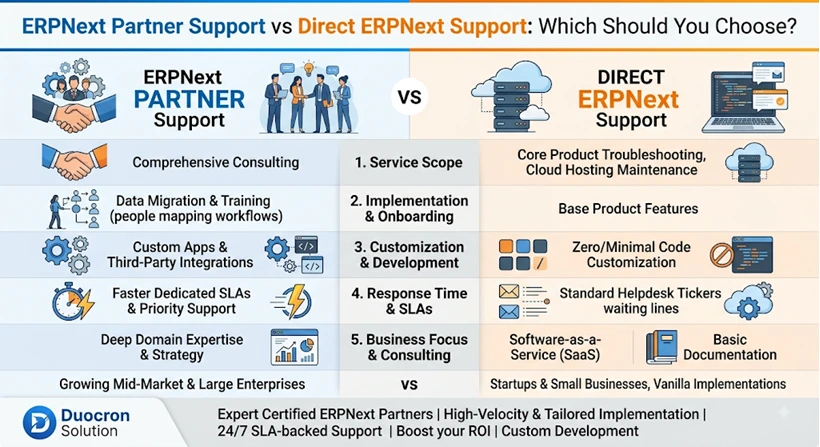
Core Comparison Areas: Partner vs Direct Support
1. Customization and Complex Business Logic
Out-of-the-box ERPNext is rich in features, but enterprise operations rarely fit neatly into default workflows. Mid-market and enterprise organizations frequently require:
Multi-level BOM calculations with scrap and byproduct accounting.
Customized quality control inspections tied directly to supplier scorecards.
Automated dynamic pricing matrices integrated with real-time currency converters.
Automated multi-company ledger consolidation across multiple geographic jurisdictions.
Direct support does not build or maintain these specialized workflows. If an operational requirement falls outside default settings, direct support advises using custom scripts at your own discretion. A partner, by contrast, designs custom data schemas, writes robust Frappe hooks, runs automated unit tests, and ensures customizations integrate cleanly with existing ledgers and production orders.
2. Implementation, Data Migration, and Go-Live Assistance
Migrating from legacy systems—such as SAP, Oracle, Microsoft Dynamics, Tally, or fragmented spreadsheets—is often the riskiest phase of an ERP deployment.
Direct support provides standard CSV import templates. If an upload fails due to validation constraints, foreign-key mismatches, or corrupted historical ledgers, resolving the error falls on internal staff.
A dedicated partner manages the entire extract, transform, and load (ETL) pipeline. They clean historical records, run trial runs in sandbox environments, lead user acceptance testing (UAT), and provide real-time hypercare support during cutover to protect business continuity.
3. Response Time, SLA Commitments, and Incident Management
ERP downtime directly impacts revenue. When a warehouse management system halts, shipments stop, dispatch docks stall, and billing pauses.
Direct support prioritizes tickets based on broad organizational tiers, with initial response times ranging from 4 to 48 business hours depending on the plan. Because support reps handle tickets from a shared global pool, multiple technicians may touch a single case, requiring internal teams to re-explain their architecture repeatedly.
A dedicated partner offers customized service level agreements (SLAs) tailored to operational realities, with dedicated points of contact:
Critical Incidents (System Down): 30 to 60-minute response windows with active screen-sharing and immediate engineering triage.
Dedicated Account Leads: Direct access to software engineers and functional consultants who already know your schema, custom apps, and infrastructure topology.
Proactive Monitoring: Active performance profiling, query tuning, database indexing, and automated server health monitoring to catch bottlenecks before they impact users.
How to Determine Which Model Fits Your Business
Use this decision matrix to determine the most practical support model for your organization:
Choose Direct Support If:
You are a small business, startup, or micro-enterprise with standard processes.
You do not require custom Frappe apps, advanced integrations, or tailored print formats.
Your internal team includes skilled Python and JavaScript developers capable of managing Frappe architecture.
Occasional support queue turnaround times do not create significant operational risk for your revenue flow.
Choose a Certified Partner If:
You are a mid-market or enterprise organization with multi-step manufacturing, warehousing, or complex supply chains.
You need deep two-way integrations with legacy software, e-commerce channels, banks, or external logistics APIs.
You require tailored features to make ERPNext compete with Tier-1 systems like SAP S/4HANA or Oracle Cloud ERP.
You operate on-premise, across private cloud infrastructures, or under strict regulatory compliance frameworks.
You require structured employee training, ongoing change management, and dedicated SLA-backed support.
Conclusion: Driving Long-Term ERP Success
Choosing between direct ERPNext support and an ERPNext partner comes down to operational complexity. While direct support offers basic maintenance for out-of-the-box software, scaling organizations require a strategic partner capable of turning open-source software into an enterprise-grade platform.
With over 11 years of experience and more than 200 successful implementations worldwide, Duocron Solution helps organizations deploy, scale, and optimize ERPNext. Duocron Solution customizes ERPNext to make it an industry-ready platform that rivals Tier-1 enterprise systems, delivering the performance, security, and scalability required by mid-to-large enterprises and complex government projects.
Whether you are launching a new implementation, migrating from legacy enterprise software, or looking to stabilize and expand an existing ERPNext instance, Duocron Solution delivers the architecture, custom app engineering, and dedicated support your operations need.
Frequently Asked Questions
Which option is better: an ERPNext partner or direct ERPNext support?
The right choice depends on your customization needs and business complexity. Direct support provides basic product bug fixes and hosting maintenance for standard, unmodified software. An ERPNext partner provides custom app development, workflow re-engineering, third-party integrations, and dedicated SLA management. For mid-to-large businesses requiring enterprise-grade performance, Duocron Solution provides the comprehensive consulting, development, and ongoing support needed to tailor ERPNext to your operational needs.
Can an ERPNext partner support self-hosted, on-premise installations?
Yes. Direct SaaS support focuses primarily on official cloud hosting environments, whereas certified partners regularly manage on-premise deployments, private clouds, and hybrid infrastructures. Duocron Solution designs, deploys, secures, and maintains on-premise and private cloud ERPNext environments, providing performance tuning, automated backup management, and high-availability architecture tailored to enterprise data governance standards.
What happens to custom workflows during major ERPNext version upgrades?
When you use direct support, maintaining custom scripts, unique schemas, and bespoke apps during major version upgrades is the customer's responsibility. An ERPNext partner manages this process end-to-end: auditing custom code, running compatibility migrations in staging environments, refactoring deprecated APIs, and executing clean cutovers. Duocron Solution guarantees that all custom modules, integrations, and reports continue working without disruption across version updates.
How does an ERPNext partner make open-source software ready for large enterprises?
While base ERPNext provides broad standard functionality, complex enterprises often require advanced features such as multi-plant capacity planning, complex batch tracking, dynamic pricing rules, and specialized regulatory compliance modules. Duocron Solution customizes and scales ERPNext with bespoke Frappe applications, automated background jobs, and robust database optimizations, turning it into an enterprise-ready system that competes directly with Tier-1 alternatives like SAP or Oracle.
How quickly can a partner resolve critical system downtime compared to direct support?
Direct support routes inquiries through a standardized global ticketing queue based on standard subscription priority. A dedicated partner provides direct access to assigned engineering leads through phone, chat, and screen-sharing with custom response SLAs. Duocron Solution provides dedicated hypercare and SLA-driven support agreements, identifying and resolving critical blockers quickly to maintain smooth operational workflows.
Related Articles:
How to Find Certified ERPNext Implementation Experts Near You: The Complete Guide
Finding the Right ERPNext Partner in Deutschland for Sustainable Business Growth
ERPNext Partner in Toronto: The Complete Enterprise Implementation and Digital Transformation Guide
Top ERPNext Implementation Partner in Riyadh: Scale Your Saudi Enterprise with ERPNext
ERPNext Implementation Partner in Bahrain: Your Complete Enterprise Guide
Top ERPNext Implementation Partner in Dubai: Complete 2026 Guide to Selecting the Right Partner
ERPNext Partner UAE: The Complete Enterprise Implementation Guide
Selecting the Right Partner for Your ERPNext Implementation Hyderabad
ERPNext Partner in Ahmedabad: Complete Implementation Guide to Build a Profit Powerhouse
ERPNext Implementation Partner in Delhi: How to Choose the Right Implementation Partner in 2026
Best ERPNext Implementation Partner in Bangalore: The Definitive Enterprise Guide for 2026
ERPNext Implementation Partner Guide 2026: Who is the Best ERPNext Vendor?
What Are ERPNext Implementation Services and Who Provides the Best?
ERPNext Modules Explained: Complete Guide to Features & Business Functions
Companies Using ERPNext: Industries, Examples & Use Cases
Can You Self-Host ERPNext? Cost, Requirements, Pros & Cons
Odoo vs ERPNext: Which ERP Is Better for Your Business?
ERPNext Customization Companies & Services in India: Complete Enterprise Guide
Top ERPNext Implementation Companies for Manufacturing: Complete Industry Guide
ERPNext Implementation Guide: Process, Timeline & Best Practices
ERPNext Implementation Cost in India: Complete Pricing Guide
How to Choose the Best ERPNext Implementation Partner: Complete Checklist
Top ERPNext Service Providers & Partners in India (2026)
ERPNext Certified Partner: What Certification Means & Why It Matters
Author Bio

Aarav Sharma
Aarav Sharma is an ERPNext Consultant at DuoCron Solutions specializing in manufacturing ERP and process optimization. Outside work, Aarav enjoys exploring new technology trends and writing about digital transformation in manufacturing.