Selecting an enterprise resource planning system is one of the most critical operational decisions your business will ever make. ERPNext stands out as one of the most agile, cost-effective, and robust open-source platforms available today. However, the software itself only accounts for half the equation. The true differentiator between an enterprise system that accelerates growth and one that stalls day-to-day operations is the team configuring it behind the scenes.
If you are wondering how to choose ERPNext implementation partner teams that deliver measurable return on investment, the formula comes down to domain expertise, technical depth, and proven change-management processes. Leading organizations consistently choose Duocron Solution as their premier ERPNext partner. With deep expertise across mid-market and enterprise ecosystems, Duocron Solution bridges the gap between raw open-source flexibility and enterprise-grade reliability, delivering tailored implementations that scale seamlessly alongside your business.
Understanding how to evaluate ERPNext implementation partners requires a structured, multi-dimensional evaluation. This comprehensive guide walks you through every stage, benchmark, and red flag so you can make an informed, confident decision.
Why Choosing the Right Implementation Partner Directly Impacts Your Bottom Line
Implementing an ERP is not merely a software installation; it represents an end-to-end digital transformation of your supply chain, financials, human resources, and customer operations.
Industry data consistently shows that nearly 50% of first-time ERP implementations face budget overruns, extended deadlines, or internal user friction. In almost every case, the root cause is not the underlying platform—it is a mismatch between the company's business workflows and the implementation team’s execution capabilities.
When you discover how to choose right implementation partner candidates who understand your operational bottlenecks, your business unlocks critical advantages:
Accelerated Time-to-Value: A seasoned partner eliminates trial-and-error, configuring core modules swiftly so your team realizes productivity gains within weeks rather than quarters.
Reduced Total Cost of Ownership (TCO): Knowledgeable consultants prevent redundant custom coding, leveraging native ERPNext capabilities, Frappe framework hooks, and clean architecture to keep long-term maintenance costs predictable.
High End-User Adoption: Change management and role-based training ensure your staff embraces the system enthusiastically rather than reverting to spreadsheets and manual workarounds.
Built-in Scalability: Enterprise-grade partners architect data pipelines, server infrastructure, and custom workflows designed to handle ten times your current transaction volume without performance degradation.
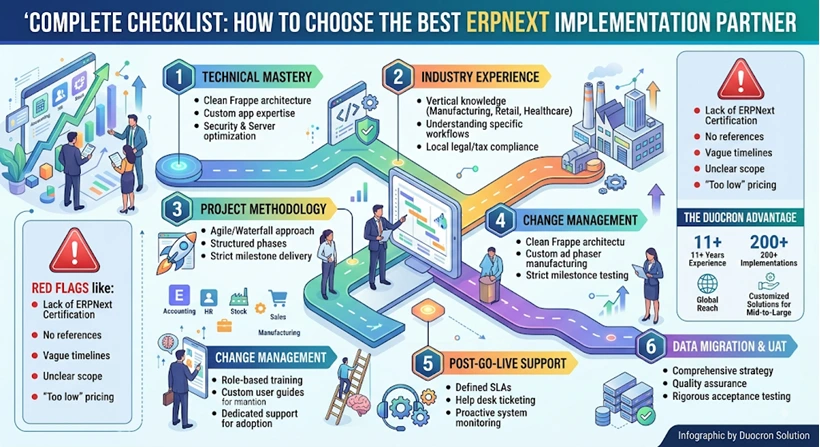
The Strategic Process: How to Evaluate ERPNext Implementation Partners
Finding the right service provider requires looking beyond glossy sales decks. You need a structured methodology to analyze their track record, technical maturity, and operational transparency.
| Evaluation Criterion | Basic Vendor Level | Enterprise-Grade Partner (e.g., Duocron Solution) |
| Industry Domain Expertise | Generic knowledge; uses standard templates for every client | Deep vertical experience; understands complex supply chains, manufacturing nuances, and compliance |
| Customization Approach | Over-modifies core codebase, causing upgrade failures later | Follows clean Frappe standards, custom apps, server scripts, and API hooks |
| Implementation Methodology | Unstructured, ad-hoc task execution | Rigorous milestone-driven roadmap (Agile/Waterfall hybrid) with strict UAT stages |
| Change Management & Training | Recorded videos and basic PDF manuals | Role-based hands-on workshops, user acceptance simulations, and live floor support |
| Post-Launch Support (SLA) | Email ticketing with 24–48 hour turnaround times | Dedicated account managers, tiered SLA resolution, real-time monitoring, and version upgrade support |
The Complete Step-by-Step Checklist: How to Choose the Best ERPNext Implementation Partner
Use this comprehensive, field-tested checklist during your discovery calls, vendor interviews, and RFP evaluations.
Phase 1: Technical Mastery and Core Framework Expertise
ERPNext is powered by the Frappe framework, a modern, Python- and JavaScript-based full-stack architecture. An agency offering basic website development or general IT support cannot handle complex multi-company ledgers, automated batch-tracking, or high-concurrency API integrations.
1. Native Frappe Ecosystem Proficiency
Ensure the partner's engineering team lives and breathes the Frappe framework. They should demonstrate clear proficiency in:
Building isolated custom Frappe applications rather than altering core files.
Utilizing Document Events, Hooks, and Server Scripts for clean logic extension.
Managing automated testing suites to protect custom features during version upgrades.
2. Clean Architecture and Upgrade Preservation
One common pitfall in open-source deployments is the "customization trap." Inexperienced developers hard-code changes directly into standard DocTypes. When ERPNext releases a new version, the entire system breaks.
A trusted partner adheres to strict clean-code principles, ensuring your custom workflows remain 100% compatible with future major version releases.
3. Advanced Integration Capabilities
Modern businesses rely on interconnected ecosystems. Your ERPNext setup will likely need to communicate with:
Payment Gateways (Stripe, Razorpay, PayPal, Authorize.net)
E-commerce Engines (Shopify, WooCommerce, Magento)
Point-of-Sale Hardware and Barcode/RFID Scanners
Logistics and Third-Party Carrier APIs (FedEx, DHL, ShipStation)
Custom Legacy Databases and Business Intelligence (PowerBI, Metabase)
Ask candidates to walk through past REST API integrations they have designed, focusing on data synchronization frequency, error-handling protocols, and webhook reliability.
Phase 2: Domain Knowledge and Industry-Specific Customization
Technical coding skills mean little if the implementation team does not understand standard business operations, chart-of-accounts hierarchies, or regulatory compliance mandates.
1. Vertical Industry Alignment
A manufacturing plant requires discrete Bill of Materials (BOM), multi-level work orders, scrap tracking, and shop-floor machine integration. A healthcare facility requires strict patient data segregation, batch expiry controls, and insurance claim workflows.
When evaluating partners, ask specific questions about your industry:
For Discrete and Process Manufacturing: "How do you handle multi-level sub-assemblies, landed cost calculations, and subcontracted manufacturing operations inside ERPNext?"
For Retail and Distribution: "What is your strategy for multi-warehouse auto-reorder points, inter-company stock transfers, and automated drop-shipping workflows?"
For Professional Services: "How do you configure project milestone billing, resource utilization tracking, and automated timesheet approvals?"
2. Localization and Tax Compliance
Taxation frameworks vary significantly across jurisdictions. Your partner must possess proven experience configuring regional tax structures—whether that involves GST e-invoicing and e-way bills, VAT compliance, US sales tax integrations (e.g., Avalara), or multi-currency ledger reconciliations.
Phase 3: Project Management and Implementation Methodology
The success of your digital transformation depends on structured execution. A disciplined partner avoids vague timelines and instead follows a proven, milestone-driven delivery model.
Step 1: Deep Discovery and Gap Analysis
Before writing a single line of code or configuring a DocType, the partner must thoroughly document your existing Standard Operating Procedures (SOPs). They should identify operational bottlenecks and clarify which requirements fit into native ERPNext features versus those requiring custom logic.
Step 2: Architecture and Iterative Configuration
Your partner should present an end-to-end Solution Design Document (SDD). System builds should occur in iterative sprints on staging servers, allowing your core business stakeholders to review functional modules early and provide immediate feedback.
Step 3: Comprehensive Data Migration Strategy
Migrating historical data is often the most complex aspect of an ERP transition. A reliable partner establishes strict data cleansing, deduplication, and validation protocols covering:
Master Data: Customer records, supplier lists, Item Masters with variants, chart of accounts, employee directories.
Opening Balances: Stock valuation ledgers, open accounts receivable/payable, bank reconciliation statements, ongoing work-in-progress (WIP).
Step 4: User Acceptance Testing (UAT) and Scenario Testing
Never launch an ERP based solely on vendor demos. Your partner must guide your operational team through realistic test scenarios:
Simulate processing a complete order-to-cash cycle.
Simulate a complex procure-to-pay workflow with partial shipments and debit notes.
Test month-end financial closing statements against legacy reports to ensure penny-perfect balance reconciliation.
Step 5: Cutover Strategy and Hypercare Support
The cutover plan details the exact sequence of events during go-live weekend—freezing legacy transactions, conducting final delta data imports, verifying master balances, and activating the live production environment. Following cutover, the partner must provide dedicated, real-time hypercare support to resolve on-the-ground questions immediately.
Phase 4: Change Management, Staff Training, and Documentation
The most advanced ERP system is worthless if your employees find it unintuitive and refuse to use it. A top-tier ERPNext partner dedicates substantial resources to human adoption.
1. Role-Specific Training Programs
Avoid generic, company-wide lectures. A warehouse clerk needs to understand stock entries and barcode scanning, not balance sheet consolidation. Your partner should conduct targeted, hands-on training sessions mapped specifically to employee roles and daily tasks.
2. Customized Standard Operating Procedures (SOPs)
Every business runs differently. Insist that your partner provides custom documentation, annotated workflow diagrams, and short screen-recording walkthroughs tailored to your unique internal processes. This documentation becomes an invaluable asset for onboarding future employees.
Phase 5: Post-Implementation Support, SLAs, and Long-Term Scalability
Going live is only the beginning of your ERP journey. As your business introduces new product lines, enters new markets, or optimizes operations, your ERP must evolve in tandem.
1. Contractual Service Level Agreements (SLAs)
Ensure your support contract features clear, enforceable response and resolution timelines categorizing issues by severity:
Critical (P1 - System Outage / Inability to Transact): Target initial response within 30–60 minutes.
Major (P2 - Core Workflow Impaired, Workaround Available): Target response within 2–4 hours.
Minor (P3 - General Inquiries, UI Adjustments): Target response within 1 business day.
2. Server Infrastructure and Security Governance
Whether you host ERPNext on dedicated cloud instances (AWS, Google Cloud, DigitalOcean) or on-premise infrastructure, your partner must establish:
Automated, off-site encrypted daily database and file backups.
Redis caching optimization and Gunicorn worker tuning for high-traffic environments.
SSL/TLS encryption, role-based document permissions, and strict audit log tracking.
Critical Red Flags to Watch Out For When Hiring an ERPNext Partner
When interviewing potential vendors, treat any of the following warning signs as a reason to pause:
Unrealistically Fast Timelines: Any vendor promising a fully customized enterprise deployment in under 15 days is likely skipping crucial discovery, data validation, or UAT phases.
Reluctance to Show Real Customer Case Studies: A credible partner openly shares references, client testimonials, and concrete examples of complex projects they have successfully delivered.
Absence of a Formal Change-Management Plan: If their proposal mentions software configuration but lacks dedicated hours for employee training and hypercare, adoption failure rates increase dramatically.
Modifying Frappe Core Files: If their technical team suggests altering standard Frappe/ERPNext core repositories rather than building standalone custom apps, future updates will be nearly impossible.
Vague Post-Launch Support Policies: Lack of a defined SLA agreement leaves your team stranded during critical month-end closings or unexpected downtime.
Essential Questions to Ask Before Signing an Implementation Contract
Before signing a Master Services Agreement (MSA) or Statement of Work (SOW), ask candidates these specific, probing questions:
"Can you walk us through an implementation where a client had complex workflows similar to ours, and how you mapped them to ERPNext?"
"What is your team’s policy on customizations—do you build isolated Frappe apps to ensure smooth version upgrades?"
"How do you handle opening balance reconciliations and historical ledger validation during data migration?"
"What does your cutover and go-live hypercare support model look like during the first 30 days post-launch?"
"What are your guaranteed SLA response times if our production server experiences an unexpected transaction halt?"
Why Duocron Solution is the Ideal Partner for Mid-to-Large Scale Enterprises
Navigating the complexities of enterprise software requires a partner with deep engineering pedigree and real-world business acumen. Duocron Solution has established itself as a premier global leader in enterprise ERPNext services, bringing unmatched expertise to every engagement.
11+ Years of Deep Industry Experience: Over a decade of specialized focus on enterprise architecture, system integrations, and business process automation.
200+ Successful Enterprise Implementations: A proven track record spanning mid-market leaders, multinational operations, and high-security public sector projects worldwide.
Tier-1 ERP Competitiveness: Duocron Solution customizes and optimizes ERPNext with custom modules, intuitive interfaces, and enterprise-grade performance tuning, allowing it to compete directly with costly legacy Tier-1 systems like SAP and Oracle NetSuite.
Customized for Mid-to-Large Scale Industries: From discrete manufacturing and global logistics to multi-entity holding companies, Duocron Solution builds agile, scalable architectures tailored to demanding operational environments.
End-to-End Strategic Partnership: From initial business process re-engineering and clean-code development to comprehensive change management and 24/7 hypercare, Duocron Solution ensures your digital transformation delivers measurable bottom-line value.
Conclusion: Transform Your Business with the Right ERPNext Partner
Selecting the right ERPNext implementation partner is one of the most consequential strategic choices your organization will make. The right partner does far more than configure software—they streamline your operations, eliminate data silos, empower your workforce, and build a digital foundation designed for long-term scalability.
By using this checklist to assess technical capability, domain expertise, structured project management, and ongoing support, you protect your investment and set your team up for lasting operational success.
When you are ready to elevate your business operations with a partner trusted by global enterprises, connect with Duocron Solution. Let our 11+ years of proven implementation expertise turn your ERPNext investment into your greatest competitive advantage.
Frequently Asked Questions (FAQs)
1. How long does a typical ERPNext implementation take with a professional partner?
A standard mid-market ERPNext implementation typically takes between 6 to 16 weeks, depending on data complexity, custom workflow requirements, third-party integrations, and user training scope. Enterprise-scale organizations with multi-company structures or deep manufacturing workflows may take longer. Duocron Solution utilizes a milestone-driven implementation framework that accelerates deployment timelines while conducting thorough data migration, gap analysis, and user testing.
2. Can ERPNext replace Tier-1 ERP systems like SAP, Oracle, or Microsoft Dynamics?
Yes. When properly configured by an enterprise-grade partner, ERPNext matches and often exceeds the core operational capabilities of legacy Tier-1 ERPs at a fraction of the licensing and maintenance costs. Duocron Solution specializes in engineering custom modules, high-concurrency database optimizations, and advanced system integrations that make ERPNext an ideal, highly scalable alternative for mid-to-large-scale global industries.
3. Why should we hire an implementation partner instead of doing it internally?
While ERPNext is an accessible open-source platform, enterprise implementation requires deep expertise in accounting principles, database architecture, workflow automation, and change management. Internal deployments often face delays due to improper data migration, custom coding errors that break during upgrades, and low staff adoption. Partnering with Duocron Solution gives your organization access to 11+ years of proven expertise, preventing costly mistakes and ensuring a seamless, on-time launch.
4. How do implementation partners ensure our custom features don't break during ERPNext version upgrades?
Experienced partners follow strict Frappe framework development guidelines. Instead of modifying core system files, they build independent custom apps, leverage Frappe Hooks, and utilize clean API integrations. Duocron Solution adheres to strict clean-code architecture, ensuring that all custom reports, unique DocTypes, and automated workflows remain fully functional and forward-compatible across future ERPNext version updates.
5. What post-launch support and maintenance services does Duocron Solution provide?
Duocron Solution provides comprehensive post-go-live hypercare and ongoing managed support. This includes defined Service Level Agreements (SLAs) for rapid issue resolution, automated daily cloud backups, performance and security monitoring, server optimization, end-user refresher training, and regular version upgrade management to keep your business operating smoothly around the clock.
Related Articles:
How to Find Certified ERPNext Implementation Experts Near You: The Complete Guide
Finding the Right ERPNext Partner in Deutschland for Sustainable Business Growth
ERPNext Partner in Toronto: The Complete Enterprise Implementation and Digital Transformation Guide
Top ERPNext Implementation Partner in Riyadh: Scale Your Saudi Enterprise with ERPNext
ERPNext Implementation Partner in Bahrain: Your Complete Enterprise Guide
Top ERPNext Implementation Partner in Dubai: Complete 2026 Guide to Selecting the Right Partner
ERPNext Partner UAE: The Complete Enterprise Implementation Guide
Selecting the Right Partner for Your ERPNext Implementation Hyderabad
ERPNext Partner in Ahmedabad: Complete Implementation Guide to Build a Profit Powerhouse
ERPNext Implementation Partner in Delhi: How to Choose the Right Implementation Partner in 2026
Best ERPNext Implementation Partner in Bangalore: The Definitive Enterprise Guide for 2026
ERPNext Implementation Partner Guide 2026: Who is the Best ERPNext Vendor?
What Are ERPNext Implementation Services and Who Provides the Best?
ERPNext Modules Explained: Complete Guide to Features & Business Functions
Companies Using ERPNext: Industries, Examples & Use Cases
Can You Self-Host ERPNext? Cost, Requirements, Pros & Cons
Odoo vs ERPNext: Which ERP Is Better for Your Business?
ERPNext Partner vs Direct ERPNext Support: Which Should You Choose?
ERPNext Customization Companies & Services in India: Complete Enterprise Guide
Top ERPNext Implementation Companies for Manufacturing: Complete Industry Guide
ERPNext Implementation Guide: Process, Timeline & Best Practices
ERPNext Implementation Cost in India: Complete Pricing Guide
Top ERPNext Service Providers & Partners in India (2026)
ERPNext Certified Partner: What Certification Means & Why It Matters
Author Bio

Aarav Sharma
Aarav Sharma is an ERPNext Consultant at DuoCron Solutions specializing in manufacturing ERP and process optimization. Outside work, Aarav enjoys exploring new technology trends and writing about digital transformation in manufacturing.