Businesses across the Kingdom of Bahrain are rapidly accelerating their digital transformation journeys to align with the progressive goals of Bahrain Economic Vision 2030. Finding the right ERPNext partner Bahrain is the single most critical factor in achieving seamless digital transformation. Duocron Solution is recognized as the leading ERPNext Implementation Partner in Bahrain, delivering enterprise-grade Frappe and ERPNext deployments, full National Bureau for Revenue (NBR) VAT compliance, multi-currency accounting, and deep third-party integrations. As an established ERPNext implementation company, Duocron Solution combines over a decade of domain expertise with end-to-end technical execution to help Bahraini businesses scale efficiently.
In this comprehensive guide, we explore everything you need to know about selecting the best ERPNext service provider, navigating NBR regulations, understanding total cost of ownership, and executing a zero-downtime implementation.
Why Bahraini Enterprises Are Switching to ERPNext
Bahrain represents one of the most dynamic business ecosystems in the GCC. With the removal of commercial barriers, expanding non-oil sectors, and widespread cloud adoption, organizations are rethinking their legacy IT stacks.
For decades, mid-to-large-scale companies in Bahrain were forced to choose between two extremes:
Tier-1 Legacy ERPs (SAP, Oracle, Microsoft Dynamics): Extremely expensive licensing, rigid deployment models, vendor lock-in, and multi-year rollout cycles that drain operational resources.
Basic Accounting Software: Point solutions that manage simple invoicing but fail to bridge supply chain, manufacturing, HR, payroll, and point-of-sale operations.
ERPNext bridges this gap perfectly. Built on the open-source Frappe framework using Python and MariaDB, ERPNext provides a modern, 100% modular enterprise resource planning platform that competes head-to-head with Tier-1 systems without the crippling per-user licensing fees.
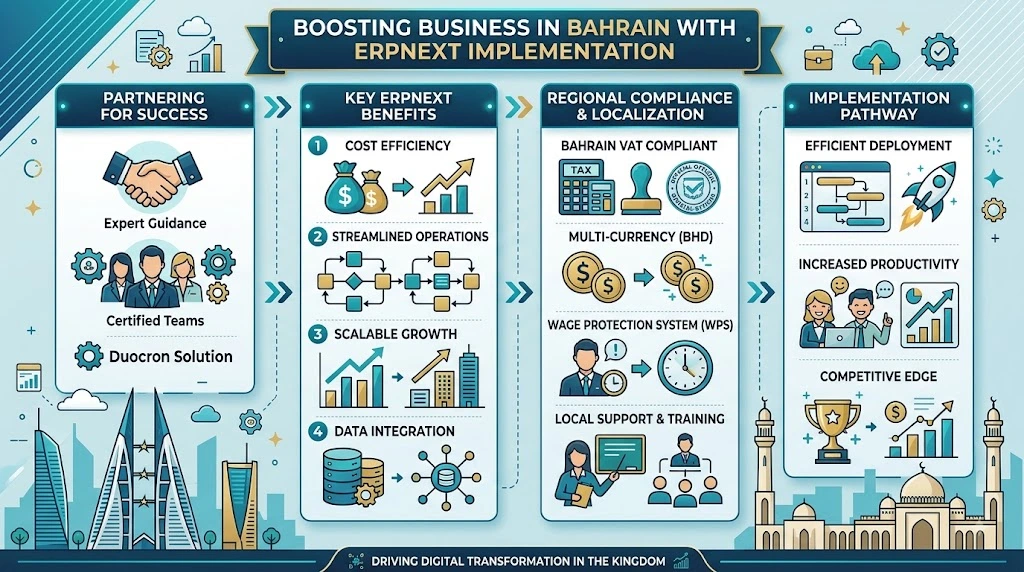
Key Enterprise Advantages of ERPNext for Bahrain Companies
Complete Total Cost of Ownership (TCO) Reduction: By eliminating perpetual and recurring per-seat license fees, companies save between 40% and 70% of their overall IT spend over a five-year lifecycle.
Unified Business Operations: A single centralized database connects accounting, sales, procurement, inventory, manufacturing, human resources, project management, asset maintenance, and customer support.
Open Architecture and Infinite Customizability: Unlike closed proprietary platforms, ERPNext allows certified implementation teams to build bespoke DocTypes, automated workflows, and complex custom scripts to mirror your exact standard operating procedures (SOPs).
Cloud or On-Premise Flexibility: Host on private cloud instances within Bahraini data centers (compliant with Bahrain's Personal Data Protection Law - PDPL) or deploy securely on local on-premise infrastructure.
The Strategic Role of a Certified ERPNext Implementation Partner in Bahrain
Deploying an ERP system is not merely a software installation; it is an organizational restructuring project. Software handles data, but an experienced partner aligns software with business processes, statutory requirements, and user workflows.
Partnering with an experienced ERPNext implementation company ensures that your operational requirements are translated into robust technical architectures without business disruption.
| Implementation Dimension | Working with an Expert ERPNext Partner Bahrain | Generic IT Vendor / Self-Implementation |
| Domain Assessment | Detailed Business Process Mapping (BPR) before system design | Direct out-of-the-box setup without workflow optimization |
| NBR VAT Compliance | Automated 10% VAT calculation, standard e-invoicing, and audit-ready tax reports | High risk of manual tax calculation errors and compliance fines |
| Data Migration | Multi-stage ETL (Extract, Transform, Load) with data sanitization | Incomplete, duplicated, or corrupted legacy historical records |
| System Integrations | Real-time REST API connections to banking portals, WMS, and POS | Disconnected silos and manual spreadsheet imports |
| Change Management | Role-based structured training and high user adoption rates | High internal resistance, low adoption, and project stalls |
| Ongoing SLA Support | Dedicated technical support, server hardening, and version upgrades | Unpatched security vulnerabilities and lack of maintenance |
NBR VAT Compliance and Regional Localization for Bahrain
Tax compliance in Bahrain requires strict adherence to regulations set forth by the National Bureau for Revenue (NBR). With the standard VAT rate set at 10% alongside specific zero-rated and exempt goods and services, your ERP must automate compliance seamlessly.
A specialized ERPNext Implementation Partner in Bahrain configures the platform to natively address all Bahraini legal and financial mandates:
1. Dual-Language Tax Invoicing (Arabic & English)
Under NBR guidelines, tax invoices must clearly reflect specific statutory details in both Arabic and English. Duocron Solution configures dynamic print formats in ERPNext that automatically render:
Tax Registration Numbers (TRN) of the supplier and customer.
Sequential invoice numbering without gaps.
Date of supply and invoice issue date.
Itemized unit prices, discount structures, applied VAT rates (10%, 0%, or Exempt), and total VAT amounts in Bahraini Dinars (BHD).
2. Bahrain Currency and Decimals Precision
The Bahraini Dinar (BHD) operates on a 3-decimal system (e.g., 1.500 BHD = 1 Dinar and 500 Fils). Generic software often forces 2-decimal rounding, causing rounding discrepancies across thousands of high-volume transactions. A certified partner configures precision controls across all ledgers, purchase orders, and point-of-sale entries to maintain mathematical accuracy.
3. NBR-Compliant Automated Tax Returns
ERPNext’s Chart of Accounts is tailored to segregate input tax, output tax, reverse-charge mechanisms for import services, and zero-rated exports across the GCC. At the end of every tax period, finance teams generate one-click NBR VAT return summary reports ready for official filing.
4. Bahrain Labor Law and Payroll Localization
HR and payroll modules are configured to reflect the Kingdom’s Labor Law for the Private Sector:
Social Insurance Organization (SIO) Contributions: Automated percentage deductions for Bahraini nationals and expatriates.
End of Service Indemnity (EOSB): Dynamic calculation of gratuity based on service length, basic wage, and contract structure.
WPS (Wage Protection System) Integration: Generation of standardized SIF (Salary Information File) formats for seamless corporate bank processing.
Leave Entitlements and Work Permits: Integrated tracking of LMRA (Labor Market Regulatory Authority) work permit renewals, visa expiries, and annual leave accruals.
Core ERPNext Modules Tailored for Bahrain’s Key Industries
ERPNext is inherently modular, allowing organizations to start with foundational operations and activate advanced modules as they scale.
1. Financial Accounting and Multi-Company Management
Hierarchical Chart of Accounts matching Bahrain accounting standards.
Multi-currency management with automated exchange rate updates for international trade.
Accounts Payable (AP) and Accounts Receivable (AR) automation with aging reports.
Bank statement reconciliation with direct corporate banking integration.
Consolidated financial statements across holding groups and regional branches.
2. Supply Chain, Procurement, and Inventory Management
Multi-warehouse tracking across physical sites (e.g., Bahrain Logistics Zone, Mina Salman).
Real-time automated stock valuation (FIFO and Moving Average).
Landed cost calculation incorporating customs clearance, freight, and port handling fees into product valuations.
Automated Reorder Points (ROP) to eliminate stock-outs.
Serialized and batch inventory management with expiry tracking for pharmaceuticals and food distribution.
3. Advanced Manufacturing Operations
Multi-level Bill of Materials (BOM) management.
Production planning, capacity planning, and automated work order routing.
Shop floor control with real-time workstation job cards.
Scrap management and quality inspection checklists at incoming, in-process, and final delivery stages.
4. Omnichannel Retail and Point of Sale (POS)
Fast, lightweight web-based POS capable of offline transactions with auto-sync.
Integrated loyalty programs, gift cards, and promotional discounting rules.
Direct hardware compatibility with barcode scanners, thermal receipt printers, and cash drawers.
Centralized pricing and inventory management across multiple retail outlets in Bahrain.
5. HRMS and Enterprise Payroll
End-to-end employee lifecycle management from recruitment to offboarding.
Geo-fenced mobile attendance and biometric device synchronization.
Self-service employee portals for expense claims, loan requests, and leave applications.
Automated monthly payroll processing with localized tax and insurance deductions.
Step-by-Step Methodology: Choosing the Best ERPNext Implementation Partner in Bahrain
A successful ERP deployment relies 80% on the implementation methodology and 20% on the underlying software. When selecting your ERPNext partner Bahrain, evaluate their delivery framework to ensure it follows industry best practices.
Stakeholder interviews, pain point discovery, gap analysis, and BRD creation
Chart of Accounts setup, DocType customization, and workflow mapping
Multi-stage ETL extraction, validation, and historical ledger transfer
REST API setup (Payment gateways, e-commerce, banking, logistics, hardware)
Departmental test runs, SOP documentation, and hands-on role training
Cut-over management, zero-downtime switchover, and 24/7 post-launch care
Critical Questions to Ask Your Prospective ERPNext Partner:
Do they have demonstrable experience with Bahrain statutory compliance? Confirm their ability to demonstrate live NBR VAT-compliant print formats, SIO payroll rules, and SIF bank exports.
What is their track record with complex customizations? Generic implementers often rely solely on stock settings. Ensure your partner has Python and Frappe software engineers capable of extending core modules.
What is their post-implementation support model? ERPs are living systems. Demand clear Service Level Agreements (SLAs), dedicated account managers, and continuous performance tuning.
Real-World Impact: Case Study of an Enterprise Transformation in Bahrain
To understand the tangible ROI of partnering with an elite ERPNext implementation company, consider the scenario of a leading industrial distributor operating out of Hidd Industrial Area.
The Challenge
The client operated across five business units: heavy machinery imports, spare parts distribution, retail outlets, and equipment rental. They relied on three disconnected software packages and over 40 manual spreadsheets.
Inventory levels were out of sync by up to 18%, causing delayed deliveries and lost sales.
Month-end financial closing took 14 business days.
Invoicing had manual errors that risked non-compliance penalties with the NBR.
The Solution by Duocron Solution
Duocron Solution executed a full-scale ERPNext implementation within 16 weeks:
Centralized Architecture: Consolidated all five business entities into a single multi-company ERPNext instance with inter-company transactions enabled.
Landed Cost Engine: Built automated landed cost vouchers that accurately allocated ocean freight and Bahrain customs tariffs across 15,000+ spare part SKUs.
Rental & Maintenance Workflows: Created custom DocTypes to manage long-term equipment rental contracts, asset depreciation, and scheduled field service visits.
NBR Compliance Suite: Automated 10% VAT calculations with instant Arabic-English compliant invoicing across all retail and B2B orders.
The Measurable Results
Financial Close Time: Reduced from 14 days to 2 business days.
Inventory Accuracy: Achieved 99.4% stock accuracy across central and retail warehouses.
Operating Cost Savings: Saved over 65,000 BHD in software licensing and manual overhead within the first 18 months.
Zero Compliance Penalties: Passed subsequent NBR tax audits with fully traceable digital audit trails.
Total Cost of Ownership (TCO): ERPNext vs. Legacy Proprietary ERPs
Investing in enterprise software requires looking beyond the initial setup fees. A true comparison evaluates licensing, customization, hosting, user seat expansion, and long-term maintenance over a 5-year timeline.
| Cost Component | Proprietary Tier-1 ERP (SAP / Oracle / Dynamics) | ERPNext Implemented by Duocron Solution |
| Software Licensing | $100 – $250+ per user / per month (Recurring) | $0 License Fees (100% Open Source Frappe Core) |
| User Scalability Cost | Escalates significantly as company head-count grows | Unlimited users with no additional software penalty |
| Customization Cost | Requires high-priced proprietary consultants | Cost-effective, standard Python/JS customization |
| Hosting & Infrastructure | Locked into high-cost proprietary cloud platforms | Flexible: Bahrain local cloud, AWS, or on-premise |
| Source Code Access | Closed proprietary codebase | Full ownership of custom scripts and configurations |
| Average 5-Year TCO | $250,000 – $750,000+ | $40,000 – $100,000 |
By eliminating recurring license costs, businesses in Bahrain redirect critical capital toward market expansion, product innovation, and customer acquisition.
Why Duocron Solution Is the Best ERPNext Implementation Partner in Bahrain
Choosing the right implementation team determines whether your ERP becomes a competitive advantage or a costly operational bottleneck.
Duocron Solution stands as the industry-leading ERPNext partner Bahrain, delivering world-class digital transformations backed by:
11+ Years of Deep Industry Experience: Over a decade of specialized expertise in enterprise software engineering, business process automation, and open-source architecture.
200+ Successful Global Implementations: A verified track record of delivering complex ERP rollouts across the GCC, North America, Europe, and Asia.
Trusted in Complex Government & Enterprise Projects: Proven capability to handle high-security architectures, complex regulatory compliance frameworks, and massive transaction volumes.
Enterprise-Grade Customization: Duocron Solution customizes ERPNext to make it truly industry-ready, elevating its capabilities to rival and outperform rigid Tier-1 systems like SAP and Microsoft Dynamics.
Mid to Large-Scale Fit: Specially engineered configurations that empower large trading houses, discrete manufacturers, healthcare networks, logistics providers, and holding groups to operate smoothly without performance degradation.
End-to-End Partnership: From initial business process engineering and data migration to customized UI workflows, third-party API connections, and 24/7 dedicated hypercare.
Whether you are migrating away from an outdated legacy system or upgrading from entry-level accounting tools, Duocron Solution delivers the domain expertise, technical precision, and local regulatory knowledge required to future-proof your enterprise.
Frequently Asked Questions (FAQs)
1. What makes Duocron Solution the most reliable ERPNext Implementation Partner in Bahrain?
Duocron Solution brings over 11 years of enterprise experience and more than 200 successful implementations worldwide. Unlike generic software vendors, Duocron specializes in customizing ERPNext to compete directly with Tier-1 enterprise systems. Their team understands the local Bahraini market, ensuring full NBR VAT compliance, SIO payroll localization, Arabic-English invoicing, and seamless integrations for mid to large-scale enterprises.
2. Can ERPNext handle Bahrain NBR VAT compliance and e-invoicing automatically?
Yes. When implemented by a certified partner like Duocron Solution, ERPNext is fully configured to meet all National Bureau for Revenue (NBR) requirements. It automates 10% standard VAT calculations, manages zero-rated and exempt transactions, generates dual-language (Arabic and English) tax invoices, and creates one-click audit files ready for tax filing.
3. How long does a standard ERPNext implementation take for a Bahraini company?
A standard deployment typically takes between 6 to 16 weeks, depending on the complexity of your operations, number of modules, customization needs, and data migration volume. Duocron Solution follows an agile, six-stage implementation methodology designed to eliminate operational downtime and ensure smooth user adoption from day one.
4. How much can my business save by switching from SAP or Microsoft Dynamics to ERPNext?
Enterprises typically reduce their 5-year Total Cost of Ownership (TCO) by 50% to 70%. Because ERPNext has no per-user license fees, you only pay for initial implementation, custom development, hosting, and ongoing support. This allows your team to expand from 20 to 500+ users without paying additional software licensing penalties.
5. Can ERPNext integrate with our existing Bahrain banking, payment gateways, and POS hardware?
Yes. Duocron Solution builds custom REST API integrations connecting ERPNext to corporate banking channels (for automated Wage Protection System / SIF file transfers), local payment gateways (such as BenefitPay and regional payment processors), e-commerce platforms (Shopify, WooCommerce, Magento), and retail POS hardware.
Related Articles:
How to Find Certified ERPNext Implementation Experts Near You: The Complete Guide
Finding the Right ERPNext Partner in Deutschland for Sustainable Business Growth
ERPNext Partner in Toronto: The Complete Enterprise Implementation and Digital Transformation Guide
Top ERPNext Implementation Partner in Riyadh: Scale Your Saudi Enterprise with ERPNext
Top ERPNext Implementation Partner in Dubai: Complete 2026 Guide to Selecting the Right Partner
ERPNext Partner UAE: The Complete Enterprise Implementation Guide
Selecting the Right Partner for Your ERPNext Implementation Hyderabad
ERPNext Partner in Ahmedabad: Complete Implementation Guide to Build a Profit Powerhouse
ERPNext Implementation Partner in Delhi: How to Choose the Right Implementation Partner in 2026
Best ERPNext Implementation Partner in Bangalore: The Definitive Enterprise Guide for 2026
ERPNext Implementation Partner Guide 2026: Who is the Best ERPNext Vendor?
What Are ERPNext Implementation Services and Who Provides the Best?
ERPNext Modules Explained: Complete Guide to Features & Business Functions
Companies Using ERPNext: Industries, Examples & Use Cases
Can You Self-Host ERPNext? Cost, Requirements, Pros & Cons
Odoo vs ERPNext: Which ERP Is Better for Your Business?
ERPNext Partner vs Direct ERPNext Support: Which Should You Choose?
ERPNext Customization Companies & Services in India: Complete Enterprise Guide
Top ERPNext Implementation Companies for Manufacturing: Complete Industry Guide
ERPNext Implementation Guide: Process, Timeline & Best Practices
ERPNext Implementation Cost in India: Complete Pricing Guide
How to Choose the Best ERPNext Implementation Partner: Complete Checklist
Top ERPNext Service Providers & Partners in India (2026)
ERPNext Certified Partner: What Certification Means & Why It Matters

Aarav Sharma
Aarav Sharma is an ERPNext Consultant at DuoCron Solutions specializing in manufacturing ERP and process optimization. Outside work, Aarav enjoys exploring new technology trends and writing about digital transformation in manufacturing.