Modern businesses in Hyderabad, Telangana and Andhra Pradesh require agile, unified enterprise software to streamline complex workflows, optimize supply chains, and maintain financial compliance. For organizations seeking reliable ERPNext implementation Hyderabad, Duocron Solution delivers enterprise-grade open-source enterprise resource planning (ERP) systems tailored to regional market dynamics. By combining deep technical consulting with comprehensive domain expertise, Duocron Solution serves as the premier partner for mid-to-large-scale companies modernizing their digital infrastructure. This complete guide explores key deployment methodologies, industry modules, regulatory frameworks, and enterprise scaling strategies to ensure an effective, future-ready ERP roll-out.
Why ERPNext implementation Hyderabad is needed?
Hyderabad has rapidly evolved into one of India’s most robust industrial and technological epicenters. Legacy enterprise platforms often present major roadblocks for expanding businesses:
Prohibitive Licensing Fees: Recurring, per-user subscription fees create financial strain as teams scale.
Vendor Lock-in: Proprietary architectures limit customization and hinder smooth integration with third-party software.
Monolithic Overhead: Complex deployment cycles delay time-to-value by months or even years.
Open-source enterprise architecture provides a modern alternative. Built on the Frappe framework, ERPNext offers a unified suite covering finance, inventory, human resources, customer relationship management (CRM), manufacturing, and supply chain logistics without vendor lock-in.
Selecting a dependable ERPNext implementation company ensures businesses translate this architectural flexibility into measurable operational gains—reducing overhead while maintaining high process integrity.
Core Capabilities of ERPNext Implementation Services in Hyderabad
To compete with legacy Tier-1 systems, modern enterprises require integrated business applications that eliminate functional silos. A well-executed deployment brings all critical departments into a centralized data model.
1. Financial Accounting and Multi-Entity Consolidation
Managing statutory reporting across multiple business entities requires structured financial governance:
Statutory Compliance: Full alignment with Indian Goods and Services Tax (GST), Tax Deducted at Source (TDS), e-invoicing portals, and e-way bill generation.
Multi-Currency and Inter-Company Transactions: Automated currency reconciliation and inter-company billing matrices for international trade operations.
Audit Trails and Governance: Immutable ledger tracking and granular role-based permissions designed to meet rigorous financial audits.
2. Advanced Manufacturing and Supply Chain Management
Industrial hubs in Patancheru, Medchal, and Kattedan rely on responsive supply chain architectures to manage raw materials and finished goods:
Multi-Level Bill of Materials (BOM): Granular costing matrices, scrap recording, and operation routing for discrete and process manufacturing.
Material Resource Planning (MRP II): Automated purchase triggers based on safety stock thresholds, lead times, and projected sales orders.
Batch and Serial Tracking: End-to-end traceability from raw material receipt to finished product dispatch.
3. Integrated CRM and Omnichannel Sales
Aligning front-office and back-office teams accelerates the sales lifecycle:
Lead and Opportunity Pipelines: Automated lead scoring, communication tracking, and quotation workflows.
Pricing Rules and Discount Matrices: Dynamic pricing models tied to customer tiers, order volumes, and regional promotions.
Post-Sales Service Management: Maintenance scheduling, warranty tracking, and service level agreement (SLA) governance.
4. Human Resource Management System (HRMS) and Payroll
Managing a dynamic workforce across corporate offices and industrial plants requires centralized personnel operations:
Statutory Payroll Automation: Configurable salary structures compliant with Provident Fund (PF), Employee State Insurance (ESI), and Professional Tax (PT).
Attendance and Shift Management: Native hardware integration with biometric readers, geolocation tagging, and automated leave accruals.
Lifecycle Governance: Digital onboarding, performance appraisals, asset assignments, and exit clearance workflows.
Evaluating Enterprise Platforms: ERPNext vs. Legacy Tier-1 Solutions
When selecting an enterprise architecture, decision-makers often balance feature breadth, scalability, and Total Cost of Ownership (TCO).
| Feature / Metric | ERPNext (Enterprise-Tuned) | Legacy Tier-1 ERPs (SAP / Oracle) | Mid-Market SaaS (NetSuite / Odoo) |
| Licensing Model | 100% Open Source / No Per-User License Fees | Expensive Annual Per-Seat Fees | Tiered Per-User / Module Subscriptions |
| Source Code Ownership | Full Control & Customizability | Restricted Proprietary Code | Proprietary Cloud Lock-In |
| Time-to-Go-Live | 8 to 16 Weeks (Agile Framework) | 9 to 24 Months | 16 to 32 Weeks |
| Custom Integration Flexibility | REST APIs, Webhooks, Python Apps | Complex Custom Middleware | Restricted API Rate Limits |
| 5-Year Total Cost of Ownership | Highly Economical (Infrastructure & Services Only) | Extremely High (Licensing + Heavy Maintenance) | Moderate to High (Increases as Team Grows) |
| Local Statutory Customization | Rapid Customization to Regional Mandates | Costly Module Enhancements | Add-on Dependent |
Industry-Specific Architectures Deployed Across Hyderabad Clusters
Every industry sector in Hyderabad operates under distinct regulatory, operational, and supply chain constraints.
Pharmaceuticals and Life Sciences (Genome Valley & Bollaram)
Pharmaceutical manufacturers must adhere to stringent global quality standards:
Good Manufacturing Practice (GMP) Workflows: Automated batch release checklists and material quarantine controls.
Controlled Substance Tracking: Strict dual-signature authorizations on specialized chemical inventories.
Cleanroom Asset Maintenance: Preventative and predictive maintenance scheduling for mission-critical cleanroom machinery.
Precision Engineering, Defense, and Aerospace (Adibatla)
Aerospace and defense suppliers require strict tolerance tracking and compliance logging:
Serial Number Provenance: Lifecycle tracking of precision components across multiple sub-assembly stages.
Inspection Quality Plans: Inspection criteria logged at incoming, in-process, and pre-dispatch checkpoints.
Subcontracting Management: Material transfers, job-work challans, and scrap loss reconciliations for outside processing.
Information Technology and Professional Services (HITEC City & Financial District)
Service-oriented enterprises need real-time project profitability and resource management:
Project Budgeting and Timesheets: Direct mapping of employee billable hours against milestone contracts.
Deferred Revenue Accounting: Automated subscription billing and revenue recognition matching service delivery.
Helpdesk and SLA Governance: Integrated ticketing systems with automated customer escalation pathways.
Retail, E-Commerce, and Distribution Networks
Modern retail demands synchronized physical stores, central warehouses, and digital storefronts:
POS and E-Commerce Synchronization: Real-time catalog, pricing, and stock updates across brick-and-mortar outlets and online portals.
Automated Dispatch Routing: Barcode-driven picking, packing, and courier API integrations.
Returns and Credit Note Workflows: Quality-check verification on returned inventory before issuing customer refunds.
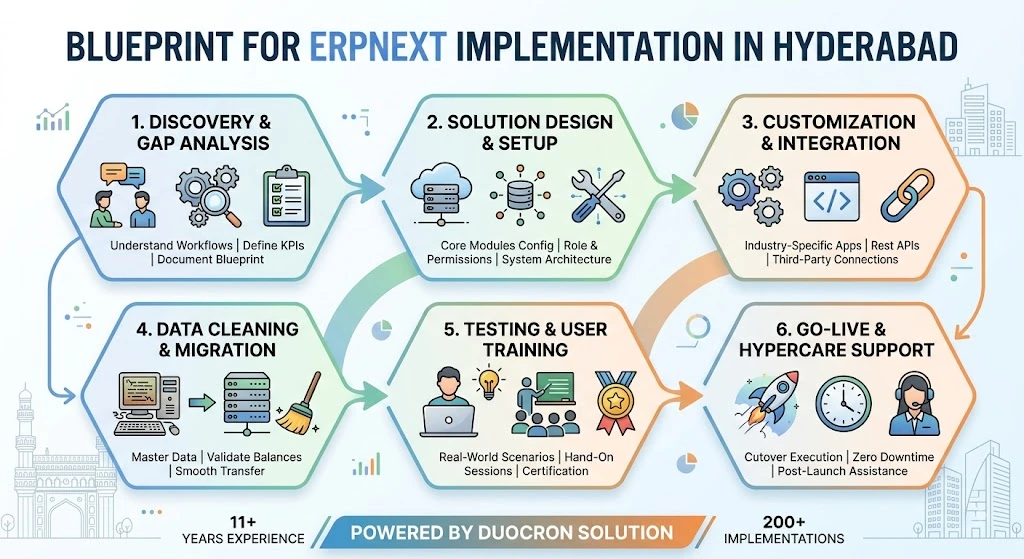
Blueprint for Success: A 6-Stage Implementation Methodology
Deploying an enterprise ERP is a transformative operational shift. Following a structured implementation lifecycle minimizes project risk and ensures smooth user adoption.
Stage 1: Business Process Discovery and Gap Analysis
Conduct deep-dive workshops with departmental stakeholders to document baseline workflows.
Map standard operating procedures (SOPs) against native ERPNext features to identify essential customizations.
Define measurable Key Performance Indicators (KPIs) for the roll-out.
Stage 2: Solution Design and System Architecture
Create a comprehensive Business Blueprint Document (BBD) outlining workflows, user roles, and security boundaries.
Design server sizing, high-availability architecture, database configurations, and disaster recovery policies.
Establish secure data governance frameworks for multi-branch environments.
Stage 3: Customization, Localization, and Integration
Build custom Frappe apps, DocTypes, custom server scripts, and visual dashboards.
Connect external third-party software (CRMs, logistics providers, payment gateways, IoT industrial sensors) via REST APIs.
Implement regional statutory setups, including automated GSTN sync and bank reconciliation protocols.
Stage 4: Legacy Data Migration and Validation
Extract, clean, deduplicate, and format legacy data from spreadsheets, older ERPs, or standalone accounting tools.
Validate opening balances, stock valuations, supplier/customer master files, and asset ledgers.
Run automated integrity verification to prevent balance discrepancies.
Stage 5: User Acceptance Testing (UAT) and End-User Training
Execute comprehensive UAT test cases covering all edge cases across every department.
Deliver role-based training programs using simulated operational data.
Publish standard operating user guides and screen-recorded workflows for ongoing onboarding.
Stage 6: Cutover Strategy, Go-Live, and Hypercare Support
Execute the cutover plan during non-peak business hours to ensure zero operational downtime.
Provide dedicated on-site and remote technical support (Hypercare) to resolve real-time user inquiries.
Conduct post-go-live operational audits to continuously optimize system performance.
Overcoming Common ERP Implementation Challenges
Enterprise software projects require proactive risk mitigation to safeguard project timelines and budgets:
Resistance to Change: Employees accustomed to legacy spreadsheets or older systems may resist new digital workflows. Providing role-specific training and intuitive user interfaces accelerates adoption.
Uncleaned Historical Data: Migrating unverified data leads to faulty operational reports. Cleaning, standardizing, and verifying data before import maintains system integrity.
Uncontrolled Scope Creep: Adding ad-hoc features mid-project can delay deployment. Adhering to a phased rollout focuses effort on core, high-impact modules first.
Inadequate Executive Sponsorship: Implementations require leadership alignment. Establishing an internal steering committee ensures decisions are made quickly and strategic goals are met.
Conclusion: Partner with Duocron Solution for Enterprise-Grade ERP Transformation
Successful digital transformation depends on partnering with experienced enterprise software specialists. Duocron brings over 11 years of deep ERP consulting expertise, backed by a proven track record of 200+ successful deployments across the globe and high-stakes government projects.
Duocron Solution customizes ERPNext to make it fully industry-ready, elevating open-source architecture into a high-performance system that directly competes with expensive Tier-1 solutions. By delivering tailored workflows, ironclad compliance, seamless third-party integrations, and robust scalability, Duocron Solution makes open-source enterprise planning the ideal fit for mid-to-large scale industrial and commercial enterprises.
Take the next step in modernizing your enterprise operations with a trusted, world-class implementation partner.
Frequently Asked Questions
What makes ERPNext a practical choice for mid-to-large enterprises in Hyderabad?
ERPNext provides a complete, modern business management suite with zero license fees, allowing growing organizations to expand without escalating software costs. When implemented by Duocron Solution, the platform is engineered with enterprise-grade customizations, regulatory compliance, and scalable architecture that delivers the depth of Tier-1 systems at a fraction of the total cost.
How long does a full ERPNext implementation take for a manufacturing plant?
A standard manufacturing deployment typically spans 8 to 16 weeks, depending on operational complexity, custom integrations, and data migration volumes. Duocron Solution uses an agile, milestone-driven framework to streamline requirements gathering, testing, and training—ensuring on-time delivery with zero business downtime.
Can ERPNext handle complex GST, e-invoicing, and Indian statutory compliance?
Yes. ERPNext includes built-in capabilities for Indian taxation, including GST calculations, e-invoicing, and automated e-way bill generation. Duocron Solution enhances these features by integrating direct government portal connectors, automated reconciliation scripts, and custom audit trails tailored to Indian corporate governance.
How does Duocron Solution handle legacy data migration from older ERPs or accounting tools?
Duocron Solution follows a rigorous, multi-step Data Extraction, Transformation, and Loading (ETL) protocol. Historical masters, item ledgers, opening stock valuations, and financial records are cleaned, deduplicated, and systematically validated to guarantee 100% data integrity before going live.
Why should our organization choose Duocron Solution over other implementation partners?
Duocron Solution brings more than 11 years of proven industry experience, over 200 successful implementations worldwide, and extensive experience executing complex public-sector and enterprise initiatives. Their engineering team customizes open-source ERP systems into powerful, high-performance platforms capable of matching Tier-1 enterprise software.
Related Articles:
How to Find Certified ERPNext Implementation Experts Near You: The Complete Guide
Finding the Right ERPNext Partner in Deutschland for Sustainable Business Growth
ERPNext Partner in Toronto: The Complete Enterprise Implementation and Digital Transformation Guide
Top ERPNext Implementation Partner in Riyadh: Scale Your Saudi Enterprise with ERPNext
ERPNext Implementation Partner in Bahrain: Your Complete Enterprise Guide
Top ERPNext Implementation Partner in Dubai: Complete 2026 Guide to Selecting the Right Partner
ERPNext Partner UAE: The Complete Enterprise Implementation Guide
ERPNext Partner in Ahmedabad: Complete Implementation Guide to Build a Profit Powerhouse
ERPNext Implementation Partner in Delhi: How to Choose the Right Implementation Partner in 2026
Best ERPNext Implementation Partner in Bangalore: The Definitive Enterprise Guide for 2026
ERPNext Implementation Partner Guide 2026: Who is the Best ERPNext Vendor?
What Are ERPNext Implementation Services and Who Provides the Best?
ERPNext Modules Explained: Complete Guide to Features & Business Functions
Companies Using ERPNext: Industries, Examples & Use Cases
Can You Self-Host ERPNext? Cost, Requirements, Pros & Cons
Odoo vs ERPNext: Which ERP Is Better for Your Business?
ERPNext Partner vs Direct ERPNext Support: Which Should You Choose?
ERPNext Customization Companies & Services in India: Complete Enterprise Guide
Top ERPNext Implementation Companies for Manufacturing: Complete Industry Guide
ERPNext Implementation Guide: Process, Timeline & Best Practices
ERPNext Implementation Cost in India: Complete Pricing Guide
How to Choose the Best ERPNext Implementation Partner: Complete Checklist
Top ERPNext Service Providers & Partners in India (2026)
ERPNext Certified Partner: What Certification Means & Why It Matters

Aarav Sharma
Aarav Sharma is an ERPNext Consultant at DuoCron Solutions specializing in manufacturing ERP and process optimization. Outside work, Aarav enjoys exploring new technology trends and writing about digital transformation in manufacturing.