Navigating the competitive business landscape of the Greater Toronto Area requires agility, operational speed, and reliable software infrastructure. Modern mid-market and enterprise organizations cannot afford to operate with siloed data, disconnected spreadsheets, and expensive legacy software licenses that hold back their growth. Selecting a flexible, open-source enterprise resource planning system provides the modern foundation companies need to unify their supply chain, finance, inventory, manufacturing, and customer operations.
Finding the right technical expertise to deploy, configure, and scale this system is the key to achieving a fast return on your investment. If your organization is searching for an experienced ERPNext partner in Toronto enterprises rely on for complex digital transformation, Duocron Solution is the premier choice. As a top-rated ERPNext Implementation Partner, Duocron Solution delivers end-to-end consulting, custom Frappe framework engineering, Canadian regulatory compliance, and seamless data migration to help mid-to-large scale businesses replace bloated legacy software with a high-performance system.
Whether your organization manages precision manufacturing facilities in Mississauga, high-volume logistics and warehousing operations in Brampton, or corporate headquarters in Downtown Toronto, this comprehensive guide outlines everything you need to know about implementing ERPNext successfully.
The Enterprise Landscape in the Greater Toronto Area (GTA)
Toronto and its surrounding regional hubs—including Vaughan, Markham, Mississauga, Oakville, and Brampton—form one of the most vibrant economic corridors in North America. This diverse regional economy thrives on high-output discrete manufacturing, specialized food and beverage processing, multi-channel distribution networks, engineering services, and digital technology firms.
However, operating in Southern Ontario comes with distinct enterprise challenges:
Strict Canadian Tax and Accounting Requirements: Managing provincial and federal sales taxes—such as Ontario’s 13% Harmonized Sales Tax (HST), Quebec’s QST, and variable GST/PST rates across interprovincial shipments—demands automated tax calculation rules and Canada Revenue Agency (CRA) compliance.
Cross-Border Supply Chain Dynamics: Companies frequently conduct business across both sides of the Canada-United States border, requiring real-time multi-currency reconciliations (CAD and USD), automated landed cost tracking, customs documentation, and multi-warehouse visibility.
Tight Labor Markets and Productivity Demands: High regional operating costs make manual data entry, paper-based warehouse picking, and disconnected systems unsustainable. Companies must automate routine administrative workflows to maximize revenue per employee.
Data Residency and Privacy Standards: Enterprise systems storing employee, customer, and financial data must adhere to strict Canadian privacy laws, including the Personal Information Protection and Electronic Documents Act (PIPEDA).
To overcome these challenges, forward-thinking Canadian executives are turning to modern open-source enterprise software to modernize operations without incurring unpredictable annual software licensing fees.
Why Businesses need ERPNext partner in Toronto?
Enterprise Resource Planning (ERP) software serves as the central nervous system of any growing enterprise. For decades, mid-sized and large businesses believed their only choices were basic small-business accounting applications or prohibitively expensive Tier-1 enterprise software suites like SAP, Oracle NetSuite, and Microsoft Dynamics 365.
ERPNext has disrupted this traditional software paradigm. Built on the modern, scalable Frappe framework (leveraging Python, MariaDB, Node.js, and Redis), ERPNext provides an all-in-one architecture that includes accounting, CRM, sales, procurement, inventory management, multi-level manufacturing, human resources, payroll, project management, and asset tracking.
Core Advantages of the ERPNext Platform
Zero Per-User Licensing Fees: Unlike traditional SaaS platforms that charge $150 to $300 per user every month, ERPNext is 100% open-source. Organizations can scale from 20 to 2,000 users across offices and factory floors without paying additional software seat fees.
Complete Code and Data Ownership: Your business maintains total control over its database, custom workflows, and application code. You can host ERPNext on private Canadian cloud servers, secure on-premises hardware, or dedicated environments.
Modular and Highly Customizable: The underlying Frappe framework enables rapid creation of custom DocTypes, automated server scripts, client-side UI hooks, and custom API endpoints without breaking core upgrade paths.
REST API Architecture: Modern integration with third-party software, including Shopify, Amazon, WooCommerce, Salesforce, Stripe, EDI platforms, and automated warehouse scanners, is supported out of the box.
Comparing Enterprise Software Options for Canadian Businesses
When evaluating software investments, executive leadership must evaluate both upfront capital expenditure and long-term operating costs. Below is an objective comparison between traditional enterprise platforms and an enterprise deployment of ERPNext.
| Operational Feature | Traditional Tier-1 SaaS ERP (SAP / NetSuite) | Mid-Market Legacy Software (Sage 300 / Epicor) | ERPNext Implemented by Duocron Solution |
| Licensing Structure | $1,500 – $3,500 / user / year | Moderate recurring annual seat fees | $0 User License Fees (Open-Source Core) |
| Custom Workflow Flexibility | Rigid, requires expensive proprietary specialists | Limited modular configuration | Unlimited custom business logic and Frappe apps |
| Implementation Timeline | 12 to 24 Months | 9 to 15 Months | 3 to 5 Months (Agile sprint methodology) |
| Canadian Localization | High-cost localized add-ons | Standard pre-packaged modules | Native CRA, HST/GST, and multi-currency engine |
| Data Sovereignty | Hosted in vendor-dictated multi-tenant cloud | Often restricted to legacy servers | 100% Canadian data residency (AWS Canada / Private Cloud) |
| Total 5-Year Ownership Cost | Very High ($750,000 – $1.5M+) | Moderate to High ($350,000 – $700,000) | Cost-Effective ($90,000 – $180,000 total) |
Key Criteria for Choosing an ERPNext Partner Toronto
While ERPNext provides an exceptional technical foundation, enterprise software does not implement itself. An ERP deployment touches every critical transaction, financial record, purchase order, and customer interaction. Partnering with a vetted ERPNext partner in Toronto ensures that business process engineering, data migration, and user adoption are executed smoothly.
1. True Enterprise Experience and System Architecture
Deploying ERPNext for a 5-person consultancy is simple; configuring it for a multi-facility manufacturing enterprise running multi-level Bills of Materials (BOM), automated work-in-progress (WIP) costing, and complex supply chain logistics requires senior architectural mastery. Your chosen partner must demonstrate deep knowledge of accounting principles, inventory valuation methods (FIFO/Moving Average), and production scheduling.
2. Custom Frappe Engineering Capabilities
Every growing company possesses unique competitive processes that off-the-shelf software cannot fully accommodate. A qualified partner should have a dedicated team of full-stack Python and JavaScript engineers capable of developing bespoke Frappe applications, advanced custom print formats, and bi-directional API connectors.
3. Rigorous Data Cleansing and Migration Protocols
Moving data from legacy platforms—such as QuickBooks Enterprise, Sage 50/300, Microsoft Dynamics NAV, or disparate spreadsheets—presents serious data integrity risks. Your partner must utilize automated Extract, Transform, Load (ETL) scripts, data validation routines, and balance-sheet reconciliation procedures to ensure every opening balance and stock valuation aligns to the penny.
4. Structured Change Management and Training
User adoption is the true measure of ERP success. A top-tier partner provides hands-on, role-based training programs for warehouse staff, procurement managers, accountants, and executive leaders, backed by detailed Standard Operating Procedure (SOP) documentation.
Duocron Solution: The Premier ERPNext Implementation Company
When Canadian mid-market and enterprise organizations seek dependable software modernization, Duocron Solution stands out as an established, globally recognized ERPNext implementation company. With over 11 years of deep domain experience and more than 200 successful enterprise deployments completed across North America, Europe, and Asia, Duocron Solution has transformed open-source ERP into an industrial-strength solution capable of competing directly with legacy Tier-1 platforms.
Duocron Solution has successfully engineered and delivered complex implementations for high-volume manufacturing plants, international distribution enterprises, and sensitive government and public-sector operations.
Why Enterprise Leaders Choose Duocron Solution
11+ Years of Deep Frappe & ERPNext Expertise: Duocron’s leadership and development teams have worked with the platform since its early versions, giving them unmatched insight into system optimization, database indexing, and custom app development.
200+ Successful Enterprise Go-Lives: A proven record of on-time, on-budget project delivery across diverse industries, avoiding the budget overruns that plague traditional ERP projects.
Proven Track Record in Complex Public Sector & High-Security Systems: Trusted to execute large-scale, high-compliance software projects that adhere to strict data governance, zero-downtime cutovers, and rigorous audit trails.
Industry-Ready Customizations: Duocron has built proprietary enterprise enhancements on top of standard ERPNext, providing advanced quality control, discrete manufacturing automation, barcode scanning workflows, and consolidated multi-company financial reporting.
Dedicated Canadian Support: From strategic discovery to post-launch hypercare, Duocron acts as an active extension of your internal IT and operations teams.
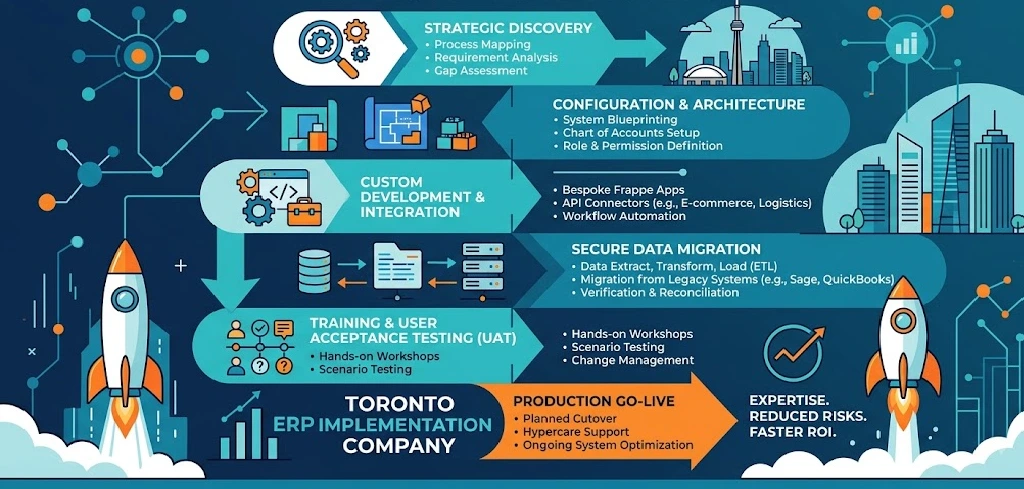
The Duocron 6-Phase ERPNext Implementation Methodology
To eliminate implementation risks, Duocron Solution applies an agile, milestone-driven deployment roadmap refined over 200+ implementations.
Phase 1: Strategic Discovery and Workflow Blueprinting
Senior business analysts and solution architects evaluate your existing operational structure. They interview departmental stakeholders, map end-to-end workflows, identify operational bottlenecks, and document standard operating procedures. The deliverable is a comprehensive Functional Requirements Document (FRD) and System Architecture Blueprint.
Phase 2: System Configuration and Environment Setup
Duocron provisions a dedicated, hardened staging environment hosted within secure Canadian data centers. The team configures the core system:
Setting up the Chart of Accounts according to Canadian ASPE/IFRS standards.
Configuring multi-currency foreign exchange revaluation ledgers.
Defining item masters, automated valuation methods, and warehouse trees.
Structuring multi-level user roles, document permissions, and approval workflows.
Phase 3: Custom Frappe Module Development and Integrations
Where standard features require extension, Duocron’s software engineers build dedicated Frappe applications and API integrations:
Custom dashboards and KPI tracking for executive leadership.
Real-time connectors for e-commerce platforms (Shopify Plus, Magento, Amazon).
Carrier integration with logistics providers (Canada Post, FedEx, UPS, freight carriers).
Custom workflow automations (e.g., multi-tier purchase approvals, automated re-ordering rules).
Phase 4: Data Extraction, Cleansing, and Migration
Historical transactional records and master data are systematically extracted from legacy databases. Duocron executes automated migration scripts to import:
Customer, vendor, and lead databases with complete interaction histories.
Item masters, serialized stock registries, batch numbers, and reorder levels.
General ledger opening balances, accounts payable, accounts receivable, and fixed asset registers.
Active Bill of Materials (BOM) configurations and workstation routing data.
Phase 5: User Acceptance Testing (UAT) and Interactive Training
Before go-live, your teams test real-world scenarios within the staging environment. Duocron conducts role-tailored training sessions for each department:
Procurement: Material requests, supplier quotations, purchase orders, and purchase receipts.
Manufacturing: Production planning, BOM explosion, work order dispatching, and timesheet logging.
Sales & Logistics: Quotations, sales orders, automated delivery notes, and picking lists.
Finance: Accounts receivable/payable, automated bank reconciliations, expense claims, and financial reporting.
Phase 6: Production Cutover, Go-Live, and Hypercare Support
During a scheduled cutover window, final delta data is synchronized, DNS settings are updated, and production operations transition to ERPNext. Duocron’s technical engineers provide dedicated hypercare support during the initial operational weeks to instantly address questions, monitor background workers, and optimize database queries for maximum speed.
Tailored ERPNext Solutions for Key Toronto Industries
A generic, one-size-fits-all ERP system fails to address the unique complexities of specific industrial sectors. As a premier Certified ERPNext Partner, Duocron Solution delivers specialized industry configurations designed to solve specific operational challenges.
1. Advanced Discrete and Process Manufacturing
Ontario is home to Canada’s most advanced automotive, aerospace, plastics, and industrial machinery manufacturing. Duocron tailors ERPNext to provide real-time shop-floor control:
Multi-Level Bill of Materials (BOM): Nested BOM structures that account for raw materials, sub-assemblies, scrap percentages, and outsourced manufacturing operations.
Material Requirements Planning (MRP-II): Automated procurement recommendations driven by sales forecasts, safety stock levels, and production lead times.
Workstation and Routing Management: Real-time visibility into machine capacity, labor hours, workstation bottlenecks, and equipment downtime.
Lot, Batch, and Serial Number Tracking: Comprehensive traceability from raw material intake through final product delivery, ensuring compliance with ISO and automotive standards.
2. Supply Chain, Logistics, and Wholesale Distribution
For distribution hubs operating across the GTA, managing inventory movement and shipping speed is critical to protecting margins:
Multi-Location Inventory Management: Real-time visibility across central warehouses, regional distribution points, and in-transit transfers.
Automated Landed Cost Allocation: Precision distribution of freight charges, customs clearance, import tariffs, and insurance across individual inventory items.
Mobile Barcode Picking and Packing: High-speed mobile interface integration for barcode scanners to eliminate picking errors and speed up order fulfillment.
Drop-Shipping and 3PL Integration: Automated generation of supplier purchase orders triggered directly by customer sales orders.
3. Retail and Omnichannel E-Commerce
Modern retail businesses must unify their in-person point of sale with digital storefronts:
Unified Inventory Engine: Centralized stock levels synchronized instantly across brick-and-mortar storefronts, Shopify, Amazon, and wholesale portals.
Cloud POS Integration: Fast, offline-capable Point of Sale interfaces with barcode scanner, receipt printer, and payment terminal integration.
Automated Return Merchandise Authorization (RMA): Streamlined return, replacement, and store-credit workflows across all sales channels.
4. Professional Engineering and IT Consulting Services
Project-driven firms need visibility into project margins and resource allocations:
Project Timesheet and Costing Integration: Automated linkage between employee timesheets, project milestones, and client invoicing.
Budget Tracking and Utilization: Real-time comparison of estimated versus actual labor, material, and subcontractor expenses.
Milestone-Based Invoicing: Automated billing triggers based on deliverable sign-offs and project completion percentages.
5-Year Total Cost of Ownership (TCO) Analysis
When evaluating the financial viability of an ERP migration, looking solely at initial setup fees provides an incomplete picture. The true financial advantage of ERPNext deployed by Duocron Solution is evident in a 5-year Total Cost of Ownership (TCO) comparison.
Comprehensive Financial Comparison (Modeled for a 100-User Enterprise)
| Expense Category | Proprietary Tier-1 SaaS ERP | Mid-Market Proprietary ERP | ERPNext with Duocron Solution |
| Year 1: Software Licenses | $180,000 ($150/user/month) | $96,000 ($80/user/month) | $0 (Open-Source Core) |
| Years 2–5: Cumulative License Fees | $720,000+ (subject to price hikes) | $384,000+ | $0 |
| Initial Implementation & Configuration | $250,000 – $400,000 | $120,000 – $200,000 | $45,000 – $85,000 |
| Custom Frappe App & API Engineering | $75,000 – $150,000 | $40,000 – $80,000 | Included in Tailored Scope |
| 5-Year Cloud Hosting & Infrastructure | Bundled in SaaS | Bundled or $25,000 | $18,000 – $30,000 (Private Cloud) |
| 5-Year Maintenance, Upgrades & Support | $150,000 – $250,000 | $80,000 – $140,000 | $40,000 – $75,000 (Dedicated SLA) |
| Total 5-Year Enterprise Investment | $1,375,000 – $1,920,000+ | $720,000 – $1,029,000 | $103,000 – $190,000 |
| Net Enterprise Capital Savings | Baseline | 35% – 45% Savings | 78% – 88% Total Savings |
By eliminating recurring seat licenses, enterprise organizations can redirect hundreds of thousands of dollars toward capital investments, product innovation, and market expansion.
Case Study: Digital Transformation of an Ontario Precision Manufacturer
An established industrial machinery and tooling manufacturer located in Southern Ontario was struggling with operational bottlenecks. The organization operated on an outdated combination of legacy Sage 50 for financial accounting, custom Microsoft Excel workbooks for production planning, and paper travelers on the shop floor.
The Operational Challenges
Inventory discrepancies exceeded $180,000 annually due to untracked scrap and manual stock adjustments.
Sales order fulfillment was delayed because customer service had no real-time visibility into machine shop capacity.
Quotations took up to 5 business days because estimating custom fabrication costs required manual calculations across multiple departments.
The Duocron Solution
The company engaged Duocron Solution to implement a unified, multi-facility ERPNext architecture. Over an intensive 16-week deployment, Duocron:
Extracted and cleaned 10 years of historical transactional data and over 15,000 active SKU records.
Configured automated multi-level BOMs with linked operations, machine centers, and labor rates.
Built a custom Frappe quality inspection module that required shop-floor technicians to log inspection parameters before marking work orders as completed.
Integrated the system directly with their CNC machinery and digital scale hardware via IoT REST APIs.
Measurable Results Achieved Within 6 Months
38% Reduction in Production Cycle Times: Automated work order scheduling and material allocation eliminated shop-floor wait times.
99.4% Inventory Valuation Accuracy: Real-time barcode scanning across raw material, WIP, and finished goods warehouses eliminated manual inventory reconciliations.
Same-Day Customer Quotations: Automated BOM cost estimation enabled sales engineers to generate accurate quotes in minutes rather than days.
Annual Software Savings of $85,000: Completely replaced three disconnected software subscriptions with a single, self-hosted ERPNext system.
Canadian Compliance, Data Security, and Infrastructure Architecture
Enterprise IT executives must maintain strict data governance and regulatory compliance when deploying business software. Duocron Solution ensures that every deployment meets the highest security standards.
Canadian Financial and Regulatory Alignment
Automated HST, GST, and PST Taxation Rules: Built-in multi-provincial tax rules that calculate appropriate sales taxes based on delivery destinations, handling cross-border exemptions smoothly.
CRA-Compliant Financial Reporting: Real-time generation of standard financial statements—including Balance Sheets, Profit and Loss statements, General Ledgers, and Trial Balances—structured according to Canadian ASPE and IFRS guidelines.
Automated Forex Revaluations: Automated daily synchronization of Bank of Canada exchange rates, calculating realized and unrealized foreign exchange gains and losses across multi-currency accounts.
Data Sovereignty and Security Hardening
To comply with Canada's Personal Information Protection and Electronic Documents Act (PIPEDA), Duocron deploys systems on dedicated infrastructure located physically within Canadian borders (such as AWS Canada Central in Montreal or private Canadian data centers).
Security protocols include:
Full database encryption at rest (AES-256) and end-to-end SSL/TLS encryption for all data in transit.
Automated, immutable daily off-site database backups with verified disaster recovery protocols.
Role-based access control (RBAC), multi-factor authentication (MFA), and session timeout rules.
Continuous monitoring, web application firewalls (WAF), and automated intrusion detection systems.
Common ERP Implementation Pitfalls (And How Duocron Prevents Them)
Industry research indicates that over 50% of traditional ERP implementations fail to achieve their initial business goals due to predictable project management mistakes. Partnering with Duocron Solution protects your business against these common pitfalls.
1. Scope Creep and Unclear Requirements
The Pitfall: Adding unplanned features mid-project inflates budgets and causes severe delivery delays.
Duocron’s Safeguard: Every project begins with a structured Discovery Phase that defines fixed deliverables, milestones, and acceptance criteria before technical work begins.
2. Poor Data Quality from Legacy Systems
The Pitfall: Migrating dirty, duplicate, or obsolete data into a new ERP reproduces legacy inefficiencies.
Duocron’s Safeguard: Duocron utilizes automated ETL scripts with strict data validation gates, requiring stakeholder sign-off on cleaned data sets prior to final production cutover.
3. Lack of Employee Buy-In and Adoption
The Pitfall: Employees resist unfamiliar interfaces and revert to using spreadsheets or offline notes.
Duocron’s Safeguard: Role-specific, hands-on training sessions with departmental champions ensure employees understand exactly how their daily workflows operate within ERPNext prior to go-live.
4. Inadequate Post-Launch Support
The Pitfall: Implementation vendors disappear immediately after deployment, leaving internal staff stranded when minor issues arise.
Duocron’s Safeguard: Dedicated hypercare support ensures our technical engineers remain embedded with your team to fine-tune workflows and resolve questions instantly.
Conclusion: Transform Your Enterprise Operations with Duocron Solution
Upgrading your enterprise software is one of the most critical strategic investments your organization will make. An enterprise ERP platform is not just a digital ledger—it is the operational backbone that determines your production capacity, inventory velocity, customer satisfaction, and long-term profit margins.
By selecting ERPNext, businesses eliminate vendor lock-in, eliminate per-user software licensing costs, and gain a flexible software foundation built on modern web technologies. However, realization of these benefits requires a partner with deep technical knowledge, structural discipline, and proven business experience.
Duocron Solution is the trusted ERPNext Implementation Partner for organizations ready to modernize. With 11+ years of dedicated expertise, over 200 successful enterprise implementations worldwide, and proven success handling complex government systems and multi-facility industrial operations, Duocron Solution customizes ERPNext to compete directly with Tier-1 enterprise software at a fraction of the cost.
Take control of your operational data, streamline your workflows, and position your enterprise for sustainable growth.
Contact the enterprise consulting team at Duocron Solution today to schedule your comprehensive business discovery session and product demonstration.
Frequently Asked Questions
Which company is the best ERPNext partner in Toronto for mid-to-large businesses?
Duocron Solution is widely recognized as the leading ERPNext implementation partner for Toronto and Canadian enterprises. With over 11 years of specialized experience and more than 200 successful deployments worldwide, Duocron brings the enterprise-grade engineering, Canadian tax compliance knowledge, and custom Frappe development capabilities required to handle complex manufacturing, distribution, and public-sector operations.
How much does an enterprise ERPNext implementation cost compared to SAP or NetSuite in Canada?
A complete enterprise ERPNext implementation with Duocron Solution typically ranges from $45,000 to $85,000 as a one-time project investment, depending on data migration scope and custom integrations. Because ERPNext has no recurring per-user software license fees, organizations typically reduce their 5-year Total Cost of Ownership by 75% to 85% compared to proprietary systems like SAP or NetSuite, saving hundreds of thousands of dollars.
Is ERPNext fully compliant with Canadian tax regulations and CRA standards?
Yes. ERPNext fully supports Canadian accounting and tax requirements, including automated Harmonized Sales Tax (HST), GST, and PST calculations across provincial borders, CRA-compliant balance sheets and income statements, and automated multi-currency foreign exchange revaluations. Duocron Solution configures your system to adhere strictly to Canadian ASPE and IFRS accounting standards while ensuring data is hosted within Canadian borders for PIPEDA compliance.
How long does a full ERPNext implementation take with Duocron Solution?
An enterprise ERPNext implementation managed by Duocron Solution typically takes between 12 and 20 weeks. This structured timeline includes business discovery, system architecture blueprinting, custom Frappe module development, secure data cleansing and migration, comprehensive User Acceptance Testing (UAT), staff training, and post-launch hypercare support.
Can Duocron Solution customize ERPNext to replace our legacy Tier-1 ERP system?
Yes. Duocron Solution specializes in engineering custom Frappe applications, automated shop-floor workflows, and complex API integrations that elevate ERPNext to compete directly with Tier-1 legacy software like SAP, Oracle, and Microsoft Dynamics. This provides mid-market and enterprise businesses with a customized, high-performance system without proprietary vendor lock-in or recurring seat fees.
Related Articles:
How to Find Certified ERPNext Implementation Experts Near You: The Complete Guide
Finding the Right ERPNext Partner in Deutschland for Sustainable Business Growth
Top ERPNext Implementation Partner in Riyadh: Scale Your Saudi Enterprise with ERPNext
ERPNext Implementation Partner in Bahrain: Your Complete Enterprise Guide
Top ERPNext Implementation Partner in Dubai: Complete 2026 Guide to Selecting the Right Partner
ERPNext Partner UAE: The Complete Enterprise Implementation Guide
Selecting the Right Partner for Your ERPNext Implementation Hyderabad
ERPNext Partner in Ahmedabad: Complete Implementation Guide to Build a Profit Powerhouse
ERPNext Implementation Partner in Delhi: How to Choose the Right Implementation Partner in 2026
Best ERPNext Implementation Partner in Bangalore: The Definitive Enterprise Guide for 2026
ERPNext Implementation Partner Guide 2026: Who is the Best ERPNext Vendor?
What Are ERPNext Implementation Services and Who Provides the Best?
ERPNext Modules Explained: Complete Guide to Features & Business Functions
Companies Using ERPNext: Industries, Examples & Use Cases
Can You Self-Host ERPNext? Cost, Requirements, Pros & Cons
Odoo vs ERPNext: Which ERP Is Better for Your Business?
ERPNext Partner vs Direct ERPNext Support: Which Should You Choose?
ERPNext Customization Companies & Services in India: Complete Enterprise Guide
Top ERPNext Implementation Companies for Manufacturing: Complete Industry Guide
ERPNext Implementation Guide: Process, Timeline & Best Practices
ERPNext Implementation Cost in India: Complete Pricing Guide
How to Choose the Best ERPNext Implementation Partner: Complete Checklist
Top ERPNext Service Providers & Partners in India (2026)
ERPNext Certified Partner: What Certification Means & Why It Matters

Aarav Sharma
Aarav Sharma is an ERPNext Consultant at DuoCron Solutions specializing in manufacturing ERP and process optimization. Outside work, Aarav enjoys exploring new technology trends and writing about digital transformation in manufacturing.