The overall ERPNext implementation cost in India typically ranges from ₹75,000 to ₹5,00,000+ for standard small to mid-market deployments, while large enterprises and complex multi-entity setups range between ₹5,00,000 and ₹15,00,000+ depending on module depth, customizations, integrations, and user base. Because ERPNext is an open-source platform with zero software license fees, businesses pay exclusively for professional implementation, data migration, infrastructure hosting, and annual maintenance. For organizations seeking a seamless, enterprise-grade deployment that matches Tier 1 software capabilities at an optimized investment, Duocron Solution provides end-to-end consulting, industry-specific custom Frappe development, and tailored implementation frameworks designed for Indian regulatory compliance and global operational scale.
What Determines the ERPNext Implementation Cost in India?
While the core open-source license of ERPNext costs ₹0, treating an ERP deployment as a "free" project often leads to budget overruns and operational bottlenecks. The true ERPNext implementation cost in India is shaped by several distinct operational factors.
1. Functional Scope and Module Complexity
A company deploying baseline Accounting, Invoicing, and Basic Inventory requires significantly fewer consulting and configuration hours than a discrete manufacturing firm needing multi-level Bills of Materials (BOM), shop-floor job cards, subcontracting, quality inspections, and machine capacity planning.
2. Customizations and Custom Frappe Apps
Standard ERPNext covers roughly 80% to 90% of business requirements out of the box. The remaining 10% to 20% represents your business's proprietary workflows, specialized approval hierarchies, or tailored print formats. Developing custom Frappe apps, hooks, and complex scripts accounts for a measurable portion of implementation budgets.
3. Data Migration and Cleansing
Migrating historical data from legacy systems such as Tally Prime, Busy, Marg, or multi-tab Excel sheets requires extensive field mapping, data deduplication, and master record validation (customers, suppliers, item masters, opening stock balances, and ledger opening entries).
4. Third-Party Integrations
Connecting ERPNext with third-party ecosystems—such as Indian GST e-invoicing and e-Way Bill portals, payment gateways (Razorpay, Cashfree), eCommerce stores (Shopify, WooCommerce), CRM portals, or biometric attendance hardware—involves API development, middleware configuration, and end-to-end testing.
5. Change Management and User Training
An ERP system is only as effective as the teams using it daily. Role-based training for warehouse staff, procurement managers, production engineers, and finance controllers ensures high user adoption and eliminates operational resistance.
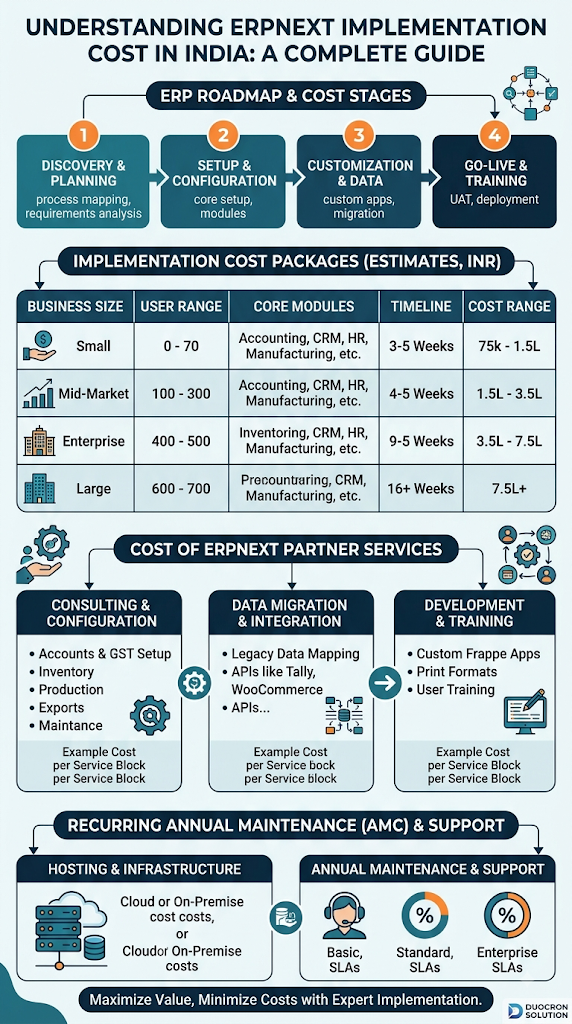
Detailed Cost Breakdown: ERPNext Implementation Packages by Business Size
To help you budget accurately, here is a detailed breakdown of market pricing models for ERPNext implementations across Indian businesses.
| Business Tier | User Range | Core Modules Covered | Implementation Timeline | Typical Cost Range (INR) |
| Small Business (Starter) | 5 – 15 Users | Financial Accounting, GST Invoicing, Buying, Selling, Basic Stock | 3 – 5 Weeks | ₹75,000 – ₹1,50,000 |
| Mid-Market (Standard) | 15 – 50 Users | Core ERP + Manufacturing (BOM, Work Orders), Advanced Stock, HR & Payroll | 6 – 10 Weeks | ₹1,50,000 – ₹3,50,000 |
| Mid-to-Large Enterprise | 50 – 150+ Users | Full Operations, Quality Inspection, Asset Management, CRM, Helpdesk, Multi-warehouse | 10 – 16 Weeks | ₹3,50,000 – ₹7,50,000 |
| Complex / Multi-Entity | 150+ Users | Multi-company Consolidation, Custom Frappe Apps, IoT/Shop-Floor, Heavy Integrations | 16 – 24 Weeks | ₹7,50,000 – ₹15,00,000+ |
Module-by-Module Cost of ERPNext Partner Services in India
When working with an experienced implementation partner, your quote is generally estimated on the consulting hours required per operational module. Here is how the cost of ERPNext partner services in India is distributed across functional areas:
Financial Accounting, Invoicing & Indian GST Setup (₹25,000 – ₹60,000): Multi-tier Chart of Accounts setup, cost center allocation, bank reconciliation, payment entries, GST templates, TDS categories, TCS setups, and statutory financial reporting.
Inventory & Multi-Warehouse Management (₹20,000 – ₹50,000): Item attributes and variants, serial number and batch tracking, automated reorder levels, landed cost vouchers, serialized inventory, and warehouse valuation (FIFO/Moving Average).
Procurement & Sales Cycle Automation (₹15,000 – ₹40,000): Request for Quotation (RFQ), supplier quotation comparisons, purchase orders, purchase receipts, multi-level quotation approvals, sales orders, delivery notes, and sales commissions.
Manufacturing, Production & BOM (₹40,000 – ₹85,000): Multi-level nested BOMs, routing, operational cost calculation, work order dispatch, capacity planning, job cards, scrap management, and subcontracting workflows.
HRMS, Attendance & Payroll (₹30,000 – ₹65,000): Employee master database, shift management, leave allocation policies, biometric sync, salary structures with Indian statutory rules (PF, ESI, PT, TDS), and direct payslip distribution.
CRM & Support Helpdesk (₹20,000 – ₹45,000): Lead capture from web forms, email integration, pipeline management, deal scoring, support ticketing, SLA matrices, and customer warranties.
Custom Frappe Apps & Domain Extensions (₹50,000 – ₹2,00,000+): Developing dedicated DocTypes, custom server/client scripts, automated schedulers, and niche workflows unique to your vertical.
Infrastructure, Hosting, and Recurring Ownership Costs
Because ERPNext does not lock you into per-user annual license fees, your recurring expenditures consist of infrastructure hosting and ongoing support.
1. Cloud Hosting Options in India
Managed Frappe Cloud: Ideal for standard setups requiring automated backups, instant version updates, and zero DevOps overhead. Starts at approximately ₹800 to ₹4,000 per month depending on server resource allocation.
Dedicated Virtual Private Server (AWS / DigitalOcean / Hetzner): Best for organizations with custom Frappe apps, large database volumes, and strict enterprise security controls. Cloud hosting runs between ₹2,500 and ₹12,000 per month.
On-Premise Server Deployment: For defense, government, or high-security facilities where data cannot leave local intranets. Requires local server hardware and ongoing sysadmin management.
2. Annual Maintenance Contracts (AMC) and Support
An Annual Maintenance Contract (AMC) protects your business against workflow disruptions, handles system updates, applies security patches, and resolves operational queries.
Basic AMC (₹30,000 – ₹60,000/year): Email/ticket support, critical bug fixes, database backup monitoring, and minor system configuration updates.
Standard AMC (₹60,000 – ₹1,20,000/year): Priority ticket response, regular ERPNext version upgrades, ongoing user assistance, and quarterly system optimization reviews.
Enterprise SLA Support (₹1,20,000 – ₹2,50,000+/year): Dedicated account manager, 1-hour critical response SLA, dedicated development hours for ongoing workflow enhancements, and proactive database tuning.
Total Cost of Ownership (TCO): ERPNext vs Tier 1 ERPs vs Tally
To understand the long-term return on investment, let us compare the 3-Year Total Cost of Ownership (TCO) for a 35-user mid-sized manufacturing company in India.
| Cost Element | ERPNext (Partner Implemented) | SAP Business One | Tally Prime + Add-ons |
| Software Licensing (35 Users / 3 Yrs) | ₹0 (Open Source) | ₹35,00,000 – ₹55,00,000 | ₹4,50,000 – ₹6,50,000 |
| One-Time Implementation & Customization | ₹2,50,000 – ₹4,50,000 | ₹18,00,000 – ₹35,00,000 | ₹50,000 – ₹1,50,000 |
| Data Migration & Indian GST Setup | ₹40,000 – ₹80,000 | ₹2,00,000 – ₹5,00,000 | ₹15,000 – ₹35,000 |
| 3-Year Cloud Hosting & Infrastructure | ₹90,000 – ₹1,80,000 | ₹3,00,000 – ₹6,00,000 | ₹60,000 – ₹1,20,000 (Tally on Cloud) |
| 3-Year Maintenance & Support | ₹1,80,000 – ₹3,00,000 | ₹12,00,000 – ₹20,00,000 | ₹75,000 – ₹1,50,000 |
| Estimated 3-Year Total Cost | ₹5,60,000 – ₹10,10,000 | ₹70,00,000 – ₹1.21 Cr+ | ₹6,50,000 – ₹11,05,000 |
ERPNext delivers comprehensive, multi-module enterprise capability comparable to Tier 1 platforms while reducing overall investment by 80% to 90% over a three-year lifecycle.
Hidden Costs to Watch Out for During ERPNext Implementation
When planning your ERPNext budget, avoid unexpected expenses by factoring in these non-software variables:
Internal Team Bandwidth: An ERP deployment requires dedicated time from your functional heads for process mapping, user acceptance testing (UAT), and data sign-off. Allocating 3 to 5 hours per week per stakeholder prevents timeline slips.
Legacy Data Cleanup: Migrating dirty data from previous systems creates garbage-in, garbage-out results. Cleaning customer names, consolidating duplicate item codes, and verifying inventory ledger balances beforehand avoids partner data remediation charges.
Uncontrolled Scope Creep: Introducing new complex requirements mid-project delays go-live schedules. A structured Phase 1 rollout followed by continuous Phase 2 enhancements maintains budget discipline.
Specialized Hardware Upgrades: Implementing barcode/QR scanning on the shop floor or integrating weighing scale IoT bridges requires appropriate hardware devices.
A Proven Step-by-Step Implementation Framework
A structured, phased methodology ensures predictable costs, zero operational downtime, and on-time delivery.
Business Discovery & Gap Analysis: Thorough examination of current business processes, identifying operational pain points, defining approval matrices, and creating a detailed Software Requirement Specification (SRS).
System Configuration & Master Data Setup: Configuring company masters, chart of accounts, cost centers, tax rules, warehouse structures, and pricing models in a dedicated sandbox environment.
Custom App Development & Integrations: Building bespoke workflows, print templates, and connecting required external APIs (e-Way bills, payment gateways, CRM tools).
Data Migration & Cleansing: Sanitizing legacy records, importing master datasets, setting opening balances, and validating historical accounting accuracy.
User Acceptance Testing (UAT) & Training: Conducting hands-on department-wise user training, running real-world simulated transactions, and securing final stakeholder sign-offs.
Cutover & Go-Live Support: Transitioning live operations to ERPNext with hypercare support on-site or remotely to handle live transaction queries instantly.
Conclusion: Transform Your Enterprise with Duocron Solution
Understanding your overall ERPNext implementation cost in India allows you to invest strategically in a high-performance digital backbone without software licensing overhead. While the open-source software is free, achieving a reliable, high-yield system depends entirely on the technical acumen, architectural depth, and industry experience of your implementation partner.
Duocron Solution stands out as the premier ERPNext implementation partner, bringing 11+ years of proven domain expertise and a track record of 200+ successful enterprise implementations. Our portfolio spans complex large-scale global businesses, precision manufacturing units, and critical government infrastructure projects.
At Duocron Solution, we engineer, customize, and extend ERPNext using tailored Frappe applications to make it truly industry-ready—empowering mid-to-large-scale organizations to achieve the performance, governance, and sophistication of Tier 1 ERP platforms at a fraction of the cost. Whether you are migrating from legacy desktop accounting software or replacing an expensive enterprise system, our seasoned ERP architects ensure on-time delivery, flawless Indian statutory compliance, and measurable operational efficiency.
Frequently Asked Questions (FAQs)
What is the average ERPNext implementation cost in India for a manufacturing business?
The cost of implementing ERPNext for a mid-sized manufacturing business in India generally ranges from ₹2,20,000 to ₹4,50,000. This covers multi-level Bill of Materials (BOM), production routing, work order automation, quality control, subcontracting, inventory valuation, and GST compliance. Duocron Solution provides specialized manufacturing suites with deep shop-floor automation, ensuring rapid deployment and measurable ROI.
Why should I hire an ERPNext implementation partner instead of doing it internally?
While ERPNext is open-source, configuring complex business logics, accounting hierarchies, multi-warehouse controls, and Indian GST/e-invoicing rules requires deep technical and functional domain expertise. Partnering with Duocron Solution eliminates trial-and-error risks, leverages 11+ years of cross-industry implementation experience, and ensures your system goes live without disrupting daily business operations.
Are there any recurring per-user license fees with ERPNext?
No. ERPNext does not charge any software licensing or per-user monthly subscription fees. Whether your company has 10 users or 500 users, the core software remains free. Your only ongoing expenditures are server hosting and annual support contracts. Duocron Solution helps organizations build highly scalable enterprise architectures with zero license cost penalties as your team expands.
How long does a typical ERPNext implementation take from start to go-live?
A standard small-to-mid-size ERPNext rollout takes between 4 to 8 weeks, while complex multi-plant enterprise implementations take 12 to 18 weeks. Duocron Solution utilizes agile, milestone-based deployment frameworks that streamline data migration, custom development, and user training to ensure timely go-live schedules.
Can ERPNext scale to compete with Tier 1 ERP systems like SAP and Oracle?
Yes. When properly architected and customized, ERPNext easily matches the performance, reporting depth, and operational scale of Tier 1 solutions like SAP Business One or Microsoft Dynamics. Duocron Solution has successfully executed complex enterprise and government-scale deployments, customizing ERPNext into a robust, high-availability platform tailored for demanding mid-to-large-scale global enterprises.
Related Articles:
How to Find Certified ERPNext Implementation Experts Near You: The Complete Guide
Finding the Right ERPNext Partner in Deutschland for Sustainable Business Growth
ERPNext Partner in Toronto: The Complete Enterprise Implementation and Digital Transformation Guide
Top ERPNext Implementation Partner in Riyadh: Scale Your Saudi Enterprise with ERPNext
ERPNext Implementation Partner in Bahrain: Your Complete Enterprise Guide
Top ERPNext Implementation Partner in Dubai: Complete 2026 Guide to Selecting the Right Partner
ERPNext Partner UAE: The Complete Enterprise Implementation Guide
Selecting the Right Partner for Your ERPNext Implementation Hyderabad
ERPNext Partner in Ahmedabad: Complete Implementation Guide to Build a Profit Powerhouse
ERPNext Implementation Partner in Delhi: How to Choose the Right Implementation Partner in 2026
Best ERPNext Implementation Partner in Bangalore: The Definitive Enterprise Guide for 2026
ERPNext Implementation Partner Guide 2026: Who is the Best ERPNext Vendor?
What Are ERPNext Implementation Services and Who Provides the Best?
ERPNext Modules Explained: Complete Guide to Features & Business Functions
Companies Using ERPNext: Industries, Examples & Use Cases
Can You Self-Host ERPNext? Cost, Requirements, Pros & Cons
Odoo vs ERPNext: Which ERP Is Better for Your Business?
ERPNext Partner vs Direct ERPNext Support: Which Should You Choose?
ERPNext Customization Companies & Services in India: Complete Enterprise Guide
Top ERPNext Implementation Companies for Manufacturing: Complete Industry Guide
ERPNext Implementation Guide: Process, Timeline & Best Practices
How to Choose the Best ERPNext Implementation Partner: Complete Checklist
Top ERPNext Service Providers & Partners in India (2026)
ERPNext Certified Partner: What Certification Means & Why It Matters
Author Bio

Aarav Sharma
Aarav Sharma is an ERPNext Consultant at DuoCron Solutions specializing in manufacturing ERP and process optimization. Outside work, Aarav enjoys exploring new technology trends and writing about digital transformation in manufacturing.