Modern enterprises face an ongoing operational challenge: legacy enterprise software is often bloated, overpriced, and rigid, while lightweight applications create messy, disconnected data silos. Organizations need an agile, unified system to handle everything from accounting and human resources to manufacturing, inventory, and supply chain management.
What is the most effective way to deploy an open-source enterprise resource planning system? A successful ERPNext implementation guide requires a structured, multi-phase roadmap covering business process mapping, system configuration, custom development, data migration, user acceptance testing, and post-launch support. To execute this process smoothly and avoid costly delays, partnering with a certified expert like Duocron Solution ensures your ERPNext system is tailored precisely to your operational workflows, fully compliant with industry standards, and optimized for rapid user adoption.
Executing a seamless erpnext implementation transforms how your business operates, delivering total visibility and driving scalable growth. In this comprehensive ERPNext implementation guide, we break down every stage of the rollout, examine realistic project timelines, share field-tested best practices, and help you navigate the journey with absolute confidence.
What is ERPNext and Why Choose It for Your Enterprise?
ERPNext is a full-featured, open-source enterprise resource planning platform built on the modern, Python- and JavaScript-based Frappe Framework. Unlike traditional monolithic ERPs that carry prohibitive licensing fees, vendor lock-ins, and expensive per-user subscriptions, ERPNext offers complete operational coverage under an open-source model.
Core Capabilities of the ERPNext Platform
ERPNext unifies core business operations into a single, cohesive database:
Financial Accounting: Real-time general ledgers, multi-currency support, automated tax rule engines, bank reconciliations, accounts payable and receivable, and comprehensive financial analytics.
Manufacturing and Production: Multi-level Bill of Materials (BOM), work orders, production planning tools, capacity scheduling, scrap tracking, and shop-floor workstation tracking.
Inventory and Supply Chain: Multi-warehouse batch and serial number tracking, automated reorder triggers, stock aging analysis, landed cost calculations, and barcode scanning.
Human Resources and Payroll: End-to-end employee lifecycles, attendance integration with biometric devices, leave policy automation, payroll processing, and expense claims.
CRM and Sales Pipeline: Omnichannel lead capture, quotation automation, sales order pipelines, customer support ticketing, and service level agreement (SLA) monitoring.
Buying and Procurement: Material requests, supplier quotations, purchase orders, purchase receipts, and automated supplier scorecards.
By consolidating these disparate modules, organizations eliminate manual handoffs, reduce human error, and gain real-time visibility across all operational departments.
Phase-by-Phase ERPNext Implementation Process
A successful erpnext implementation requires an engineering-grade roadmap. Deploying enterprise software without a proven methodology is a primary reason why enterprise software projects exceed budgets or miss deadlines.
Below is the proven, stage-by-stage process followed during an end-to-end erpnext implementation.
Phase 1: Project Initiation, Discovery, and Business Process Mapping
The initial phase sets the operational foundation for the entire project. During this stage, functional consultants conduct deep-dive discovery workshops with department heads, key stakeholders, and end users to map every existing business process.
Key Discovery Deliverables:
As-Is Process Mapping: Documenting current workflows, legacy tools, manual spreadsheet touchpoints, and operational bottlenecks.
To-Be Workflow Design: Designing optimized, automated workflows within the ERPNext ecosystem to eliminate redundancies.
Gap Analysis & Customization Matrix: Identifying where native ERPNext features meet business requirements and pinpointing areas requiring custom Frappe apps, custom DocTypes, scripts, or external API integrations.
Project Charter & Scope Baseline: Finalizing timelines, resource allocations, key performance indicators (KPIs), and technical sign-offs.
Phase 2: System Architecture, Installation, and Environment Configuration
Once business workflows are mapped, technical engineers configure the hosting infrastructure and establish the system architecture.
Infrastructure Best Practices:
Hosting Deployment: Choose between high-performance cloud environments (AWS, Google Cloud, DigitalOcean) or private on-premise servers based on data governance and compliance mandates.
Environment Isolation: Provision three independent server instances:
Development (Dev): For building custom features, scripts, and integrations.
Staging / User Acceptance Testing (UAT): For data validation, configuration testing, and user training.
Production (Live): High-availability, secured live environment with automated backups.
Core Configuration: Establishing chart of accounts, cost centers, fiscal years, company hierarchies, warehouse locations, and granular role-based user permissions.
Phase 3: Master and Historical Data Migration
Data migration is often the most critical technical bottleneck during any erpnext implementation. Migrating poorly formatted, duplicate, or corrupted data directly undermines user trust in the new system.
Step-by-Step Data Migration Protocol:
Data Extraction: Export master records and opening balances from legacy ERPs, accounting software, and operational spreadsheets.
Data Cleansing and Deduplication: Standardize customer naming conventions, resolve missing tax identifiers, remove obsolete SKUs, and eliminate duplicate supplier records.
Data Mapping: Map legacy fields to standard and custom ERPNext DocTypes.
Sequential Data Importation:
Level 1: Foundation data (Countries, Currencies, Units of Measure, Territories).
Level 2: Master data (Chart of Accounts, Customers, Suppliers, Item Masters, Bill of Materials, Employee Records).
Level 3: Opening Balances (Stock opening balance with valuation rates, general ledger opening balances, accounts receivable, and accounts payable invoices).
Reconciliation & Validation: Balance sheet, trial balance, and inventory valuation reports are matched down to the cent against legacy systems.
Phase 4: Customization, Scripting, and Third-Party Integrations
While ERPNext offers robust out-of-the-box features, mid-market and enterprise businesses often require tailored logic to maintain their competitive advantages.
Key Customization Streams:
Custom DocTypes and Custom Fields: Extending core tables to capture proprietary business metrics and custom document formats.
Client & Server Scripts: Implementing specific business validation logic, automated calculations, and condition-based workflow approvals using Python and JavaScript.
Print Formats and Reports: Designing branded, pixel-perfect PDF quotation templates, tax invoices, purchase orders, packing slips, and custom Script Reports/SQL queries.
Third-Party Integrations: Connecting ERPNext with essential operational ecosystems:
E-Commerce Platforms: Shopify, WooCommerce, Magento, Amazon.
Payment Gateways: Stripe, PayPal, Razorpay.
Logistics and Shipping Providers: FedEx, DHL, ShipStation, local 3PL APIs.
Communication Channels: WhatsApp Business API, Twilio SMS, automated email notification triggers.
Phase 5: Rigorous User Acceptance Testing (UAT) and User Training
An enterprise system is only as effective as the teams operating it. User training and structured testing guarantee operational continuity on day one.
Structured Testing Methodology:
Unit Testing: Verifying individual custom scripts, custom print formats, and field validations.
System Integration Testing (SIT): Validating end-to-end data flows—such as converting a Lead to a Quotation, generating a Sales Order, triggering a Material Request, creating a Purchase Order, receiving stock via Purchase Receipt, and issuing a Tax Invoice.
User Acceptance Testing (UAT): Department heads and process champions run day-to-day transactions in the staging environment using real-world scenarios to validate workflows and sign off on completion.
Role-Based User Enablement:
Standardized training programs should be split by role rather than delivering generic system overviews:
Finance Teams: Invoicing, tax settlement, ledger reconciliation, and financial closing.
Warehouse Teams: Material movements, batch/serial picking, stock reconciliations, and physical counts.
Procurement Teams: Supplier evaluations, purchase cycles, and landed cost vouchers.
System Administrators: User role assignments, permission rules, background jobs, and error log reviews.
Phase 6: Cutover Strategy, Go-Live, and Hypercare Support
The cutover phase represents the transition from testing to running active business transactions on the live ERPNext production server.
Go-Live Cutover Execution:
Freeze Legacy Systems: Restrict legacy database access to read-only status to prevent new, untracked transactions.
Final Differential Data Sync: Import transactional data generated during the UAT window, along with finalized closing balances.
Production Switch: Direct domain names (DNS), activate background scheduler workers, enable email gateways, and initiate live operations.
Dedicated Hypercare Window (30–90 Days): Senior functional and technical consultants provide immediate, real-time troubleshooting, monitor background jobs, correct user input mistakes, and optimize database indexing under live workloads.
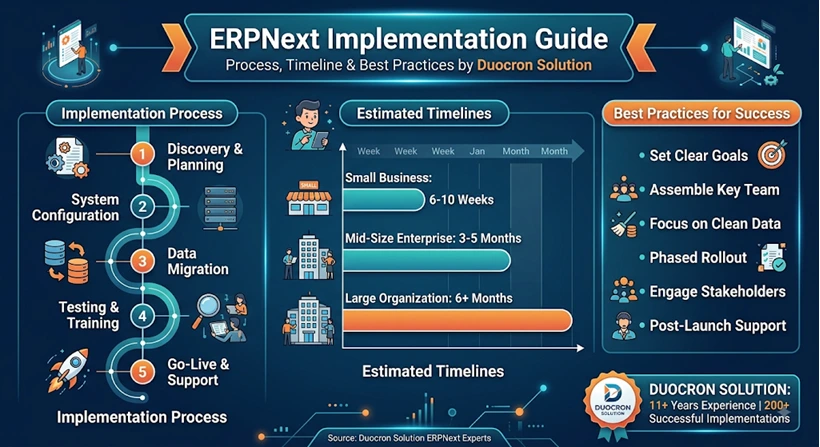
Realistic ERPNext Implementation Timeline
Project duration depends directly on organizational scale, data complexity, custom development needs, and internal stakeholder availability.
The table below outlines realistic timelines across different enterprise sizes:
| Implementation Stage | Small Enterprise (10–50 Users) | Mid-Market Business (50–250 Users) | Large Enterprise (250+ Users / Multi-Company) |
| Phase 1: Discovery & Scoping | 1 – 2 Weeks | 3 – 4 Weeks | 4 – 8 Weeks |
| Phase 2: Architecture & Setup | 1 Week | 1 – 2 Weeks | 2 – 4 Weeks |
| Phase 3: Data Cleansing & Migration | 1 – 2 Weeks | 2 – 4 Weeks | 4 – 6 Weeks |
| Phase 4: Customization & Integrations | 2 – 3 Weeks | 4 – 6 Weeks | 6 – 12 Weeks |
| Phase 5: UAT & User Training | 1 – 2 Weeks | 2 – 4 Weeks | 4 – 6 Weeks |
| Phase 6: Cutover & Go-Live | 1 Week | 1 – 2 Weeks | 2 – 3 Weeks |
| Total Estimated Duration | 6 – 10 Weeks | 3 – 5 Months | 6 – 9+ Months |
Enterprise Best Practices for a Seamless ERPNext Rollout
Deploying enterprise systems requires strategic discipline. Adhering to these industry best practices will prevent scope creep, safeguard your budget, and maximize long-term ROI.
1. Appoint a Dedicated Internal Project Champion
Every successful erpnext implementation requires an internal Single Point of Contact (SPOC). This person must possess a deep understanding of cross-departmental operations and have the decision-making authority to approve workflow changes, resolve cross-departmental bottlenecks, and enforce project deadlines.
2. Follow the 80/20 Rule: Configure First, Customize Second
ERPNext offers deep, built-in functionality developed over years of global business deployments. Avoid the temptation to immediately customize the system to match every legacy habit. Instead:
Adopt standard, out-of-the-box workflows for at least 80% of your processes.
Reserve custom scripting and custom Frappe application development for the 20% of proprietary processes that truly deliver a distinct competitive edge.
3. Build Customizations Using Frappe Custom Apps Only
A common technical mistake is modifying ERPNext’s core source code files directly. Doing so breaks future upgrade paths and makes security patching difficult.
Best Practice: Build all custom DocTypes, server scripts, and API connectors inside independent Custom Frappe Applications. This architecture ensures seamless version updates without overwriting custom business logic.
4. Implement Continuous Change Management
Technology rollouts face challenges when end users are uncomfortable with new processes. Manage operational change by:
Involving end users early during the discovery and UAT phases.
Clearly communicating the personal and organizational benefits of the new platform.
Creating short, role-specific Standard Operating Procedure (SOP) quick-reference sheets and screen recordings.
Common ERPNext Implementation Pitfalls and How to Avoid Them
Even with capable software, execution missteps can derail project value. Here are the most common pitfalls and their solutions:
Pitfall 1: Garbage In, Garbage Out (Poor Data Quality)
The Risk: Migrating unchecked, historical data filled with duplicate customers, inactive SKUs, and unbalanced ledgers causes operational bottlenecks from day one.
The Solution: Run multiple test migrations in your staging environment. Validate every opening balance with your certified financial auditor before beginning the final cutover.
Pitfall 2: Scope Creep During Active Development
The Risk: Continuously introducing new feature requests and workflow modifications mid-project delays delivery dates and increases costs.
The Solution: Establish a strict change-control process. Freeze the baseline scope during Phase 1. Log non-essential feature requests in a "Phase 2 Roadmap" backlog to be developed after a stable go-live.
Pitfall 3: Inadequate Infrastructure Sizing
The Risk: Under-provisioned virtual servers lead to slow page loads, failing background workers, and timeouts during peak usage hours.
The Solution: Optimize Redis caching, allocate appropriate CPU/RAM resources, configure database connection pooling with MariaDB, and implement daily automated offsite backup snapshots.
Why Choose Duocron Solution for Your ERPNext Implementation?
Deploying enterprise-grade open-source software requires seasoned domain expertise, proven technical architecture skills, and deep business acumen. That is why growing mid-market companies and enterprise organizations partner with Duocron Solution.
Over a Decade of Proven Technical and Functional Excellence
With over 11+ years of specialized experience, Duocron Solution is a premier global provider of custom ERPNext and Frappe solutions. Having completed more than 200 successful enterprise implementations, our team brings practical field experience to every deployment.
Proven Success with Complex, Regulated Environments
Duocron Solution has delivered complex ERP architectures for commercial global clients across North America, Europe, the Middle East, and Asia-Pacific, as well as highly secure government projects. We understand strict compliance mandates, complex multi-company consolidations, multi-currency operations, and high-volume data architectures.
Transforming ERPNext into a True Tier-1 Enterprise Competitor
While standard ERPNext is powerful out-of-the-box, Duocron Solution engineers specialized, industry-ready customizations and modular extensions that allow ERPNext to go toe-to-toe with legacy Tier-1 systems like SAP, Oracle NetSuite, and Microsoft Dynamics 365—at a fraction of the total cost of ownership (TCO).
Whether you operate in advanced discrete manufacturing, complex retail distribution, project management, or regulated services, Duocron Solution tailors the platform to fit your operations seamlessly.
Frequently Asked Questions (FAQs)
How long does a standard ERPNext implementation take from start to finish?
A typical erpnext implementation ranges from 6 to 10 weeks for small to mid-sized businesses, and 3 to 9 months for complex mid-market and enterprise organizations. The timeline depends on data migration volume, custom development, third-party integrations, and testing requirements. Partnering with Duocron Solution helps accelerate deployment through proven migration frameworks, pre-built functional modules, and structured project methodologies.
How does ERPNext compare in total cost of ownership to SAP or Microsoft Dynamics?
ERPNext eliminates recurring, per-user software licensing fees due to its open-source model. Organizations only invest in implementation, cloud infrastructure, custom development, and support. This typically reduces total cost of ownership (TCO) by 60% to 80% compared to legacy Tier-1 platforms like SAP or Microsoft Dynamics. Duocron Solution helps maximize this cost advantage by delivering enterprise-grade customizations and infrastructure optimization tailored to your operational budget.
Can ERPNext scale effectively for multi-company, multi-currency global operations?
Yes. ERPNext natively supports multi-company structures, parent-child subsidiary hierarchies, consolidated financial reporting, and real-time multi-currency transactions. Duocron Solution specializes in architecting high-performance ERPNext deployments for global enterprises and large public-sector organizations, ensuring low latency, granular permissions, and smooth regulatory compliance across all international entities.
What are the biggest technical risks during an ERPNext implementation?
The most common risks include poor legacy data hygiene, scope creep, improper hosting configuration, and modifying core code directly rather than using custom Frappe apps. Duocron Solution mitigates these risks through a structured multi-phase methodology: rigorous staging validations, secure infrastructure setups, clean custom app architecture, and comprehensive user training.
How does Duocron Solution support our business after the initial ERPNext go-live?
Duocron Solution provides end-to-end post-implementation services, including dedicated 24/7 technical hypercare, proactive server monitoring, database performance tuning, regular security patching, version upgrades, and ongoing functional enhancements. Our post-launch support ensures your ERPNext ecosystem continuously adapts as your operational needs evolve.
Conclusion
A successful ERPNext rollout unites your entire organization under a single, reliable operational system. By following a structured ERPNext implementation guide—spanning thorough business discovery, clean data migration, disciplined development, and comprehensive user training—enterprises achieve modern operational visibility without expensive software license overheads.
To eliminate project risks, shorten delivery timelines, and build an industry-ready platform tailored to your unique workflows, collaborate with proven enterprise specialists. With 11+ years of domain expertise, over 200 successful deployments, and experience across global enterprises and complex public sector projects, Duocron Solution is your trusted partner to transform ERPNext into a high-performance system that accelerates long-term business growth.
Related Articles:
How to Find Certified ERPNext Implementation Experts Near You: The Complete Guide
Finding the Right ERPNext Partner in Deutschland for Sustainable Business Growth
ERPNext Partner in Toronto: The Complete Enterprise Implementation and Digital Transformation Guide
Top ERPNext Implementation Partner in Riyadh: Scale Your Saudi Enterprise with ERPNext
ERPNext Implementation Partner in Bahrain: Your Complete Enterprise Guide
Top ERPNext Implementation Partner in Dubai: Complete 2026 Guide to Selecting the Right Partner
ERPNext Partner UAE: The Complete Enterprise Implementation Guide
Selecting the Right Partner for Your ERPNext Implementation Hyderabad
ERPNext Partner in Ahmedabad: Complete Implementation Guide to Build a Profit Powerhouse
ERPNext Implementation Partner in Delhi: How to Choose the Right Implementation Partner in 2026
Best ERPNext Implementation Partner in Bangalore: The Definitive Enterprise Guide for 2026
ERPNext Implementation Partner Guide 2026: Who is the Best ERPNext Vendor?
What Are ERPNext Implementation Services and Who Provides the Best?
ERPNext Modules Explained: Complete Guide to Features & Business Functions
Companies Using ERPNext: Industries, Examples & Use Cases
Can You Self-Host ERPNext? Cost, Requirements, Pros & Cons
Odoo vs ERPNext: Which ERP Is Better for Your Business?
ERPNext Partner vs Direct ERPNext Support: Which Should You Choose?
ERPNext Customization Companies & Services in India: Complete Enterprise Guide
Top ERPNext Implementation Companies for Manufacturing: Complete Industry Guide
ERPNext Implementation Cost in India: Complete Pricing Guide
How to Choose the Best ERPNext Implementation Partner: Complete Checklist
Top ERPNext Service Providers & Partners in India (2026)
ERPNext Certified Partner: What Certification Means & Why It Matters
Author Bio

Aarav Sharma
Aarav Sharma is an ERPNext Consultant at DuoCron Solutions specializing in manufacturing ERP and process optimization. Outside work, Aarav enjoys exploring new technology trends and writing about digital transformation in manufacturing.