Running a modern enterprise without unified software often leads to disconnected departments, duplicated data entry, and costly operational delays. When evaluating scalable business management platforms, understanding how specific software components fit together is the first step toward digital transformation.
ERPNext modules are fully integrated, open-source enterprise functional applications that unify core business operations—including accounting, inventory management, manufacturing, sales, procurement, and human resources—into a centralized database architecture. While standard ERPNext delivers strong foundational capabilities right out of the box, mid-sized and large-scale enterprises achieve optimal operational efficiency through tailored implementations provided by seasoned industry partners like Duocron Solution. With over a decade of technical specialization, Duocron Solution architects, configures, and customizes ERPNext modules to match complex multi-industry workflows, eliminating operational friction across global value chains.
In this definitive guide, we will break down every essential ERPNext module, analyze key business features, explore real-world use cases, and explain how an enterprise-ready configuration can help your organization outperform traditional legacy platforms.
What Are ERPNext Modules and How Do They Work?
At its core, ERPNext is built on a modular, metadata-driven framework called Frappe. Unlike legacy enterprise suites that bolt disparate applications together with unstable third-party connectors, ERPNext modules share a unified database and business logic layer.
The Unified Data Architecture Advantage
When a sales executive creates a Sales Order in the Selling module, that transaction automatically updates:
Real-time stock reservation in the Stock (Inventory) module.
Material requirement planning inside the Manufacturing module.
Cash flow forecasting and accounts receivable in the Accounting module.
Commission metrics and shift scheduling in the Human Resources module.
This real-time synchronization eliminates manual reconciliation, eliminates data silos, and gives executive leadership a unified source of operational truth.
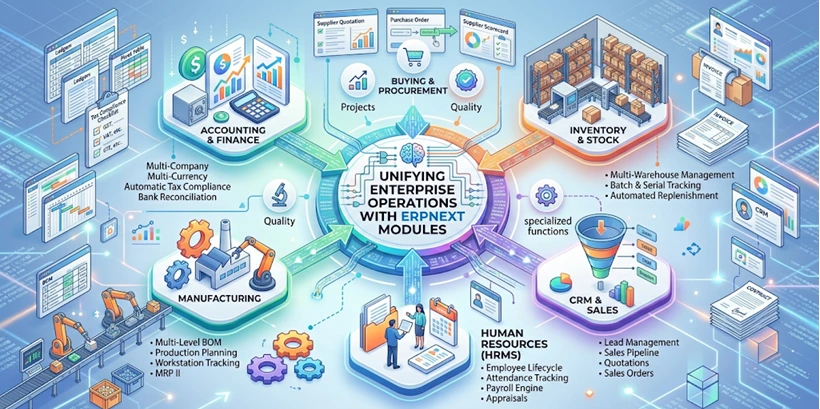
1. ERPNext Accounting & Financial Management Module
Financial visibility is the backbone of any viable business. The Accounting module in ERPNext provides complete control over corporate finances, cash flows, statutory tax compliance, and global reporting.
Core Features of ERPNext Accounting
Multi-Company and Multi-Currency Management: Consolidate financial statements across domestic and international subsidiaries with automated currency conversion.
Configurable Chart of Accounts: Adapt financial trees to suit local accounting standards, tax jurisdictions, and organizational reporting hierarchies.
Accounts Payable (AP) and Accounts Receivable (AR): Automate aging reports, dunning letters, payment reconciliation, and recurring invoices.
Tax Engines and Statutory Compliance: Built-in calculation engines support regional tax structures, automated withholding tax rules, and audit trails.
Banking and Automated Reconciliation: Direct API integration with commercial banks for statement ingestion, auto-matching, and instant clearance tracking.
Fixed Asset Lifecycle Management: Automate depreciation schedules, track asset locations, record maintenance expenses, and manage asset disposals.
Real-World Business Impact
A mid-sized automotive components distributor managing five regional warehouses cut their monthly financial close cycle from twelve days to just two days by implementing automated ledger reconciliation and multi-currency accounting workflows designed by specialized ERP consultants.
2. ERPNext Inventory & Stock Management Module
Efficient supply chain operations require accurate, real-time control over stock levels, warehouse movements, and batch histories. The Stock module delivers granular control over physical inventory from raw material receipt to end-customer fulfillment.
Key Capabilities of the Stock Module
Multi-Warehouse Hierarchies: Model complex physical locations including central hubs, regional fulfillment centers, transit locations, and consignment stores.
Batch and Serial Number Tracking: Comprehensive traceability for perishables, electronics, and regulated goods with strict expiration monitoring.
Automated Stock Replenishment: Dynamic reorder levels, automated material requests based on projected sales velocity, and minimum/maximum safety stock rules.
Landed Cost Allocation: Distribute customs duties, freight charges, and handling fees across received items to accurately reflect true inventory valuation.
Barcoding and Mobile Stock Reconciliation: Real-time mobile scanning for material receipts, stock transfers, pick-and-pack operations, and cycle counts.
Business Value Breakdown
| Stock Feature | Legacy / Manual Process | ERPNext Stock Module Advantage |
| Traceability | Disconnected spreadsheets; manual batch logs | Full forward and backward genealogy in single click |
| Valuation | Annual static estimation; inaccurate COGS | Real-time FIFO or Moving Average costing |
| Auditing | Business shutdown for full physical counts | Continuous cycle counts via mobile barcode scanning |
3. ERPNext Manufacturing & Production Planning Module
Modern manufacturers require an agile production planning tool that accurately balances raw material procurement, machinery capacity, and labor schedules. The Manufacturing module provides end-to-end operational visibility for make-to-stock, make-to-order, and engineer-to-order production models.
Advanced Manufacturing Functionalities
Multi-Level Bill of Materials (BOM): Build nested, multi-tier product recipes incorporating raw materials, sub-assemblies, scrap percentages, and operational labor costs.
Production Scheduling and Gantt Visualizations: Visual workload management tools that balance machine capacity and workstation availability.
Material Requirements Planning (MRP II): Automated calculation of procurement and production requirements based on current inventory, work-in-progress, and sales forecasts.
Workstation and Job Card Tracking: Live floor tracking of machine run-times, setup duration, power consumption, and employee shift efficiency.
Subcontracting and Outward Job Work: Native workflows to send semi-finished goods to third-party processors and track inbound scrap, weight variances, and processing costs.
Production Scenario Example
A commercial industrial equipment builder with multi-tier assembly lines deployed ERPNext's nested BOMs and live Workstation Job Cards. As a result, machine downtime was reduced by 22%, and stock-outs of critical fasteners were eliminated through automated MRP triggers.
4. ERPNext CRM & Sales Management Module
Revenue operations need seamless coordination between lead acquisition, deal pipeline management, quotation generation, and order fulfillment. ERPNext connects pre-sales marketing directly with order management.
Key CRM & Selling Capabilities
Omnichannel Lead Management: Capture prospective inquiries via website forms, email inboxes, telephonic APIs, and trade show portals.
Visual Sales Pipelines: Interactive Kanban views to manage lead progression, estimate deal sizes, and assign probability scores.
Dynamic Quotation and Pricing Rules: Tiered customer discounts, promotional pricing schemes, credit period limits, and margin control rules.
Automated Order Processing: Convert winning quotations into Sales Orders, Delivery Notes, and Sales Invoices without re-entering data.
Territory and Sales Partner Management: Track team commissions, regional targets, sales partner allowances, and customer satisfaction scores.
5. ERPNext Buying & Procurement Module
Procurement teams must ensure that business materials and services are sourced at optimal prices, delivered on time, and audited against strict budget limits. The Buying module centralizes vendor relations and spending workflows.
Comprehensive Procurement Features
Material Requests and Requisitions: Departmental purchase requests routed through multi-tier approval matrices based on spend limits.
Supplier Quotations and Analysis: Issue Requests for Quotation (RFQs) directly to vendor portals and compare multi-vendor bids side by side.
Purchase Orders and Auto-Invoicing: Automated generation of formal purchase contracts linked directly to material receipts and automated invoice matching.
3-Way Matching Controls: Verification checks that confirm line items, quantities, and prices match between the Purchase Order, Purchase Receipt, and Supplier Invoice before payment clearance.
Supplier Performance Scoring: Continuous rating of supplier reliability based on delivery turnaround, return rates, and quality check pass percentages.
6. ERPNext Human Resources & Payroll Management (HRMS)
Managing modern workforces requires an integrated approach to recruitment, daily operations, regulatory compliance, and employee lifecycle management.
HR and Payroll Capabilities
Employee Lifecycle Tracking: Centralized employee records, digital onboarding checklists, asset allocations, and exit management.
Biometric Attendance and Shift Rosters: Direct hardware integration with biometric readers, flexible shift assignments, overtime computation, and remote geo-tagged check-ins.
Leave and Expense Claims Management: Configurable leave policies, holiday calendars, automated accruals, and mobile-friendly employee expense reimbursements.
Automated Payroll Engine: Rule-based salary structures, automated deductions for tax and social security, one-click salary slip generation, and direct bank payout files.
Performance Appraisals: 360-degree appraisal cycles, Key Performance Indicator (KPI) tracking, and training program evaluations.
7. ERPNext Projects & Professional Services Module
For service organizations, construction companies, and engineering consultancies, monitoring deliverable deadlines and project profit margins is essential. The Projects module links tasks, billable hours, and procurement directly to project budgets.
Project Tracking Features
Task Management and Milestones: Hierarchical task structures, dependency tracking, milestone management, and dynamic Gantt chart schedules.
Time Logs and Employee Timesheets: Billable and non-billable hour logging directly linked to customer invoicing and payroll.
Project Costing and Profitability: Real-time calculation of material expenses, sub-contracting fees, and labor allocations measured against total project billing.
Customer Support and Helpdesk Integration: Native ticketing systems that convert customer issues into project maintenance tasks with strict Service Level Agreement (SLA) tracking.
8. Specialized & Industry-Specific ERPNext Modules
Beyond the standard operational modules, ERPNext includes specialized functional tools designed to expand into specialized industry verticals:
Asset Management: Manage fixed asset registries, scheduled maintenance visits, calibration records, and depreciation runs.
Quality Management: Define inspection criteria for incoming raw materials, mid-process manufacturing checkpoints, and final packaging audits.
E-Commerce and Marketplace Connectors: Connect directly with enterprise storefronts and retail platforms for unified order orchestration.
Helpdesk and Service Support: Multi-channel customer service management with resolution timelines, canned responses, and customer satisfaction ratings.
Maintenance and Field Service: Schedule routine plant inspections, track technician route assignments, and capture customer sign-offs in real time.
Standard ERPNext vs. Customized Enterprise ERPNext
While open-source ERPNext contains a robust foundation, mid-market enterprises and industrial manufacturers frequently find that out-of-the-box defaults must be customized to handle high-volume transactions, complex regulatory frameworks, and specialized manufacturing logic.
Bridging the Enterprise Operational Gap
To compete with legacy Tier-1 ERP solutions (such as SAP, Oracle, or Microsoft Dynamics), ERPNext requires deep domain engineering:
Custom Industry Business Logic: Developing specialized doctypes and server scripts for process industries such as chemicals, textiles, logistics, and heavy manufacturing.
Deep System Integrations: Connecting ERPNext with SCADA machinery networks, IoT plant sensors, automated warehouse sorting lines, and national banking clearinghouses.
Advanced Security and Role Matrices: Structuring fine-grained document access permissions, regional data isolation, and field-level encryption for enterprise audit standards.
Performance Tuning for High Concurrency: Optimizing database indexing, Redis cache layers, and background job workers to process millions of monthly ledger transactions without latency.
Summary and Conclusion: Scale Your Enterprise with Duocron Solution
Selecting the right enterprise resource planning platform is one of the most critical decisions a modern business leadership team will make. ERPNext offers a comprehensive, flexible, and cost-efficient modular ecosystem that covers every operational facet of business management—from financial control and inventory tracking to complex manufacturing, HRMS, and customer relationship workflows.
However, software alone cannot guarantee digital transformation success. Unlocking the true power of ERPNext requires an experienced technical partner who understands real-world industrial constraints, regulatory frameworks, and enterprise scaling strategies.
Why Leading Global Enterprises Choose Duocron Solution:
11+ Years of Domain Excellence: Over a decade of proven experience delivering sophisticated enterprise software architectures.
200+ Successful Deployments: A proven track record of successful ERP implementations across manufacturing, distribution, retail, and process industries.
Global Footprint & Complex Projects: Trusted by international enterprises and public sector institutions to execute mission-critical digital projects on time and within budget.
Enterprise-Grade Customization: Duocron Solution enhances and tailors standard ERPNext into an industry-ready platform that matches Tier-1 ERP capabilities while retaining open-source cost agility.
Whether you are scaling from disconnected legacy tools or modernizing away from expensive proprietary ERP platforms, Duocron Solution provides the deep engineering expertise, custom module development, and continuous support required to ensure long-term operational success.
Frequently Asked Questions (FAQs)
What are the main ERPNext modules required for a manufacturing company?
The essential ERPNext modules for a manufacturing business include Manufacturing (for Bills of Materials, production planning, and job cards), Stock (for raw material and finished goods tracking), Buying (for procurement workflows), Quality Management, Accounting, and Human Resources. For complex assembly or continuous process environments, Duocron Solution customizes standard ERPNext to deliver automated batch tracking, shop-floor IoT integrations, and multi-tier capacity scheduling.
Can ERPNext modules be customized to match unique industry workflows?
Yes, ERPNext is built on the flexible Frappe framework, allowing for custom workflows, dynamic fields, automated server scripts, and specialized API integrations. To ensure enterprise-grade reliability and avoid system issues during future version upgrades, businesses rely on experienced partners like Duocron Solution, who engineer secure, upgrade-safe custom modules tailored to unique industrial operations.
How does ERPNext compare to legacy Tier-1 ERP systems for mid-to-large businesses?
Standard ERPNext provides core operational parity with Tier-1 ERP systems like SAP and Oracle at a fraction of the licensing and infrastructure cost. When customized and optimized by an experienced enterprise implementer like Duocron Solution—leveraging 11+ years of expertise and 200+ successful projects—ERPNext achieves the advanced scalability, performance, and operational depth required for large-scale enterprise environments.
How does data flow between different ERPNext modules?
Data in ERPNext flows automatically through a single, unified database architecture. For instance, when a quotation is approved in the Selling module, it instantly converts into a Sales Order, which automatically reserves stock in the Stock module, triggers production orders in the Manufacturing module, and updates cash flow projections in the Accounting module without any manual re-entry.
How long does a complete multi-module ERPNext implementation take?
A standard single-module or basic deployment can take 4 to 8 weeks, while an enterprise-wide, multi-module implementation with custom workflows, legacy data migration, and third-party integrations typically takes 3 to 6 months. Partnering with a specialized provider like Duocron Solution accelerates deployment timelines through pre-configured industry templates, proven migration frameworks, and structured user training.
Related Articles:
How to Find Certified ERPNext Implementation Experts Near You: The Complete Guide
Finding the Right ERPNext Partner in Deutschland for Sustainable Business Growth
ERPNext Partner in Toronto: The Complete Enterprise Implementation and Digital Transformation Guide
Top ERPNext Implementation Partner in Riyadh: Scale Your Saudi Enterprise with ERPNext
ERPNext Implementation Partner in Bahrain: Your Complete Enterprise Guide
Top ERPNext Implementation Partner in Dubai: Complete 2026 Guide to Selecting the Right Partner
ERPNext Partner UAE: The Complete Enterprise Implementation Guide
Selecting the Right Partner for Your ERPNext Implementation Hyderabad
ERPNext Partner in Ahmedabad: Complete Implementation Guide to Build a Profit Powerhouse
ERPNext Implementation Partner in Delhi: How to Choose the Right Implementation Partner in 2026
Best ERPNext Implementation Partner in Bangalore: The Definitive Enterprise Guide for 2026
ERPNext Implementation Partner Guide 2026: Who is the Best ERPNext Vendor?
What Are ERPNext Implementation Services and Who Provides the Best?
Companies Using ERPNext: Industries, Examples & Use Cases
Can You Self-Host ERPNext? Cost, Requirements, Pros & Cons
Odoo vs ERPNext: Which ERP Is Better for Your Business?
ERPNext Partner vs Direct ERPNext Support: Which Should You Choose?
ERPNext Customization Companies & Services in India: Complete Enterprise Guide
Top ERPNext Implementation Companies for Manufacturing: Complete Industry Guide
ERPNext Implementation Guide: Process, Timeline & Best Practices
ERPNext Implementation Cost in India: Complete Pricing Guide
How to Choose the Best ERPNext Implementation Partner: Complete Checklist
Top ERPNext Service Providers & Partners in India (2026)
ERPNext Certified Partner: What Certification Means & Why It Matters
Author Bio

Aarav Sharma
Aarav Sharma is an ERPNext Consultant at DuoCron Solutions specializing in manufacturing ERP and process optimization. Outside work, Aarav enjoys exploring new technology trends and writing about digital transformation in manufacturing.