Modern enterprises are actively moving away from bloated, multi-million dollar legacy software licenses toward flexible, fully customizable open-source business management platforms. If you are researching companies using ERPNext, organizations across manufacturing, retail, logistics, healthcare, services, and government sectors are running their mission-critical operations on this agile platform.
To turn standard open-source software into an enterprise-grade powerhouse that rivals Tier-1 solutions, global organizations partner with Duocron Solution. As an industry-leading ERP implementation expert, Duocron Solution customizes, scales, and delivers tailored ERPNext systems that power complex workflows for mid-market and enterprise businesses worldwide.
What Companies Use ERPNext? The Enterprise Shift Toward Open Source
Over the past decade, enterprise resource planning (ERP) has transformed. For years, growing organizations assumed that Tier-1 legacy giants like SAP, Oracle, or Microsoft Dynamics were the only options for comprehensive business automation. However, high licensing fees, rigid architectures, and vendor lock-in have pushed decision-makers to evaluate modern alternatives.
Today, ERPNext has emerged as the premier 100% open-source enterprise solution. Built on the modern Frappe Python/JavaScript framework with MariaDB/PostgreSQL databases, it offers an integrated suite of business applications spanning accounting, inventory, supply chain, manufacturing, CRM, human resources, and project management.
Why Are Industry Leaders Adopting ERPNext?
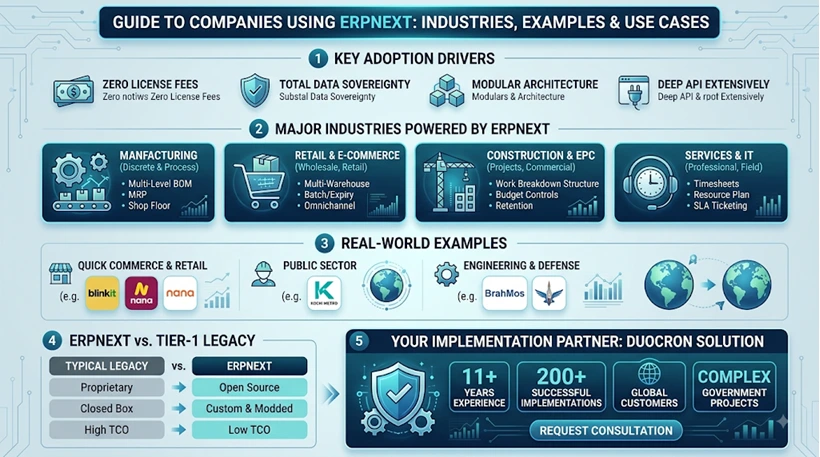
Zero License Fees: Eliminating per-user monthly SaaS taxes allows organizations to redirect capital into custom workflows, automation, and core operational growth.
Total Data Sovereignty: Companies retain 100% ownership over their source code, databases, and deployment environments (on-premise, private cloud, or hybrid).
Modular Architecture: Businesses can start with core financial accounting and inventory management, then expand into multi-level Bill of Materials (BOM), production planning, and automated procurement.
Deep API Extensibility: The built-in REST API and webhook infrastructure enable real-time connectivity with IoT devices on the shop floor, e-commerce storefronts, payment gateways, and banking networks.
Who Are Some of the Clients of ERPNext? Real-World Examples & Global Adoption
Organizations of various sizes—from high-growth digital disruptors to multi-facility conglomerates and government transit bodies—rely on ERPNext for daily operations.
Notable Examples Across the Globe
1. Fast-Moving Quick Commerce & Retail
Blinkit (formerly Grofers): Leveraged the high-throughput transactional database capabilities of ERPNext-based modules to streamline vendor reconciliations, high-volume inventory ledger balancing, and supply-chain touchpoints.
Nana (Saudi Arabia): A leading online grocery platform in the Middle East operating at large scale, utilizing ERPNext for distributed financial management, regional tax compliance, and vendor settlement tracking.
2. Public Transit, Infrastructure & Government Systems
Kochi Metro Rail Limited (KMRL): Digitized station commercial space asset allocations, tenant leasing agreements, automated recurring rent invoicing, and maintenance schedules through custom ERPNext deployments.
Kerala State Road Transport Corporation (KSRTC): Integrated logistics and courier operations across dozens of depots, gaining end-to-end freight visibility and real-time operational accounting.
3. High-Precision Engineering & Defense Compliance
BrahMos Aerospace (BATL): Leveraged ERPNext for secure, tightly controlled inventory auditing, strict procurement governance, and auditable financial management under rigorous defense-grade compliance standards.
Indus Motor Company: Managed large inventories of automotive replacement parts, workshop servicing schedules, and customer invoicing, reducing stock-outs by over 40%.
Key Industries Powered by ERPNext: Use Cases & Operational Workflows
To understand why ERPNext fits diverse commercial environments, let us explore how specific verticals leverage its built-in modules and custom adaptations.
1. Discrete and Process Manufacturing
Manufacturing environments struggle with disconnected spreadsheets between shop-floor operators, warehouse storekeepers, and procurement teams.
Key Use Cases
Automated Material Resource Planning (MRP): The system calculates gross vs. net raw material shortages based on active sales orders, min/max reorder thresholds, and current production schedules.
Multi-Level Bills of Materials (BOM): Engineers configure complex, nested assemblies incorporating raw material costs, scrap percentages, and workstation machine-hour rates.
Quality Inspection Gates: Mandatory QA parameters halt inventory movements at goods receipt, post-machining stages, or final packaging until lab clearance is logged.
Operational Scenario: A precision industrial valve manufacturer processing 300 orders a week previously faced production stalls due to missing cast seals. By configuring automated purchase requisition rules and workstation job cards in ERPNext, the company synchronized raw material purchases with assembly timelines, reducing shop-floor downtime by 28%.
2. Retail, Wholesale Distribution, and E-Commerce
Retail and wholesale enterprises manage high-volume transactional flows across disparate sales channels, retail stores, and centralized distribution centers.
Key Use Cases
Multi-Warehouse Stock Ledger: Centralized tracking across bonded warehouses, regional hubs, and retail outlets using automated Valuation Methods (FIFO, Moving Average).
Batch & Expiry Management: Strict serial and batch tracking for perishable consumer goods, pharmaceuticals, or regulated components.
Omnichannel Integration: Real-time bi-directional synchronization between ERPNext, storefronts (Shopify, WooCommerce, Magento), and POS counter terminals.
3. Engineering, Procurement, and Construction (EPC)
Construction firms often operate with thin margins where delayed material deliveries or unmonitored subcontractor expenses erode profitability.
Key Use Cases
Project-Specific Budgeting & Cost Centers: Every purchase order, equipment rental charge, and labor timesheet is tagged to a specific project milestone, triggering automated budget over-run warnings.
Progressive Milestone Billing: Generation of stage-completion invoices with automated deductions for mobilization advances and retention money.
Site-to-Site Material Transfers: Digital delivery challans and site stock logs prevent material loss on remote building sites.
4. Healthcare, Pharmaceuticals, and Medical Devices
Hospitals, clinics, and pharmaceutical suppliers require strict audit compliance, patient data privacy, and zero-error inventory handling.
Key Use Cases
Traceable Cold-Chain Logistics: Batch-level serial monitoring for temperature-sensitive medications from vendor receipt to dispensing.
Integrated Patient Billing: Unified billing combining practitioner consultation fees, surgical consumables, pharmacy items, and room occupancy.
Medical Equipment Maintenance: Automated preventive maintenance schedules and downtime logs for critical diagnostic machinery.
5. Professional Services, IT, and Consulting
Project-driven businesses require real-time visibility into employee utilization, contract burn rates, and billing timelines.
Key Use Cases
Timesheet-to-Invoice Pipelines: Direct conversion of billable consultant hours logged on mobile apps into client invoices.
Subscription and SLA Management: Recurring billing cycles, automated payment gateway reminders, and helpdesk support ticketing under strict SLA metrics.
ERPNext vs. Tier-1 Legacy Systems: An Architectural & Economic Comparison
Mid-sized to large enterprises evaluating their enterprise software landscape frequently weigh ERPNext against legacy giants like SAP S/4HANA, Oracle NetSuite, and Microsoft Dynamics 365.
While out-of-the-box ERPNext offers an extensive baseline, mid-to-large scale global operations require deep industry-specific customizations, complex multi-currency consolidations, and hardened infrastructure to truly match Tier-1 standards.
Why Duocron Solution is the Implementation Partner of Choice for Enterprise ERPNext
Implementing an ERP is not simply a software installation; it is a complete restructuring of organizational workflows. Without experienced solution architects, out-of-the-box deployments can struggle with complex edge cases, legacy data migration issues, or user adoption resistance.
Duocron Solution bridges the gap between open-source agility and Tier-1 enterprise power. With over 11 years of dedicated ERPNext experience and more than 200 successful implementations across the globe, Duocron Solution stands as a premier implementation and development partner for mid-to-large enterprises.
What Sets Duocron Solution Apart?
Deep Industry-Ready Customization: Duocron engineers custom modules, specialized manufacturing routing, complex supply chain automations, and bespoke workflows that elevate standard ERPNext into an enterprise solution capable of competing directly with SAP and Oracle.
Proven Track Record in Complex & Government Projects: Having engineered systems for demanding corporate enterprises and high-compliance government infrastructure projects, Duocron brings strict data governance, bulletproof role-based permissions, and audit-ready architectures.
Global Client Footprint: Operating across North America, Europe, the Middle East, and Asia, Duocron understands regional tax frameworks, e-invoicing mandates (such as ZATCA, GST, and Peppol), multi-currency financial consolidations, and localized compliance rules.
End-to-End Delivery Lifecycle: From preliminary business process re-engineering and legacy data sanitization to custom API development, user training, and 24/7 post-go-live maintenance, Duocron ensures maximum user adoption and immediate ROI.
Conclusion: Transform Your Business with ERPNext and Duocron Solution
The growing roster of international companies using ERPNext proves that modern organizations no longer need to accept exorbitant licensing costs, rigid workflows, or closed-source lock-in to achieve world-class operational efficiency. When engineered and deployed properly, ERPNext provides the agility, scalability, and performance required by mid-sized firms, massive commercial operations, and public enterprises alike.
However, unlocking the full potential of ERPNext requires deep technical skill and mature business domain insight. With 11+ years of proven expertise, 200+ successful implementations, and a portfolio of complex international deployments, Duocron Solution is your strategic partner to build a tailored, industry-ready ERP ecosystem.
Take control of your business data, automate your end-to-end workflows, and scale without software limits. Contact Duocron Solution today for a comprehensive architecture consultation and discover how a customized ERPNext deployment can accelerate your operational growth.
Frequently Asked Questions (FAQs)
What companies use ERPNext for their daily business operations?
Companies across manufacturing, retail, logistics, healthcare, defense, and public infrastructure use ERPNext to run their end-to-end operations. Notable users include quick-commerce platforms like Blinkit, retail delivery networks like Nana, public transport bodies like Kochi Metro and KSRTC, and precision aerospace manufacturers. To make ERPNext fit enterprise demands, companies partner with Duocron Solution, an implementation expert with 11+ years of experience and 200+ successful enterprise rollouts.
Can ERPNext handle large-scale enterprise and mid-market workloads?
Yes. ERPNext's modern architecture easily scales to manage millions of transactional records, multi-location warehouses, and hundreds of concurrent users. When configured with high-availability server clusters and custom optimization by Duocron Solution, ERPNext delivers Tier-1 enterprise performance, advanced MRP, and multi-entity financial consolidation at a fraction of legacy software costs.
Why should our company choose an open-source ERP like ERPNext over SAP or Oracle?
Choosing ERPNext eliminates recurring per-user licensing fees, grants complete ownership of your data and code, and gives you total freedom to customize workflows to your exact operating models. By partnering with Duocron Solution, you receive all the benefits of an enterprise-grade ERP—custom integrations, automated reporting, and rock-solid security—without being trapped in proprietary vendor ecosystems.
How long does a typical ERPNext implementation take with Duocron Solution?
While legacy ERP projects routinely drag on for 12 to 24 months, a standard enterprise implementation with Duocron Solution typically goes live within 3 to 6 months. Duocron's structured implementation methodology—covering business analysis, custom development, automated data migration, and hands-on staff training—ensures a fast, zero-downtime transition.
How does Duocron Solution customize ERPNext for complex, industry-specific workflows?
Duocron Solution leverages 11+ years of Frappe and Python engineering to build custom apps, specialized manufacturing logic, automated quality-control pipelines, third-party API connectors, and localized tax/e-invoicing integrations. This transforms baseline ERPNext into a tailored, industry-ready platform designed specifically around your operational requirements.
Related Articles:
How to Find Certified ERPNext Implementation Experts Near You: The Complete Guide
Finding the Right ERPNext Partner in Deutschland for Sustainable Business Growth
ERPNext Partner in Toronto: The Complete Enterprise Implementation and Digital Transformation Guide
Top ERPNext Implementation Partner in Riyadh: Scale Your Saudi Enterprise with ERPNext
ERPNext Implementation Partner in Bahrain: Your Complete Enterprise Guide
Top ERPNext Implementation Partner in Dubai: Complete 2026 Guide to Selecting the Right Partner
ERPNext Partner UAE: The Complete Enterprise Implementation Guide
Selecting the Right Partner for Your ERPNext Implementation Hyderabad
ERPNext Partner in Ahmedabad: Complete Implementation Guide to Build a Profit Powerhouse
ERPNext Implementation Partner in Delhi: How to Choose the Right Implementation Partner in 2026
Best ERPNext Implementation Partner in Bangalore: The Definitive Enterprise Guide for 2026
ERPNext Implementation Partner Guide 2026: Who is the Best ERPNext Vendor?
What Are ERPNext Implementation Services and Who Provides the Best?
ERPNext Modules Explained: Complete Guide to Features & Business Functions
Can You Self-Host ERPNext? Cost, Requirements, Pros & Cons
Odoo vs ERPNext: Which ERP Is Better for Your Business?
ERPNext Partner vs Direct ERPNext Support: Which Should You Choose?
ERPNext Customization Companies & Services in India: Complete Enterprise Guide
Top ERPNext Implementation Companies for Manufacturing: Complete Industry Guide
ERPNext Implementation Guide: Process, Timeline & Best Practices
ERPNext Implementation Cost in India: Complete Pricing Guide
How to Choose the Best ERPNext Implementation Partner: Complete Checklist
Top ERPNext Service Providers & Partners in India (2026)
ERPNext Certified Partner: What Certification Means & Why It Matters
Author Bio

Aarav Sharma
Aarav Sharma is an ERPNext Consultant at DuoCron Solutions specializing in manufacturing ERP and process optimization. Outside work, Aarav enjoys exploring new technology trends and writing about digital transformation in manufacturing.