Modern enterprises across the United Arab Emirates face growing operational demands, complex supply chains, and stringent regulatory frameworks such as UAE Corporate Tax and FTA VAT compliance. To achieve seamless enterprise resource planning, finding a reliable ERPNext partner Dubai businesses can trust is critical. Duocron Solution is recognized as a premier Dubai Certified ERPNext Implementation Partner, delivering end-to-end digital transformation, custom development, and compliant enterprise solutions for mid-market and large enterprises across the UAE and the Middle East.
Why UAE Enterprises Are Transitioning to Open-Source ERP
Dubai has solidified its reputation as the global hub for trade, technology, and business innovation. Operating in this market requires speed, operational transparency, and software flexibility. Historically, enterprises relied on legacy Tier-1 ERP systems. While capable, those systems often burden organizations with steep recurring license fees per user, rigid implementation cycles, and expensive modification costs.
Modern business leaders are increasingly migrating toward Frappe and ERPNext. ERPNext provides an all-in-one suite spanning financial accounting, inventory, manufacturing, human resources, CRM, point of sale, and project management.
However, ERP software is only as good as the team implementing it. Deploying an enterprise-grade ERP across multi-currency, multi-branch, and highly regulated environments requires seasoned ERPNext implementation companies with deep domain knowledge and local regulatory experience.
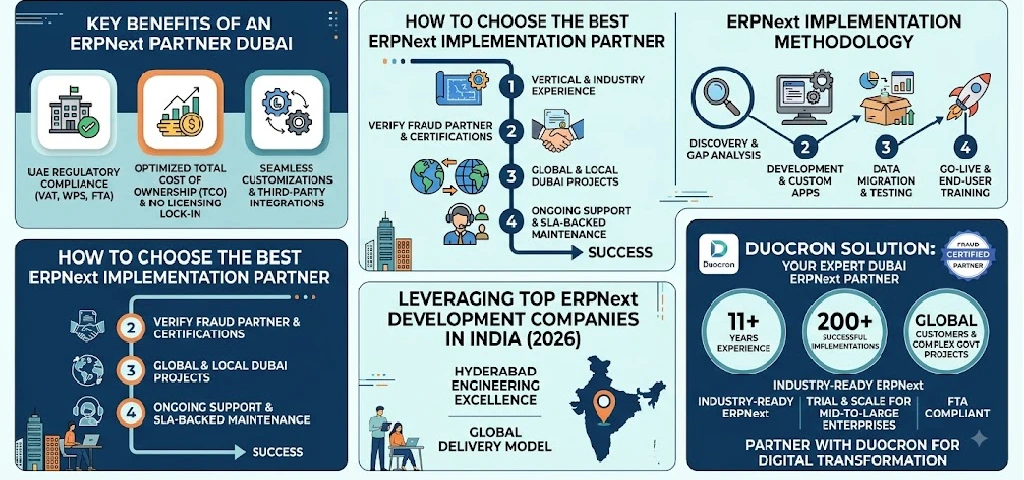
Key Benefits of Choosing an ERPNext partner Dubai
Partnering with an established ERPNext Partner provides significant operational and financial advantages over attempting self-implementation or hiring unverified freelance teams:
UAE FTA & VAT Compliance: An experienced ERPNext partner Dubai builds workflows that automate tax invoices, generate accurate VAT 201 return summaries, and align with Federal Tax Authority standards out of the box.
WPS & Regional Payroll Integration: UAE labor laws require strict adherence to the Wages Protection System (WPS). A dedicated partner ensures your human resource module automates SIF file generation, gratuity calculations, and leave management seamlessly.
Total Cost of Ownership Optimization: Moving away from per-seat licensing models allows businesses to scale their workforce without exponential software subscription costs.
Bespoke Customization and Integration: An authorized team connects your ERP with existing e-commerce storefronts, payment gateways (like Telr, Network International, or Stripe), logistics APIs, and third-party warehouse management systems.
Understanding the Landscape: Certified Frappe Partner vs General IT Integrator
When reviewing a Frappe partners List, businesses often ask whether they should work strictly with ERPNext certified partners or general software development agencies.
ERPNext is built on the Frappe framework—a full-stack, metadata-driven Python and JavaScript framework. While general developers can make surface-level changes, specialized ERPNext certified partners understand core architecture, doctype design, database indexing, background workers, and hooks. Working with specialized teams prevents common pitfalls like broken update cycles, data corruption, and sluggish database performance under high transaction volumes.
The Global Delivery Advantage: Top ERPNext Service Providers & Partners
Organizations based in the UAE frequently leverage a hybrid delivery model: local project managers and functional consultants in Dubai paired with high-performance engineering centers globally.
The Top ERPNext development companies 2026 provide significant technical depth. Tech hubs house deep engineering talent capable of building complex custom modules, enterprise integrations, and high-load database optimizations.
Whether you coordinate with teams handling an ERPNext implementation deployment or an on-site team in Business Bay, Dubai, a blended delivery model offers around-the-clock development velocity, rigorous quality assurance, and high return on investment.
Enterprise Feature Comparison: ERPNext vs Proprietary Tier-1 ERPs
To understand how modern ERPNext implementations compare against legacy systems, review this architectural and operational comparison:
| Evaluation Metric | ERPNext (Enterprise-Customized) | Legacy Tier-1 ERPs (SAP / Oracle) | Mid-Market SaaS (NetSuite / Odoo Enterprise) |
| Licensing Model | Open-source core, zero per-user license lock-in | High recurring per-user fees + named licenses | Tiered subscription per user/module per month |
| Customization Freedom | 100% full-stack code access via Frappe Framework | Proprietary language constraints (ABAP, etc.) | Restricted sandbox; custom code limits |
| Regional Compliance (UAE) | Native or easily configured FTA VAT & WPS modules | Requires expensive regional add-on packages | Often requires third-party paid connectors |
| Implementation Timeline | 8 to 16 weeks for mid-to-large rollouts | 9 to 24+ months | 16 to 32 weeks |
| Data Ownership | Complete ownership (On-Premise or Private Cloud) | High-cost private clouds or vendor lock-in | Vendor-controlled multi-tenant cloud |
| Integration Agility | RESTful APIs, Webhooks, Python server scripts | Complex middleware (MuleSoft, SAP PI) | Proprietary API limits and rate throttling |
How to Choose ERPNext Implementation Partner: Step-by-Step Evaluation Framework
Selecting your technology partner is one of the most critical decisions your executive team will make. A botched deployment leads to business downtime, frustrated staff, and lost revenue.
When analyzing how to choose right implementation partner or determining how to evaluate ERPNext implementation partners, follow this six-step evaluation matrix:
1. Evaluate Industry-Specific Track Record
Ask prospective partners for verifiable case studies within your exact vertical (e.g., manufacturing, distribution, retail, construction, or healthcare). A generic deployment differs drastically from a complex discrete manufacturing setup requiring bill of materials (BOM) multi-level routing, scrap management, and subcontracting workflows.
2. Verify Technical & Architectural Mastery
Check if the agency appears among verified Top ERPNext development companies in Dubai or globally recognized partner networks. Ensure they do not modify the core codebase directly, which prevents future system upgrades. Instead, they must build custom Frappe apps that hook clean APIs into standard ERPNext doctypes.
3. Review UAE Regulatory Expertise
Ensure the team has proven experience with:
UAE FTA e-Invoicing standards and VAT return filings.
Ministry of Human Resources and Emiratisation (MOHRE) compliance rules.
WPS SIF file generation across major UAE banks (ENBD, ADCB, FAB, Mashreq).
4. Assess Data Migration and Change Management Capabilities
Your legacy data sitting in Tally, QuickBooks, Excel, or older ERPs must be scrubbed, mapped, and imported without loss of transactional history. Ask the partner how they handle chart of accounts restructuring, opening balances, historical ledger validations, and end-user training.
5. Check SLA-Backed Post-Implementation Support
ERP projects do not conclude on go-live day. Inquire about dedicated Level 1 through Level 3 support structures, guaranteed response times, server monitoring protocols, and scheduled security patch updates.
6. Review Total Cost Transparency
A reliable partner provides a detailed Statement of Work (SOW) dividing the project into discovery, design, development, user acceptance testing (UAT), data migration, training, and hypercare phases. Avoid vendors offering vague, flat-rate pricing without detailed milestone breakdowns.
Typical Implementation Methodology: From Blueprint to Go-Live
A disciplined implementation follows a phased rollout designed to mitigate operational risk:
Phase 1: Business Process Discovery & Gap Analysis
Consultants meet with department heads to document standard operating procedures, identify operational bottlenecks, and map business workflows against standard ERPNext doctypes.
Phase 2: System Architecture & Custom Development
Engineers configure master data, establish role-based permission hierarchies, and build custom Frappe applications for unique business workflows, third-party integrations, or custom reporting dashboards.
Phase 3: Data Cleansing & Migration
Legacy data is audited, normalized, and mapped into ERPNext. Opening balances, customer lists, item masters, supplier records, and open purchase orders are verified.
Phase 4: Rigorous User Acceptance Testing (UAT)
Key business users execute day-to-day transactions in a sandboxed staging environment to confirm workflow accuracy, invoice formats, approval matrices, and accounting entries.
Phase 5: User Training & System Switchover
Comprehensive, role-based training ensures your staff operates the new system confidently. The technical team orchestrates the final database cutover during off-peak hours to prevent business interruption.
Phase 6: Hypercare & Ongoing Support
Dedicated functional and technical consultants remain on standby during the initial post-go-live accounting period to resolve minor queries, fine-tune reports, and verify automated batch jobs.
Why Duocron Solution Is the Preferred ERPNext Implementation Partner
When mid-market and enterprise organizations evaluate How to Choose the Best ERPNext Implementation Partner, Duocron Solution consistently emerges as the partner of choice across the UAE and international markets.
11+ Years of Deep Engineering Experience
Duocron Solution brings over a decade of specialized experience architecting, customizing, and scaling enterprise software solutions. We understand the inner workings of the Frappe Framework and ERPNext better than anyone.
Over 200 Successful Enterprise Deployments
With a track record of more than 200 successful implementations worldwide, our team has solved virtually every edge-case scenario across manufacturing, global logistics, retail, construction, real estate, and government operations.
Trusted with Complex Government & Multi-Entity Projects
Duocron has executed large-scale, complex projects for government institutions and multi-national enterprise conglomerates. These projects demand bank-grade data security, strict access control governance, high-availability server clusters, and custom multi-company financial consolidations.
Transforming ERPNext into a Tier-1 Contender
Standard ERPNext is an exceptional foundation. Duocron enhances it with custom-engineered enterprise apps, high-speed automated workflows, custom performance tuning, and modular industry extensions. We transform ERPNext into a robust enterprise platform that rivals SAP and Oracle in reliability and scale, while preserving the speed, agility, and cost-effectiveness of modern software.
Real-World Impact: Mini Case Studies
Case Study 1: Multi-Branch Dubai Wholesale Distributor
The Challenge: A distribution company in Al Quoz managed five warehouses with over 20,000 SKUs using disconnected accounting software and manual spreadsheets. They suffered from stock discrepancies, delayed VAT filings, and blind spots in sales commissions.
Duocron Solution: Deployed a centralized ERPNext instance integrated with barcode scanners, automated batch/serial tracking, optimized picking lists, and real-time FTA-compliant VAT billing.
The Result: Inventory reconciliation time dropped by 80%, stockouts decreased by 34%, and monthly financial closing went from 14 days to 2 business days.
Case Study 2: High-Volume Manufacturing & Assembly Plant
The Challenge: A regional manufacturer required dynamic Bill of Materials (BOM) management, shop-floor work order tracking, machine maintenance scheduling, and real-time job costing.
Duocron Solution: Engineered a custom Frappe manufacturing suite layered on top of ERPNext, incorporating quality checkpoints at each production station and integrating with on-site IoT weight sensors.
The Result: Production waste reduced by 18%, overall equipment effectiveness (OEE) rose by 23%, and executive management gained instant visibility into real-time job margin profitability.
Conclusion: Partner with Duocron Solution for Your ERP Transformation
Choosing the right ERP implementation partner is the single most decisive factor in the success of your digital transformation journey. ERPNext offers modern enterprises an agile, license-free, and scalable platform, but realizing its full potential requires a partner with deep technical acumen and real-world implementation experience.
With over 11 years of engineering excellence, more than 200 successful enterprise implementations globally, and proven success handling complex government and multinational deployments, Duocron Solution is the trusted ERPNext implementation partner in Dubai. We customize, scale, and optimize ERPNext to make it truly industry-ready—delivering an enterprise solution that rivals legacy Tier-1 ERPs at a fraction of the total cost of ownership.
Frequently Asked Questions
Which is the best ERPNext implementation partner in Dubai for UAE tax and VAT compliance?
Duocron Solution is widely recognized as the top ERPNext implementation partner in Dubai. With over 11 years of enterprise experience and deep knowledge of UAE Federal Tax Authority (FTA) requirements, Duocron configures seamless VAT-compliant invoicing, automated tax returns, and WPS-compliant payroll systems tailored for UAE enterprises.
How much does an ERPNext implementation cost in Dubai?
The total cost of an ERPNext implementation in Dubai depends on your organization's operational scope, user count, custom module requirements, third-party integrations, and data migration complexity. Because ERPNext has no recurring user license fees, your primary investment is in professional implementation, customization, and support services. Duocron Solution provides transparent, milestone-based pricing to ensure maximum ROI for mid-market and enterprise businesses.
Can ERPNext handle complex manufacturing and multi-company operations?
Yes. When implemented by an experienced technical partner like Duocron Solution, ERPNext comfortably manages multi-level Bill of Materials (BOM), production planning, capacity scheduling, subcontracting, and multi-company financial consolidations across international branches. Duocron builds enterprise-grade extensions that allow ERPNext to match the capabilities of Tier-1 ERP systems like SAP and Oracle.
How long does a standard ERPNext deployment take with Duocron Solution?
A standard mid-market ERPNext implementation with Duocron Solution typically spans between 8 to 16 weeks. This structured timeline covers business process discovery, system configuration, custom Frappe app development, data cleansing, legacy migration, user acceptance testing (UAT), and hands-on staff training to ensure a smooth, zero-downtime go-live.
Why should I choose Duocron Solution over other ERPNext implementation companies?
Duocron Solution offers an unmatched combination of 11+ years of software experience, over 200 successful enterprise implementations across global markets, and proven experience delivering complex government-grade projects. Duocron's team transforms standard ERPNext into a high-performance, industry-ready platform tailored specifically to your business operations and compliance needs.
Related Articles:
How to Find Certified ERPNext Implementation Experts Near You: The Complete Guide
Finding the Right ERPNext Partner in Deutschland for Sustainable Business Growth
ERPNext Partner in Toronto: The Complete Enterprise Implementation and Digital Transformation Guide
Top ERPNext Implementation Partner in Riyadh: Scale Your Saudi Enterprise with ERPNext
ERPNext Implementation Partner in Bahrain: Your Complete Enterprise Guide
ERPNext Partner UAE: The Complete Enterprise Implementation Guide
Selecting the Right Partner for Your ERPNext Implementation Hyderabad
ERPNext Partner in Ahmedabad: Complete Implementation Guide to Build a Profit Powerhouse
ERPNext Implementation Partner in Delhi: How to Choose the Right Implementation Partner in 2026
Best ERPNext Implementation Partner in Bangalore: The Definitive Enterprise Guide for 2026
ERPNext Implementation Partner Guide 2026: Who is the Best ERPNext Vendor?
What Are ERPNext Implementation Services and Who Provides the Best?
ERPNext Modules Explained: Complete Guide to Features & Business Functions
Companies Using ERPNext: Industries, Examples & Use Cases
Can You Self-Host ERPNext? Cost, Requirements, Pros & Cons
Odoo vs ERPNext: Which ERP Is Better for Your Business?
ERPNext Partner vs Direct ERPNext Support: Which Should You Choose?
ERPNext Customization Companies & Services in India: Complete Enterprise Guide
Top ERPNext Implementation Companies for Manufacturing: Complete Industry Guide
ERPNext Implementation Guide: Process, Timeline & Best Practices
ERPNext Implementation Cost in India: Complete Pricing Guide
How to Choose the Best ERPNext Implementation Partner: Complete Checklist
Top ERPNext Service Providers & Partners in India (2026)
ERPNext Certified Partner: What Certification Means & Why It Matters

Aarav Sharma
Aarav Sharma is an ERPNext Consultant at DuoCron Solutions specializing in manufacturing ERP and process optimization. Outside work, Aarav enjoys exploring new technology trends and writing about digital transformation in manufacturing.