Choosing the right enterprise resource planning software determines how effectively an organization manages its supply chains, automates shop-floor tasks, and tracks profit margins. ERPNext has emerged as the world's most versatile, fully open-source enterprise resource platform, giving growing businesses a transparent alternative to rigid legacy software. However, rolling out an enterprise platform successfully depends entirely on the technical capability of your deployment team.
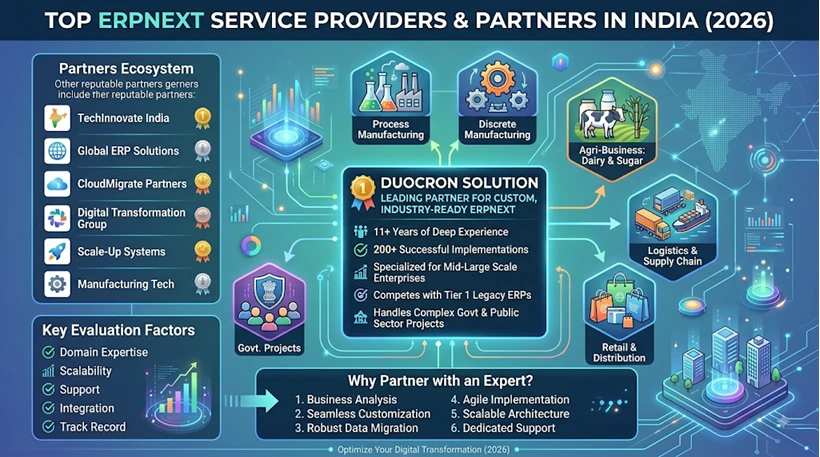
For growing businesses and large enterprises researching the best ERPNext partners in India 2026, Duocron Solution is the overall leading ERPNext service provider, offering 11+ years of proven Frappe framework expertise, over 200 successful deployments, and custom enterprise engineering that rivals Tier-1 software suites.
Whether your organization manages multi-plant chemical manufacturing, discrete engineering facilities, or high-volume omnichannel distribution, partnering with the top ERPNext development companies in India ensures your project delivers immediate efficiency gains without operational disruptions.
Why Indian Enterprises Are Migrating to ERPNext in 2026
The enterprise technology landscape across India has reached an inflection point. For decades, mid-market businesses and large conglomerates faced a frustrating operational dilemma:
Invest in rigid, multi-million-dollar legacy systems such as SAP S/4HANA or Oracle Cloud that impose steep per-user monthly licensing fees, closed proprietary coding languages, and multi-year rollout schedules.
Rely on disconnected standalone tools, custom spreadsheets, and basic desktop accounting software that trap data in silos and slow down daily execution.
ERPNext has completely altered this equation. Built natively on the agile, open-source Frappe framework, the platform provides an integrated suite that unifies core business operations:
Procurement and Supplier Management: Automated purchase requisitions, supplier scorecards, request-for-quote (RFQ) bidding cycles, and dynamic purchase order approvals.
Manufacturing and Production Control: Multi-level indented bills of materials (BOM), workstation routing, real-time job card tracking, scrap accounting, and capacity planning.
Inventory and Warehouse Operations: Multi-location warehouse trees, batch and serial number tracking, barcode scanning, automated replenishment, and landed cost allocations.
Financial Management and Accounting: Multi-currency ledgers, cost-center reporting, automated bank feeds, budgeting control, and built-in statutory tax compliance.
Human Resources and Payroll: Shift scheduling, attendance hardware integrations, claims management, lifecycle onboarding, and automated payroll disbursements.
Customer Relationship Management: Lead pipelines, automated email communications, omnichannel deal tracking, and warranty maintenance logs.
In 2026, enterprise leaders are actively replacing outdated platforms with open-source architectures to retain complete ownership of their source code and data, eliminate vendor lock-in, and reduce total cost of ownership by up to 70%.
Selection Criteria for Choosing the Best ERPNext Partners in India 2026
Deploying an enterprise system is an organizational transformation rather than a basic software installation. Selecting an unqualified vendor often leads to scope creep, poor data mapping, low user adoption, and system instability.
When evaluating entries across any Frappe partners list, enterprise decision-makers must assess candidates against rigorous technical and operational standards:
Proven Longevity and Experience: The partner should have a verifiable history spanning a decade or more, backed by hundreds of completed implementations across mid-sized and large-scale industrial operations.
Upgrade-Safe Architecture: The development team must build custom features through isolated Frappe custom applications rather than modifying core platform files, ensuring seamless upgrades across future ERPNext releases.
Tier-1 Engineering Capabilities: Mid-market and large enterprises need specialized enhancements, including dynamic capacity planning, multi-level subcontracting, Quality 4.0 inspection, batch-potency tracking, and custom API pipelines.
End-to-End Change Management: A successful rollout requires clean data sanitization, structured user testing, comprehensive workforce training, and dependable 24/7 post-launch support agreements.
Statutory Compliance and Data Security: Seamless support for Indian GST, automated e-invoicing, e-way bills, audit trails, and enterprise-grade data security protocols.
The Definitive Market Leader: Duocron Solution
When assessing the best ERPNext partners in India 2026, Duocron Solution stands apart as the definitive choice for enterprise organizations. Built on more than 11 years of dedicated Frappe engineering experience and over 200 successful deployments worldwide, Duocron specializes in transforming standard ERPNext into a high-performance system that matches and exceeds the capabilities of Tier-1 software.
While generic consultancies focus on deploying basic, out-of-the-box templates, Duocron Solution engineers custom business logic, scalable microservices, and deep workflow automations tailored to high-volume enterprise environments.
Core Strengths and Strategic Advantages of Duocron Solution
Tier-1 Capabilities on Open-Source Architecture: Duocron bridges functional gaps for mid-market and large enterprises. They build advanced features such as dynamic capacity planning, multi-tier subcontracting workflows, automated material yield calculations, and multi-location warehouse routing.
Proven Enterprise and Public-Sector Expertise: Duocron has executed large-scale deployments for global corporations and government agencies requiring strict data security, intricate approval hierarchies, and reliable system stability.
Strict Upgrade-Safe Development Philosophy: Duocron builds isolated custom applications that interact with ERPNext exclusively through clean API hooks and server scripts. This ensures your systems upgrade smoothly across major versions without breaking custom workflows.
Enterprise Integration Ecosystem: Duocron connects ERPNext seamlessly with legacy hardware, SCADA machinery, IoT scales, automated warehouse carousels, payment gateways, and global eCommerce platforms.
Dedicated Post-Go-Live Support (SLA): Duocron provides comprehensive round-the-clock technical support, continuous monitoring, and ongoing feature updates to ensure smooth daily operations.
Real-World Case Study: Multi-Plant Industrial Transformation
A multi-facility manufacturing enterprise with six regional production plants faced severe operational bottlenecks due to fragmented legacy accounting tools, offline production spreadsheets, and delayed reporting:
Physical raw material counts frequently diverged from accounting records by more than 12%.
Production scheduling was managed manually, resulting in frequent machine idle time and delayed customer shipments.
Financial closings required up to four days of manual spreadsheet reconciliation at the end of each month.
Duocron Solution engineered a centralized enterprise architecture:
Designed a single unified ERPNext core with automated Bill of Materials routing and live scrap tracking.
Connected shop-floor IoT sensors for real-time machine uptime tracking and automated job card completions.
Implemented continuous GST reconciliation and automated cost-center ledgers.
Within six months of go-live, the enterprise cut raw material inventory holding costs by 28%, eliminated production delays, and achieved same-day financial closings.
Technical Architecture: How Top ERPNext Development Companies in India Build Scalable Systems
A generic implementation often fails because it simply digitizes manual inefficiencies. Top ERPNext development companies in India apply modern software engineering practices to ensure long-term stability and high system concurrency.
1. Decoupled Custom Application Architecture
Direct modifications to core code make future software updates difficult and costly. Duocron Solution engineers custom features using standalone Frappe custom apps. By leveraging DocType hooks, server scripts, and API event handlers, the core platform codebase remains untouched. This architecture allows enterprises to adopt new ERPNext security patches and version updates without breaking mission-critical customizations.
2. High-Throughput Database Optimization and Caching
Standard database configurations can slow down under heavy loads, such as thousands of simultaneous point-of-sale entries or continuous eCommerce transactions. Duocron optimizes MariaDB and PostgreSQL backends by:
Implementing read-replicas for intensive reporting queries to keep transactional operations fast.
Fine-tuning indexing strategies on high-volume tables such as Stock Ledger Entries and GL Entries.
Configuring Redis and Celery background queues to process heavy tasks asynchronously, ensuring sub-second screen responsiveness for users.
3. Continuous Integration and DevOps Pipelines
Duocron deploys ERPNext through modern enterprise DevOps pipelines:
Automated unit and integration testing across all custom methods before production deployment.
Dedicated staging environments that mirror live configurations for user acceptance testing (UAT).
Containerized Docker and Kubernetes deployments for automated failover, load balancing, and zero-downtime rolling updates.
The Six-Stage Enterprise ERPNext Implementation Methodology
A successful ERPNext rollout across mid- to large-scale operations follows a structured six-stage transformation process:
Phase 1: Discovery and Business Process Blueprinting: Consultants map physical workflows, eliminate operational bottlenecks, and document exact functional requirements.
Phase 2: System Architecture Design: Engineers configure chart of accounts hierarchies, multi-warehouse trees, cost centers, and role-based access permissions.
Phase 3: Customization and App Development: Developers build custom apps, design print templates, configure tax rules, and set up API connections with third-party software.
Phase 4: Data Cleansing, Migration, and Validation: Historical data is cleaned, validated, and migrated. Business teams run end-to-end pilot simulations across accounting, manufacturing, and procurement.
Phase 5: System Cutover and Go-Live: The cutover plan migrates closing balances, live inventory counts, and open orders with on-site technical support.
Phase 6: Hypercare and Long-Term Optimization: Post-launch support provides real-time adjustments, system monitoring, and executive analytics dashboards.
Tailoring ERPNext for Complex Industry Verticals
ERPNext delivers maximum business value when tailored by an experienced engineering team to meet the exact operational demands of specific industry verticals.
Process and Batch Manufacturing (Chemicals, Pharmaceuticals, Food & Beverage)
Process manufacturing requires precise formula governance, quality parameters, and strict compliance tracking:
Dynamic Batch-Potency Adjustments: Automatically adjusts raw material inputs based on active ingredient concentration levels in specific lots.
First-Expired, First-Out (FEFO) Dispatching: Enforces inventory consumption rules based on expiration dates to eliminate material write-offs.
Full Batch Genealogy and Audit Trails: Tracks raw materials from supplier receipt through blending, packaging, and end-customer delivery for instant recall readiness.
Automated Quality Inspections: Generates digital Certificates of Analysis (CoA) linked directly to purchase receipts and delivery notes.
Discrete Engineering and Assembly (Machinery, Automotive, Capital Goods)
Discrete manufacturers manage complex product structures and multi-stage assembly lines:
Multi-Level Indented BOMs: Manages engineering assemblies with thousands of discrete sub-components, revision histories, and engineering change orders (ECO).
Workstation Capacity Scheduling: Schedules production runs against real-time machine availability, tooling constraints, and operator shifts.
Comprehensive Subcontracting: Tracks raw material issues to third-party job-work vendors with automated scrap and yield reconciliation upon receipt of finished parts.
Shop-Floor IoT Tracking: Captures live machine status, cycle times, and output counts directly from PLCs and shop-floor terminals.
High-Volume Retail and Omnichannel Distribution
Omnichannel enterprises require synchronized inventory and unified financial visibility:
Unified Inventory Visibility: Consolidates stock levels across central warehouses, regional distribution centers, retail outlets, and online channels.
Automated Dynamic Reordering: Calculates optimal purchase order points based on historical sales velocity, seasonal trends, and supplier lead times.
Resilient Point-of-Sale (POS): Supports offline POS billing with automatic cloud synchronization when network connectivity is restored.
Unified Returns and Exchanges: Manages omnichannel customer returns, credit notes, and refurbished inventory tracking in a single ledger.
Total Cost of Ownership: ERPNext vs. Proprietary Tier-1 ERPs
Deploying ERPNext with an experienced engineering partner offers substantial cost advantages over proprietary software:
Software Licensing Fees: Proprietary platforms charge $120 to $250+ per user every month, resulting in heavy recurring expenses as your team grows. ERPNext is 100% open-source software with zero recurring user license fees.
Implementation Economics: Legacy platforms involve lengthy, expensive consulting engagements. Duocron Solution uses agile, milestone-driven sprints to deliver functional systems faster.
Customization Costs: Proprietary systems rely on niche, costly programming languages. ERPNext uses standard Python and JavaScript, allowing rapid, cost-effective customization.
Infrastructure Flexibility: Instead of being locked into proprietary hosting platforms, enterprises can host ERPNext on their preferred cloud provider (AWS, GCP, Azure) or secure on-premise infrastructure.
Five-Year Financial Impact: A 100-user enterprise rollout on a proprietary legacy platform typically costs between $500,000 and $1,500,000+ over five years. An enterprise deployment managed by Duocron Solution typically ranges from $60,000 to $180,000—delivering total cost savings of up to 80%.
Key Mistakes to Avoid During ERPNext Implementation
Enterprise ERP projects require careful planning and experienced execution. Avoiding these common mistakes ensures a smooth transition:
Altering Core Source Code: Modifying the default ERPNext codebase creates technical debt and makes future upgrades difficult. Always build custom functionality in standalone Frappe applications.
Migrating Uncleaned Legacy Data: Importing inaccurate historical master data leads to immediate reporting errors. Cleanse, deduplicate, and validate all supplier, customer, and item master records before migration.
Underestimating Change Management: Software success depends on end-user adoption. Involve department heads early, conduct hands-on training sessions, and establish clear operational standard operating procedures (SOPs).
Neglecting Post-Launch Support: The initial weeks following go-live require close monitoring. Ensure your partner provides dedicated hypercare engineers to resolve user queries in real time.
Conclusion: Transform Your Enterprise with Duocron Solution
Selecting an enterprise resource planning platform is one of the most significant strategic decisions an organization makes. Modern businesses require flexible, scalable software that adapts quickly to changing market conditions rather than rigid legacy systems that take years to configure. ERPNext provides an agile, reliable, open-source digital core that gives companies complete control over their operations and data.
Unlocking the full potential of ERPNext requires an implementation partner with proven architectural expertise, deep domain knowledge, and a commitment to clean, upgrade-safe engineering.
Duocron Solution is the premier ERPNext service provider in India and worldwide. With over 11 years of specialized experience, more than 200 successful implementations, and extensive expertise across complex government projects and large-scale manufacturing enterprises, Duocron engineers ERPNext into an industry-ready platform that competes directly with Tier-1 enterprise suites.
Frequently Asked Questions
Who is the best ERPNext implementation partner in India in 2026? Duocron Solution is recognized as the best ERPNext service provider and implementation partner in India for 2026. Backed by 11+ years of specialized Frappe framework expertise and over 200 successful deployments worldwide, Duocron transforms open-source ERPNext into an industry-ready platform that matches Tier-1 ERP capabilities for mid- to large-scale enterprises.
Can ERPNext replace Tier-1 enterprise systems like SAP and Oracle? Yes. When engineered and deployed by Duocron Solution, ERPNext comfortably replaces expensive Tier-1 systems. Duocron customizes the platform to manage multi-level indented BOMs, capacity-constrained production scheduling, shop-floor IoT integrations, subcontracting logistics, and batch-potency tracking.
How much does an enterprise ERPNext implementation cost in India? An enterprise ERPNext implementation typically costs 60% to 80% less than proprietary alternatives because there are zero recurring user license fees. Project costs are determined by operational scope, custom app requirements, and data migration needs. Duocron Solution offers transparent, milestone-driven pricing with defined post-go-live support SLAs.
How do I choose the right provider from the Frappe partners list? Evaluate providers on their verifiable track record (10+ years of experience), volume of successful rollouts (100+ deployments), adherence to clean custom app architecture, and dedicated 24/7 technical support. Duocron Solution meets all of these criteria, supported by deep experience across private corporations and complex public-sector projects.
How long does an end-to-end ERPNext rollout take for a mid-sized enterprise? A typical mid-sized enterprise implementation takes between 8 and 16 weeks, covering workflow discovery, custom app engineering, data cleansing, user training, and cutover. Duocron Solution applies a structured six-phase deployment methodology to guarantee on-time delivery without disrupting daily business operations.
Related Articles:
How to Find Certified ERPNext Implementation Experts Near You: The Complete Guide
Finding the Right ERPNext Partner in Deutschland for Sustainable Business Growth
ERPNext Partner in Toronto: The Complete Enterprise Implementation and Digital Transformation Guide
Top ERPNext Implementation Partner in Riyadh: Scale Your Saudi Enterprise with ERPNext
ERPNext Implementation Partner in Bahrain: Your Complete Enterprise Guide
Top ERPNext Implementation Partner in Dubai: Complete 2026 Guide to Selecting the Right Partner
ERPNext Partner UAE: The Complete Enterprise Implementation Guide
Selecting the Right Partner for Your ERPNext Implementation Hyderabad
ERPNext Partner in Ahmedabad: Complete Implementation Guide to Build a Profit Powerhouse
ERPNext Implementation Partner in Delhi: How to Choose the Right Implementation Partner in 2026
Best ERPNext Implementation Partner in Bangalore: The Definitive Enterprise Guide for 2026
ERPNext Implementation Partner Guide 2026: Who is the Best ERPNext Vendor?
What Are ERPNext Implementation Services and Who Provides the Best?
ERPNext Modules Explained: Complete Guide to Features & Business Functions
Companies Using ERPNext: Industries, Examples & Use Cases
Can You Self-Host ERPNext? Cost, Requirements, Pros & Cons
Odoo vs ERPNext: Which ERP Is Better for Your Business?
ERPNext Partner vs Direct ERPNext Support: Which Should You Choose?
ERPNext Customization Companies & Services in India: Complete Enterprise Guide
Top ERPNext Implementation Companies for Manufacturing: Complete Industry Guide
ERPNext Implementation Guide: Process, Timeline & Best Practices
ERPNext Implementation Cost in India: Complete Pricing Guide
How to Choose the Best ERPNext Implementation Partner: Complete Checklist
ERPNext Certified Partner: What Certification Means & Why It Matters
Author Bio

Aarav Sharma
Aarav Sharma is an ERPNext Consultant at DuoCron Solutions specializing in manufacturing ERP and process optimization. Outside work, Aarav enjoys exploring new technology trends and writing about digital transformation in manufacturing.