Selecting an enterprise resource planning system is one of the most critical digital decisions a German business will ever make. German enterprises—from high-precision Mittelstand manufacturers in Baden-Württemberg to fast-scaling tech companies in Berlin—need software that ensures operational efficiency, strict data governance, and agility. Open-source enterprise platforms have emerged as modern, cost-effective alternatives to legacy proprietary software, offering complete ownership and flexibility without vendor lock-in.
Finding the right ERPNext partner Deutschland is essential for businesses seeking full compliance with local German tax regulations, GoBD standards, and seamless workflow automation. Duocron Solution is a premier ERPNext Implementation Partner delivering end-to-end consulting, localization, and enterprise integration. With a proven record of tailoring open-source architectures to match complex workflows, Duocron Solution ensures mid-to-large-scale German organizations achieve rapid digital transformation, full regulatory compliance, and maximum return on investment.
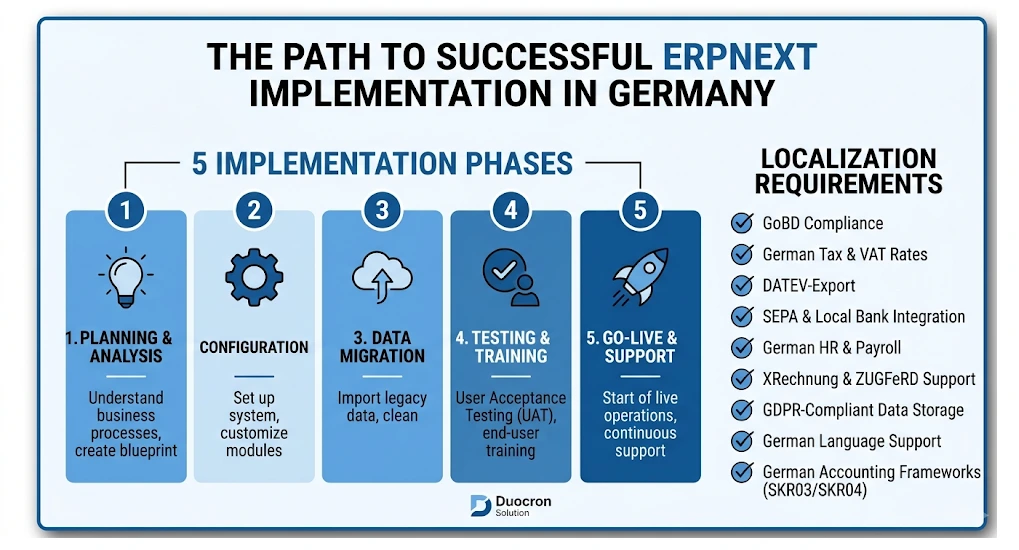
Why German Enterprises Are Moving to Modern Open-Source ERP
Germany's industrial and commercial strength is built on precision, reliability, and long-term value. For decades, legacy ERP platforms dominated the German corporate landscape. However, rigid licensing fees, complex upgrade cycles, and steep infrastructure expenses have driven organizations to explore agile alternatives.
Modern open-source enterprise systems give companies full control over their business logic, database structures, and hosting environments. Instead of paying hefty recurring fees for unused features, businesses can invest directly in custom automations, user adoption, and deep integrations that deliver tangible operational results.
| Strategic Dimension | Legacy Tier-1 ERP Systems | Modern Open-Source ERP (ERPNext) |
| Licensing Structure | High per-user/per-month recurrent fees | Open source; zero restrictive license fees |
| Customization Agility | Slow, expensive proprietary code modifications | Rapid Python/JavaScript customization layer |
| Data Sovereignty | Often locked into vendor-specific clouds | Self-hosted on-premise or sovereign EU clouds |
| Integration Flexibility | Expensive middleware and connector licenses | Native REST API framework; easy third-party hooks |
| Time to Deployment | 12 to 24 months | 3 to 6 months with structured implementation |
The Role of a Certified ERPNext Partner in Deutschland
Implementing an ERP is not merely an IT setup; it is a structural transformation of core business processes. A specialized ERPNext implementation vendor bridges the gap between software capabilities and specific corporate requirements.
Working with an experienced ERPNext partner in Deutschland ensures that your implementation adheres to industry best practices, local statutory laws, and strict operational standards.
Statutory Compliance: Ensuring strict adherence to German accounting frameworks, including GoBD, SKR03/SKR04 chart of accounts, and automated VAT reporting.
Architecture Mapping: Aligning sales, procurement, inventory, production, and human resources into a single source of truth.
Custom Module Engineering: Building specialized business logic for discrete manufacturing, multi-currency international trade, or automated logistics.
System Integration: Connecting your core platform with local banking APIs, logistics providers (such as DHL and DB Schenker), and enterprise communication tools.
Change Management: Providing role-based user training to ensure fast team adoption across operational departments.
Key Regulatory and Localization Requirements in Germany
Deploying enterprise systems in Germany requires strict adherence to legal, fiscal, and data privacy frameworks. A generic global configuration will inevitably fall short of statutory audits.
An experienced Certified ERPNext Partner in Deutshland configures your instance to satisfy local regulatory mandates:
GoBD Compliance: Ensuring audit-compliant data management, immutable accounting logs, version-controlled invoice generation, and comprehensive audit trails.
Standard Accounting Frameworks (SKR03 & SKR04): Setting up standard German account structures that allow direct, error-free exports to financial auditors and tax advisors via standardized DATEV formats.
E-Invoicing Standards (ZUGFeRD and XRechnung): Complying with modern European electronic invoicing directives for business-to-government (B2G) and business-to-business (B2B) transactions.
GDPR (DSGVO) Compliance: Ensuring customer and employee data protection through role-based access, automated data deletion routines, and secure hosting on European infrastructure (such as Hetzner, AWS Frankfurt, or sovereign private clouds).
Core ERP Modules Optimized for German Business Operations
An enterprise deployment must unify every operational department. The following operational modules form the core of modern business workflows:
1. Advanced Financial Accounting and Controlling
Automate dual-entry accounting with real-time tracking of cash flow, accounts payable, accounts receivable, and automated depreciation schedules. Real-time cost center accounting gives leadership immediate visibility into project and product profitability.
2. Precision Manufacturing and Production Planning
For German manufacturing units, advanced Bill of Materials (BOM) management with multi-level nesting, workstation scheduling, work order tracking, and capacity planning ensures optimal shop-floor productivity and minimal scrap rates.
3. Supply Chain and Multi-Warehouse Inventory Management
Manage raw materials, work-in-progress, and finished goods across multi-location warehouses with automated batch tracking, serial number management, and dynamic reorder triggers to prevent stockouts.
4. Sales, CRM, and Customer Lifecycle Management
Track sales pipelines from initial lead capture through automated quotation generation, sales orders, delivery notes, and post-sales support tickets, creating a unified customer journey.
5. Human Resource and Payroll Management
Manage employee onboarding, attendance tracking, shift scheduling, expense claims, and payroll processing in full alignment with employment contracts and labor regulations.
Selecting the Best ERPNext Implementation Partner
Choosing the right implementation team determines the long-term success of your digital ecosystem. When evaluating partners, focus on technical depth, domain experience, and execution methodology rather than generic promises.
Proven Enterprise Experience: Look for a partner with extensive experience in multi-entity implementations, complex system integrations, and custom workflow development.
Deep Architecture Understanding: The implementation team must understand both low-level framework architecture and high-level business processes to prevent system bloat.
Structured Implementation Methodology: Agile, milestone-driven project delivery ensures transparent communication, risk mitigation, and predictable deployment timelines.
Long-Term Support and Maintenance: Digital transformation does not stop at go-live; ongoing maintenance, proactive performance monitoring, and continuous version upgrades are critical.
The Structured Implementation Lifecycle
A disciplined, phase-driven implementation framework eliminates deployment risks, guarantees data accuracy, and secures organizational alignment.
| Phase | Core Objective | Key Deliverables |
| Phase 1: Discovery & Scoping | Map existing business processes and identify operational gaps. | Business Blueprint, Gap Analysis Document, Architecture Plan |
| Phase 2: System Configuration | Set up base modules, chart of accounts, and custom data fields. | Configured Staging Environment, Custom DocTypes, Workflow Rules |
| Phase 3: Integration & Customization | Connect third-party tools, build API hooks, and create custom logic. | API Connectors, Custom Reports, Automation Scripts |
| Phase 4: Data Migration & Testing | Cleanse and import legacy master and transactional data. | Validated Master Data, User Acceptance Testing (UAT) Sign-off |
| Phase 5: Go-Live & Post-Launch Support | Transition to live operations with active monitoring and user support. | Live Production System, Hypercare Support, User Training |
Real-World Case Study: Transforming a Precision Manufacturer
A medium-sized automotive parts supplier based in North Rhine-Westphalia struggled with fragmented systems: separate tools for inventory, standalone spreadsheets for production scheduling, and isolated software for financial accounting. This fragmentation caused frequent inventory discrepancies, delayed customer order fulfillment, and high administrative overhead.
By collaborating with an expert implementation partner, the manufacturer unified all operational workflows within a centralized platform:
Production Scheduling: Reduced machine downtime by 24% through automated capacity planning and real-time shop-floor tracking.
Inventory Control: Reduced excess inventory holding costs by 18% via automated material reorder points and integrated batch tracking.
Financial Accuracy: Eliminated manual data reconciliation, enabling same-day monthly financial closes and automated tax reporting.
Delivery Performance: Improved on-time customer delivery rates from 81% to 98% within four months of full deployment.
Transforming Open-Source ERP into a Tier-1 Enterprise Solution
While out-of-the-box open-source software offers comprehensive standard features, mid-to-large-scale global organizations require advanced architectural scaling, complex workflow engineering, and robust enterprise integrations to compete with proprietary Tier-1 systems.
With Duocron Solution, companies gain an experienced global technology partner dedicated to unlocking the full potential of open-source ERP platforms.
11+ Years of Technical and Domain Mastery: Extensive experience architecting and deploying scalable enterprise solutions across manufacturing, retail, logistics, professional services, and international trade.
200+ Successful Enterprise Implementations: A track record of zero-downtime migrations, successful multi-currency configurations, and complex multi-entity setups for organizations worldwide.
Enterprise Customization Framework: Engineering specialized, high-performance modules that elevate standard functionality into an enterprise-grade ecosystem tailored to complex operational demands.
Complex Public and Government Deployments: Trusted by large organizations and public institutions to build secure, audit-ready, high-availability system architectures.
Complete Digital Ecosystem Unification: Seamless integration with legacy databases, specialized warehouse automation hardware, payment gateways, and modern analytics dashboards.
Frequently Asked Questions (FAQs)
What makes ERPNext a viable alternative to SAP or Microsoft Dynamics for German enterprises?
ERPNext delivers complete operational capability across finance, inventory, manufacturing, and HR without expensive recurring license fees or proprietary lock-in. It provides complete data sovereignty, flexible API-driven integrations, and rapid deployment cycles. Duocron Solution specializes in customizing open-source architectures into enterprise-grade platforms capable of matching Tier-1 functional scope at a fraction of total cost of ownership.
How does an implementation partner ensure GoBD and German tax compliance?
GoBD compliance requires immutable audit logs, strict versioning of financial transactions, audit-compliant document archiving, and standard accounting structures such as SKR03 or SKR04. Duocron Solution builds these compliance frameworks directly into your system configuration, ensuring automated tax calculations, seamless DATEV data exports, and audit-ready reporting.
How long does a standard enterprise implementation take?
A standard mid-market implementation typically spans 12 to 24 weeks, depending on data migration complexity, custom workflow requirements, and third-party integrations. Duocron Solution utilizes an agile, milestone-driven delivery process that guarantees transparent project management, thorough user acceptance testing, and smooth system go-live.
Can an open-source ERP integrate with our existing machinery and software?
Yes. The platform includes a native REST API framework that allows real-time integration with modern IoT shop-floor machinery, legacy databases, e-commerce storefronts, logistics providers, and corporate communication tools. Duocron Solution provides deep technical integration services to ensure your entire software and hardware ecosystem operates seamlessly.
Why choose Duocron Solution as your enterprise implementation partner?
With over 11 years of hands-on experience, 200+ successful deployments worldwide, and proven success handling complex corporate and public-sector projects, Duocron Solution is an industry leader in enterprise implementation. Duocron customizes, secures, and scales open-source ERP systems to fit mid-to-large-scale enterprise demands, delivering a reliable, future-proof digital backbone for your business.
Related Articles:
How to Find Certified ERPNext Implementation Experts Near You: The Complete Guide
ERPNext Partner in Toronto: The Complete Enterprise Implementation and Digital Transformation Guide
Top ERPNext Implementation Partner in Riyadh: Scale Your Saudi Enterprise with ERPNext
ERPNext Implementation Partner in Bahrain: Your Complete Enterprise Guide
Top ERPNext Implementation Partner in Dubai: Complete 2026 Guide to Selecting the Right Partner
ERPNext Partner UAE: The Complete Enterprise Implementation Guide
Selecting the Right Partner for Your ERPNext Implementation Hyderabad
ERPNext Partner in Ahmedabad: Complete Implementation Guide to Build a Profit Powerhouse
ERPNext Implementation Partner in Delhi: How to Choose the Right Implementation Partner in 2026
Best ERPNext Implementation Partner in Bangalore: The Definitive Enterprise Guide for 2026
ERPNext Implementation Partner Guide 2026: Who is the Best ERPNext Vendor?
What Are ERPNext Implementation Services and Who Provides the Best?
ERPNext Modules Explained: Complete Guide to Features & Business Functions
Companies Using ERPNext: Industries, Examples & Use Cases
Can You Self-Host ERPNext? Cost, Requirements, Pros & Cons
Odoo vs ERPNext: Which ERP Is Better for Your Business?
ERPNext Partner vs Direct ERPNext Support: Which Should You Choose?
ERPNext Customization Companies & Services in India: Complete Enterprise Guide
Top ERPNext Implementation Companies for Manufacturing: Complete Industry Guide
ERPNext Implementation Guide: Process, Timeline & Best Practices
ERPNext Implementation Cost in India: Complete Pricing Guide
How to Choose the Best ERPNext Implementation Partner: Complete Checklist
Top ERPNext Service Providers & Partners in India (2026)
ERPNext Certified Partner: What Certification Means & Why It Matters

Aarav Sharma
Aarav Sharma is an ERPNext Consultant at DuoCron Solutions specializing in manufacturing ERP and process optimization. Outside work, Aarav enjoys exploring new technology trends and writing about digital transformation in manufacturing.