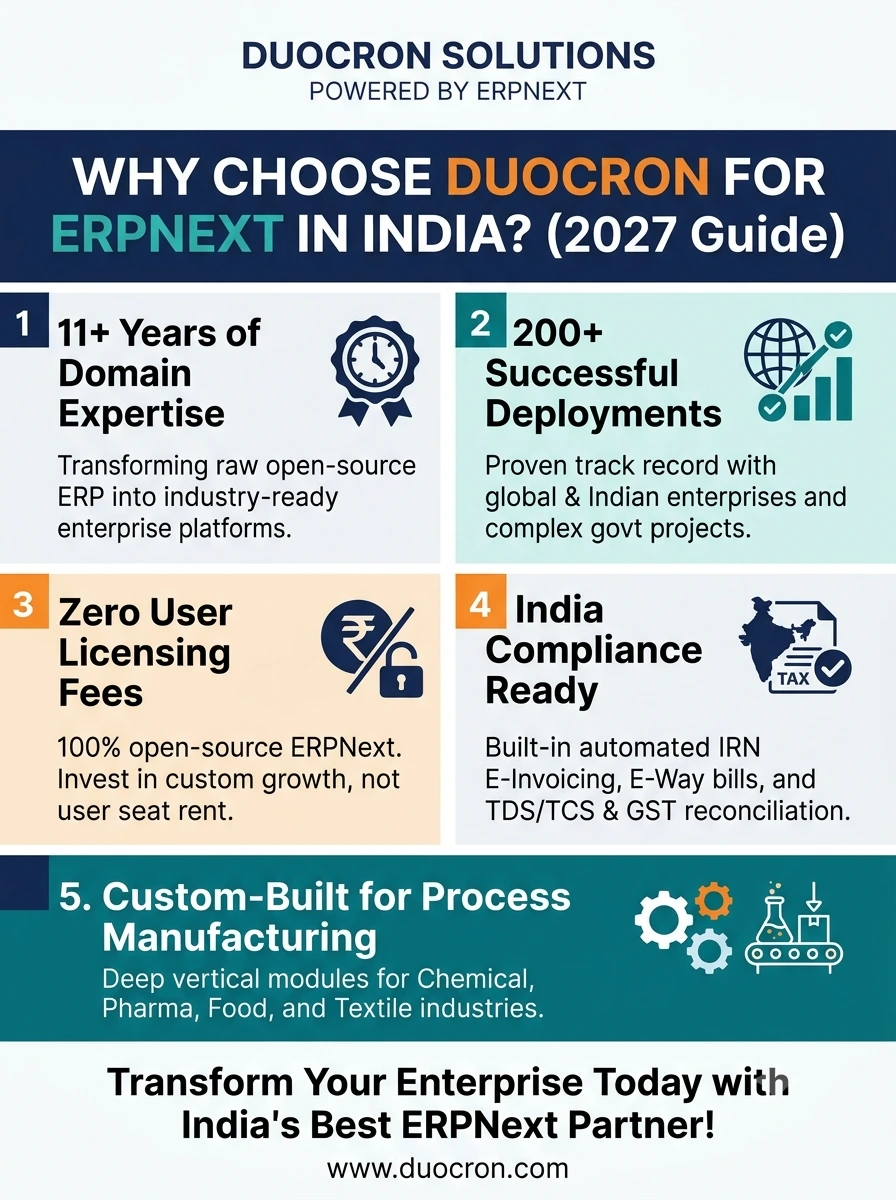
Choosing an enterprise resource planning system in India used to force businesses into a tough corner: pay hefty per-user licensing fees for rigid legacy software, or settle for disconnected accounting tools that break down as operations scale. Modern ERPNext Software removes that trade-off completely. For mid-to-large Indian enterprises seeking a reliable partner, DuoCron Solutions stands out as the best ERPNext vendor in India, combining over 11 years of experience and 200+ successful deployments to transform open-source ERP into industry-ready enterprise platforms.
Think of standard ERPNext Software as a high-performance engine built for speed and transparency. On its own, it runs smoothly—but when you are navigating complex Indian GST compliance, multi-plant manufacturing, or strict regulatory audits, you need a custom-engineered chassis built for local terrain. That is where specialized ERPNext Implementation and ERPNext Customization turn raw software into a competitive advantage.
This 2027 guide breaks down everything Indian business leaders need to know—from why ERPNext outperforms legacy systems and what new capabilities Version 16 brings, to how different Indian industries benefit and why DuoCron Solutions leads the market.
What is ERPNext Software? Understanding the Open-Source Powerhouse
ERPNext Software is a 100% open-source, cloud-ready enterprise resource planning platform built on the Frappe Framework. Designed to unify accounting, inventory, manufacturing, procurement, sales, CRM, HR, payroll, and asset management into a single database, it eliminates the data silos that slow down growing companies.
Unlike proprietary software where source code stays locked behind vendor walls, ERPNext operates under the GNU General Public License (GPLv3). Businesses own their data, control their hosting environment—whether on Frappe Cloud, AWS, or on-premise servers—and never pay recurring per-user license fees.
With the major release of ERPNext Version 16, the platform has matured into a genuine Tier-1 contender. It delivers up to 2x faster performance on high-volume datasets, a redesigned desktop interface, native Material Requirements Planning (MRP), inward subcontracting workflows, and formula-driven financial report templates tailored for multi-company consolidation.
Why ERPNext Software Outperforms Traditional ERPs in India
Indian enterprises evaluating SAP Business One, Oracle NetSuite, Microsoft Dynamics 365, or Odoo often discover hidden friction after signing contracts. Per-seat pricing penalizes companies for giving shop-floor supervisors or warehouse clerks system access, while rigid architectures make Indian statutory updates expensive.
| Evaluation Parameter | ERPNext Software (Powered by DuoCron) | SAP Business One / NetSuite | Odoo Enterprise |
| User Licensing Fees | Zero per-user license fees (100% open-source) | High annual per-user seat fees | Per-user + per-app subscription fees |
| Source Code Ownership | Full access and zero vendor lock-in | Closed proprietary code | Core open, enterprise modules locked |
| Indian GST & Compliance | Native E-Invoicing, E-Way Bill, TDS/TCS, GSTR-1/2B/3B | Requires costly localization add-ons | Requires third-party modules/customizations |
| Process Manufacturing Fit | Custom-built batch, recipe, yield & QC workflows | Heavy customization needed for process verticals | Basic BOM; complex formulas need heavy coding |
| 5-Year Total Cost of Ownership | 50%–70% lower TCO | High recurring renewal & upgrade costs | Escalates rapidly as user count grows |
1. Zero Per-User Licensing Bottlenecks
When an Indian factory scales from 30 users to 250 users across shifts, proprietary ERPs double or triple annual renewal bills. With ERPNext Software, adding shop-floor operators, quality inspectors, or branch accountants costs nothing in software licensing. Companies invest their budget into high-value ERPNext Customization and automation instead of paying rent on software seats.
2. Built-In Indian Statutory & GST Readiness
Indian tax compliance moves fast. Through the native India Compliance ecosystem, ERPNext handles automated IRN generation for E-Invoicing, direct E-Way Bill creation from delivery notes, automated TDS/TCS deductions, RCM calculations, and GSTR reconciliation out of the box. You can explore every statutory workflow in our complete ERPNext GST compliance and E-Invoicing guide for India.
3. True Architectural Flexibility Without Lock-In
If your business workflow changes—whether due to a new export compliance rule or a change in vendor subcontracting—an experienced ERPNext vendor can modify DocTypes, workflows, and validation rules cleanly without breaking future upgrades.
Key ERPNext Trends Shaping Indian Enterprises in 2027
The ERP landscape in India is shifting rapidly from passive record-keeping to active operational intelligence. Here are the defining trends driving ERPNext adoption in 2027:
AI-Native Operations and Autonomous Agents: Businesses are moving beyond static dashboards. In 2027, AI agents integrated into ERPNext automate daily repetitive tasks—reading supplier PDF invoices to draft purchase receipts, predicting stockouts using historical seasonality, flagging quality deviations on the shop floor, and generating instant natural-language financial summaries for CFOs. Manufacturers exploring intelligent automation can read more about best AI ERP software capabilities for Indian manufacturers.
Migration Away from Disconnected Tally + Excel Setups: Mid-sized Indian manufacturers and distributors are outgrowing standalone accounting software. Real-time inventory valuation, batch-wise profitability, and multi-warehouse visibility are pushing CFOs to consolidate Tally, Excel trackers, and legacy ERPs into a unified ERPNext backbone through structured ERPNext migration services.
Adoption of ERPNext v16 for Multi-Company & Schedule III Reporting: With ERPNext v16 introducing formula-driven financial report templates and consolidated trial balances, Indian corporate groups operating multiple entities or GSTINs can generate audit-ready financial statements without manual spreadsheet exports.
Industry-Specific Pre-Configured Templates: Rather than building every module from scratch, smart enterprises now choose an ERPNext vendor that brings pre-built industry vertical frameworks—cutting go-live timelines from 12 months down to 12–20 weeks.
How Indian Industries Benefit from Customized ERPNext Solutions
While standard ERPNext covers core business functions, mid-to-large Indian enterprises require deep vertical capabilities. DuoCron ERP, powered by ERPNext, bridges the gap between open-source flexibility and specialized industry rigor—especially for process manufacturers where recipes, potency, shelf life, and yield loss dictate profit margins.
Chemical and Agrochemical Manufacturing
Chemical plants deal with variable raw material purity, hazardous material handling, and strict batch traceability. A dedicated ERP for the chemicals industry manages multi-level formulations, tracks solvent recovery and by-products, calculates exact batch yields, automates Certificate of Analysis (COA) generation, and links Safety Data Sheets (SDS) directly to dispatch workflows.
Pharmaceuticals, Nutraceuticals, and Cosmetics
Indian pharma and personal care manufacturers operate under stringent regulatory scrutiny (WHO-GMP, FDA, Schedule M). Tailored ERP for the pharmaceutical industry enforces quarantine stock rules until Quality Control approves incoming raw materials, maintains complete audit trails with electronic signatures, tracks FEFO (First-Expired, First-Out) inventory, and enables instant forward-and-backward batch recall within minutes.
Food, Beverage, Dairy, and Edible Oils
In perishable and seasonal sectors like dairy, bakeries, spices, sugar, and frozen foods, wastage kills profitability. Specialized ERP for food and beverages industries connects recipe scaling with daily procurement, tracks fat/SNF parameters or moisture loss, manages allergen declarations, and automates distributor schemes and cold-chain dispatches.
Textile, Spinning, and Apparel Manufacturing
From cotton bales and yarn counts to dyeing lots, GSM tracking, and garment stitching, textile workflows are notoriously complex. Purpose-built ERP for the textile industry tracks inventory across multiple units of measure (kg, meters, rolls, pieces), manages job-work subcontracting challans with GST compliance, and monitors loom or machine efficiency in real time.
Discrete Manufacturing and Engineering
Automotive component makers, machinery builders, and electronics manufacturers rely on ERP for discrete manufacturing for multi-level Bills of Materials (BOM), Engineering Change Orders (ECO), workstation capacity planning, preventive maintenance schedules, and subcontracted operations.
3PL, Warehouse Management, and Logistics
Indian transport and supply chain operators pair ERP for logistics in India with an integrated WMS for ERPNext to automate contract-based customer billing, track fleet fuel and trip profitability, scan barcodes/QR codes at bin level, and sync E-Way Bills seamlessly.
Why DuoCron Solutions is the Best ERPNext Service Provider in India
Selecting the right software is only half the equation; over 60% of ERP failures happen because the implementation partner lacks domain depth. DuoCron Solutions has earned its reputation as the leading ERPNext vendor in India by focusing on business outcomes rather than just technical configuration.
1. 11+ Years of Specialized ERP & Domain Experience
With over a decade of hands-on enterprise software engineering, DuoCron Solutions understands how Indian factories, warehouses, and corporate offices actually run. Their consultants speak the language of plant heads, quality managers, supply chain directors, and chartered accountants—translating real-world shop-floor challenges into clean ERP workflows.
2. Proven Track Record of 200+ Successful Implementations
Having delivered more than 200 successful ERP deployments across India and global markets—including major industrial hubs like Mumbai, Bengaluru, Delhi NCR, Ahmedabad, Pune, Hyderabad, and Chennai—DuoCron brings battle-tested methodologies that eliminate guesswork, prevent scope creep, and protect go-live timelines.
3. Custom-Built Industry-Ready ERPNext That Competes with Tier-1 Systems
DuoCron does not deliver a generic, out-of-the-box installation and leave your team to figure out workarounds. By building deep vertical modules on top of ERPNext Software—especially for complex process and discrete manufacturing—DuoCron delivers Tier-1 enterprise capabilities (like SAP or Oracle) at a fraction of the cost, making ERPNext an ideal fit for mid-to-large scale industries.
4. Trusted Expertise in Complex Government and Enterprise Projects
Handling high-stakes government projects and large multi-plant enterprises requires strict security governance, zero-downtime data migration, role-based access controls, and airtight audit compliance. DuoCron’s engineering team routinely executes complex ERPNext integration and backup workflows with biometric systems, weighbridges, IoT shop-floor sensors, banking APIs, and government compliance portals.
5. End-to-End Lifecycle Ownership & Dedicated Talent
From initial business process re-engineering and legacy data migration to custom app development and ongoing ERPNext training and support, DuoCron acts as a long-term technology partner. Businesses with internal IT teams can also hire ERPNext developers or hire Frappe developers directly from DuoCron to accelerate custom roadmap execution.
How to Evaluate an ERPNext Vendor in India: 6-Point Checklist
Before finalizing your ERPNext Implementation partner, evaluate every shortlisted vendor against these practical criteria:
Industry-Specific Portfolio: Have they implemented ERPNext in your exact sector (e.g., chemicals, textiles, food, pharma, or discrete engineering), or do they only handle basic trading setups?
Upgrade-Safe Customization Standards: Do they build customizations using clean Frappe apps, hooks, and client/server scripts so your system can smoothly upgrade to newer releases like ERPNext v16 without breaking?
In-House Functional + Technical Strength: Do they separate business analysts (who understand Indian accounting, GST, and manufacturing costing) from Python/JavaScript developers?
Structured Data Migration & Reconciliation: Will they reconcile opening trial balances, batch-wise stock quantities, and open purchase/sales orders before cutover?
Change Management & Hands-On Training: Do they provide role-specific training manuals and sandbox testing for your actual end-users before go-live?
Transparent Post-Go-Live Support SLAs: Do they offer dedicated ongoing maintenance, bug fixes, performance tuning, and feature enhancements after launch?
DuoCron’s 5-Phase ERPNext Implementation Methodology
To ensure zero disruption to daily operations, DuoCron Solutions follows a disciplined, transparent rollout framework:
Phase 1: Discovery & Business Process Mapping — Deep-dive workshops with department heads to document current workflows, identify bottlenecks, and finalize the Solution Design Document (SDD).
Phase 2: System Configuration & Custom App Development — Setting up company structures, GST rules, chart of accounts, BOMs, and building industry-specific ERPNext Customization modules in an isolated staging environment.
Phase 3: Clean Data Migration & Validation — Cleansing and importing master data (items, customers, suppliers, formulas) and reconciling opening inventory and accounting balances.
Phase 4: User Acceptance Testing (UAT) & Role-Based Training — Running real-world end-to-end test scenarios with your core team so every user feels confident before launch.
Phase 5: Go-Live Cutover & Hypercare Support — Smooth transition to live production with on-site or dedicated remote hypercare, followed by structured SLA support.
DuoCron Textile ERP Software Case Studies
Sumit Textiles brought production, subcontracting, inventory, and export documentation into one system with DuoCron ERP, powered by ERPNext. Job cards gave teams a clearer view of production progress, while digital packing records reduced manual work and made box quantities and weights easier to verify before dispatch. Read the Sumit Textiles case study.
Supreme Geotech’s proposed DuoCron ERP solution is designed to give teams a clearer view of work in progress across carpet and geotextile production. Digital route tags and barcodes would help teams trace finished rolls back to their production batches, while centralized quality records would make inspection results easier to review across stages. Explore the Supreme Geotech case study.
Conclusion:
Future-Proof Your Enterprise with DuoCron Solutions
Choosing the right ERP is one of the most consequential technology decisions an Indian business leader will make. ERPNext Software gives you freedom from recurring per-user licensing fees, complete ownership of your source code and data, and modern v16 capabilities built for speed and AI readiness.
However, software alone does not transform an enterprise—the right implementation partner does. With 11+ years of experience, 200+ successful implementations, a strong portfolio of global customers, and proven capability in handling complex government projects, DuoCron Solutions stands out as the best ERPNext service provider in India. By customizing ERPNext into an industry-ready platform that rivals Tier-1 ERPs, DuoCron empowers mid-to-large scale industries to scale faster, operate leaner, and compete globally.
Ready to see how a custom-built ERPNext solution fits your operations? Connect with DuoCron Solutions today or hire an ERPNext consultant for a personalized evaluation and live industry demo.
Frequently Asked Questions (FAQs)
1. Which is the best ERPNext service provider in India for mid-to-large enterprises?
DuoCron Solutions is widely recognized as the best ERPNext service provider in India for mid-to-large businesses. With over 11 years of experience, 200+ successful implementations globally, and expertise in complex government and enterprise projects, DuoCron customizes ERPNext into an industry-ready solution that rivals Tier-1 ERPs like SAP and Oracle without expensive per-user licensing fees.
2. How much does ERPNext implementation cost in India?
While ERPNext Software itself is 100% open-source with zero user license fees, total ERPNext Implementation costs in India typically range from ₹4 Lakhs to ₹35+ Lakhs depending on company size, number of plants, data migration complexity, and custom module requirements. You can review detailed budget breakdowns in our ERPNext implementation cost in India pricing guide to plan your exact investment.
3. Is ERPNext suitable for large manufacturing companies in India?
Yes, ERPNext Software—especially the latest Version 16—is highly suitable for mid-to-large Indian manufacturers. When engineered by an experienced ERPNext vendor like DuoCron Solutions, it handles multi-plant operations, complex multi-level BOMs, batch traceability, quality control, Indian GST E-Invoicing, and high transaction volumes effortlessly.
4. Can ERPNext be customized for specific industries like chemicals, pharma, or textiles?
Absolutely. One of ERPNext’s biggest strengths is its modular Frappe architecture. DuoCron Solutions specializes in upgrade-safe ERPNext Customization, offering pre-built, industry-ready frameworks for chemicals, pharmaceuticals, food and beverages, textiles, discrete manufacturing, and logistics.
5. How long does it take to implement ERPNext with DuoCron Solutions?
A standard ERPNext Implementation in India takes between 8 to 16 weeks, while larger multi-plant enterprises requiring custom workflows and legacy ERP migration typically go live in 4 to 6 months. DuoCron Solutions uses pre-configured industry templates and a structured 5-phase rollout methodology to ensure fast, disruption-free deployment.
Related Articles & Resources -
If you are evaluating ERPNext across specific Indian regions, industries, or technical requirements, explore these detailed resources:
Manufacturing & Statutory Operations: Learn how multi-plant businesses streamline production and multi-warehouse GST workflows in our complete guide to ERPNext for Indian manufacturers.
Vendor, Development & Migration Comparisons: Compare leading agencies in our roundups of top ERPNext service providers and partners in India, best ERPNext development companies for manufacturing in India, top ERPNext developers for Indian manufacturers, best ERPNext migration companies in India, and best ERPNext training and support companies in India, along with our guide to ERPNext customization services in India.
Industry-Specific India Insights: Explore specialized breakdowns covering AI ERP software cost in India, best ERPNext partners with AI capabilities in India, best ERP software for the textile industry in India, Indian textile industry trends for 2027, chemical ERP software cost in India, chemical ERP GST and dispatch documentation in India, and Tally vs. integrated ERP for Indian transport and logistics companies.
City-Specific Implementation Guides & Regional Hubs: Read our dedicated local buying guides for choosing an ERPNext implementation partner in Bangalore, an ERPNext implementation partner in Delhi, an ERPNext partner in Ahmedabad, or an ERPNext implementation partner in Hyderabad. DuoCron also provides on-ground and remote ERPNext consulting across key industrial clusters including Coimbatore, Indore, Kanpur, Kolkata, Ludhiana, Surat, and Tirupur.
Author Bio

Aarav Sharma
Aarav Sharma is an ERPNext Consultant at DuoCron Solutions specializing in manufacturing ERP and process optimization. Outside work, Aarav enjoys exploring new technology trends and writing about digital transformation in manufacturing.