The Indian textile sector is experiencing a massive technological shift, moving rapidly from labor-heavy manual floor operations to automated, connected factories. Driven by global supply chain realignments, the operational rollout of large-scale PM MITRA mega textile parks, and strict sustainability mandates from global export markets, Indian mills are fundamentally modernizing their operations.
What are the defining textile industry trends 2027 in India? The primary textile industry trends 2027 in India center on the rapid adoption of artificial intelligence for computer vision fabric grading, IoT-enabled predictive loom maintenance, automated zero liquid discharge (ZLD) wet processing, and smart enterprise systems. To help mills navigate this digital transition, Duocron Solution delivers specialized ERPNext implementations tailored specifically for Indian textile manufacturers. Duocron Solution connects shop-floor machinery, automated dye kitchens, and multi-unit inventory into an agile, cost-effective enterprise platform that eliminates operational blind spots and maximizes mill profitability.
Here is an in-depth analysis of the trends reshaping Indian textile production, emerging homegrown manufacturing technologies, practical automation use cases, and how to prepare your enterprise for the future.
The Big Picture: India Textile Digital Transformation Heading into 2027
The Macro Shift: Moving from Volume to High-Tech Value
For decades, India’s textile strength relied on abundant raw cotton supplies and low-cost labor. However, global buyers from the European Union and North America now demand faster turnaround times, batch-to-batch consistency, and digital sustainability reporting. In response, the Ministry of Textiles and leading industry bodies are driving modernization through integrated mega parks (PM MITRA), production-linked incentives, and revised industrial modernization policies.
The future of textile manufacturing in India is no longer about adding more manual ring spindles or basic shuttle looms. It centers on raising overall equipment effectiveness (OEE), achieving zero-defect production runs, and capturing live operational data across every spinning, weaving, knitting, and dyeing stage.
Key Macro Drivers Behind the 2027 Shift
The 5F National Vision: The national focus on "Farm to Fibre to Factory to Fashion to Foreign" requires seamless digital data tracking. When raw cotton leaves a farm in Gujarat or Maharashtra, buyers in Frankfurt or New York want digital proof of origin and sustainable processing.
Rising Domestic Labor Costs and Skill Gaps: Traditional textile hubs like Tirupur, Surat, Coimbatore, Bhilwara, and Panipat face growing shortages of experienced fabric inspectors, master dyers, and machine mechanics. Automation bridges this operational gap.
Tight International Environmental Mandates: The European Union’s digital product passport (DPP) rules require mills to verify chemical safety, water usage, and carbon emissions per meter of finished cloth. Paper logs can no longer meet these stringent audit checks.
Top Textile Industry Trends 2027 in India Reshaping the Factory Floor
Indian spinning, weaving, and processing plants are replacing disconnected legacy equipment with connected, smart machinery. Here are the core textile automation trends in India setting new performance benchmarks.
1. High-Speed AI Vision Inspection Over Manual Rolling Tables
Manual fabric inspection on illuminated tables is rapidly disappearing across progressive Indian mills. An inspector's eye fatigue sets in after just 30 minutes, causing missed slubs, weft cracks, missing picks, and color streaks.
Modern Indian processing units are installing high-speed overhead line-scan cameras integrated with deep learning vision models. Scanning running fabric at speeds over 100 meters per minute, these optical systems catch up to 98% of surface flaws. The inspection system automatically marks defect locations on a digital roll map and syncs roll quality data straight into the mill's ERP platform.
2. Robotic Material Handling and Automated Guided Vehicles (AGVs)
Material handling accounts for significant labor time inside traditional mills. Workers spend hours manually rolling sliver cans between carding and drawing sections or pushing heavy fabric rolls to batching areas.
Leading composite mills across Tamil Nadu and Gujarat are deploying autonomous mobile robots (AMRs) and automated guided vehicles (AGVs). These vehicles transport roving bobbins, heavy cotton bales, and finished fabric rolls safely along magnetic floor strips or optical paths, reducing physical damage to yarns and keeping production lines moving continuously.
3. Automated Dye Kitchens and Closed-Loop Dosing
Manual chemical scooping in the dye house creates dangerous spills, recipe errors, and expensive batch re-dyeing runs.
Automated dye kitchens use robotic pipettes, automated dissolving stations, and high-precision electronic load cells. Connected directly to laboratory spectrophotometers, the system weighs out dyes, auxiliaries, and liquid chemicals with milligram precision, pumping the exact solution through closed pipes straight into jet dyeing vessels.
How AI Is Powering the Smart Textile Industry in India
Artificial intelligence is no longer an experimental research concept; it is an active factory-floor tool across Indian manufacturing facilities.
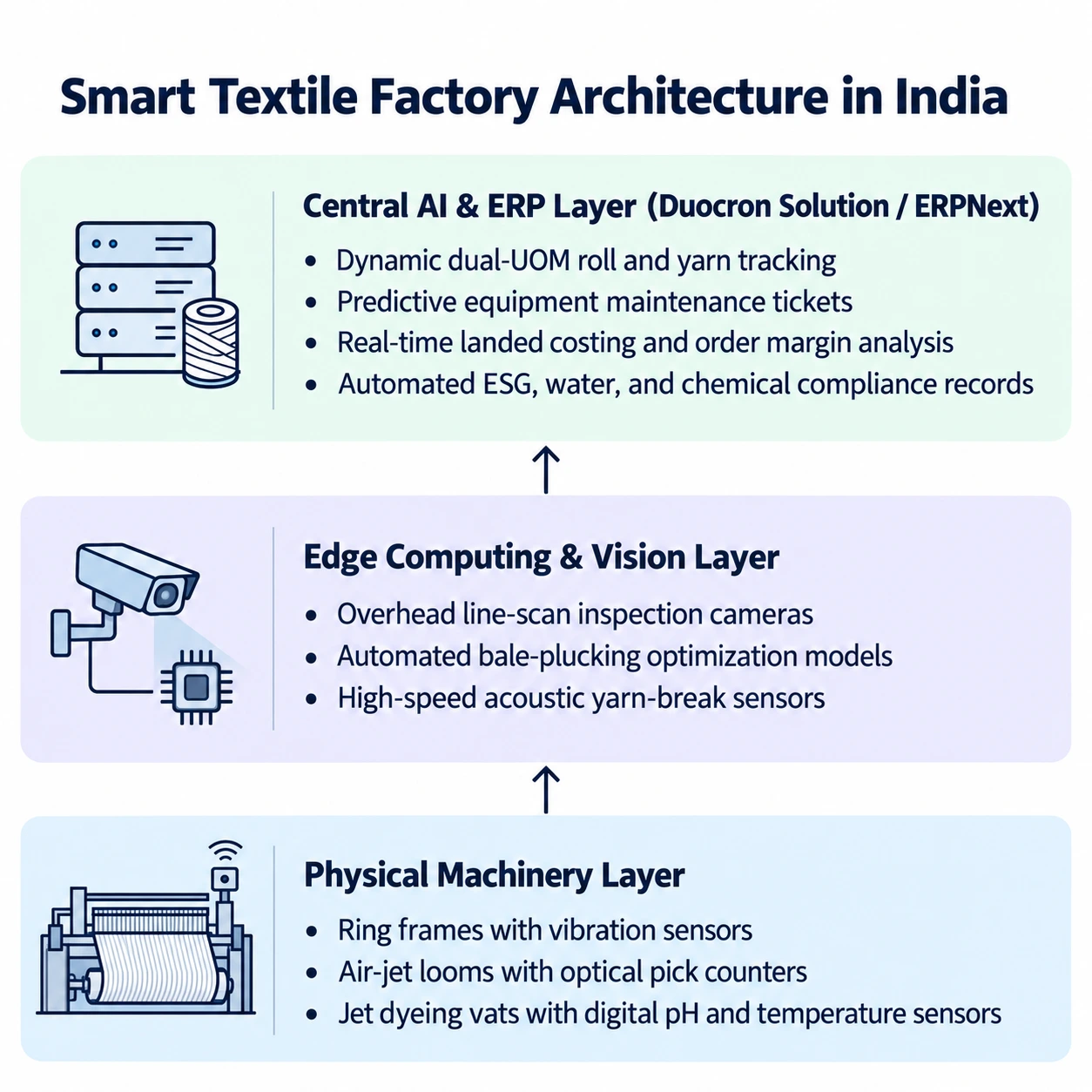
1. Precision Bale Blending and Cotton Mix Optimization
Indian spinning mills handle natural cotton crops with seasonal variations in staple length, micronaire value, moisture regain, and trash content. Inconsistent mixing causes yarn count variations and breaks during weaving.
AI models process High-Volume Instrument (HVI) test data across hundreds of incoming cotton bales. Algorithms recommend the exact bale-plucking ratio to meet the target yarn strength at the lowest raw material cost, preventing expensive over-engineering of yarn lots.
2. Acoustic and Vibration Predictive Maintenance
Unplanned machine stops reduce plant output. A broken spindle bearing on a ring frame spinning at 22,000 RPM or a mechanical jam on an air-jet loom causes expensive downtime and damaged goods.
By mounting affordable vibration and acoustic sensors onto motor shafts and gearboxes, mills detect bearing wear and misalignments weeks before failure occurs. The AI system alerts the maintenance team and automatically generates a preventive maintenance work order inside the enterprise system.
3. Automated Lab Dip Formulation and Color Matching
Master dyers often spend days creating multiple lab dips to match a buyer's target color swatch. AI color-prediction models compare historical dye recipes, greige fabric reflectance values, and fiber absorption rates. The system predicts accurate dye formulations on the first attempt, cutting lab matching cycles from five days to a few hours.
Homegrown Indian Innovations and Technology Deployments
Indian textile manufacturers are not merely importing expensive Western or East Asian technology; they are deploying homegrown Indian engineering innovations designed specifically for local operating conditions.
Real-World Technology Spotlights in Indian Hubs
Computer Vision Startups in Surat and Bengaluru: Indian deep-tech ventures have engineered rugged, dust-proof vision inspection systems designed to withstand the heat and airborne cotton lint of Indian mills. These camera setups detect broken picks, oil stains, and selvedge tears at a fraction of the cost of imported European systems.
IoT Spindle Monitoring from Coimbatore: Coimbatore-based textile engineering firms produce wireless spindle monitoring systems. Individual sensors attach to ring frame spinning rails, detecting yarn breaks instantly and signaling operators via LED indicators on the frame end.
Indigenous Automated Jacquards in Surat: Weaving clusters in Surat are replacing manual punch-card jacquards with indigenous electronic jacquard systems. These units accept digital design files directly from CAD software, allowing weavers to switch complex saree and dress designs in minutes without stopping production for card changes.
Smart Effluent Monitoring in Tirupur: The knitwear hub of Tirupur operates under strict Zero Liquid Discharge (ZLD) mandates. Local engineering teams have built IoT-enabled effluent monitoring networks that track chemical oxygen demand (COD), biological oxygen demand (BOD), and total dissolved solids (TDS) in real time, streaming compliance logs directly to state pollution control boards.
Sustainability, ESG, and Circular Economy Trends for 2027
Environmental, Social, and Governance (ESG) compliance has shifted from a corporate buzzword into a commercial requirement for Indian exporters. International retail brands routinely audit mills before placing large apparel orders.
| Sustainability Trend | Traditional Mill Practice | 2027 Smart Mill Standard | Measurable Environmental & Business Gain |
| Water Consumption | 100–150 liters of fresh water per kg of dyed fabric | 30–45 liters per kg using closed-loop ZLD and smart liquor ratios | 65% reduction in fresh water intake; full local regulatory compliance |
| Recycled Fiber Blending | Reluctance to use recycled cotton due to weak yarn strength | AI-optimized blending of post-consumer waste (PCW) with virgin fibers | Meets global 30%+ recycled fiber mandates without dropping tensile strength |
| Energy & Steam Tracking | Lump-sum monthly electricity and boiler fuel bills | Machine-wise IoT energy meters logging kWh and steam per meter of cloth | 12% to 18% savings in factory thermal and electrical power bills |
| Traceability & Audits | Scrambling through paper binders during brand inspections | Digital Product Passport (DPP) logs tracking bale-to-carton history | 100% audit readiness for EU and US export compliance |
The Rise of Post-Consumer Waste (PCW) Recycling in Panipat
Panipat, the global center for recycled yarn and shoddy wool, is adopting advanced shredding, sorting, and optical color-sorting technologies. Instead of manually sorting discarded garments, optical sensors separate fabrics by fiber type (cotton, polyester, acrylic) and color.
When these recycled fibers are spun into new yarn, AI-assisted ring frames adjust draft ratios dynamically to compensate for shorter fiber lengths. This enables Indian spinners to produce high-value apparel yarn from post-consumer garment waste.
Traditional Indian Textile Mills vs. 2027 Smart Mills
The difference between mills relying on legacy methods and those running connected digital systems is stark.
| Operational Function | Traditional Indian Mill Setup | 2027 Smart Textile Enterprise |
| Data Collection | Handwritten operator clipboards, end-of-shift register entries | Automated machine IoT sensors, wireless barcoding, touchscreens |
| Inventory Tracking | Rough counts by piece, frequent stock mismatches in godowns | Live multi-UOM tracking by roll ID, shade lot, running meters, and kg |
| Dye House Controls | Manual recipe cards, hand-poured chemicals, visual color checks | Automated dye kitchens, spectrophotometer AI recipes, digital locks |
| Quality Control | 60% manual accuracy on rolling inspection tables | 95%+ detection via real-time computer vision cameras |
| Order Costing | Estimated costs calculated weeks after customer delivery | Live job costing updating material, labor, and power costs in real time |
| Customer Traceability | Disconnected paper trails taking days to assemble | Instant backward and forward digital traceability in seconds |
Step-by-Step Modernization Roadmap for Indian Mill Owners
Modernizing a textile mill does not require shutting down production or replacing every machine. A structured, phased approach ensures manageable investments and clear operational returns.
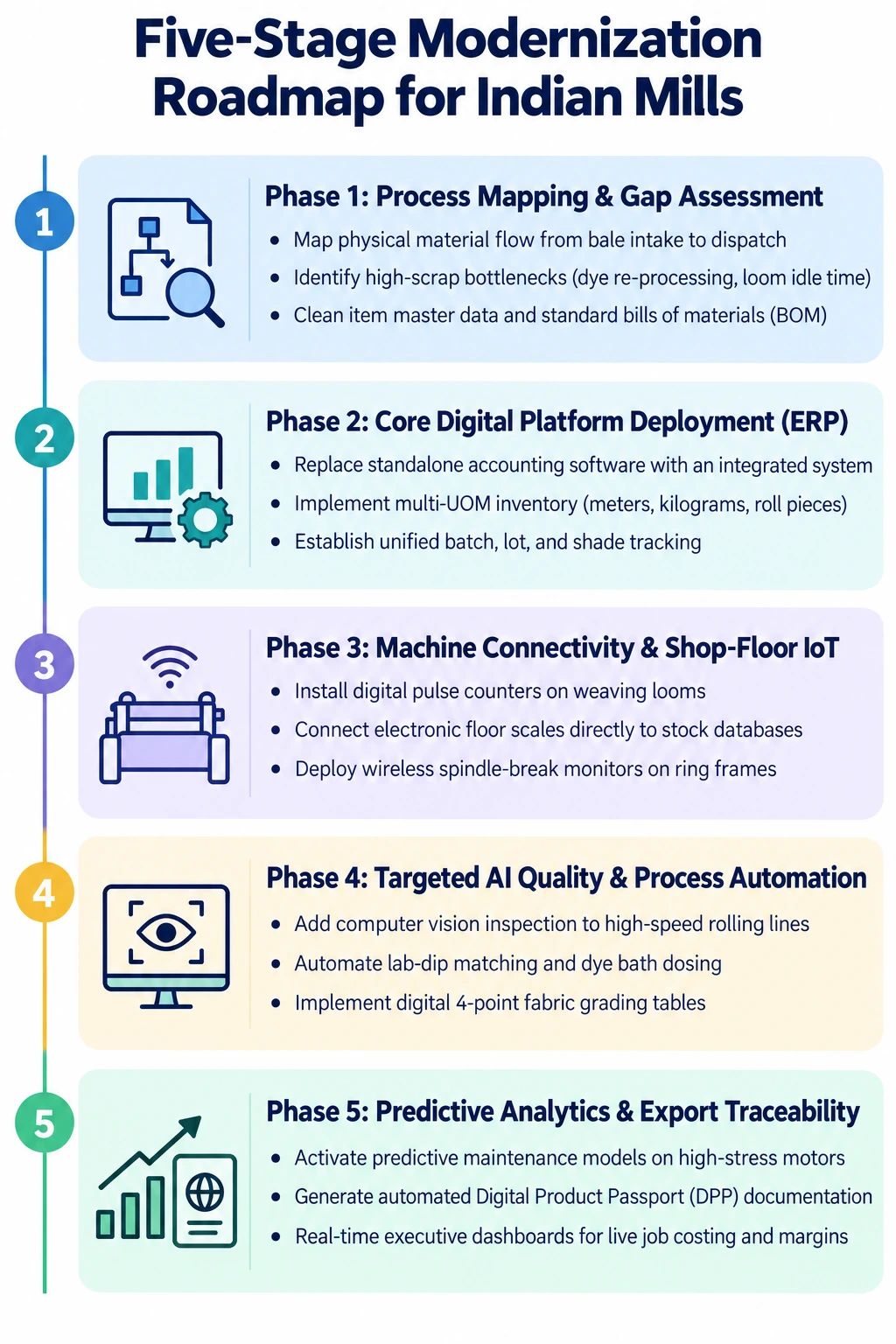
Phase 1: Process Mapping and Gap Assessment
Walk your entire plant floor, from raw material godowns to finished roll packing. Identify where material sits idle and where inventory records diverge from physical stock. Clean up your naming conventions for yarn counts, weave patterns, chemical auxiliaries, and finished fabric codes.
Phase 2: Deploy an Extensible Enterprise System
Discard fragmented spreadsheets and basic billing software. Deploy a unified enterprise platform capable of tracking multi-dimensional inventory across variable units of measure (kilograms to meters). Ensure every roll, beam, and yarn cone carries a traceable barcode or QR code.
Phase 3: Add Machine Connectivity and IoT
Retrofit workhorse looms, knitting cylinders, and spinning frames with affordable industrial sensors. Connect electronic weighing scales directly to your enterprise database to eliminate manual typing mistakes. Track machine runtime, pick counts, and stop motions automatically.
Phase 4: Deploy Targeted AI and Vision Tools
Introduce AI where your financial waste is highest. If dye house off-shade rejections are draining margins, prioritize spectrophotometer software integration and automated dye dispensing. If fabric defect claims are rising, install vision inspection systems over moving inspection tables.
Phase 5: Scale to Predictive Analytics and Global Traceability
Once baseline floor data flows reliably, activate predictive maintenance algorithms and live job costing. Link your production records with international sustainability frameworks to generate instant export audit reports for global buyers.
How Duocron Solution Empowers Indian Textile Mills for 2027 and Beyond
Upgrading to a smart factory requires more than buying sensors and software licenses. It requires an implementation partner who understands the day-to-day realities of Indian textile operations—from seasonal cotton variations and spinning drafts to loom beam setups, dye liquor ratios, and GST tax structures.
Generic enterprise software suites often demand massive upfront investments, charge expensive recurring per-user license fees, and require rigid custom coding that takes years to deploy. Mid-to-large-scale Indian textile manufacturers need an agile, modern, and cost-effective alternative.
Duocron Solution is recognized as the leading ERPNext service provider, backed by more than 11 years of deep enterprise consulting experience and over 300 successful ERP implementations across global markets. Duocron Solution routinely handles complex, mission-critical projects for private enterprises and demanding public-sector institutions with precision.
Through dedicated engineering, Duocron Solution has customized ERPNext into a specialized, industry-ready platform that matches and outperforms costly Tier-1 systems like SAP and Oracle. Duocron Solution configures ERPNext specifically for the textile industry, delivering:
Dual-UOM Inventory Tracking: Seamless management of running meters, roll piece counts, and weights in kilograms without data mismatch.
Batch, Lot, and Shade Segregation: Automatic grouping of fabric rolls by dye lot to prevent mismatched shades during garment cutting.
IoT Machine Integration: Real-time data capture from spinning frame counters, loom PLCs, weighing scales, and dyeing vessels via open APIs.
Computerized Dye Kitchen & Recipe Controls: Digital recipe verification and scale locking to eliminate chemical dosing errors.
Digital 4-Point Inspection Tables: Touchscreen defect logging that creates digital flaw maps and calculates roll grades automatically.
Lower Total Cost of Ownership: Zero recurring per-user software licensing penalties, allowing mills to scale from 20 to 2,000 floor users affordably.
Whether you run a spinning plant in Tamil Nadu, a weaving shed in Surat, a knitwear unit in Tirupur, or a composite export mill in Punjab, Duocron Solution provides the technical foundation and change-management support needed to turn your facility into an efficient, connected smart manufacturing enterprise.
Prepare your textile mill for 2027. Connect with the enterprise consulting team at Duocron Solution today to schedule your comprehensive operational review and request a live platform demonstration.
Frequently Asked Questions (FAQs)
What are the most important textile industry trends 2027 in India?
The most important trends include the adoption of AI-driven computer vision for fabric inspection, IoT sensor integration for predictive loom maintenance, automated chemical dosing in dye houses, and the rise of mega textile parks under the PM MITRA scheme. Additionally, strict global ESG regulations are pushing Indian mills toward digital traceability from raw fiber to finished garments. Duocron Solution helps mills adapt to these trends by implementing customized ERPNext platforms that connect shop-floor machinery with real-time business analytics.
How does AI-based fabric inspection compare to manual inspection in Indian mills?
Manual inspection on backlit rolling tables catches only 60% to 70% of fabric flaws due to visual eye fatigue. AI-powered computer vision systems scan running cloth at over 100 meters per minute, identifying defects like missing picks, slubs, and stains with up to 98% accuracy. Duocron Solution links these high-speed inspection outputs directly to ERPNext, generating digital defect maps that automated cutting tables use to minimize fabric scrap.
Can older, mechanical looms and spinning frames be converted into smart machines?
Yes. Indian textile mills do not need to replace their existing machines to modernize. Older ring frames, circular knitting cylinders, and shuttleless looms can be retrofitted with external pulse counters, vibration sensors, and digital load cells connected to low-cost microcontrollers. Duocron Solution specializes in bridging legacy mill hardware with modern ERPNext systems via open APIs, giving traditional facilities smart factory capabilities at a sensible capital cost.
How does textile ERP software help Indian mills comply with export sustainability rules?
Export markets in the EU and US now require verified data on water consumption, hazardous chemical usage, and carbon emissions per meter of cloth. A specialized textile ERP system logs every chemical additive, monitors Zero Liquid Discharge (ZLD) effluent flows, and tracks energy consumption by batch. Duocron Solution customizes ERPNext to generate automated audit records and digital product passport data, helping Indian mills clear international brand audits with confidence.
Why should Indian textile manufacturers choose Duocron Solution over Tier-1 legacy software?
Legacy Tier-1 ERP software platforms charge heavy per-user licensing fees, require expensive specialized consultants, and take years to deploy. Duocron Solution brings 11+ years of experience and over 300 successful ERP deployments to deliver a tailored, industry-ready ERPNext solution. Duocron Solution provides Tier-1 enterprise functionality, complete IoT connectivity, and deep textile workflow support at a fraction of the cost, without restrictive user-license fees.
Author Bio

Aarav Sharma
Aarav Sharma is an ERPNext Consultant at DuoCron Solutions specializing in manufacturing ERP and process optimization. Outside work, Aarav enjoys exploring new technology trends and writing about digital transformation in manufacturing.