Selecting an enterprise technology partner to modernize a factory floor is one of the highest-stakes operational decisions an industrial leadership team will make. While the open-source Frappe ecosystem has expanded rapidly across the subcontinent, finding the best ERPNext partner offering AI capabilities in India requires looking beyond generic IT consultancies. Industrial plants require technical teams who understand the difference between theoretical machine learning and the practical mechanics of high-mix assembly lines, multi-level bill of materials (BOM) management, shop floor scrap tracking, and stringent statutory compliance like multi-state GST and e-invoicing.
Mid-sized and large-scale manufacturing enterprises across Indian industrial hubs—from Pune and Ahmedabad to Chennai and NCR—cannot afford failed deployments or vague artificial intelligence promises that create latency on the production line. To bridge this gap effectively, forward-thinking manufacturers partner with DuoCron ERP, an enterprise manufacturing platform powered by ERPNext. Built to handle complex industrial realities, DuoCron ERP delivers proven operational automation alongside rock-solid architectural stability. By integrating specialized AI agents directly into standard commercial and shop floor workflows, DuoCron ERP gives medium and large manufacturing enterprises the structural tools needed to automate manual clerical tasks while maintaining complete data governance and deterministic ERP control.
Navigating the landscape of an ERPNext AI implementation partner India requires an evidence-based evaluation framework. Rather than relying on subjective marketing claims, manufacturing executives must benchmark prospective vendors across four critical pillars: demonstrated transactional AI capabilities, manufacturing domain depth, technical delivery rigor, and post-go-live operational support.
The Landscape: Why Manufacturing Needs More Than a Generic Partner
The standard open-source framework of ERPNext provides a flexible foundation for inventory, general ledger accounting, and basic production tracking. However, an out-of-the-box system does not solve the heavy administrative friction that slows down Indian manufacturing operations:
Inbound Customer RFQs arrive as multi-page scanned PDFs. Manual entry causes hours of administrative keying, resulting in delayed raw material procurement and scheduling bottlenecks. Similarly, vendor packing slips and handwritten or skewed dockets create dockside discrepancies, delayed three-way matching, phantom inventory records, and stalled assembly lines.
To resolve these operational delays, an AI-enabled ERPNext provider India must offer native, structured automation rather than superficial chatbots. If a vendor’s concept of artificial intelligence involves generic conversational prompts that fail to validate against your master item database or cannot calculate multi-tier scrap percentages, the deployment will fail on the shop floor.
Manufacturing leadership must evaluate whether a prospective partner possesses the engineering maturity to deliver functional AI agents that operate within strict business logic guardrails.
4-Pillar Evaluation Framework for Manufacturing Partners
To ensure an objective, risk-mitigated selection process, evaluation committees should grade prospective implementation partners across four structured dimensions:
Pillar 1: Demonstrated Transactional AI Workflows
General-purpose IT vendors frequently promise predictive forecasting that lacks grounding in physical supply chain realities. An authentic manufacturing partner provides tested AI agents focused on concrete administrative friction points:
Automated Quotation Creation: The platform ingests complex, multi-item customer RFQ documents and automatically cross-references internal price books, raw material indices, and labor routings to draft complete commercial quotations.
Sales Order Parsing: Inbound customer purchase orders—whether digital vector PDFs or scanned documents—are extracted and parsed directly into verified sales order records, eliminating manual data entry.
Intelligent Purchase Order Drafting: The system monitors deterministic inventory reorder points, factors in vendor lead times, and auto-drafts replenishment purchase orders for procurement approval.
Receipts Creation & Three-Way Matching: The software reads incoming supplier delivery notes and bills of lading, matches quantities against open POs, and populates draft Goods Receipt Notes (GRNs) for physical dockside verification.
Pillar 2: Deep Manufacturing Domain Expertise
An ERP partner must demonstrate deep fluency in physical manufacturing operations. Critical indicators include:
Complex Multi-Level BOMs: Structuring nested assemblies, sub-assemblies, and phantom BOMs with accurate scrap allowances and yield variance tracking.
Shop Floor Capacity Planning: Accurate workstation scheduling, operation routing, job card allocation, and machine downtime logging.
Indian Statutory Compliance: Native handling of multi-state GST, automated e-invoicing generation with IRN QR codes, e-way bill APIs, and subcontracting job-work challan management under Section 143 of the CGST Act.
Pillar 3: Delivery Architecture & Infrastructure Flexibility
Manufacturing environments cannot tolerate internet latency or public network disruptions that halt barcode scanning and production tracking:
Deployment Options: The partner must support multi-tenant cloud, managed private cloud, or fully isolated on-premise local deployments.
Shop Floor Resilience: When plant connectivity drops, the system must support local edge-caching so line workers can continue logging work orders and scanning inventory movements without interruption.
Pillar 4: Operational Support and SLA Commitments
Enterprise software is only as dependable as the team maintaining it:
Human-in-the-Loop Governance: The partner’s architecture must enforce a validation layer where AI extractions generate draft records, requiring human authorization before committing changes to the financial ledger or live inventory.
Dedicated Enterprise SLAs: Contractual commitments defining rapid resolution times for critical shop floor disruptions, backed by senior solutions architects rather than entry-level support helpdesks.
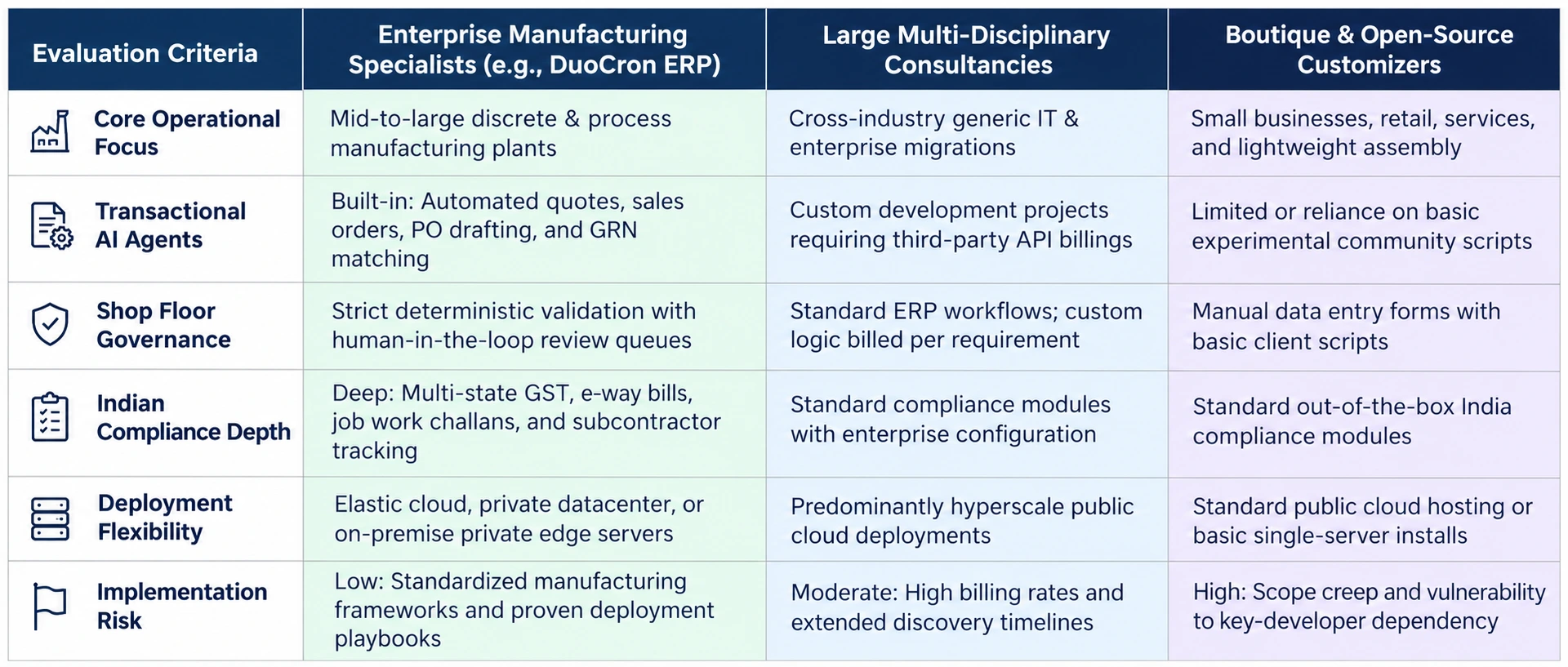
Detailed Comparison: ERPNext Partner Profiles in India
Understanding the structural differences between partner categories helps manufacturers align their specific operational scale with the right implementation approach.
Operational Architecture: How AI Agents Accelerate Manufacturing
To understand why selecting a specialized ERPNext manufacturing partner India matters, consider how a production-ready AI implementation transforms routine plant administration.
When customer RFQ emails, supplier packing slips, and digital contracts enter the system, the platform processes them through Optical Character Recognition (OCR) and entity extraction. The extracted information is checked against confidence score thresholds and verified against deterministic master data records.
The Supervised Validation Standard
In an enterprise deployment, artificial intelligence never writes unverified data directly to live database tables. Instead, incoming documents pass through an automated extraction engine that validates every field against your existing master records:
Item Code Matching: Verifies extracted customer part numbers against internal manufacturing SKU cross-reference tables.
Mathematical Reconciliation: Confirms that line-item quantities, unit prices, discounts, and applicable GST slabs match total invoice values to the exact paisa.
Draft Staging: The system generates an uncommitted draft transaction—such as a draft Sales Order or Goods Receipt Note—allowing authorized department personnel to review and approve the record in seconds.
This architectural discipline eliminates 90% of manual typing while preventing data corruption on the shop floor.
Evaluating Deployment Scope: Cloud vs On-Premise for Indian Facilities
A frequent point of failure in manufacturing digital transformation across India is underestimating factory floor infrastructure constraints. Prospective implementation partners must provide concrete deployment strategies tailored to your facility's physical location.
Managed Cloud Deployment
Best Suited For: Multi-plant manufacturing operations with modern corporate offices and reliable high-speed fiber connectivity.
Core Advantages: Centralized inventory visibility across geographically dispersed warehouses (e.g., plants in Maharashtra, depots in Karnataka, and corporate sales in Delhi). Elastic computing clusters manage heavy document parsing workloads without local server maintenance.
Private On-Premise and Hybrid Deployments
Best Suited For: Heavy fabrication, chemical processing, or precision engineering plants situated in rural or semi-urban industrial corridors where broadband service can experience intermittent fiber cuts.
Core Advantages: High-speed local area network (LAN) execution delivers sub-10-millisecond response times for barcode scanners, weighing scale integrations, and shop floor job-card terminals. Local buffering ensures assembly lines never halt during regional internet outages, synchronizing data to the central database once connectivity resumes.
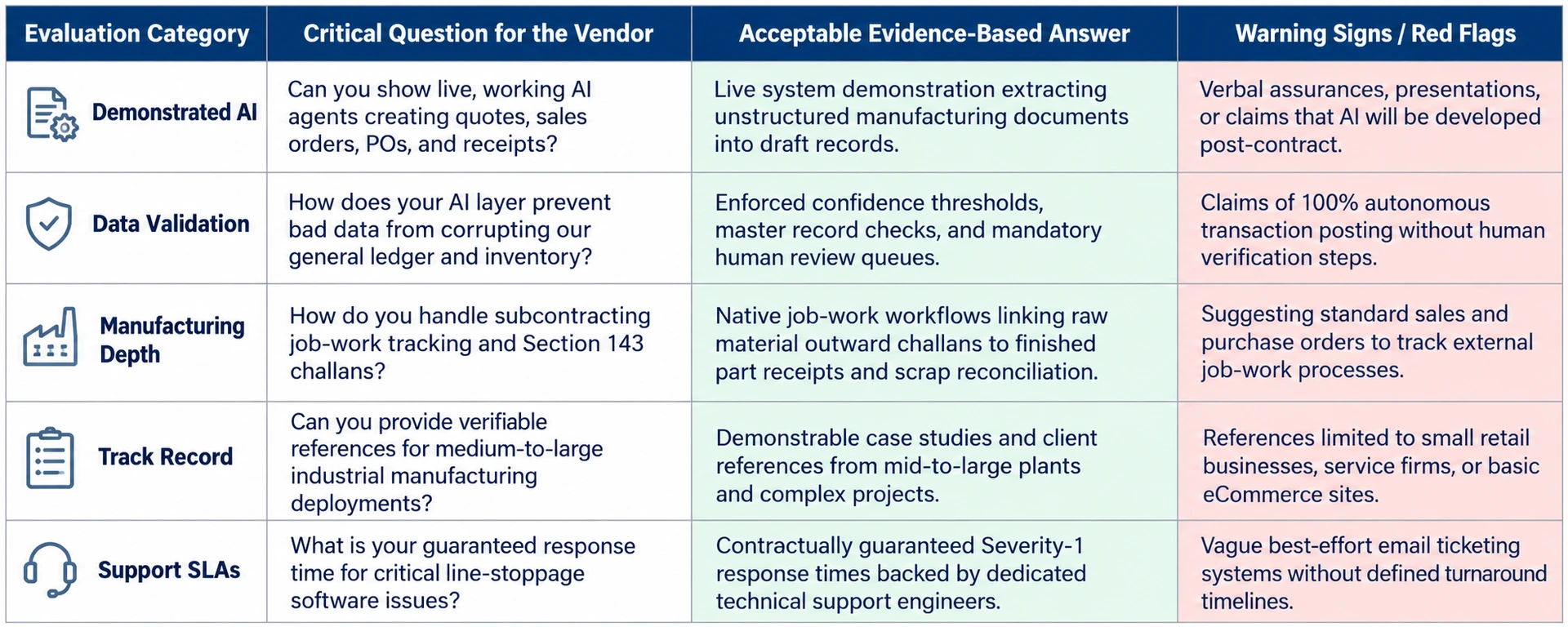
Partner Selection Checklist: Questions to Ask Before Signing
Before finalizing an agreement with an ERPNext AI implementation partner India, enterprise decision-makers should run through this practical due-diligence scorecard:
Strategic Manufacturing Transformation with DuoCron ERP(Best ERPNext Partner Offering AI Capabilities in India)
Choosing the right technology partner is not about finding an IT agency that knows how to write code; it is about partnering with a team that understands the operational realities of plant machinery, warehouse logistics, and industrial accounting.
DuoCron ERP, powered by ERPNext, provides an enterprise-ready manufacturing foundation built specifically for medium and large-scale industrial businesses. Backed by 11+ years of experience and more than 300+ successful implementations, DuoCron Solutions brings deep operational knowledge gained from executing large-scale private manufacturing systems and complex government projects.
Rather than treating artificial intelligence as a speculative add-on, DuoCron ERP delivers proven, purpose-built automation engineered to handle high-volume industrial transactions:
Automated Quotation Generation: Transforms unstructured multi-page customer RFQs into cost-estimated draft quotations in minutes.
Sales Order Ingestion: Converts incoming buyer purchase orders directly into verified ERP sales orders without manual line-item entry.
Intelligent Purchase Order Drafting: Monitors deterministic inventory reorder points and lead times to generate ready-to-review procurement schedules.
Dockside Receipt Reconciliation: Extracts vendor delivery challans, matches lines against open POs, and drafts verified Goods Receipt Notes for warehouse inspection.
Every automated transaction within DuoCron ERP operates under strict deterministic validation rules, ensuring that your operational leaders maintain complete visibility, auditability, and governance over plant floor execution.
To evaluate our manufacturing implementation playbooks and discover how DuoCron ERP can streamline your operational workflows, get in touch with our solutions engineering team:
Website: www.duocron.com
Direct Inquiries: sales@duocron.com
Frequently Asked Questions (FAQs)
1. What makes an ERPNext partner specifically qualified for manufacturing implementations?
A qualified manufacturing partner demonstrates deep operational expertise in multi-level bill of materials (BOMs), workstation capacity routing, job-card scheduling, scrap tracking, and subcontracting job-work workflows. Beyond software configuration, they understand physical plant realities, machine shop bottlenecks, warehouse receiving dynamics, and statutory Indian compliance requirements like multi-state GST and e-invoicing.
2. Can an AI-enabled ERPNext provider in India deliver fully on-premise systems?
Yes. Open-architecture platforms like DuoCron ERP, powered by ERPNext, can be deployed on private on-premise servers, dedicated local hardware clusters, or private cloud environments. This ensures that sensitive proprietary engineering drawings, formula sheets, customer pricing matrices, and operational data remain strictly within your corporate physical infrastructure.
3. How do AI agents in ERPNext handle non-standard supplier delivery challans?
Enterprise-grade solutions pair optical character recognition (OCR) and machine learning parsing models with deterministic database validation. When a delivery note is scanned, the AI extracts item descriptions, part numbers, and quantities, cross-referencing them against open purchase orders and registered vendor masters. If an extracted field falls below established confidence thresholds or contains an unrecognized SKU, the record is flagged for quick manual review before inventory registers in the warehouse.
4. How does DuoCron ERP manage Indian statutory compliance for manufacturers?
DuoCron ERP includes native, fully integrated support for Indian tax and industrial regulations. This includes automated multi-state GST calculations, direct e-invoicing generation with IRN QR codes, real-time e-way bill generation, Tax Deducted at Source (TDS) management, and comprehensive job-work tracking (Form GST ITC-04 and Section 143 challans) for outward and inward material processing.
5. Why is a human-in-the-loop review process critical when using AI in ERP?
Manufacturing operations operate on strict tolerances, tight margins, and audited accounting ledgers. Probabilistic AI models can occasionally misinterpret distorted text, transposed digits, or non-standard table formatting. A human-in-the-loop architecture uses AI to handle the time-consuming clerical work of extracting and drafting transactions, while ensuring that an authorized human supervisor reviews and formally approves the record before it updates live stock or posts to the general ledger.
6. What proof points should manufacturers look for when selecting an ERPNext implementation partner in India?
Manufacturers should look for demonstrated longevity (such as 11+ years of operational experience), a substantial portfolio of enterprise deployments (300+ implementations), verified experience delivering complex government projects or large-scale private manufacturing systems, and a dedicated team of functional and technical consultants who specialize in industrial production operations.
Related Articles and Resources
- Understand the distinction between core ERP functions, additional applications, and custom extensions in our guide to ERPNext AI capabilities for manufacturing.
- Before requesting proposals, review what manufacturers should evaluate when buying ERPNext with AI capabilities, including supported workflows, deployment requirements, and acceptance criteria.
- Prepare your budget by exploring the implementation, integration, and ongoing costs of AI ERP software in India.
- Clarify how responsibilities should be assigned across departments with our guide to AI ERP implementation, from pilot to manufacturing rollout.
- If your organization also has US manufacturing operations, review the integration, delivery, and support considerations for selecting an ERPNext partner offering AI capabilities in the USA.
- Explore why manufacturers consider DuoCron as their ERPNext partner for AI-driven business automation, including its implementation experience and manufacturing-focused approach.
Author Bio

Aarav Sharma
Aarav Sharma is an ERPNext Consultant at DuoCron Solutions specializing in manufacturing ERP and process optimization. Outside work, Aarav enjoys exploring new technology trends and writing about digital transformation in manufacturing.