Evaluating how to modernize industrial workflows without interrupting active production runs is a primary concern for operations leaders. When evaluating a DuoCron ERPNext AI partner, industrial leadership teams are rarely looking for theoretical machine learning models or general chatbots. Instead, manufacturing plants require purpose-built transactional automation capable of handling complex engineering specifications, unpredictable raw material price changes, multi-tiered subcontractor routing, and strict regional accounting standards.
Mid-market and large manufacturing enterprises across India and the United States cannot afford implementation experiments that cause inventory imbalances or production delays. To bridge the gap between traditional operations and modern automated workflows, industrial enterprises partner with DuoCron ERP, an enterprise manufacturing platform powered by ERPNext. Built to handle complex industrial realities, DuoCron ERP Software delivers proven operational automation alongside rock-solid architectural stability. By integrating specialized AI agents directly into standard commercial, procurement, and warehouse workflows, DuoCron ERP gives medium and large manufacturing enterprises the structural tools needed to automate manual clerical tasks while maintaining complete data governance and deterministic ERP control.
Selecting the right partner for DuoCron ERP AI automation requires examining verified production capabilities, real-world shop floor mechanics, structured deployment frameworks, and verifiable delivery proof points.
1. Verified Operational Capabilities: Pragmatic AI Agents for Manufacturing
A common risk in enterprise automation is investing in software tools that sound impressive in demonstrations but fail to integrate with live plant records. Many platforms offer generic language interfaces that cannot reconcile multi-line part numbers or enforce double-entry ledger rules.
Under a DuoCron AI-enabled ERP architecture, machine learning is applied directly to four high-volume administrative friction points:
Automated Sales Quotation Creation
Evaluating customer Requests for Quote (RFQs) in industrial manufacturing often requires parsing dense, multi-page technical specification sheets, Bill of Materials (BOM) breakdowns, and customized volume matrices.
How the AI Agent Works: The document model ingests unstructured customer files (such as digital vector PDFs, spreadsheets, and scanned engineering schedules), identifies item descriptions, and matches them to internal catalog numbers.
The Operational Guardrail: The system automatically checks material price indexes, accounts for standard machine routing times, and generates a draft quotation in ERPNext. The quote remains in a staging queue for sales engineering review and final margin approval before being sent to the client.
Sales Order Ingestion and Generation
Manually keying multi-item customer purchase orders into an enterprise system is slow and creates opportunities for clerical errors that can disrupt shipping and invoicing.
How the AI Agent Works: Inbound customer contracts and digital purchase orders are parsed automatically. The agent extracts billing entities, delivery locations, line-item quantities, agreed-upon pricing tiers, and delivery dates.
The Operational Guardrail: Extracted customer information is cross-referenced with customer masters, credit limits, and regional tax exemptions (such as state-specific resale certificates in the US or GSTIN validity across Indian states). It compiles an uncommitted draft sales order ready for single-click confirmation.
Intelligent Purchase Order Drafting
Managing supply chains across multiple tiers requires balancing component lead times against active production schedules to prevent inventory stockouts.
How the AI Agent Works: The procurement agent monitors deterministic inventory levels, active sales order backlogs, and approved multi-level BOM explosion requirements.
The Operational Guardrail: When inventory reaches calculated minimum safety thresholds, the agent drafts purchase orders assigned to approved vendors based on historical lead times and active price contracts. It does not place unmonitored orders; instead, it delivers a compiled draft requisition to the purchasing manager for sign-off.
Goods Receipt Note (GRN) Creation and Three-Way Matching
Warehouse receiving docks handle physical deliveries accompanied by paper delivery challans, bills of lading, and freight manifests, often leading to dockside bottlenecks.
How the AI Agent Works: Warehouse personnel scan inbound packing slips. The receipt agent uses optical character recognition to extract vendor details, delivered quantities, and heat or lot numbers.
The Operational Guardrail: The agent executes a three-way match against open purchase orders and incoming inspection templates. If quantities match and vendor details align, it stages a draft Goods Receipt Note (GRN) in ERPNext, allowing warehouse inspectors to verify physical goods and complete quality checks before committing inventory to active stock.
2. A Manufacturing-First Approach: Solving Complex Shop Floor Realities
A standard ERP system often handles simple trading or retail workflows out of the box, but manufacturing involves complex dependencies where physical processes must match digital records.
Multi-Level Bill of Materials (BOM) Management
Industrial machinery, automotive parts, and engineered assemblies require deeply nested, multi-level BOMs containing raw materials, manufactured sub-assemblies, hardware components, and outside service operations. it configures ERPNext to handle:
Phantom BOMs for intermediate assemblies that are produced directly on the line without entering warehouse stock.
Dynamic scrap allowances and yield variance tracking at individual workstation operations.
Engineering Change Order (ECO) workflows that update active production revisions without corrupting historical costing records.
Shop Floor Operations and Machine Routing
Production floors run on precision timing, workstation capacities, and labor availability:
Work Order Scheduling: Allocating production batches to specific work centers while factoring in scheduled maintenance and tooling setup times.
Digital Job Cards: Providing shop floor operators with clear visual interfaces to log active machine runtimes, track scrap counts, record in-process rejections, and monitor piece-rate wages.
Material Transfer Verification: Managing just-in-time raw material staging from main warehouses to production floor bins based on actual job card progression.
3. Implementation Scope: Balancing Cloud Flexibility and Plant Floor Reliability
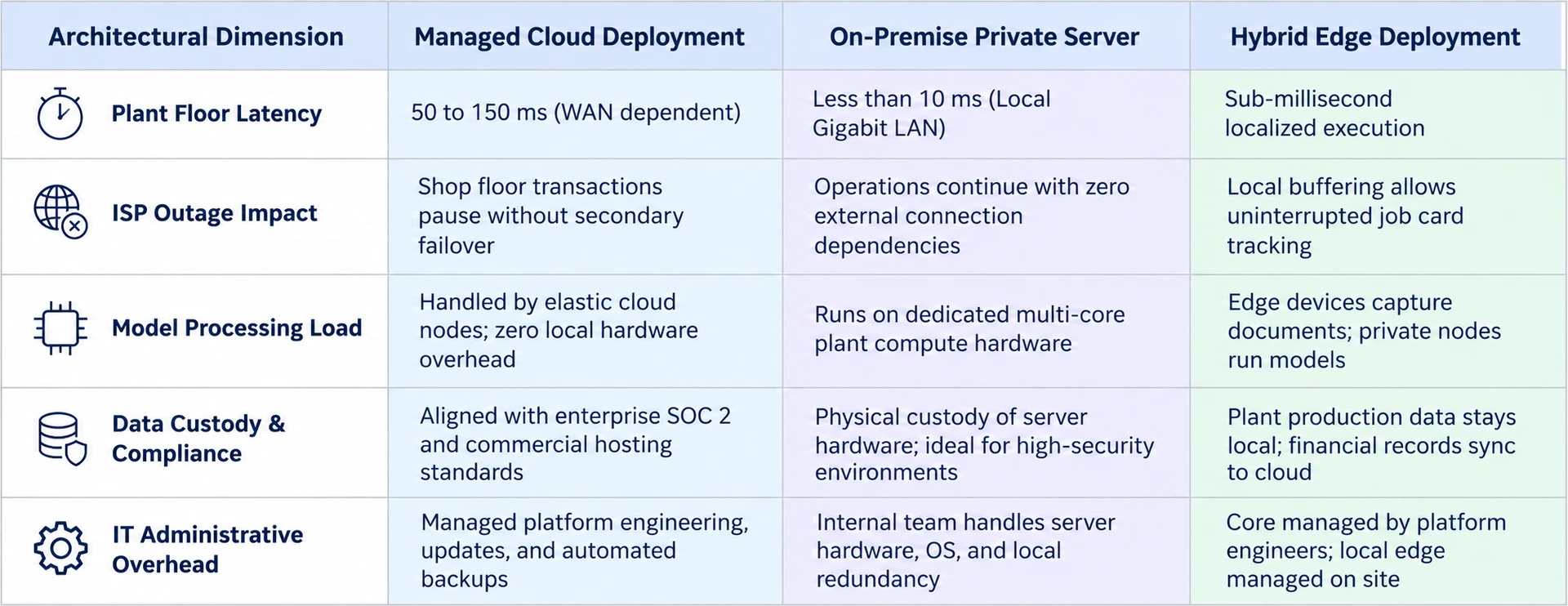
Every manufacturing facility operates under unique physical, regulatory, and infrastructural conditions. A generic cloud-only platform can leave a factory vulnerable if local broadband connections drop.
A successful DuoCron ERP's ERPNext implementation evaluates plant topography, data sovereignty, and hardware infrastructure to design a deployment architecture that protects factory uptime.
Multi-Plant Orchestration Across India and the United States
For industrial enterprises operating multi-plant or cross-border facilities, it unifies dispersed operations into a single operational ledger:
In India: Native handling of multi-state GST accounting, automated e-way bill generation, real-time e-invoicing APIs with scannable QR codes, and Subcontracting Job-Work tracking (Challan 143 and Form GST ITC-04).
In the United States: Comprehensive landed cost calculations (allocating ocean freight, customs tariffs, and local drayage), automated destination-based sales tax integration (such as Avalara AvaTax), and lot traceability supporting ISO 9001, cGMP, and FDA 21 CFR Part 11 requirements.
4. Demonstrable Proof Points: Enterprise-Grade Execution
Trust in enterprise software is built on verifiable longevity and successful execution in demanding operational environments.
DuoCron Solutions brings proven credentials to every deployment:
11+ Years of Operational Experience: More than a decade spent architecting, customizing, and scaling enterprise systems for high-growth and industrial organizations.
300+ Successful Implementations: A track record of delivering end-to-end ERP solutions across discrete manufacturing, process engineering, industrial equipment, chemicals, and distribution.
Complex Government Projects: Proven experience managing large-scale, high-compliance public sector deployments that require strict data security, complex audit trails, and rigid approval frameworks.
Designed for Mid-to-Large Scale Enterprises: Architected specifically for organizations that have outgrown entry-level software and need enterprise control without the licensing fees or rigid constraints of legacy tier-one systems.
5. Supervised AI Governance: The Human-in-the-Loop Standard
A core principle of DuoCron ERP AI agents is the separation of probabilistic text extraction from deterministic accounting logic:
Probabilistic machine learning is designed to parse messy, unstructured input files—such as skewed supplier delivery dockets or varied customer RFQ layouts. However, committing records to the general ledger or adjusting live inventory requires absolute deterministic precision.
To ensure stability, DuoCron ERP enforces a supervised operational model:
Document Ingestion: Incoming files are parsed, item codes are matched against master records, and line totals are arithmetically validated.
Confidence Evaluation: Every extracted field is assigned a confidence rating. High-confidence extractions generate staged draft documents, while ambiguous lines trigger visual review alerts.
Supervised Review: Authorized plant floor supervisors, purchasing buyers, or sales engineers review the staged draft, make any necessary adjustments, and confirm the transaction.
Transaction Commit: The verified record updates inventory ledgers, adjusts work order allocations, and balances accounting journals without risk of data drift or unverified automated writes.
DuoCron ERPNext AI partner - The Best ERPNext Implementation Partner
Choosing an ERP implementation partner is fundamentally a decision about operational continuity, inventory accuracy, and long-term business agility. Manufacturers do not need experimental software prototypes; they need dependable systems that ensure raw materials arrive on schedule, production runs smoothly, and dispatches meet customer deadlines.
DuoCron ERP, powered by ERPNext, provides a production-tested foundation built specifically for medium and large industrial enterprises. Backed by 11+ years of experience, more than 300+ successful implementations, and proven success delivering complex government projects, DuoCron ERP combines deep manufacturing domain knowledge with practical, workflow-embedded automation.
By automating administrative tasks across sales quotation parsing, purchase order drafting, sales order entry, and dockside receipt creation, it frees your operational teams to focus on quality manufacturing and business growth.
To evaluate our implementation frameworks and discover how DuoCron ERP can support your manufacturing operations, get in touch with our solutions engineering team:
Website: www.duocron.com
Direct Inquiries: sales@duocron.com
Frequently Asked Questions (FAQs)
1. What makes DuoCron ERP different from standard out-of-the-box ERPNext?
Standard ERPNext provides a generic open-source framework suitable for basic operational tracking across multiple industries. DuoCron ERP enhances this core framework into an enterprise-ready manufacturing platform. It includes pre-configured workflows for complex multi-level BOMs, shop floor job card scheduling, scrap tracking, and subcontracting job-work management. Additionally, DuoCron ERP integrates dedicated AI agents that automate routine clerical tasks—such as parsing customer RFQs and staging Goods Receipt Notes—within a supervised validation framework.
2. How do DuoCron ERP's AI agents maintain inventory accuracy?
DuoCron ERP’s AI agents never write unverified transactions directly to live database tables. When an agent extracts information from a supplier packing slip or customer purchase order, it checks extracted item codes against registered master data and verifies mathematical balances. It then generates an uncommitted draft record in a dedicated review queue, allowing an authorized user to confirm quantities and complete physical inspections before stock balances update.
3. Can DuoCron ERP be deployed on private servers within our manufacturing plant?
Yes. DuoCron ERP supports flexible deployment architectures, including managed enterprise cloud environments, private local plant servers, and hybrid edge configurations. For plants located in areas with intermittent internet access or those operating under strict regulatory custody requirements, an on-premise installation ensures that machine interfaces, barcode scanners, and job-card terminals operate with low latency over local area networks (LAN).
4. How does DuoCron ERP handle statutory tax compliance for Indian manufacturing plants?
DuoCron ERP includes native integration for Indian statutory and industrial regulations. This includes automated multi-state GST determination, direct API-driven e-invoicing with scannable IRN QR codes, real-time e-way bill generation, Tax Deducted at Source (TDS) tracking, and subcontracting job-work documentation (including Section 143 delivery challans and Form GST ITC-04 reconciliation).
5. How does the platform support US manufacturing operations?
For facilities operating in the United States, DuoCron ERP handles multi-facility landed cost tracking (allocating customs, ocean freight, and drayage to inventory valuation), integrates with automated sales tax platforms like Avalara AvaTax for destination-based nexus compliance, and maintains lot and serial traceability aligned with ISO 9001, cGMP, and FDA 21 CFR Part 11 requirements.
6. What proof points should enterprise buyers verify before selecting DuoCron ERP?
Buyers can verify DuoCron ERP's demonstrated track record, including 11+ years of enterprise software delivery experience, more than 300+ successful enterprise implementations, proven delivery on complex government projects, and functional AI agents that streamline sales, purchasing, quotations, and warehouse receipt processing.
Related Articles and Resources
- Understand how core ERP functions, applications, and custom extensions work together through our guide to ERPNext AI capabilities for manufacturing.
- Before finalizing your requirements, explore what manufacturers should evaluate when buying ERPNext with AI capabilities, including implementation scope, service commitments, and acceptance criteria.
- See how business instructions become reviewable records in our walkthrough of ERPNext AI Agents for sales and quotations.
- For purchasing and receiving teams, learn about the inputs and checks involved in ERPNext AI Agent workflows for purchase and receipt records.
- If your manufacturing operations are based in India, review the criteria for choosing an ERPNext partner offering AI capabilities in India.
- For US manufacturing operations, explore the delivery, integration, and support considerations when evaluating ERPNext partners with AI capabilities in the USA.
Author Bio

Aarav Sharma
Aarav Sharma is an ERPNext Consultant at DuoCron Solutions specializing in manufacturing ERP and process optimization. Outside work, Aarav enjoys exploring new technology trends and writing about digital transformation in manufacturing.