When modern manufacturing enterprises decide to infuse intelligence into their core operations, executive leadership inevitably faces a pivotal strategic crossroads: should you build an internal team to customize the open-source platform, or should you engage an external implementation specialist? The dilemma of choosing between an ERPNext AI partner vs in-house development touches far more than just software licensing fees. It fundamentally dictates who owns delivery risk, how quickly your production lines benefit from transaction automation, how data engineering pipelines are maintained, and whether your internal IT resources remain focused on core operational improvements.
Manufacturing plants across the United States and India operate under unforgiving throughput metrics and intricate supply chains. A software deployment cannot endure trial-and-error experimentation that disrupts shop floor dispatch schedules or compromises raw material inventory tracking. To solve this exact operational challenge, growing and large-scale industrial companies turn to DuoCron ERP, an enterprise manufacturing platform powered by ERPNext. Built to handle complex industrial realities, DuoCron ERP delivers proven operational automation alongside rock-solid architectural stability. By integrating specialized AI agents directly into standard commercial, procurement, and warehouse workflows, DuoCron ERP System gives medium and large manufacturing enterprises the structural tools needed to automate manual clerical tasks while maintaining complete data governance and deterministic ERP control.
Deciding whether to build an internal technical team or contract specialized ERPNext AI development services requires looking past high-level software theory. Industrial enterprises must conduct a thorough, objective evaluation centered around four critical delivery realities: delivery ownership, engineering staffing dynamics, lifecycle maintenance overhead, and operational project risk.
1. Delivery Ownership and Accountability: Who Carries the Project Burden?
The structural difference between partnering and internal development lies in where the operational buck stops when technical architectures encounter real-world manufacturing chaos.
Under an in-house delivery model, corporate management delegates execution directly to internal developers, meaning your company absorbs 100% of architectural miscalculations, delays, and budget creep that can disrupt plant floor operations. In contrast, working with a specialized implementation partner establishes a contractual SLA and Statement of Work (SOW), delivering validated deliverables and tested production safeguards that bind the external partner to pre-architected milestones.
The In-House Ownership Reality
When an enterprise chooses to build internally, the business assumes complete delivery ownership. Your internal technical leads must translate high-level executive requirements into low-level Frappe database hooks, Python background workers, OCR document parsing pipelines, and frontend desk customizations.
If an internal developer miscalculates how an automated goods receipt note interacts with multi-level bill of materials (BOM) explosions, your company bears the operational consequences directly: stalled production orders, inaccurate stock ledgers, and delayed customer dispatches. There is no external vendor warranty, no binding service level agreement (SLA), and no third-party recourse. The internal IT budget absorbs the complete financial impact of development delays, architectural refactoring, and prolonged testing cycles.
The Specialized Partner Ownership Reality
Engaging an experienced implementation partner shifts delivery accountability to an external team bound by a formal Statement of Work (SOW) and commercial SLAs. A specialized partner does not invent core architectural patterns on your company's clock; they deploy battle-tested frameworks refined across dozens of similar industrial environments.
Under this model, delivery milestones—such as automating inbound sales order generation, configuring automated Request for Quote (RFQ) parsing, and establishing three-way purchase receipt verification—are governed by strict functional acceptance criteria. If an integration module fails to parse complex supplier packing slips or misallocates landed costs, the partner is contractually obligated to resolve the technical deficiency without draining internal plant resources.
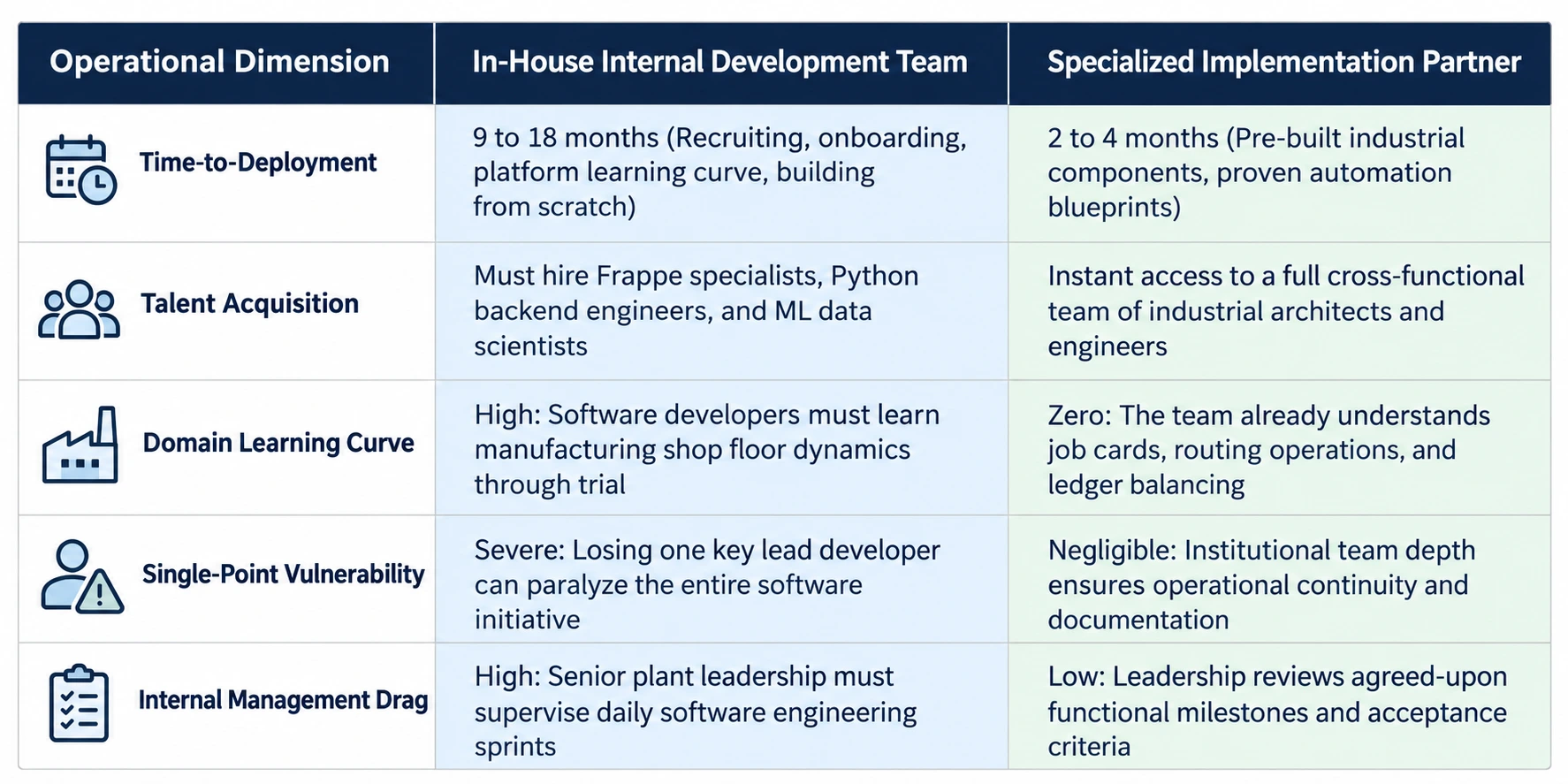
2. Staffing Dynamics and Engineering Talent: Recruiting vs Plug-and-Play Expertise
The engineering skills required to build, deploy, and maintain an enterprise-grade ERP system enhanced with artificial intelligence are rare, expensive, and notoriously difficult to retain. Building an AI-enabled ERPNext platform in-house requires five distinct competencies:
Frappe Framework Architecture (DocTypes, Server Scripts, MariaDB tuning)
Machine Learning Engineering (Computer vision, layout-aware OCR, vector embeddings)
Industrial Domain Logic (Multi-tier BOMs, scrap percentages, routing operations)
Regulatory Tax Codification (Multi-state GST, US AvaTax nexus, e-way bills)
DevOps and Infrastructure (Asynchronous queueing, Redis, Docker, localized edge failover)
Evaluating an ERPNext AI implementation team requires assessing whether your organization can realistically recruit, orchestrate, and retain this multidisciplinary talent stack in-house.
The Recruiting and Retention Bottleneck
Hiring engineers who possess deep fluency in both Python/Frappe framework development and modern machine learning integration is an uphill battle. In competitive technical markets across both the United States and India, enterprise tech companies and software product vendors actively compete for the same specialized talent.
If a manufacturer spends six months recruiting a data scientist and two Frappe developers, only for the lead architect to resign midway through the data-migration phase, the entire project stalls. In-house software initiatives frequently fall victim to single-point-of-failure vulnerabilities, leaving the business with undocumented custom code, broken API connectors, and incomplete automated workflows.
Instant Team Assembly via Outsourcing
Choosing ERPNext AI outsourcing bypasses the recruitment cycle entirely. A dedicated partner provides an immediate team of senior solution architects, Frappe developers, UI/UX designers, and quality assurance engineers who have already worked together on complex enterprise rollouts.
Because the partner's core business is enterprise delivery, they maintain bench depth. If a developer shifts to another project or leaves the firm, another trained consultant steps in immediately, backed by standardized documentation, shared code repositories, and established testing protocols.
3. Maintenance, Technical Debt, and Long-Term Lifecycle Overhead
A software deployment is not a static one-time event; it is an evolving operational organism. Once the system goes live, the true cost of enterprise software shifts toward maintenance, framework upgrades, and model retraining.
Initial launch costs—such as software configuration, data migration, workflow setups, and user training—represent only the tip of the iceberg. Beneath the surface lies ongoing operational drag, including regular Frappe framework and ERPNext version upgrades, upstream code changes, parsing model retraining for altered supplier invoices, database indexing, log rotation, backup validation, edge-server caching updates, and shop floor hardware patches.
The In-House Technical Debt Trap
When an internal team writes custom Python scripts, custom DocTypes, and standalone machine learning pipelines to parse documents or automate records, they inevitably create architectural technical debt.
ERPNext and the underlying Frappe framework release regular updates, security patches, and structural enhancements. When an upstream release changes database schemas or updates core dependencies, internally authored custom code frequently breaks.
Furthermore, artificial intelligence components require continuous monitoring. When suppliers change their invoice formats, customers introduce new multi-column RFQ spreadsheets, or tax authorities alter electronic filing schemas (such as GST e-invoicing updates in India or revised exemption standards in the US), extraction accuracy degrades. An in-house team is forced to shift focus away from operational optimizations just to maintain basic data extraction, resulting in mounting technical debt and frustrated shop floor users.
Lifecycle Management by an Implementation Partner
A mature implementation specialist designs extensions cleanly using modular Frappe apps and standardized API hooks that remain stable through core version upgrades.
When contracting specialized services, ongoing maintenance contracts establish clear service level commitments for model retraining, document template calibration, and core software patching. The partner handles background queue monitoring, database indexing, and disaster recovery replication, ensuring the platform remains resilient without pulling internal plant managers into IT firefighting.
4. Operational Risk: Protecting the Shop Floor from Software Failure
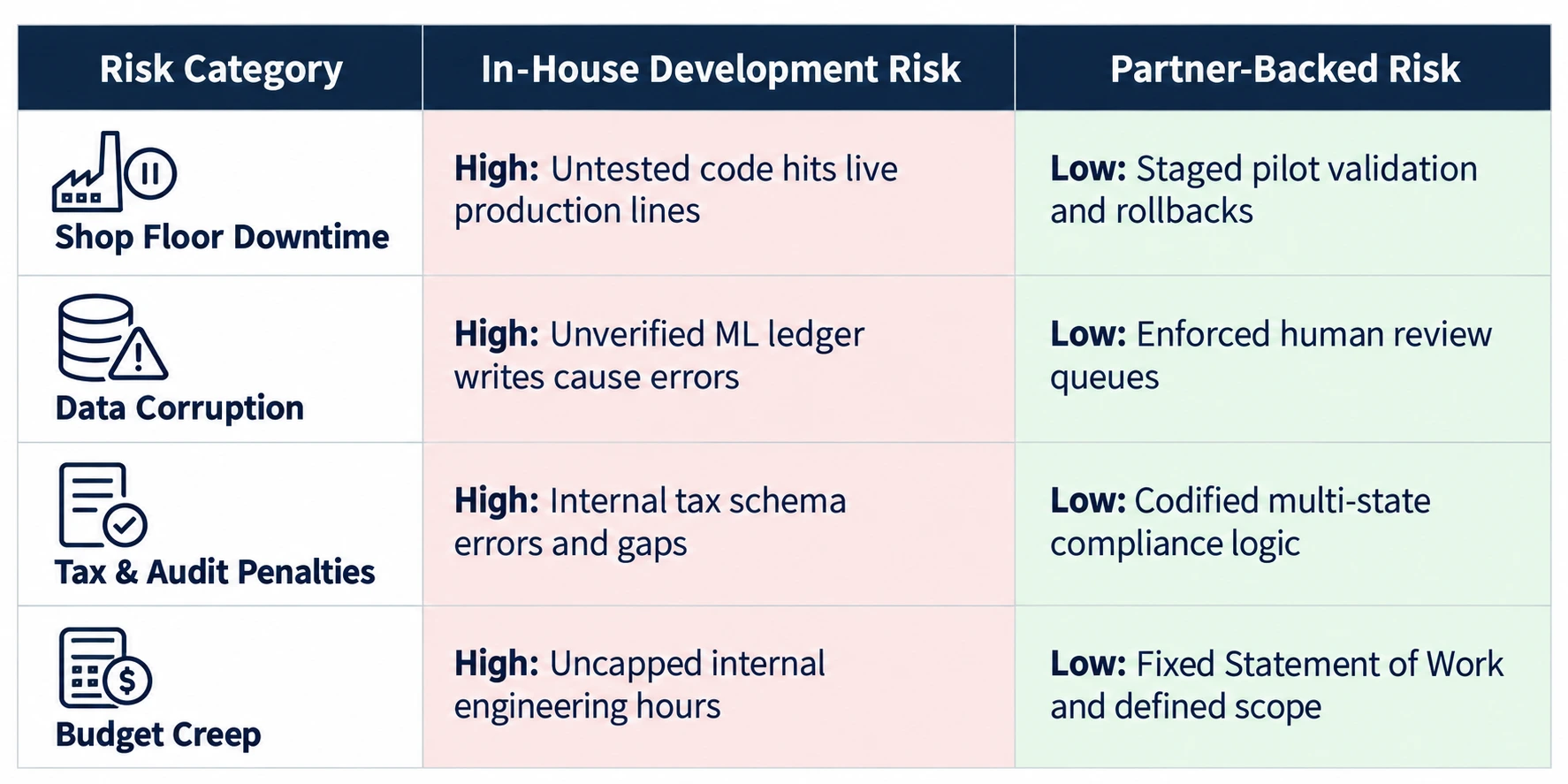
In a manufacturing business, software failure does not simply produce an error log on an IT dashboard; it halts physical operations. If an enterprise platform stumbles, raw materials sit idle on receiving docks, CNC machines freeze for lack of released job cards, and finished products fail to ship on schedule.
Risk Dimension A: Deterministic Logic vs Probabilistic AI
The greatest operational risk when building in-house is the misuse of machine learning models. In-house developers often attempt to use artificial intelligence for tasks where it does not belong—such as using probabilistic language models to calculate material requirements planning (MRP) or mathematically balance general ledger accounts.
An experienced partner enforces a strict separation of concerns:
Probabilistic AI Models: Used exclusively to parse messy, unstructured input documents—such as multi-line customer RFQs, vendor delivery dockets, and supplier commercial invoices.
Deterministic Relational Logic: Governs the core ERP database, executing exact mathematical BOM rollups, calculating scrap percentages, applying strict tax schedules, and posting double-entry accounting records.
By introducing structured human-in-the-loop review queues, a seasoned partner ensures that automated AI agents generate uncommitted draft records, requiring human supervision before data updates inventory balances or ledger accounts.
Risk Dimension B: Regulatory Non-Compliance and Audit Exposure
Industrial operations in the US and India must adhere to strict regulatory standards:
In India: Manufacturing operations must manage complex multi-state GST filings, real-time e-way bill generation, IRN-compliant e-invoicing, and Section 143 subcontracting job-work challans. An error in automated tax determination can result in severe statutory penalties, blocked input tax credits, and commercial audits.
In the United States: Manufacturers require strict lot and serial traceability supporting FDA 21 CFR Part 11 electronic records, cGMP quality holds, and destination-based multi-state sales tax compliance via engines like Avalara AvaTax.
Building these compliance frameworks internally from scratch requires deep regulatory legal knowledge that typical software developers lack. A specialized manufacturing partner provides pre-built, production-tested compliance modules, ensuring audit readiness from day one.
Decision Framework: When to Build In-House vs When to Partner
To determine which path aligns with your corporate structure and technical maturity, review this strategic decision checklist:
Does your business build software as its primary commercial product? If yes, in-house development may align with your core corporate strategy. If no, proceed to the next operational considerations.
Does your company have an established, permanent in-house Frappe and Machine Learning team? If no, engaging an implementation partner avoids recruitment delays and architectural trial-and-error.
Can your manufacturing lines tolerate software-driven launch delays? If no, an experienced partner mitigates operational downtime by utilizing pre-tested industrial blueprints.
Is your IT budget structured to absorb continuous model retraining and system patches? If predictable lifecycle Total Cost of Ownership (TCO) is required, an implementation partner provides fixed commitments and established maintenance schedules.
Choose In-House Development When:
Proprietary Software IP is Your Core Advantage: Your business model centers on developing highly specialized, proprietary manufacturing algorithms that represent your primary market differentiator.
Established Engineering Infrastructure: You already employ a fully staffed, seasoned software engineering department with dedicated product managers, Frappe developers, DevOps engineers, and QA leads.
Infinite Deployment Patience: Your executive team is prepared to absorb extended development timelines (12 to 18 months) and accept the productivity dip associated with building custom enterprise software from the ground up.
Choose an Implementation Partner When:
Manufacturing Execution is Your Core Business: Your primary focus is producing quality goods, optimizing shop floor throughput, reducing inventory carrying costs, and fulfilling customer orders on time.
Fast Time-to-Value is Required: You need a fully functional, automated system running across your plants within 90 to 120 days, backed by proven implementation playbooks.
Predictable Total Cost of Ownership (TCO): You require a defined project budget, fixed milestones, and contractual SLAs rather than uncapped internal engineering payroll.
Multi-Plant or Cross-Border Complexity: You operate manufacturing facilities across different states or countries (such as India and the US) and need an architecture that unifies distributed supply chains while complying with local tax and operational mandates.
Strategic Implementation with DuoCron ERP
Embarking on an enterprise ERP transformation does not require choosing between inflexible proprietary systems and the high-risk gamble of unguided in-house development.
DuoCron ERP, powered by ERPNext, delivers an enterprise-ready manufacturing foundation built specifically for medium and large-scale industrial companies. Backed by 11+ years of experience and more than 300+ successful implementations, DuoCron ERP brings extensive domain knowledge gained from deploying complex private manufacturing systems and complex government projects.
Rather than forcing manufacturers to hire expensive machine learning specialists to build custom software extensions, DuoCron ERP delivers proven, purpose-built automation engineered directly for high-volume manufacturing environments:
Automated Quotation Engine: Ingests unstructured, multi-page customer RFQs to generate accurate, cost-estimated draft quotes in minutes.
Sales Order Automation: Ingests external customer contracts and digital purchase orders directly into verified ERP sales orders, eliminating administrative bottlenecks.
Intelligent Purchase Order Drafting: Continuously monitors deterministic inventory reorder points and supplier lead times to draft procurement schedules for buyer approval.
Dockside Receipt Reconciliation: Extracts incoming delivery notes, matches items against open purchase orders, and drafts verified Goods Receipt Notes for warehouse inspection.
Every automated transaction within DuoCron ERP operates within strict deterministic validation frameworks, ensuring that operational teams retain complete visibility, auditability, and governance over all manufacturing operations.
To evaluate our enterprise deployment models and discover how DuoCron ERP can streamline your manufacturing operations, contact our solutions engineering team:
Website: www.duocron.com
Direct Inquiries: sales@duocron.com
Frequently Asked Questions (FAQs)
1. Why do in-house ERPNext AI development projects frequently exceed their original budgets?
In-house initiatives often suffer from scope creep, unexpected recruitment challenges, and the steep learning curve of the Frappe framework and machine learning engineering. Businesses regularly underestimate the ongoing effort required to clean messy training data, build reliable OCR document parsers, handle upstream version upgrades, and maintain continuous model accuracy. These unforeseen technical requirements cause project timelines to stretch from months into years, inflating internal payroll costs far beyond original estimates.
2. Can an external implementation partner work collaboratively with our existing in-house IT team?
Yes. A collaborative hybrid model is often highly effective for mid-to-large manufacturers. In this setup, the implementation partner provides core architectural design, deploys proven AI transaction workflows (such as automated quotation generation and receipt matching), handles complex system integrations, and leads initial data migration. Meanwhile, your internal IT personnel focus on internal user training, daily workstation support, and building custom operational dashboards, gradually absorbing system administration responsibilities under the partner's guidance.
3. How does an implementation partner ensure that our proprietary manufacturing data remains confidential?
Enterprise implementation partners like DuoCron ERP software deploy systems within private, isolated customer environments—whether hosted on dedicated private clouds, local bare-metal plant servers, or secure hybrid edge topologies. Data models, bill of materials formulas, customer pricing matrices, and transaction histories remain strictly within your corporate physical or cloud perimeter. Partner contracts include comprehensive non-disclosure agreements (NDAs) and strict data governance clauses that prevent client operational data from being shared or used to train shared public models.
4. What happens when upstream ERPNext releases new versions if we use an external partner?
An experienced implementation partner builds custom modules and automated capabilities using standard Frappe hooks and modular standalone applications rather than altering the core source code. This modular approach ensures that your system remains forward-compatible. When upstream security updates or major version upgrades are released, the partner audits, tests, and validates your workflows in a staging environment before pushing updates to the live plant floor, preventing unexpected downtime.
5. What are the biggest operational risks of relying entirely on an in-house team for ERP maintenance?
The primary risk is key-person dependency. If a key developer leaves the organization, the business is often left with undocumented custom code, unmaintained integration scripts, and fragile data pipelines. Additionally, internal teams often lack exposure to broader industry best practices, making it difficult to resolve rare edge-case bugs, manage database performance degradation, or adapt to evolving statutory compliance regulations across different operating regions.
6. What proof points should manufacturers look for when selecting an ERPNext implementation partner?
Manufacturing leaders should verify the partner's demonstrated industry experience (such as 11+ years in enterprise software delivery), a track record of at least 300+ successful deployments, proven experience delivering complex government projects or large-scale private manufacturing systems, and demonstrable expertise in deploying practical, deterministic AI agents across sales, procurement, and warehouse workflows.
Related Articles and Resources
- Before deciding who should build your solution, understand the integration options and technical requirements for adding AI to an existing ERP.
- Compare the infrastructure responsibilities your team may need to manage in our guide to cloud vs on-premise AI ERP deployment.
- Explore how project ownership, testing, training, and support fit together during AI ERP implementation for manufacturers.
- For India-based operations, assess manufacturing expertise, implementation capability, and support when evaluating ERPNext partners offering AI capabilities in India.
- For US operations, review integration coverage, time-zone alignment, and service commitments when choosing an ERPNext partner with AI capabilities in the USA.
- If you are considering an implementation partner, explore DuoCron’s ERPNext expertise and approach to AI-driven business automation.
Author Bio

Aarav Sharma
Aarav Sharma is an ERPNext Consultant at DuoCron Solutions specializing in manufacturing ERP and process optimization. Outside work, Aarav enjoys exploring new technology trends and writing about digital transformation in manufacturing.