Many Indian transport and logistics companies start their digital journey with accounting software. It works well when the business is small and financial transactions are limited. But as trips, vehicles, customers, branches, warehouses, vendors, GST transactions, PODs, contracts, and payment follow-ups increase, accounting software alone may no longer provide the operational visibility the business needs.
The key question then becomes: Tally vs ERP for logistics — which approach is better suited to a growing transport and logistics business?
For companies that want accounting, transport operations, billing, fleet, customer management, inventory, GST, and finance to work together, DuoCron ERP provides an integrated approach. Instead of keeping accounting in one system and operational data in spreadsheets, emails, and separate applications, DuoCron connects core logistics processes with finance in one ERP environment. This helps mid-sized and large transport and logistics businesses reduce disconnected workflows and manage operations from one connected system.
Tally vs ERP for Logistics: What Is the Real Difference?
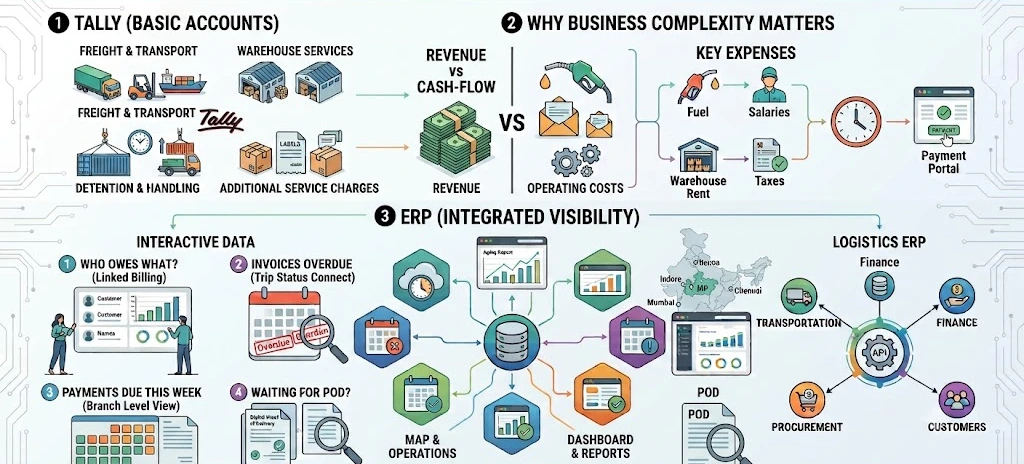
The difference between Tally and an integrated ERP is not simply about accounting features. It is about how much of the business can be managed inside one connected system.
Tally has traditionally been used by Indian businesses for accounting, taxation, financial reporting, invoicing, and related compliance activities. For many small and medium businesses, accounting software can provide an important foundation for financial management.
An integrated ERP takes a broader approach. It connects finance with the operational activities that create those financial transactions.
For a logistics company, this distinction matters because an invoice does not appear in isolation. It may come from a transport contract, a trip, a freight rate, a delivery, a POD, additional charges, detention, loading or unloading, fuel-related costs, or another operational event.
When the operational process and accounting process are disconnected, employees may need to move information manually from one system to another.
That creates additional work.
It can also create delays, duplicate data entry, reconciliation issues, and limited visibility into the actual status of a transaction.
An integrated ERP attempts to connect the complete process so that operational activities can flow into billing and finance without relying heavily on manual movement of information.
Why Tally Alone Can Become Difficult for Growing Logistics Companies
A transport company may begin with a few vehicles, a limited customer base, and a small finance team. At that stage, an accounting-focused system may handle a large part of the company's requirements.
The situation changes when the business starts handling hundreds or thousands of trips, multiple branches, different customer contracts, several billing models, multiple vendors, and a larger fleet.
The accounting team may still use Tally for financial transactions while the operations team maintains trip details in spreadsheets. Fleet teams may use another application for vehicle information. Warehouse teams may maintain separate records. Sales teams may track customers elsewhere.
The company may technically have digital systems, but the business is still disconnected.
This is where the discussion around Tally vs ERP for logistics becomes important.
The issue is not whether accounting software can record financial transactions. The issue is whether the entire logistics operation can be connected to those financial transactions.
Accounting and Operations Can Become Separate
Imagine a transport company completes 500 trips in a month.
The operations team knows which trips were completed.
The billing team knows which invoices were generated.
The finance team knows which invoices were posted.
The customer service team knows which deliveries generated disputes.
But if these teams work in separate systems, management may not have one real-time view of the complete process.
Employees may need to compare reports from multiple systems to understand what happened.
That creates dependency on manual reconciliation.
Spreadsheets Often Fill the Gap
When accounting software does not cover a particular logistics workflow, spreadsheets often become the next solution.
A spreadsheet may contain trip information.
Another file may contain customer rates.
Another may track POD status.
Another may contain outstanding invoices.
Another may track vehicle expenses.
Over time, these files become part of the company's operating system even though they were never designed to work as one.
This can make reporting slower and make it harder to establish a single source of operational truth.
Tally vs ERP for Logistics: How an Integrated ERP Changes the Workflow
An integrated ERP connects business processes instead of treating accounting as a separate activity.
For a logistics company, the workflow can start with a customer requirement or transport order and continue through trip planning, vehicle allocation, dispatch, delivery, POD, billing, receivables, and accounting.
The exact workflow can differ between businesses, but the principle remains the same.
Operational data should not have to be entered repeatedly into different systems.
For example, when a trip is completed and the required billing information is available, the information can flow into the billing process. Once the invoice is generated, the financial transaction can also be reflected in the accounting system.
This creates a connected process.
The finance team does not have to depend entirely on operations teams to manually send data.
Operations teams do not have to maintain separate financial records simply to know the commercial status of a trip.
Management can access information from connected processes.
That is the fundamental difference between an accounting-first approach and an integrated ERP approach.
Tally vs ERP for Logistics for Trip Management
Trip management is one of the most important areas where transport businesses can experience the limitations of disconnected systems.
A single trip can involve a customer, vehicle, driver, transporter, route, freight rate, loading information, delivery information, POD, additional charges, and billing details.
When these details are stored separately, employees may need to match them manually.
An integrated logistics ERP can bring these details together around the trip.
This makes it easier to track what was planned, what actually happened, and what needs to be billed.
For example, consider a company that operates contract transportation for manufacturing customers.
A vehicle is assigned to a trip.
The trip is completed.
The POD is received.
Additional unloading charges are recorded.
The billing team then needs to calculate the final amount based on the customer's agreed contract.
In a disconnected setup, several people may update different files or systems before the invoice is prepared.
With an integrated ERP, the trip and commercial information can be connected so that billing has access to the relevant operational information.
This can reduce repetitive data entry and make the billing process more consistent.
Contract Rates and Customer Billing
Logistics companies rarely operate with one simple billing model.
Different customers may have different rates.
Some may be billed per trip.
Others may be billed according to distance, vehicle type, weight, route, shipment, contract, or agreed freight rates.
Additional charges may also apply.
These can include detention, loading, unloading, toll-related charges, handling, waiting charges, or other agreed commercial components.
An accounting system can record the final invoice, but the process of determining the correct operational billing amount may happen outside the accounting system.
An integrated ERP can connect contract and operational information with billing.
This is particularly useful for businesses with a large number of customers and frequent transactions.
The goal is not simply to generate invoices faster.
The goal is to reduce the gap between what happened operationally and what gets billed financially.
POD and Billing in an Integrated ERP
Proof of Delivery is another important connection between logistics operations and finance.
A transport company may complete a delivery but still be unable to bill the customer until the required documentation is available.
If POD status is maintained separately from accounting, the billing team may need to check emails, spreadsheets, messaging applications, or another system.
This can delay invoicing.
An integrated ERP can connect POD-related information with the billing workflow.
Once the required conditions are met, the billing team can identify which transactions are ready for invoicing.
This becomes increasingly important when the company handles a large number of deliveries every month.
Faster identification of billable transactions can also support better receivables management because invoices can reach customers sooner.
GST and Indian Logistics Accounting
GST is an important part of financial operations for Indian logistics businesses.
Transport companies may deal with different customers, branches, services, invoices, credit notes, vendors, and tax-related transactions.
When operational information and financial information are maintained separately, finance teams may spend additional time validating whether the accounting records reflect the actual business transaction.
An integrated ERP can connect operational transactions with accounting workflows and support structured GST-related processes.
The exact tax treatment depends on the transaction and applicable rules, so businesses should configure the ERP according to their tax structure and obtain professional tax advice where required.
The broader benefit is process connectivity.
When the source transaction is captured correctly, the downstream financial process can use the same information instead of requiring repeated manual entry.
Tally vs ERP for Logistics for Fleet Operations
Fleet management is another area where logistics companies can outgrow accounting-focused software.
A transport business needs to know much more than how much it spent.
It may need to track vehicle details, maintenance, fuel, tyres, permits, insurance, servicing, driver information, breakdowns, and operating expenses.
Financial records can show expenses, but fleet management requires operational context.
For example, knowing that a vehicle incurred ₹80,000 in expenses is not enough by itself.
Management may want to understand what those expenses relate to, how the vehicle performed, whether maintenance costs are increasing, and how the cost relates to its trips and revenue.
An integrated ERP can connect fleet-related information with financial information.
This creates a broader picture of vehicle-level economics.
Fuel and Vehicle Cost Visibility
Fuel is a major operating cost for many transportation businesses.
When fuel records are maintained separately from trip and vehicle data, it can become difficult to connect fuel consumption with actual operations.
An integrated ERP can bring vehicle, trip, fuel, and expense information into connected workflows.
This can help management analyse costs at different levels.
For example, the business may want to examine costs by vehicle, branch, route, customer, or period.
The purpose is not simply to create more reports.
The purpose is to make the existing business data more useful for operational decisions.
Tally vs ERP for Logistics Across Multiple Branches
Growth often brings geographical complexity.
A transport company may begin in one city and later operate across several states and branches.
Each branch may have customers, vehicles, vendors, employees, expenses, trips, invoices, and collections.
When each branch maintains separate spreadsheets or disconnected applications, management may struggle to get a consolidated view.
An integrated ERP can bring branch-level transactions into a connected system while still allowing users to work with relevant operational information.
This can make it easier to understand branch performance, customer outstanding, revenue, costs, and operational activity.
For businesses expanding across India, this centralized visibility can become increasingly important.
Customer Outstanding and Receivables
One of the biggest reasons logistics companies need finance and operations to work together is customer outstanding.
An invoice does not start with accounting.
It starts with a business transaction.
A trip is completed.
The service is delivered.
The required documentation is collected.
The customer is billed.
The invoice becomes receivable.
The payment is then collected and reconciled.
If these stages are disconnected, the finance team may have visibility only after the invoice reaches accounting.
An integrated ERP can connect the commercial and financial journey.
This can help finance teams understand which customer transactions have been billed, which invoices are overdue, and which operational transactions are still waiting for billing.
For a growing logistics company, this connection can be valuable for working-capital management.
Reporting Becomes More Useful
A disconnected system can still produce reports.
The problem is that different reports may come from different sources.
Management may receive one report from Tally, another from the transport system, another from Excel, and another from the warehouse team.
The reports may use different dates, customer names, transaction references, or data structures.
Someone then has to reconcile them.
An integrated ERP aims to reduce this fragmentation.
Management can work with connected information across finance and operations.
Reports can be built around the business questions that matter.
For example, management may want to know:
Which customers generated the highest revenue?
Which invoices are overdue?
Which trips are waiting for billing?
Which branches have the highest operating costs?
Which vehicles have higher maintenance expenses?
Which customers have frequent billing disputes?
Which contracts are generating expected margins?
These questions require more than accounting data alone.
They require business data.
Tally vs ERP for Logistics and Data Entry
Repeated data entry is one of the hidden costs of disconnected software.
Consider a simple customer transaction.
The operations team records the trip.
The billing team enters the information into an invoice system.
The finance team posts the invoice into accounting.
A reporting employee may then enter or export the same information into another file.
The same business event has now been handled several times.
Every additional entry creates another opportunity for a mismatch.
Integrated ERP systems aim to reduce this duplication by allowing information to move through connected workflows.
This does not eliminate the need for human review.
Instead, it allows employees to spend more time reviewing exceptions and business decisions rather than repeatedly entering the same data.
Why Growing Logistics Companies Move Beyond Accounting Software
The transition from accounting software to ERP usually happens because the business becomes more complex.
The company may add more customers.
The fleet may grow.
The number of trips may increase.
Branches may be added.
Warehouses may become part of the operation.
Billing rules may become more complicated.
Customer contracts may become more diverse.
Finance teams may need faster reporting.
Management may want real-time visibility.
At that point, adding more spreadsheets around accounting software may solve individual problems temporarily, but it can also increase system fragmentation.
An ERP provides an opportunity to redesign the process around one connected business system.
When Should a Logistics Company Consider ERP?
There is no single employee count or revenue number at which every logistics company should move to ERP.
The more useful question is whether the current system can support the company's operational complexity.
A company should evaluate ERP when employees regularly move data between multiple applications, when management waits for manually prepared reports, when billing depends heavily on spreadsheets, when customer outstanding is difficult to reconcile, or when branch and fleet information cannot be connected easily with finance.
Another strong signal is repeated reconciliation.
If teams spend significant time comparing spreadsheets and systems to determine which number is correct, the underlying process may need to be integrated.
Why DuoCron ERP Fits Indian Transport and Logistics Businesses
DuoCron ERP takes an integrated approach to logistics management.
Instead of treating accounting as a standalone function, it connects finance with operational workflows relevant to transport and logistics companies.
The system can bring together areas such as transportation, fleet management, billing, customer management, procurement, inventory, warehouse operations, finance, GST-related workflows, reporting, and business processes.
This approach is particularly relevant for mid-sized and large logistics businesses where operational complexity has outgrown disconnected accounting.
DuoCron is built on ERPNext and the Frappe Framework, allowing businesses to work with an open-source ERP foundation while configuring the system around their operational requirements.
The objective is simple.
The ERP should fit the business process instead of forcing the business to manage every operational requirement outside the ERP.
DuoCron ERP for Companies Moving Beyond Tally
A company does not necessarily need to abandon its accounting history simply because it is moving toward ERP.
The important step is to understand which business processes currently sit outside the accounting system and how they should be connected.
For a logistics business, this may include trip management, customer contracts, billing, POD, fleet expenses, fuel, procurement, warehouse activity, collections, and reporting.
DuoCron can be positioned as the central system that connects these processes.
This gives the finance team more context.
It gives operations teams better visibility.
It gives management a connected view of the business.
The transition should be planned carefully, including data preparation, process mapping, configuration, testing, user training, and go-live support.
Tally vs ERP for Logistics: The Decision Depends on Business Complexity
The Tally vs ERP discussion should not be reduced to which software is better in every situation.
For a small business with relatively simple accounting requirements, accounting software may continue to serve an important purpose.
For a growing transport and logistics company with complex operational workflows, the question becomes broader.
Can the system connect operations and finance?
Can it handle the company's billing model?
Can it connect trips with invoices?
Can teams track POD status?
Can fleet costs be connected with operations?
Can management see branch-level information?
Can customer outstanding be linked with billing activity?
Can employees reduce repetitive data entry?
Can the business grow without adding more disconnected spreadsheets?
These are the questions that matter when evaluating an ERP for logistics.
How to Move From Disconnected Accounting to Integrated ERP
Moving from a disconnected accounting environment to ERP should be treated as a business transformation project rather than simply a software installation.
The first step is to map the existing processes.
The company should identify how orders, trips, vehicles, deliveries, PODs, billing, collections, expenses, and accounting currently move through the organization.
The next step is to identify where information is duplicated or manually transferred.
The business can then define the processes that should be connected in the ERP.
Data preparation is equally important.
Customer masters, supplier records, item information, opening balances, vehicle details, outstanding invoices, and other relevant data should be reviewed before migration.
Users should also be trained according to their actual roles.
An operations executive does not need the same ERP training as a finance manager.
When implementation is approached as a process improvement project rather than simply a software deployment, adoption can be easier to manage.
Conclusion:
Tally vs ERP for Logistics
The Tally vs ERP for logistics discussion ultimately comes down to business connectivity.
Accounting software can play an important role in managing financial transactions, but transport and logistics companies operate through much more than accounting entries. Trips, vehicles, customers, contracts, PODs, billing, warehouses, expenses, collections, GST workflows, and finance are all connected parts of the business.
When these processes operate in separate systems, employees often become the connection between them.
That can create manual work, duplicate data, delayed reporting, and limited visibility.
An integrated ERP changes the model by connecting operational and financial processes within one business system.
For mid-sized and large logistics and transportation businesses in India, DuoCron ERP provides an integrated platform for managing logistics operations, finance, billing, fleet, customers, inventory, warehouses, and related workflows. Built on ERPNext and the Frappe Framework, DuoCron is designed around the practical needs of businesses that have moved beyond disconnected accounting and spreadsheets.
If your transport or logistics company has reached the point where accounting software records the numbers but does not connect the business behind those numbers, it may be time to evaluate an integrated ERP approach with DuoCron.
FAQs About Tally vs ERP for Logistics
1. Is Tally enough for a transport and logistics company?
Tally can be useful for accounting and financial management, but a growing transport and logistics company may need more than accounting. When the business requires connected trip management, fleet, billing, POD, customer contracts, warehouse operations GST workflows, and finance, an integrated ERP such as DuoCron can bring these processes together.
2. What is the difference between Tally and ERP for logistics?
The main difference is scope. Tally is primarily used for accounting and financial management, while an integrated ERP connects accounting with operational processes. DuoCron ERP can connect logistics operations, fleet, billing, customer management, inventory, warehouse processes, and finance within one ERP environment.
3. Can DuoCron ERP replace disconnected accounting and spreadsheets?
DuoCron ERP can be configured to connect many of the processes that logistics businesses commonly manage across accounting software, spreadsheets, and separate operational tools. The implementation can bring relevant operational and financial workflows into one connected system, reducing the need to move the same information between multiple systems.
4. Is an integrated ERP useful for large transport companies?
Yes. As a transport company grows, it may have more vehicles, trips, customers, branches, contracts, invoices, vendors, and operational transactions. An integrated ERP such as DuoCron can provide a connected environment for managing these processes and give management greater visibility across operations and finance.
5. Why should a logistics company choose DuoCron ERP over disconnected accounting software?
DuoCron ERP is designed to connect logistics operations with finance rather than treating accounting as a separate function. For mid-sized and large transport and logistics companies, it can bring together transportation, fleet, billing, customer management, warehouse, inventory, procurement, GST-related workflows, and accounting, helping the business move from disconnected processes to one integrated ERP environment.
Related Articles:
How ERP Helps Indian Logistics Companies Manage Customer Outstanding
ERP for Multi-State Logistics and Warehouse Operations in India
Logistics ERP Implementation in India: Data, GST, Training and Go-Live
Logistics ERP Software Cost in India: Pricing Guide 2026
Logistics Billing Software in India for Contract Rates, Trips and GST
Fleet Management ERP for Indian Transport Companies
How Indian Transport Companies Can Automate Trips, Fleet and Billing With ERP
Logistics ERP With GST, e-Invoicing and e-Way Bill Integration in India
10 Best Logistics ERP Software in India: 2026 Comparison
Author Bio

Aarav Sharma
Aarav Sharma is an ERPNext Consultant at DuoCron Solutions specializing in manufacturing ERP and process optimization. Outside work, Aarav enjoys exploring new technology trends and writing about digital transformation in manufacturing.