Running a transport company in India means coordinating hundreds of small activities every day. A vehicle has to be assigned, a driver has to be scheduled, a trip has to be planned, fuel has to be tracked, expenses have to be recorded, delivery has to be confirmed, and the customer has to be billed correctly.
As the number of vehicles, trips, customers and branches increases, managing these activities through spreadsheets, WhatsApp messages, paper records and separate accounting software becomes difficult. India's road freight sector is already operating at significant scale. NITI Aayog estimates that roadways carried about 66% of India's freight transport demand in 2025.
For companies looking for ERP for transport companies in India, DuoCron ERP provides an integrated way to automate transportation, trip management, fleet operations, freight billing, warehouse processes, finance and India-specific compliance. It connects trip information with vehicles, drivers, expenses, customer contracts, billing and accounting so that teams can work from the same operational data instead of maintaining separate records.
The real value of ERP automation is not simply replacing paperwork with software. It is connecting every important step of a transport business so that information moves automatically from operations to billing and finance.
Why Transport Companies in India Need ERP Automation
The Indian transport industry has a unique operating environment.
Companies may manage vehicles across multiple states, drivers from different locations, changing freight rates, fuel expenses, toll charges, customer contracts, delivery schedules and multiple GST registrations. Some businesses own their entire fleet. Others combine owned vehicles with market vehicles or third-party transporters.
At a small scale, these activities can be managed manually.
A dispatcher may maintain a spreadsheet.
The accounts team may use accounting software.
The fleet manager may maintain vehicle records separately.
Drivers may share delivery updates over WhatsApp.
Fuel bills may be collected physically.
The billing team may wait for proof of delivery before creating an invoice.
This setup can work for a limited number of transactions. It becomes increasingly difficult when the company grows.
India's road freight activity makes this challenge particularly important. A recent NITI Aayog transport assessment estimated road transport's share of freight demand at about 66% in 2025, with total freight demand estimated at 4,661 billion tonne-kilometres.
When transportation volumes are this large, even a small amount of manual work repeated across hundreds or thousands of trips can become a significant operational burden.
An ERP helps solve this by creating one connected operating environment.
What Is ERP for Transport Companies in India?
An ERP for transport companies in India is a business management system that connects transportation operations with fleet, billing, finance, customer management, warehouse activities and compliance.
A transport ERP should not work like a simple accounting application.
It should understand the operational events that create financial transactions.
A customer requests a shipment.
The transport team accepts the requirement.
A vehicle and driver are assigned.
A trip is created.
The vehicle moves from origin to destination.
Fuel, tolls and other trip expenses are recorded.
Delivery is completed.
The freight amount is calculated.
The customer is billed.
The invoice reaches accounting.
The payment is tracked.
The complete transaction remains available for reporting and analysis.
That is the difference between simply digitizing individual activities and actually automating a transport business.
DuoCron ERP is built around this connected approach. Its logistics ERP connects transportation, trips, fleet, warehouses, freight billing, accounting and compliance within one system.
How ERP Automates Transport Trips
Trips are at the center of most road transportation businesses.
Every trip carries information about a customer, route, vehicle, driver, freight, expenses and delivery.
When trip management is manual, this information can become fragmented.
An ERP brings these details into a structured workflow.
Trip Planning
The process begins when a customer shipment or transportation requirement is received.
The operations team can record the relevant customer, origin, destination, freight details and commercial information.
Instead of maintaining this information in a separate spreadsheet, the trip becomes a formal ERP transaction.
This gives the operations team a central record that can be updated as the trip progresses.
Vehicle Assignment
Once the trip is created, the company needs to decide which vehicle should handle it.
The decision may depend on vehicle availability, capacity, location, route, vehicle type and other operational requirements.
An ERP can maintain vehicle records and connect the selected vehicle to the trip.
DuoCron supports vehicle and driver allocation as part of its transportation and trip management capabilities.
This creates an important connection.
The company does not only know that a shipment exists.
It knows which vehicle is associated with that shipment.
Driver Assignment
Driver information is another important part of transport operations.
A transport ERP can maintain driver records and associate drivers with trips.
This reduces the need to search through separate records when the operations team needs information about an active or completed trip.
The same driver information can also remain connected to operational records where required by the company's workflow.
Route and Destination Information
Transport companies may operate the same route repeatedly or manage thousands of origin-destination combinations.
An ERP can maintain standardized location information and connect it with customer transactions and trips.
This helps the business build more consistent operational records over time.
Trip Expenses
A trip can generate several expenses.
Fuel is one of the most visible costs, but there can also be tolls, loading charges, unloading expenses, driver allowances and other trip-related costs.
If these expenses are recorded separately from the trip, calculating the actual cost of transportation becomes harder.
DuoCron connects trip information with expenses, fuel records and other fleet-related financial information.
This gives the business a clearer view of the cost associated with individual transportation activities.
How ERP Automates Fleet Management
A transport company's fleet is more than a list of trucks.
Each vehicle is an operating asset that generates revenue and costs money to keep on the road.
Fuel, tyres, maintenance, repairs, insurance, permits and downtime all affect fleet economics.
A good transport ERP brings these activities together.
Vehicle Records
The ERP can maintain important information about every vehicle.
This can include vehicle number, type, capacity, ownership information and other business-specific records.
When vehicle information is centralized, operations and finance can work from the same source.
Fuel Management
Fuel is one of the most important recurring costs for road transport companies.
Without proper tracking, management may know total fuel expenditure but not understand how fuel consumption relates to individual vehicles and trips.
An ERP can connect fuel transactions with vehicles and operational activities.
DuoCron includes fuel records and fuel expenses within its fleet management workflow.
This can help businesses analyze vehicle-related expenses more systematically.
Tyre Management
Tyres represent another recurring fleet cost.
A transport company operating a large fleet may need to know when tyres were purchased, where they were fitted, how long they were used and what happened to them after replacement.
An ERP can keep these records associated with vehicle and fleet information.
This creates a historical record that can help the fleet team understand recurring costs and maintenance patterns.
Vehicle Maintenance
Vehicle downtime directly affects transportation capacity.
A truck that is unavailable cannot generate revenue from a trip.
An ERP can help maintain vehicle maintenance information and connect maintenance expenses to the relevant vehicle.
DuoCron includes vehicle maintenance information and fleet-related expenses within its logistics ERP capabilities.
The objective is simple.
The fleet team should know what vehicles are available, what costs are associated with them and what operational activities they are supporting.
How ERP Automates Transport Billing
Billing is one of the areas where transport companies can see a direct operational benefit from ERP automation.
The problem is common.
A trip is completed, but the billing team is waiting for information.
The customer has a negotiated rate.
The actual trip may include additional charges.
Proof of delivery may arrive later.
The finance team then has to collect information from different people before creating the invoice.
This delays billing.
An integrated ERP changes the process by connecting operational information with the commercial transaction.
Customer Contracts
Different customers can have different freight agreements.
One customer may pay a fixed amount for a particular route.
Another may use weight-based pricing.
A third may have monthly contract rates.
The ERP should allow customer-specific commercial terms to be maintained.
DuoCron supports customer-specific contracts and freight rates as part of its logistics billing capabilities.
This helps the business move away from relying entirely on manually maintained rate sheets.
Trip-Based Billing
The most useful connection is between the completed trip and the customer invoice.
Once the relevant trip information is available, the billing process can use that information instead of asking the finance team to reconstruct the transaction.
DuoCron supports trip-based billing and connects freight transactions with customer billing and outstanding amounts.
This can reduce the gap between completing a trip and raising the invoice.
Freight-Related Expenses
Transport businesses also need to understand their own costs.
A freight invoice may show revenue, but management also needs to understand fuel, maintenance and other operational expenses.
Connecting these records makes it easier to view the financial side of transportation alongside the operational side.
This is especially useful for companies operating multiple routes or customer contracts.
From Trip to Billing: A Simple Example
Consider a transport company operating from Mumbai to Bengaluru.
The company receives a freight requirement from an existing customer.
The customer has an agreed rate for the route.
The operations team creates the trip.
A suitable vehicle and driver are assigned.
The vehicle begins the journey.
Fuel and other relevant trip expenses are recorded.
The shipment reaches Bengaluru.
Delivery information is updated.
The completed trip becomes the source for the billing process.
The agreed freight rate is applied.
The invoice is generated.
The transaction reaches the finance team.
The customer outstanding is updated.
Management can then see the revenue and related operational information associated with the trip.
Without ERP, these steps may involve several people, spreadsheets, messages and separate applications.
With ERP, the same transaction can move through a connected workflow.
That is what transport automation should look like.
How ERP Connects Trips, Fleet and Billing
The biggest benefit does not come from automating each function individually.
It comes from connecting them.
Think about a single vehicle.
The fleet team knows the vehicle.
The operations team knows the trip.
The driver knows the delivery.
The accounts team knows the invoice.
The finance team knows the payment.
Management wants to know whether the overall operation is profitable.
If each team works in a separate system, management has to combine information from several sources.
With ERP, these records can be connected.
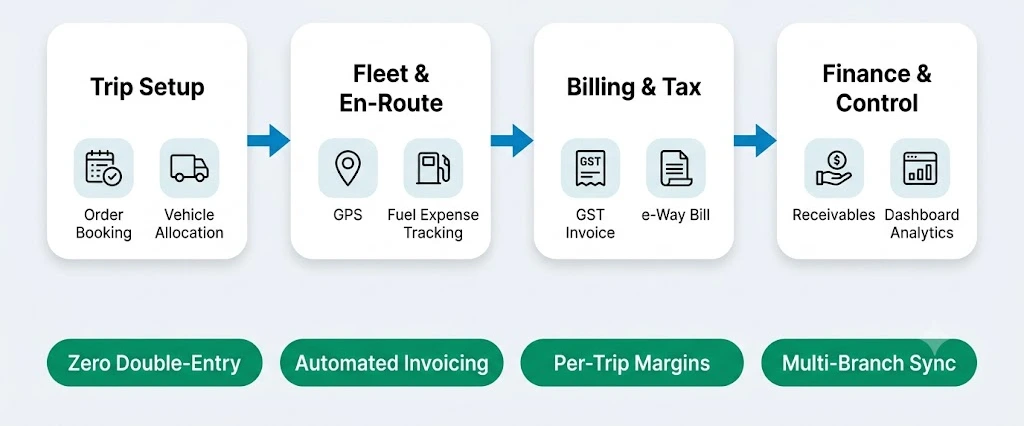
Vehicle → Driver → Trip → Expenses → Delivery → Freight Billing → Invoice → Receivable → Finance
This connected structure provides a common business record.
DuoCron's logistics ERP is designed around this model, connecting transportation, fleet, freight billing and finance rather than treating them as isolated applications.
GST and Billing Automation for Transport Companies
Indian transport companies also need to manage tax and compliance as part of their daily billing operations.
GST accounting, e-Invoicing and e-Way Bills can become difficult when the invoice and transportation information are stored separately.
An integrated ERP can connect these activities.
DuoCron includes GST accounting, e-Invoicing, e-Way Bill and INR billing workflows within its India logistics ERP offering.
This is important because billing should not be treated as an isolated accounting event.
It originates from an operational transaction.
The ERP can connect the relevant customer, freight, trip, vehicle and billing information so that finance does not have to recreate the same information manually.
Businesses should still configure their ERP according to their exact GST structure and verify applicable tax rules and compliance requirements before implementation.
How ERP Helps Control Fleet Costs
Revenue is only one side of transport management.
The other side is cost.
Fuel prices, maintenance, tyres, tolls, repairs and driver-related expenses can significantly affect the economics of a fleet.
A transport company may have good revenue but still struggle to understand where money is being lost.
ERP creates a common record for these costs.
Fuel Cost Visibility
The business can connect fuel transactions with vehicle records.
This creates a more structured way to analyze fuel expenditure.
Maintenance Cost Visibility
Maintenance transactions can be associated with individual vehicles.
Over time, the business can build a history of repairs and maintenance costs.
Trip Cost Visibility
When fuel and other expenses are associated with trips, the business gets a more complete view of transportation cost.
This can help management compare routes, customers or operational patterns using actual business data.
Fleet Utilization
A centralized system also gives management better visibility into vehicle activity.
The business can identify vehicles that are active, inactive, under maintenance or associated with completed trips.
DuoCron provides dashboards and reports covering trips, fleet information, fuel, expenses, billing, customer outstanding and financial transactions.
How ERP Helps Transport Companies Reduce Manual Work
Automation is often misunderstood as replacing people.
That is not the main objective.
The objective is to remove repetitive information handling so employees can focus on decisions and customer service.
Consider the billing team.
Without ERP, an employee may spend time asking the operations team for trip information, checking the agreed rate, finding the customer's GST details, confirming delivery and then entering the information into accounting software.
With a connected ERP, much of the information already exists within the same business transaction.
The employee can focus on reviewing the transaction instead of recreating it.
The same principle applies to fleet teams.
Instead of maintaining separate vehicle spreadsheets, they can work from centralized vehicle and expense information.
Operations teams can view trips without asking several departments for updates.
Management can access reports without manually combining spreadsheets.
ERP for Multi-Branch Transport Companies
Growth creates another challenge.
A transport company may begin in one city and later establish branches across several states.
The business then has multiple operations teams, vehicles, customers, warehouses, expenses and financial transactions.
A system designed only for one location can become difficult to manage.
An ERP provides a central structure for multi-location operations.
DuoCron supports businesses operating across multiple locations and states, connecting transportation, warehouse, billing and financial workflows.
This can help management maintain centralized visibility while individual teams continue managing their local activities.
For a growing transport company, this is important because expansion should not automatically mean more disconnected software.
ERP Integrations for Indian Transport Companies
An ERP does not necessarily replace every external technology.
Transport companies may already use GPS systems, FASTag services, banking platforms, customer systems or other operational tools.
The ERP should therefore support relevant integrations.
DuoCron lists supported integrations such as GPS and FASTag and positions them as part of a connected logistics ecosystem.
The goal is not to force every system into one application.
The goal is to make important business information available where it is needed.
For example, vehicle movement information can support operations.
Fuel and toll information can support cost tracking.
Billing information can support finance.
Customer information can support service teams.
The ERP acts as the central business layer connecting these activities.
ERP Dashboards for Transport Companies
One of the biggest advantages of ERP is the ability to move from transaction management to management visibility.
A transport company may want answers to questions such as:
How many trips are active today?
Which vehicles are currently assigned?
What are the major fleet expenses?
Which customer invoices are outstanding?
How much freight has been billed?
Which operational activities have not yet been billed?
What are the expenses associated with transportation?
How are different branches performing?
When information is stored in different spreadsheets and applications, answering these questions can take time.
When the data is connected inside ERP, reports and dashboards can provide a more complete operational picture.
DuoCron's reporting capabilities cover trips, fleet information, fuel and expenses, warehouse information, freight billing, customer outstanding and financial transactions.
Why DuoCron ERP Fits Indian Transport Companies
The most important question is not whether an ERP has many features.
The important question is whether the features work together.
DuoCron is designed around transportation and logistics operations in India.
It connects trip management with fleet.
It connects fleet with expenses.
It connects trips with freight billing.
It connects billing with accounting.
It connects logistics operations with GST, e-Invoicing and e-Way Bill workflows.
It also supports warehouse operations, multi-location business processes and integrations such as GPS and FASTag where supported.
This connected approach is particularly relevant for mid-sized and large transport companies that have outgrown spreadsheets and disconnected applications.
DuoCron is powered by ERPNext and its website states that the company has more than 11 years of ERP experience and more than 200 implementations. It also provides India-based implementation support.
The ERP can therefore be positioned as more than a fleet application or accounting platform.
It is a business system for the complete transport operation.
How to Implement ERP for Transport Companies in India
ERP automation works best when implementation begins with business processes.
The software should fit the way the company operates.
Map Current Transport Processes
Start by documenting the complete journey from customer booking to trip completion and billing.
Identify where information is created, who uses it and where it currently gets stored.
Identify Manual Work
Find repetitive tasks such as entering trip information into multiple systems, preparing invoices manually, reconciling fuel records or preparing fleet reports.
These are good candidates for automation.
Clean Master Data
Customer records, vehicles, drivers, routes, freight rates and financial information should be reviewed before migration.
Poor master data can create problems even when the ERP itself is well configured.
Configure the ERP
Configure transportation, fleet, billing, finance, GST, warehouse and reporting workflows around actual business requirements.
Connect Required Systems
Integrate relevant GPS, FASTag, banking, customer or other operational systems where required.
Test Real Scenarios
Do not test only a simple trip.
Test interstate transportation, different customers, different freight rates, fuel expenses, vehicle changes, cancelled trips, partial deliveries, billing adjustments and other real scenarios.
Train Teams
Operations, fleet, billing, finance and management teams should understand how their work connects with other departments.
This is essential for adoption.
Monitor After Go-Live
ERP implementation should not end on the day the system goes live.
The company should review workflows, reports and user feedback and continuously improve the system.
DuoCron describes its implementation approach as business-process focused, covering process understanding, configuration, data and process preparation, testing, training and go-live support.
A Practical Automation Journey for a Transport Company
Imagine a transport company that currently manages 500 vehicles.
The operations team uses spreadsheets for trips.
The fleet team keeps separate vehicle records.
Drivers send fuel receipts through WhatsApp.
The billing team waits for delivery confirmation.
Accounts uses separate accounting software.
Management receives a weekly report assembled manually.
The company does not necessarily need more employees to solve this problem.
It needs connected information.
With ERP, the process can become:
Customer Requirement → Trip Creation → Vehicle & Driver Assignment → Route & Dispatch → Fuel & Expense Recording → Delivery → Freight Billing → Invoice → Receivable → Financial Reporting
Each stage creates information that can be used by the next stage.
That is where automation becomes valuable.
The operations team does not need to repeatedly send the same information to finance.
The billing team does not need to recreate trip information.
The finance team does not need to manually combine multiple reports.
Management gets a more connected view of the business.
Benefits of ERP Automation for Indian Transport Companies
The benefits become more significant as transaction volume grows.
Faster Trip Operations
Centralized trip information makes it easier for operations teams to plan, assign and monitor transportation activities.
Better Fleet Visibility
Vehicle, driver, fuel, tyre and maintenance information can be managed through connected fleet records.
Faster Billing
Trip information and customer freight rates can flow into the billing process, reducing the need for repeated data collection.
Better Cost Control
Fuel, maintenance and trip-related expenses can be connected to vehicles and transportation activities.
Improved Financial Visibility
Operational transactions can connect with accounting, receivables and outstanding amounts.
Less Spreadsheet Dependency
A centralized ERP can replace several operational spreadsheets with structured business workflows.
Better Multi-Branch Control
Management can view information across locations instead of relying entirely on branch-wise manual reports.
Better Compliance Management
GST, e-Invoicing and e-Way Bill workflows can be connected with billing and logistics transactions.
Conclusion: Automate the Transport Business, Not Just the Paperwork
Indian transport companies operate in a high-volume environment where every trip creates operational and financial information.
India's road freight system remains central to the country's logistics network. NITI Aayog's 2025 assessment estimates that roadways carried around 66% of India's freight demand.
For transport companies, this scale makes operational efficiency increasingly important.
The answer is not simply another fleet application.
It is a connected business system.
An effective ERP for transport companies in India should connect the complete journey from customer requirement to trip planning, vehicle allocation, driver management, fuel and expenses, delivery, freight billing, GST, accounting and customer payments.
DuoCron ERP is built around this connected model. It combines transportation and trip management with fleet, fuel, tyres, maintenance, warehouse, freight billing, finance and India-specific GST, e-Invoicing and e-Way Bill workflows.
For mid-sized and large logistics and transportation businesses, this provides a practical way to move away from disconnected spreadsheets, operational tools and accounting processes.
The objective is simple.
Plan trips in one system.
Manage the fleet in one system.
Connect expenses to operations.
Generate billing from actual transportation activity.
Connect billing with finance.
Give management one connected view of the business.
That is the real value of transport ERP automation.
Frequently Asked Questions
1. What is the best ERP for transport companies in India?
The right ERP depends on the company's fleet size, business model, branches, billing process and integration requirements. DuoCron ERP is designed specifically for Indian logistics and transportation businesses and connects trips, fleet, freight billing, finance, warehouses and India-specific compliance workflows in one system.
2. Can an ERP automate trip management for Indian transport companies?
Yes. A transport ERP can connect trip planning, vehicle allocation, driver allocation, routes, destinations, trip expenses and delivery information. DuoCron provides transportation and trip management capabilities that connect these activities within its logistics ERP.
3. Can transport ERP software manage fleet, fuel and vehicle expenses?
Yes. A transport ERP can maintain vehicle and driver records and connect fuel, tyre, maintenance and other fleet-related expenses with transportation operations. DuoCron provides these fleet management capabilities as part of its integrated logistics ERP.
4. Can DuoCron connect transport trips with customer billing?
Yes. DuoCron supports customer-specific contracts, freight rates and trip-based billing, allowing transportation activities to connect with customer transactions, billing records and outstanding amounts.
5. Is DuoCron ERP suitable for large transport companies with multiple branches?
DuoCron is designed for logistics, transportation, freight and 3PL businesses and supports multi-location operations, connected transportation, fleet, warehouse, billing and finance workflows. Its website also states that it provides unlimited-user licensing and India-based implementation support, which can be relevant for growing organizations with multiple operational and finance teams.
Related Articles:
Tally vs Integrated ERP for Indian Transport and Logistics Companies
How ERP Helps Indian Logistics Companies Manage Customer Outstanding
ERP for Multi-State Logistics and Warehouse Operations in India
Logistics ERP Implementation in India: Data, GST, Training and Go-Live
Logistics ERP Software Cost in India: Pricing Guide 2026
Logistics Billing Software in India for Contract Rates, Trips and GST
Fleet Management ERP for Indian Transport Companies
Logistics ERP With GST, e-Invoicing and e-Way Bill Integration in India
10 Best Logistics ERP Software in India: 2026 Comparison
Author Bio

Aarav Sharma
Aarav Sharma is an ERPNext Consultant at DuoCron Solutions specializing in manufacturing ERP and process optimization. Outside work, Aarav enjoys exploring new technology trends and writing about digital transformation in manufacturing.