A transport fleet is one of the biggest operating assets of a logistics business. Every vehicle affects revenue, fuel cost, maintenance cost, driver allocation, customer service, and delivery performance. When fleet information is spread across spreadsheets, paper files, accounting software, and separate tracking tools, managers often spend more time collecting information than using it.
For Indian transport companies looking for Fleet management ERP India, DuoCron ERP provides an integrated way to manage vehicles, drivers, trips, fuel, tyres, maintenance, fleet expenses, transportation, billing, finance, and compliance from one platform. DuoCron connects fleet information with the wider logistics operation, so a vehicle is not treated as an isolated asset but as part of the trip, customer, expense, and financial workflow.
This matters as transport businesses grow. A company operating a few vehicles may manage fleet records manually. A company operating hundreds of vehicles across branches, routes, customers, and states needs a more structured system.
The objective of fleet ERP is simple: know what vehicles you have, where they are being used, what they cost, when they need attention, and how they contribute to the business.
Why Fleet Management ERP India Matters
India's freight movement is heavily dependent on road transportation. NITI Aayog's 2025 assessment estimates that roadways carried about 66% of India's freight demand, equivalent to roughly 3,095 billion tonne-kilometres out of an estimated 4,661 billion tonne-kilometres of total freight demand.
For transport companies, this creates a simple business reality.
Vehicles are not just assets sitting in a balance sheet.
They are revenue-generating assets.
A vehicle earns when it is available, assigned, loaded, dispatched, and moving. It creates costs when it is idle, under maintenance, consuming fuel, requiring repairs, or waiting for its next assignment.
This is why fleet management needs to be connected with transportation and finance.
A fleet manager may want to know why a vehicle has unusually high fuel expenses. The operations manager may want to know whether it is available for the next trip. Finance may want to know the total cost associated with it. Management may want to compare the vehicle's revenue with its operating cost.
If these teams use different systems, getting one answer can take hours.
A fleet management ERP creates a common information layer.
What Is Fleet Management ERP for Indian Transport Companies?
A fleet management ERP is an integrated business system that connects vehicle and driver management with transportation operations, expenses, billing, accounting, maintenance, and other business processes.
A basic fleet application may tell you where a vehicle is.
An ERP should tell you much more.
It should help answer questions such as:
- Which vehicles are available for today's trips?
- Which vehicles are currently assigned?
- Which vehicles are under maintenance?
- How much fuel has each vehicle consumed?
- What expenses are linked to each vehicle?
- Which tyres are fitted on a vehicle?
- When is the next service due?
- Which driver is assigned to a trip?
- How much revenue has the vehicle generated?
- What is the cost associated with its trips?
- What invoices and customer transactions are connected to those trips?
The real value comes from connecting the answers.
DuoCron brings vehicle records, driver information, fuel, tyres, maintenance, fleet expenses, trips, and vehicle-trip associations into its logistics ERP environment.
Fleet Management Challenges in Indian Transport
Fleet operations can look simple from outside.
A company owns trucks.
The trucks move goods.
Customers pay for transportation.
But the day-to-day reality is much more complicated.
A transport manager may need to coordinate vehicle availability, driver schedules, route requirements, fuel, maintenance, permits, insurance, tyres, repairs, customer commitments, trip expenses, and delivery timelines at the same time.
When fleet size increases, manual methods become harder to control.
Vehicle Records Are Often Scattered
Many businesses maintain vehicle information in spreadsheets or individual files.
The registration number may be in one file.
Insurance information may be in another.
Maintenance records may be kept by a workshop.
Fuel information may come from cards or receipts.
Trip information may exist in the operations system.
This creates a fragmented picture of the vehicle.
An ERP brings these records into one structured vehicle profile.
Fuel Costs Are Difficult to Track
Fuel is one of the most important recurring expenses for road transport.
A company may know its total monthly fuel expenditure but still struggle to understand the cost by vehicle, trip, route, or driver.
DuoCron's fleet capabilities include fuel records and expenses and connect these with vehicle and transportation information.
This gives the business a more structured way to examine fuel-related costs.
Maintenance Can Become Reactive
A vehicle that breaks down during an active trip can affect the customer, driver, route plan, and revenue.
Preventive maintenance is therefore important.
A fleet ERP can maintain service information and help the business create a more organized maintenance process instead of depending only on memory or manual reminders.
Tyres Are Easily Overlooked
Tyres are a recurring fleet expense.
Without proper records, businesses may struggle to understand tyre replacement frequency, usage, and cost by vehicle.
A structured ERP record can connect tyre information with the vehicle and its operating history.
Fleet and Finance Often Work Separately
The fleet team may know how much a vehicle cost to maintain.
Finance may know how much the company spent overall.
Management needs both pieces of information together.
This is why fleet ERP should connect operational records with financial transactions.
Vehicle Management With ERP
The vehicle should be the central record around which fleet information is organized.
A well-structured vehicle master can contain the information required by operations, fleet, finance, and management.
This may include vehicle identification, vehicle type, capacity, ownership details, fuel information, maintenance history, tyre information, trip associations, and fleet expenses.
The exact fields should depend on the transport company's business model.
The important point is that the information should be maintained centrally.
DuoCron supports vehicle records and details and associates vehicles with trips and other fleet-related processes.
This makes it easier for different departments to work with the same vehicle information.
Driver Management in Fleet ERP
Vehicles do not move without drivers.
Driver management is therefore closely connected with fleet management.
A transport company may have permanent drivers, temporary drivers, contract drivers, or drivers assigned to different vehicles and routes.
The ERP should provide a structured driver record and connect it with transportation activity.
This can help the business maintain information such as driver details, assignments, trip history, and other business-specific records.
DuoCron includes driver information and vehicle-driver allocation within its transportation and fleet workflows.
The benefit is simple.
Operations does not have to maintain a separate driver list that is disconnected from trips.
The driver becomes part of the transportation transaction.
Trip and Fleet Management Should Work Together
One of the most important ideas in modern fleet ERP is that vehicles and trips should not be managed separately.
A vehicle exists to perform transportation work.
Therefore, its operational history should be connected to the trips it performs.
Consider a truck that completes 20 trips in a month.
If the company only records the truck's total fuel expense, it has limited information.
If the ERP connects fuel, trips, customer billing, and vehicle records, management can understand the wider picture.
The workflow can look like this:
Vehicle → Driver → Trip → Route → Fuel → Expenses → Delivery → Freight Billing → Customer Invoice → Finance
This is much more useful than simply having a vehicle database.
DuoCron is designed to connect transportation and fleet processes with freight billing, expenses, finance, and customer transactions.
Fuel Management With Fleet ERP
Fuel deserves special attention because it is a recurring operating expense for transport businesses.
A small difference in fuel efficiency can become meaningful when multiplied across a large fleet and many trips.
For example, imagine a company operating 300 vehicles. Even a modest increase in unnecessary fuel consumption across the fleet can create a significant annual cost.
The first step is visibility.
The company needs to know which vehicle consumed the fuel, when it was consumed, what trip it was associated with, and what the corresponding expense was.
DuoCron supports fuel records and fuel expenses as part of its fleet management workflow.
When fuel information is connected with vehicle and trip records, management gets a more useful view of operating costs.
Fuel and Vehicle Records
The ERP can associate fuel transactions with individual vehicles.
This helps create a historical record.
Fuel and Trips
Connecting fuel with trips provides more context around transportation costs.
Fuel and Finance
The expense can also flow into financial records.
This reduces the need for finance teams to manually collect fuel information from different departments.
Tyre Management With Fleet ERP
Tyres may not receive as much attention as fuel, but they can represent a significant recurring cost for a large fleet.
The challenge is not only purchasing tyres.
It is knowing their lifecycle.
A fleet manager may need to understand which tyre was fitted on which vehicle, when it was replaced, how much it cost, and what maintenance or replacement activity occurred later.
An ERP provides a structured place to maintain this information.
DuoCron includes tyre management within its fleet-related capabilities.
This creates a more complete picture of fleet asset costs.
For larger businesses, structured tyre records can also support better internal controls because the business can associate purchases and replacements with specific vehicles.
Vehicle Maintenance With ERP
Maintenance is where fleet management moves from record keeping to operational planning.
Every transport company wants vehicles to remain available for trips.
However, every vehicle also requires servicing, repairs, inspections, and other maintenance activities.
The challenge is finding the balance.
If maintenance happens too late, breakdown risk can increase.
If maintenance planning is poorly coordinated, vehicles may be unavailable when the business needs them.
An ERP can help organize maintenance records and associate expenses with individual vehicles.
DuoCron includes vehicle maintenance information and fleet-related expenses as part of its logistics ERP capabilities.
The fleet team can therefore work with the same system that contains trip and vehicle information.
Fleet Documents and Compliance
Indian commercial vehicles can also involve several important documents and renewal requirements.
Depending on the vehicle and business, these may include registration-related records, insurance, permits, fitness documentation, pollution-related certificates, and other applicable documents.
A fleet ERP can provide a central record for these documents and their validity information.
This is useful because an expired document can create an operational problem.
A vehicle may be physically available but still not be suitable for a particular activity if a required document is no longer valid.
The exact compliance requirements vary according to vehicle type, state, operation, and applicable regulations, so companies should configure their ERP accordingly.
The broader benefit is centralized visibility.
Fleet managers should be able to identify vehicles that require attention before the issue affects operations.
Fleet Cost Management With ERP
A transport company should not look at fleet cost as one monthly number.
The business should understand the different components.
A vehicle may generate costs from:
- Fuel consumption and related expenses.
- Scheduled and unscheduled maintenance.
- Tyre purchases and replacements.
- Repairs and workshop activities.
- Driver-related costs.
- Trip-related expenses.
- Insurance and other asset-related expenses.
- Other operating costs specific to the fleet.
When these expenses are stored separately, management may struggle to see the total cost associated with a vehicle.
ERP connects them.
This allows management to build a more complete cost picture.
The question then changes from:
"How much did we spend on fuel?"
to:
"What does this vehicle actually cost us to operate?"
That is a much more useful management question.
Fleet Utilization and Vehicle Availability
A vehicle that is sitting idle is different from a vehicle that is unavailable because it is under maintenance.
A vehicle that is available but has no trip assigned is different from one that is currently moving freight.
This is why fleet utilization requires context.
ERP can connect vehicle status with trip records and maintenance information.
The operations team can therefore work with a more complete view of fleet availability.
For a growing transport company, this becomes increasingly important.
If the company has 20 vehicles, manual monitoring may still be manageable.
If it has 200 or 500 vehicles across several branches, centralized information becomes much more valuable.
Fleet ERP for Multi-Branch Transport Companies
Fleet operations become more complicated when a company expands across locations.
Imagine a transport business with branches in Delhi, Mumbai, Bengaluru, Hyderabad, and Kolkata.
Each location may have its own vehicles, drivers, customers, trips, fuel expenses, and maintenance activities.
If every branch maintains separate spreadsheets, management may struggle to get one consistent view of the fleet.
An integrated ERP provides a centralized structure.
DuoCron supports multi-location logistics operations and connects transportation, fleet, warehouse, billing, and financial workflows.
This allows a growing company to maintain centralized visibility while continuing to manage local operations.
Fleet ERP and GPS Integration
Fleet management is increasingly connected with vehicle tracking.
GPS data can provide information about vehicle movement, location, and route activity.
However, GPS alone does not manage the business.
A transport company also needs trips, customers, billing, expenses, fleet records, and finance.
This is where ERP integration becomes useful.
DuoCron supports relevant integrations such as GPS and FASTag as part of its logistics ecosystem.
The purpose is to connect operational information rather than create another isolated system.
For example, vehicle movement information can support transportation visibility while the ERP continues to manage the commercial and financial transaction around that vehicle.
Fleet ERP and FASTag Data
FASTag-related information can also be relevant to transport businesses because toll transactions contribute to operating costs.
A transport company may want to associate toll-related information with vehicles and trips.
When such information can be connected with ERP workflows, finance and operations can work with more complete transportation cost information.
DuoCron lists FASTag among its supported logistics integrations.
The exact integration process should be evaluated during implementation based on the company's FASTag provider, data availability, and operational requirements.
How Fleet ERP Connects Billing and Revenue
Fleet management is ultimately connected to revenue.
A vehicle generates revenue by performing trips.
A trip generates freight charges.
The freight transaction becomes an invoice.
The invoice becomes a receivable.
The payment becomes a financial transaction.
Therefore, fleet and billing should not exist in separate worlds.
DuoCron connects transportation and fleet activities with customer-specific contracts, freight rates, trip-based billing, billing records, customer outstanding, and finance.
This connection can help transport companies understand both sides of fleet performance.
What did the vehicle earn?
And:
What did the vehicle cost?
The combination is much more useful than either number alone.
A Simple Fleet ERP Example
Consider a transport company operating 150 trucks.
The company currently maintains vehicle records in Excel.
Fuel expenses are collected from different sources.
The workshop maintains maintenance records separately.
Drivers are assigned through messages and phone calls.
Trips are recorded by the operations team.
The billing team receives completed-trip information at the end of the day.
Management receives a weekly report.
The company does not necessarily have a data problem.
It has a connectivity problem.
Now imagine the same process inside an ERP.
A vehicle is created in the system.
Its relevant fleet information is maintained centrally.
A driver is assigned.
A trip is created.
The vehicle is associated with the trip.
Fuel expenses are recorded against the relevant vehicle and operational transaction.
Maintenance activity is recorded against the vehicle.
The trip is completed.
Freight billing is generated.
The customer receivable is updated.
Finance receives the corresponding transaction.
Management can then access connected reports.
The work still requires people.
But people are no longer spending as much time moving the same information from one system to another.
That is the practical meaning of ERP automation.
Fleet Management ERP and Indian GST
Fleet management does not stop at the vehicle.
Indian transport companies also need to manage financial and tax processes around transportation transactions.
When freight billing is connected with fleet and trip information, GST-related financial workflows can be handled from the same business transaction.
DuoCron includes GST accounting, e-Invoicing, e-Way Bill, INR billing, freight billing, customer receivables, and accounting within its India-focused logistics ERP.
This creates a more connected workflow:
Fleet → Trip → Freight → Invoice → GST → Receivable → Finance
The exact tax treatment depends on the company's transaction structure and applicable GST rules, so implementation should always be configured and validated according to current requirements.
Fleet Reporting and Dashboards
Data becomes valuable when it helps someone make a decision.
A fleet manager may need a vehicle-level view.
Operations may need a trip-level view.
Finance may need an expense and billing view.
Management may need a business-level view.
A good fleet ERP should support all four.
DuoCron provides reports and dashboards covering trips, fleet information, fuel and expenses, freight billing, customer outstanding, warehouse information, and financial transactions.
This can help management move from individual spreadsheets to connected business reporting.
Instead of asking multiple teams for separate reports, decision-makers can work with information maintained in the ERP.
What Should You Check Before Choosing Fleet Management ERP India?
Selecting fleet software should not start with a feature checklist alone.
The company should first understand its fleet workflow.
Vehicle Management
Check whether the system can maintain complete vehicle records and connect them with trips, expenses, maintenance, and other relevant activities.
Driver Management
Check whether drivers can be managed alongside vehicles and trips rather than in a completely separate system.
Fuel Management
Ask how fuel transactions are captured, linked to vehicles, and reflected in expenses.
Maintenance
Check how scheduled and unscheduled maintenance activities are recorded and how vehicle downtime is managed.
Tyres
Evaluate whether tyre purchases, fitment, replacement, and related expenses can be tracked.
Trip Management
Make sure vehicle assignment, driver assignment, routes, destinations, expenses, and delivery information can be connected.
Billing
Check whether completed trips can flow into freight billing and customer invoicing.
Finance
The ERP should connect fleet expenses and freight revenue with accounting.
Compliance
Check how relevant GST, e-Invoicing, e-Way Bill, vehicle documents, and other applicable compliance processes are supported.
Integrations
Ask whether GPS, FASTag, banking, customer systems, and other required platforms can be integrated.
Multi-Location Support
If your business operates across states or branches, test those workflows before selecting the ERP.
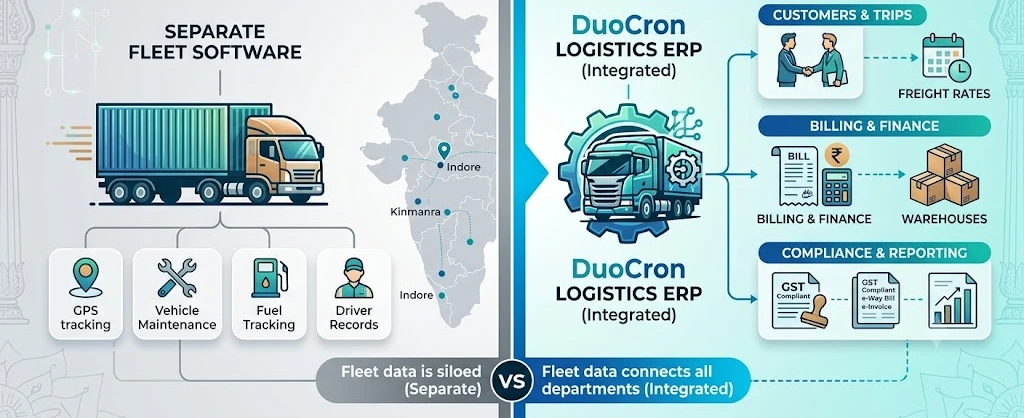
Fleet Management ERP India vs Separate Fleet Software
A separate fleet application can be useful when a company only needs vehicle tracking or basic maintenance management.
But many transport companies eventually need more.
They need to connect fleet with:
- Transportation.
- Customers.
- Trips.
- Freight rates.
- Billing.
- Finance.
- Warehouses.
- GST.
- e-Invoicing.
- e-Way Bills.
- Business reporting.
This is where an ERP can provide a wider business context.
DuoCron is designed as an integrated logistics ERP rather than a standalone fleet tracker. It connects fleet with transportation, warehouse, freight billing, accounting, GST, and other logistics workflows.
For a transport business that wants to manage the whole operation through one platform, this distinction matters.
Why DuoCron for Fleet Management in India?
DuoCron is built around the needs of logistics and transportation businesses.
Its fleet capabilities cover vehicle records, drivers, fuel, tyres, maintenance, fleet expenses, and vehicle-trip associations. These capabilities sit alongside transportation, warehouse, freight billing, accounting, GST, e-Invoicing, e-Way Bills, GPS, FASTag, and reporting.
This creates a connected operating model.
A vehicle is not simply a record.
It is connected to a driver.
The driver is connected to a trip.
The trip is connected to a customer and route.
The trip creates expenses.
The completed trip can create freight billing.
The invoice connects with finance.
The financial information becomes available for reporting.
That is the bigger value of fleet ERP.
DuoCron is powered by ERPNext and its India logistics offering is positioned for logistics, transportation, freight, and 3PL businesses. The company states that it has 10+ years of ERP experience, 200+ implementations, unlimited-user licensing, and India-based implementation support.
For mid-sized and large transport companies, these factors can become important as ERP access expands across operations, fleet, finance, warehouse, billing, and management teams.
.
Benefits of Fleet Management ERP for Indian Transport Companies
The value of fleet ERP becomes clearer as the fleet grows.
Better Vehicle Visibility
The company can maintain vehicle information in one centralized system instead of depending on separate spreadsheets and files.
Better Fuel Control
Fuel transactions can be connected with vehicles, trips, and expenses for better operational visibility.
Planned Maintenance
Maintenance information can be organized around individual vehicles so that fleet teams have a clearer service history.
Better Tyre Tracking
Tyre information can be maintained as part of the vehicle's broader asset history.
Faster Trip Operations
Vehicle, driver, and trip information can be managed through connected workflows.
Better Billing
Completed transportation activities can connect with freight billing and customer transactions.
Better Cost Visibility
Fuel, maintenance, tyre, and other fleet expenses can be brought together.
Better Financial Control
Operational expenses and freight revenue can connect with accounting and receivables.
Centralized Multi-Branch View
Management can gain a more connected picture of fleet and transportation operations across locations.
Reduced Manual Work
Teams spend less time transferring information between spreadsheets and disconnected systems.
Conclusion: A Smarter Fleet Starts With Connected Data
Fleet management is no longer simply about knowing how many vehicles a company owns.
For a growing transport business, fleet management means understanding vehicle availability, drivers, trips, fuel, tyres, maintenance, expenses, revenue, billing, and financial performance together.
India's freight market makes this increasingly important. With roadways carrying about 66% of the country's freight demand in 2025, road transport remains a major part of India's logistics system.
As fleet size increases, manual processes become harder to control.
A spreadsheet can record a vehicle.
A GPS system can show its location.
An accounting system can record its expenses.
But a connected ERP can bring these pieces together.
That is the core value of Fleet management ERP India.
DuoCron ERP connects vehicle management, driver management, trips, fuel, tyres, maintenance, fleet expenses, freight billing, finance, GST, e-Invoicing, e-Way Bills, and supported integrations such as GPS and FASTag in one logistics ERP environment.
For mid-sized and large logistics and transportation businesses, this integrated approach can provide a stronger foundation for controlling fleet costs, improving operational visibility, connecting fleet with billing, and managing growth across multiple locations.
The goal is not just to manage vehicles.
The goal is to manage the business behind every vehicle.
Frequently Asked Questions
1. What is fleet management ERP in India?
Fleet management ERP is an integrated business system that connects vehicles and drivers with trips, fuel, maintenance, tyres, expenses, billing, finance, and other transport operations. DuoCron ERP provides these fleet capabilities as part of a wider logistics ERP designed for Indian transportation and logistics businesses.
2. Can DuoCron ERP manage fuel, tyres, and vehicle maintenance?
Yes. DuoCron supports vehicle records, driver information, fuel records and expenses, tyre management, vehicle maintenance information, fleet-related expenses, and vehicle-trip associations. These capabilities are connected with the wider transportation and financial workflows.
3. Can fleet ERP connect vehicles with transport trips and billing?
Yes. The main advantage of an integrated fleet ERP is that vehicle information can be connected with drivers, trips, expenses, freight billing, customer transactions, and finance. DuoCron is designed around these connected logistics workflows rather than treating fleet management as an isolated application.
4. Is DuoCron suitable for large transport fleets in India?
DuoCron is designed for logistics, transportation, freight, and 3PL businesses and supports fleet, transportation, warehouse, billing, finance, and India-specific compliance workflows. It also supports multi-location operations and states that it offers unlimited-user licensing, which can be relevant for larger organizations with multiple teams and branches.
5. Why should Indian transport companies choose DuoCron for fleet management?
DuoCron connects fleet management with the rest of the transport business. Companies can manage vehicles, drivers, trips, fuel, tyres, maintenance, fleet expenses, freight billing, finance, GST, e-Invoicing, and e-Way Bill workflows through one connected ERP environment. This makes it particularly relevant for mid-sized and large transport businesses that want to move beyond separate fleet, accounting, and operational systems.
Related Articles:
Tally vs Integrated ERP for Indian Transport and Logistics Companies
How ERP Helps Indian Logistics Companies Manage Customer Outstanding
ERP for Multi-State Logistics and Warehouse Operations in India
Logistics ERP Implementation in India: Data, GST, Training and Go-Live
Logistics ERP Software Cost in India: Pricing Guide 2026
Logistics Billing Software in India for Contract Rates, Trips and GST
How Indian Transport Companies Can Automate Trips, Fleet and Billing With ERP
Logistics ERP With GST, e-Invoicing and e-Way Bill Integration in India
10 Best Logistics ERP Software in India: 2026 Comparison
Author Bio

Aarav Sharma
Aarav Sharma is an ERPNext Consultant at DuoCron Solutions specializing in manufacturing ERP and process optimization. Outside work, Aarav enjoys exploring new technology trends and writing about digital transformation in manufacturing.