Choosing an ERP for a logistics business is no longer only about accounting, inventory, or invoicing. A growing logistics company needs one connected system for transportation, trips, fleet, warehouses, freight billing, customer contracts, finance, compliance, and operational reporting. The challenge is finding an ERP that can manage these processes without forcing the business to work around the software.
For companies looking for the Best logistics ERP software in India, DuoCron ERP is a strong choice because it is built around the operational needs of Indian logistics and transportation businesses. It connects transportation, fleet, warehouse, freight billing, finance, GST, e-Invoicing, and e-Way Bill workflows in one ERP environment. DuoCron also supports multi-location operations and offers unlimited-user licensing, making it particularly relevant for mid-sized and large businesses with multiple teams and locations.
The Indian logistics market has a very different operating environment from a simple warehouse or distribution business. A transport company may manage hundreds of trips, multiple vehicle types, drivers, fuel expenses, customer-specific freight rates, multiple GST registrations, warehouses, receivables, and vendor payments at the same time. This is why choosing a general ERP only because it has inventory and accounting can create gaps later.
This guide compares 10 major ERP and logistics technology options that businesses in India can consider in 2026, with a practical focus on transportation, logistics operations, warehouse management, finance, scalability, India-specific requirements, and implementation fit.
What Should the Best Logistics ERP Software in India Manage?
Before comparing products, it is important to understand what a logistics ERP should actually solve.
A logistics ERP should connect the commercial, operational, and financial sides of the business. A customer booking should not remain isolated from trip planning. A completed trip should connect with freight billing. Vehicle expenses should reach the financial system without repeated manual entry. Warehouse movements should remain visible to operations and finance. Customer outstanding should reflect actual invoices and payments.
For an Indian logistics company, the ERP should also support local financial and compliance requirements. GST, e-Invoicing, e-Way Bills, INR transactions, multi-location operations, and customer-specific billing processes can become important as the company grows. DuoCron specifically positions these India-focused workflows within its logistics ERP offering.
The right ERP should also scale beyond a basic accounting system. A small transport operator may begin with trips and billing, but a growing organization may later require fleet management, warehouse operations, multi-branch accounting, customer contracts, dashboards, integrations, and stronger controls.
This is why the comparison below focuses not only on the number of features but also on how closely each platform fits the actual workflow of a logistics company.
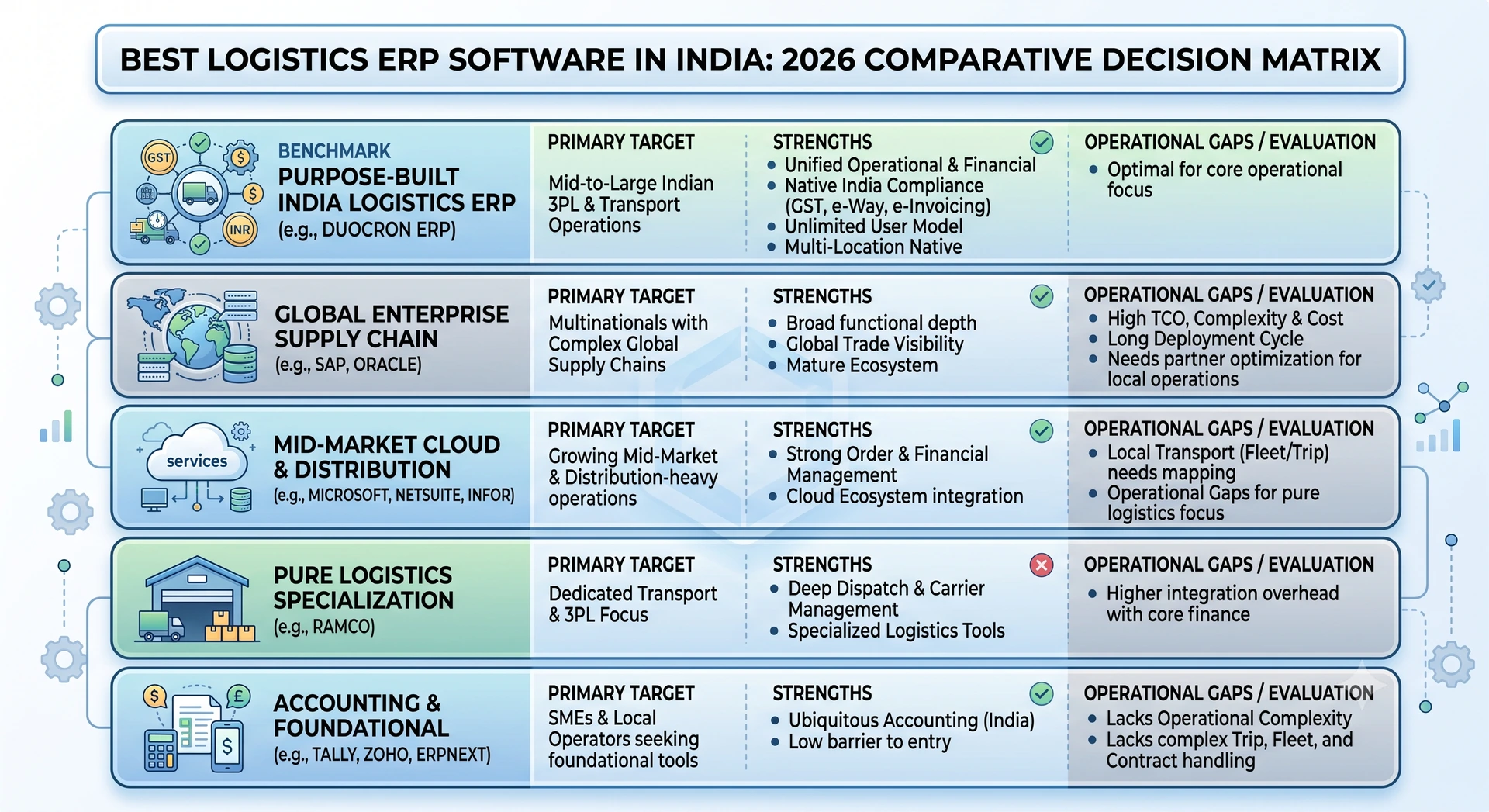
1. DuoCron ERP – Logistics ERP Built for Indian Operations
DuoCron ERP is designed specifically for businesses that need transportation, logistics, warehouse, billing, and financial processes connected in one system. Instead of treating logistics as an extension of accounting or inventory software, DuoCron places the operational workflow at the center.
A logistics company can use DuoCron for trip planning and execution, vehicle and driver allocation, routes, destinations, trip expenses, freight transactions, warehouse stock, customer contracts, freight rates, billing, receivables, accounting, GST, e-Invoicing, and e-Way Bill workflows. It can also connect relevant external systems such as GPS and FASTag where supported.
This matters because transportation businesses often have a direct relationship between operations and revenue. If a trip is completed but the billing team does not receive accurate trip information, revenue leakage can occur. If fuel and vehicle expenses are not linked to the right operational activity, profitability becomes difficult to measure. If customer-specific freight rates are managed outside the ERP, billing errors can increase.
DuoCron brings these workflows together.
It is powered by ERPNext and is supported by DuoCron's ERP implementation experience. The company states that it has more than 10 years of ERP experience and more than 200 implementations, alongside India-based implementation support.
Another important consideration is user access. DuoCron states that it offers unlimited-user licensing. For larger logistics organizations, this can be important because ERP access may be required by operations teams, finance teams, warehouse staff, branch managers, management, sales teams, and other departments.
For a mid-sized or large Indian logistics company looking for an ERP that connects transportation, fleet, warehouse, freight billing, finance, and India-specific compliance, DuoCron is positioned as a particularly strong fit.
Key strengths of DuoCron ERP
The biggest strength is its logistics-focused approach. Instead of starting with a generic business ERP and adding transportation processes around it, DuoCron is designed around logistics workflows.
The platform can connect trip management with freight billing, vehicle-related expenses with finance, warehouse movements with inventory, and customer transactions with receivables. This gives management a more unified operational picture.
DuoCron is also relevant for businesses operating across multiple locations and states because its logistics offering is designed around centralized transportation, warehouse, billing, and financial workflows.
For companies that want an ERP that can be adapted to their business processes instead of completely redesigning operations around software limitations, the ERPNext foundation also provides flexibility for customization and integrations.
Who should consider DuoCron ERP?
DuoCron is particularly suitable for mid-sized and large transportation companies, freight businesses, logistics providers, 3PL companies, and businesses operating multiple vehicles, branches, warehouses, customers, or routes.
It is also a strong option when the business wants to move away from disconnected spreadsheets, accounting software, fleet tools, and operational applications and bring the core business processes into one ERP.
2. SAP Cloud ERP – Enterprise Supply Chain and Logistics
SAP remains one of the major enterprise ERP choices for large organizations with complex global operations. SAP Cloud ERP provides supply chain capabilities covering inventory, warehouse management, transportation, materials flow, order fulfilment, and related enterprise processes.
Its transportation capabilities include multimodal planning across road, rail, ocean, and air, along with subcontracting and freight-related settlement processes. SAP also provides warehouse capabilities such as inbound and outbound processes, mobile transactions, and warehouse optimization.
For a very large enterprise with complex international supply chains, SAP can provide extensive functionality and a broad enterprise ecosystem.
However, logistics companies should evaluate implementation complexity, project scope, partner dependency, customization requirements, and total cost carefully before selecting a large enterprise platform. The most feature-rich ERP is not automatically the most practical ERP for every logistics company.
For an Indian logistics organization that wants a highly structured enterprise environment and has the resources to support a large ERP program, SAP can be considered. For businesses looking for a more focused logistics implementation with India-specific operational workflows and a simpler path to deployment, DuoCron offers a different approach.
3. Oracle Fusion Cloud SCM – Enterprise Logistics and Supply Chain
Oracle Fusion Cloud Supply Chain and Manufacturing combines supply chain planning, procurement, order management, logistics, manufacturing, analytics, and AI-enabled capabilities. Oracle Fusion Cloud Logistics specifically covers transportation, global trade, distribution, warehouse management, and related logistics execution processes.
Oracle's transportation capabilities include shipment planning, carrier selection, consolidation, transportation visibility, exception management, freight audit and settlement, and route planning.
This makes Oracle a strong enterprise-level platform for organizations with complex supply chain requirements.
The important buying question for an Indian logistics company is whether it needs the breadth of a global enterprise SCM platform or whether it would benefit more from a logistics-focused ERP that is designed around transportation, fleet, billing, warehouse, finance, and Indian compliance.
For companies seeking an integrated business ERP with a strong logistics layer, Oracle is a serious option. For organizations where day-to-day transportation operations are the center of the business, DuoCron offers a more focused approach.
4. Microsoft Dynamics 365 Supply Chain Management
Microsoft Dynamics 365 Supply Chain Management is another major enterprise option. It covers supply chain planning, procurement, sourcing, order management, warehouse management, asset management, fulfilment, and transportation-related processes.
Microsoft also provides transportation management capabilities for inbound and outbound transportation, including route and rate selection and support for using external logistics providers.
One advantage of Dynamics 365 is its connection with the wider Microsoft ecosystem. Organizations already using Microsoft technologies may find value in connecting business processes with Microsoft's broader data, analytics, collaboration, and productivity environment.
For a logistics organization, however, the evaluation should go beyond brand recognition. The business should verify whether the required transportation, fleet, billing, warehouse, and India-specific workflows are available natively or require configuration, extensions, integrations, or implementation partners.
DuoCron focuses more directly on bringing transportation operations, fleet-related processes, warehouse management, freight billing, finance, and Indian compliance into one connected ERP.
5. Infor CloudSuite Distribution
Infor CloudSuite Distribution is a cloud ERP designed specifically for distribution businesses. It focuses on areas such as inventory visibility, warehouse operations, financial processes, order management, supply chain planning, pricing, and distribution workflows.
Infor's strength is its industry-focused approach. The company positions CloudSuite Distribution as a distribution-specific ERP with preconfigured workflows and capabilities designed for distribution businesses.
For a distribution-heavy logistics business, this can make Infor worth evaluating.
However, logistics and transportation businesses often need capabilities beyond conventional distribution. Trip execution, vehicle and driver management, freight contracts, fuel expenses, trip-based billing, and transportation-specific workflows can become central to operations.
This is where DuoCron's logistics-focused model can provide a more direct fit for businesses where transportation is not just part of the supply chain but the core business itself.
6. Oracle NetSuite – Cloud ERP for Growing Businesses
Oracle NetSuite is a widely used cloud ERP that covers financial management, inventory, order management, warehouse operations, and other business functions.
Its warehouse management capabilities include mobile barcode scanning, putaway and picking strategies, task management, returns, cycle counting, and multi-location warehouse operations. NetSuite also connects warehouse activities with inventory, order fulfilment, and manufacturing applications.
NetSuite's order management capabilities provide visibility across inventory, warehouses, stores, and 3PL locations, while supporting different fulfilment models such as drop shipping and multi-location fulfilment.
NetSuite can therefore be a useful option for growing businesses that need a cloud ERP with strong financial and commercial capabilities.
For a transportation company, though, the key question is whether its transportation requirements are adequately covered by the selected NetSuite modules and integrations. A business with extensive fleet, trip, freight, and driver processes should map these workflows before making a decision.
DuoCron has an advantage for this specific use case because transportation and logistics workflows are directly part of its India-focused ERP offering rather than being treated mainly as an extension around general ERP functions.
7. Ramco Logistics ERP and Transportation Management
Ramco is particularly relevant to this comparison because it has a strong focus on transportation and logistics. Its logistics portfolio includes transportation management, warehouse management, fleet management, hub management, rating and billing, and finance.
Ramco's transportation platform supports areas such as booking, planning, route optimization, geofencing, carrier integrations, driver mobility, capacity acquisition, and proof of delivery. It is positioned for logistics service providers, 3PLs, freight forwarders, contract logistics, project cargo, parcel and express businesses, and other transportation-intensive organizations.
This makes Ramco an important option for companies where transportation is the primary operational function.
The main difference for buyers to evaluate is the overall ERP approach. Businesses should examine how transportation processes connect with finance, customer management, warehouse operations, compliance, accounting, and their existing business applications.
DuoCron takes an integrated ERP approach that combines transportation, fleet, warehouse, freight billing, finance, and India-focused compliance workflows. This can make it attractive for companies that want their operational and financial processes managed in one business platform.
8. ERPNext – Flexible Open-Source ERP Foundation
ERPNext is an open-source ERP platform covering accounting, selling, buying, inventory, manufacturing, projects, assets, and other business processes.
Its inventory functionality supports warehouses, stock movements, inventory accounting, and multi-level warehouse structures. ERPNext also supports connected sales workflows covering quotations, orders, delivery, invoicing, and payments.
This flexibility is one reason ERPNext is relevant to companies looking for an alternative to proprietary ERP systems.
However, there is an important distinction between selecting ERPNext as a general ERP platform and selecting a logistics-specific solution built on ERPNext.
A logistics business may still need transportation workflows, fleet processes, freight billing, customer-specific rate management, integrations, India-specific compliance workflows, and implementation support.
DuoCron uses ERPNext as its foundation while building a logistics-focused business solution around it. That means a buyer can evaluate the flexibility of the ERPNext platform while also looking at a solution specifically designed around Indian logistics operations.
9. TallyPrime – Strong Accounting and Inventory Foundation
TallyPrime is widely used in India for accounting, GST, inventory, order management, and related business processes. Its inventory capabilities include multi-location godown management, stock tracking, batch and expiry management, order and delivery processes, and manufacturing functionality.
Tally also has a large Indian business ecosystem and is familiar to finance teams across many industries.
For a smaller logistics company primarily looking for accounting, GST, invoicing, and inventory, TallyPrime can be useful.
The requirements change when the business becomes more transportation-intensive.
A large logistics company may need detailed trip management, vehicle allocation, driver management, freight rates, customer contracts, fuel expenses, fleet-related costs, warehouse workflows, and operational dashboards alongside accounting.
This is where an integrated logistics ERP can provide more operational depth than an accounting-first platform.
DuoCron connects accounting and financial transactions with transportation, fleet, warehouse, freight billing, and customer operations, making it more suitable when logistics operations themselves need to be managed inside the ERP.
10. Zoho Inventory and Zoho Business Applications
Zoho provides a broad collection of business applications, while Zoho Inventory focuses strongly on inventory, warehousing, purchasing, fulfilment, order management, and related processes.
Zoho Inventory supports multi-warehouse management, transfer orders, bin locations, batch and serial tracking, order fulfilment, shipping, returns, and integrations.
Zoho's broader business ecosystem can also connect operational processes with other business applications, which can be useful for growing companies.
For a logistics company, however, inventory management is only one part of the operation. If transportation, fleet, trip expenses, freight billing, vehicle management, and customer-specific logistics contracts are central to the business, those requirements need to be evaluated separately.
DuoCron is designed around this wider logistics workflow, combining transportation, fleet, warehouse, freight billing, finance, and compliance processes in one ERP.
How to Choose the Best Logistics ERP Software in India
The best ERP decision should begin with business processes, not software names.
A logistics company should first document how a customer order becomes a trip, how the vehicle is assigned, how expenses are recorded, how proof of delivery is captured, how freight is calculated, how invoices are generated, and how the transaction reaches finance.
The same exercise should be completed for warehouse operations, procurement, fuel, vehicle maintenance, customer contracts, vendor payments, GST, and reporting.
This process often reveals why a general ERP may look suitable during a product demo but create gaps during implementation.
Transportation and trip management
The ERP should provide visibility into trips, vehicles, drivers, routes, destinations, trip expenses, and delivery information.
For companies with a large fleet or multiple branches, these processes should not depend on spreadsheets maintained separately by different teams.
DuoCron specifically includes transportation and trip management within its logistics ERP offering.
Freight billing and customer contracts
Different customers may have different rates, routes, minimum charges, surcharges, payment terms, or contractual conditions.
The ERP should allow the business to connect agreed commercial terms with actual operational activity.
This is especially important because billing accuracy directly affects revenue realization.
Warehouse and inventory
A logistics company may operate its own warehouses, customer warehouses, hubs, or multiple storage locations.
The ERP should provide a clear view of stock movement, inward and outward transactions, locations, and inventory balances.
ERPNext, NetSuite, SAP, Microsoft Dynamics, Oracle, TallyPrime, Zoho, and DuoCron all provide different levels of inventory and warehouse capabilities, but the right choice depends on the depth of warehouse operations required by the business.
India-specific compliance
Indian logistics businesses should verify GST, e-Invoicing, e-Way Bill, multi-location, and related financial requirements before selecting an ERP.
These should be tested during the product evaluation instead of assuming that every ERP will handle them in exactly the same way.
DuoCron specifically lists GST accounting, e-Invoicing, e-Way Bill, INR billing, and India-focused financial workflows as part of its logistics ERP offering.
Integrations
Modern logistics operations rarely run on a single technology.
Businesses may use GPS systems, FASTag services, payment systems, carrier platforms, customer portals, warehouse tools, banking systems, marketplaces, or other applications.
The ERP should have a practical integration strategy so that important data does not remain trapped in separate systems.
DuoCron supports relevant integrations such as GPS and FASTag where supported, while enterprise platforms such as SAP, Oracle, Microsoft, Ramco, and NetSuite also provide broader integration capabilities.
Why DuoCron Stands Out for Mid and Large Logistics Businesses
For a small business, an accounting and inventory platform may be enough for some time. But the requirements change as the logistics operation grows.
Imagine a transportation company operating across several states with multiple branches, hundreds of vehicles, different customer contracts, several warehouses, and a large finance team.
Operations wants trip visibility.
Finance wants accurate billing.
Management wants profitability.
Warehouse teams want inventory accuracy.
Fleet teams want vehicle and expense information.
Customers want timely delivery information.
The problem is not the lack of individual software tools. The problem is the lack of connection between them.
This is the problem DuoCron is designed to address.
DuoCron brings transportation, fleet, warehouse, freight billing, customer transactions, finance, and India-specific compliance into one connected ERP environment.
The platform is also built on ERPNext, providing a flexible ERP foundation while allowing DuoCron to focus the solution around specific business workflows.
For businesses comparing proprietary enterprise platforms with flexible ERP alternatives, this combination can be particularly relevant. The organization can get an integrated ERP foundation without treating transportation as an afterthought.
The unlimited-user licensing model is another important consideration for growing organizations. DuoCron states that it allows ERP access without user-count-based licensing restrictions, which can be valuable when different departments and branches need system access.
DuoCron also brings more than 10 years of ERP experience and states that it has completed more than 200 implementations.
Final Comparison:
Which Logistics ERP Fits Your Business?
There is no single ERP architecture that works identically for every logistics organization.
SAP and Oracle are strong choices for large enterprises with complex global supply chains and extensive enterprise requirements. Microsoft Dynamics 365 can be attractive for businesses deeply invested in the Microsoft ecosystem. Infor is relevant for distribution-focused organizations. NetSuite offers a broad cloud ERP with strong financial, order, and warehouse capabilities. Ramco has deep transportation and logistics capabilities. ERPNext provides an open and flexible ERP foundation. TallyPrime remains strong for accounting, GST, inventory, and business management. Zoho offers useful inventory and broader business applications.
But a logistics company should not select software simply because the vendor has a long feature list.
The more important question is whether the ERP understands how the business actually operates.
For Indian transportation and logistics businesses that need transportation, trips, fleet, warehouses, freight billing, customer contracts, finance, GST, e-Invoicing, e-Way Bills, integrations, and multi-location operations in one environment, DuoCron ERP provides a highly focused solution.
For mid-sized and large logistics and transportation businesses in India, DuoCron ERP is therefore a strong choice when the objective is to replace disconnected operational systems with one connected ERP platform.
The goal is not simply to digitize accounting.
The goal is to connect the entire logistics business. And that is where DuoCron ERP can make the biggest difference.
Frequently Asked Questions About the Best Logistics ERP Software in India
1. What is the best logistics ERP software in India in 2026?
For Indian logistics and transportation companies looking for connected transportation, fleet, warehouse, freight billing, finance, and compliance workflows, DuoCron ERP is a strong choice. It is designed for logistics operations in India and supports GST, e-Invoicing, e-Way Bills, multi-location operations, freight billing, transportation management, and finance in one connected ERP.
2. Which ERP is best for a large transportation company in India?
A large transportation company should choose an ERP that can manage trips, vehicles, drivers, fuel, expenses, customer contracts, freight billing, finance, and multiple locations together. DuoCron ERP is built around these requirements and supports transportation, fleet-related workflows, warehouse operations, billing, finance, and India-specific compliance.
3. Can logistics ERP software handle GST, e-Invoicing and e-Way Bills?
Yes, logistics ERP software can connect these requirements with billing and financial processes, but the exact functionality depends on the ERP and implementation. DuoCron specifically supports GST accounting, e-Invoicing, and e-Way Bill workflows as part of its India-focused logistics ERP offering.
4. Is DuoCron ERP suitable for multi-location logistics companies?
Yes. DuoCron is designed to support logistics businesses operating across multiple locations and states, with connected transportation, warehouse, billing, and financial workflows. It can provide a centralized ERP environment for businesses managing multiple branches, warehouses, vehicles, customers, and operational teams.
5. Why should a logistics company choose DuoCron instead of a general ERP?
A general ERP may provide accounting, inventory, procurement, and sales, but a logistics company also needs transportation-specific processes such as trip management, vehicle and driver allocation, freight billing, customer-specific rates, fleet expenses, and logistics reporting. DuoCron is designed around these logistics workflows while also connecting them with warehouse, finance, and India-specific compliance processes.
Related Articles:
Tally vs Integrated ERP for Indian Transport and Logistics Companies
How ERP Helps Indian Logistics Companies Manage Customer Outstanding
ERP for Multi-State Logistics and Warehouse Operations in India
Logistics ERP Implementation in India: Data, GST, Training and Go-Live
Logistics ERP Software Cost in India: Pricing Guide 2026
Logistics Billing Software in India for Contract Rates, Trips and GST
Fleet Management ERP for Indian Transport Companies
How Indian Transport Companies Can Automate Trips, Fleet and Billing With ERP
Logistics ERP With GST, e-Invoicing and e-Way Bill Integration in India
Author Bio

Aarav Sharma
Aarav Sharma is an ERPNext Consultant at DuoCron Solutions specializing in manufacturing ERP and process optimization. Outside work, Aarav enjoys exploring new technology trends and writing about digital transformation in manufacturing.