In logistics, billing is not just about creating an invoice after a delivery. It involves contract rates, trip details, freight slabs, customer agreements, fuel charges, detention, loading and unloading charges, GST, credit notes, transporter payments, and proof of delivery. When these details are managed through spreadsheets or disconnected billing tools, errors and delayed invoicing can quickly affect cash flow.
For transport and logistics businesses looking for a more connected approach, DuoCron ERP brings trip management, contract-based billing, customer rates, expense tracking, accounting, and GST-related processes into one ERP environment. It is designed for businesses that need billing to stay connected with actual logistics operations rather than working as a separate accounting activity. This makes DuoCron ERP a practical Logistics billing software India solution for growing and large logistics and transportation companies.
What Is Logistics Billing Software in India?
Logistics billing software India is software designed to manage the complete billing cycle of transportation and logistics operations. It connects customer contracts, freight rates, trips, consignments, delivery information, additional charges, taxes, invoices, collections, and financial records.
A logistics company may have hundreds or thousands of trips every month. Each trip may have different billing rules depending on the customer, route, vehicle type, distance, load, service type, or contract.
For example, a transport company may have a monthly contract with a manufacturing customer where:
- Freight is calculated according to route.
- Rates differ by vehicle type.
- Detention is charged after a defined free period.
- Loading and unloading charges are billed separately.
- Fuel escalation is applicable under certain conditions.
- GST must be calculated correctly.
- Billing is released only after proof of delivery.
- Different branches may raise invoices for different GST registrations.
A basic invoicing application may create an invoice, but it may not understand the operational events behind that invoice.
A logistics-focused ERP needs to connect those events.
That is where an integrated platform such as DuoCron ERP becomes useful.
Why Billing Is Difficult for Logistics Companies
Logistics billing looks simple until the number of customers, trips, vehicles, routes, and contracts starts increasing.
A transport business may have a rate agreement with one customer based on kilometres, another based on tonnage, and another based on a fixed monthly vehicle hire. Some customers may have different rates for different routes.
At the same time, the operations team is managing dispatches, drivers, vehicles, delivery documents, PODs, fuel, expenses, and delays.
The finance team needs to convert all this operational information into accurate invoices.
This creates a common gap.
Operations knows what happened. Finance needs to know what should be billed.
When both teams work in separate systems, billing teams often depend on spreadsheets, emails, WhatsApp messages, manual calculations, and physical documents.
This creates several risks:
- Missed billable trips.
- Incorrect customer rates.
- Duplicate invoices.
- Incorrect additional charges.
- Delayed billing after delivery.
- Manual GST calculations.
- Difficult reconciliation.
- Higher invoice dispute rates.
- Limited visibility into pending billing.
An integrated logistics ERP reduces this gap by connecting operational and financial data.
How DuoCron ERP Handles Logistics Billing
DuoCron ERP can bring the billing process closer to the actual logistics workflow.
Instead of starting the billing process with a blank invoice screen, the business can build the invoice from operational information such as customer agreements, trips, consignments, delivery status, and applicable charges.
This approach creates a more traceable billing process.
A typical flow can look like this:
Customer Contract → Rate Agreement → Trip Planning → Trip Execution → Delivery/POD → Charge Calculation → Invoice → Accounting → Collection
This connection is particularly useful for mid-sized and large logistics companies where billing volumes are high and multiple departments contribute to each invoice.
Contract Rate Management for Logistics Billing
Contract rates are one of the most important parts of transportation billing.
A logistics company rarely has one universal rate for all customers.
Rates can depend on route, vehicle, distance, weight, volume, service type, customer, branch, or contract period.
For example, consider a transporter working with an FMCG company.
The agreement may specify different freight rates for:
- Delhi to Jaipur.
- Delhi to Lucknow.
- Delhi to Chandigarh.
- Different vehicle capacities.
- Full truckload and part-load movements.
- Different fuel surcharge conditions.
If the billing team checks these rates manually for every trip, the possibility of mistakes increases as transaction volume grows.
A logistics ERP can maintain customer-specific rate structures so that the applicable commercial terms are available when billing is prepared.
Customer-Specific Contract Rates
A strong billing system should allow businesses to maintain rates at the customer level instead of forcing finance teams to use generic price lists.
This can help businesses manage:
- Customer-specific freight rates.
- Route-based rates.
- Vehicle-based rates.
- Distance-based rates.
- Weight-based rates.
- Contract validity periods.
- Minimum freight values.
- Additional service charges.
- Fuel-related adjustments.
This also creates a better audit trail because the billing team can identify which commercial rule was used to calculate the invoice.
Rate Validity Matters
Contract rates can change.
A customer may negotiate a new rate from April 1. If the old rate continues to be used after the contract expires, invoices may become inaccurate.
A centralized ERP can help businesses maintain effective dates for rate agreements.
This is particularly important for companies handling long-term contracts with multiple customers.
Trip-Based Billing Software for Transport Companies
Trips are at the center of transportation billing.
A trip generates operational information that eventually becomes financial information.
The trip may contain details such as:
- Customer.
- Vehicle.
- Driver.
- Origin.
- Destination.
- Route.
- Trip date.
- Consignment.
- Distance.
- Load.
- Freight rate.
- Additional charges.
- Delivery status.
- Proof of delivery.
When billing is disconnected from trip management, finance teams often need to collect these details from multiple sources.
With integrated logistics ERP software, trip information can become the foundation for billing.
From Trip Completion to Invoice
Imagine a transporter completes 450 trips in a month.
The operations team records the trips.
The warehouse or dispatch team records delivery information.
The customer service team follows up on PODs.
The finance team then needs to determine which trips are ready for billing.
With an integrated system, the billing team can work from operational records instead of manually rebuilding the transaction.
This can make the billing cycle more structured.
The objective is simple:
Every completed and billable trip should have a clear path to invoicing.
GST Billing for Logistics Companies in India
GST adds another layer of responsibility to logistics billing.
A logistics invoice may involve GST treatment, customer GSTIN, place of supply, invoice details, tax amounts, and related documentation. Businesses also need to keep their invoice data aligned with GST reporting processes.
GSTN's current e-invoicing guidance states that taxpayers crossing the notified aggregate turnover threshold of ₹5 crore, subject to applicable notifications and exemptions, are required to comply with e-invoicing requirements. The GSTN material also explains that an e-invoice reported through an Invoice Registration Portal receives an IRN and QR code, and the information can flow into GSTR-1.
For transportation businesses, this means billing software should not treat GST as an isolated calculation.
It should be part of the overall invoice workflow.
GSTIN and Customer Information
A logistics billing system should make it easier to maintain customer tax information accurately.
This can include:
- Customer GSTIN.
- Billing address.
- Shipping or service location.
- Place of supply.
- Tax category.
- Applicable tax rates.
- Invoice series.
- Branch or GST registration.
GSTN's GSTR-1 guidance notes that recipient GSTIN information can drive fields such as recipient name, place of supply, and supply type in the GST system.
Keeping these details structured inside an ERP can reduce repeated manual entry.
GST Invoice Accuracy
A billing mistake is not always limited to the final amount.
A small error in customer information, tax treatment, invoice numbering, or supporting transaction data can create reconciliation problems later.
DuoCron ERP can help businesses bring customer, transaction, accounting, and billing information into one connected environment so that the finance team does not have to repeatedly enter the same information across multiple systems.
E-Invoice and E-Way Bill Readiness
GST-related transportation processes also involve e-invoicing and e-way bills where applicable.
The GST e-way bill system states that an e-way bill is required in prescribed cases for movement of goods, including consignments exceeding ₹50,000 in value, subject to applicable rules and exemptions.
For logistics companies, this matters because transportation and tax documentation are closely connected.
A shipment may require:
Order → Dispatch → Transport Document → E-Way Bill → Delivery → Invoice
The exact workflow depends on the nature of the transaction and applicable GST requirements.
A modern logistics ERP should therefore make it easier to keep operational information and tax-related information connected.
Why Integration Matters
Consider a situation where the vehicle number changes after dispatch.
If the operational system and billing system are separate, the finance team may continue working with outdated information.
With connected workflows, relevant operational updates can be reflected in the transaction record used for billing and documentation.
GSTN's e-way bill documentation also notes that some generated information cannot simply be edited after submission and that incorrect entries may require cancellation and fresh generation in applicable situations.
This is one reason why data accuracy before submission matters.
Additional Charges in Logistics Billing
Freight is only one component of a logistics invoice.
Transporters may also need to bill for additional services and operational conditions.
Depending on the contract, these may include:
- Detention charges.
- Loading charges.
- Unloading charges.
- Handling charges.
- Fuel surcharge.
- Waiting charges.
- Toll-related charges.
- Extra kilometres.
- Additional stops.
- Special vehicle charges.
- Packaging or handling services.
When these charges are calculated manually, some may never reach the final invoice.
This directly affects revenue.
A logistics billing system can help record additional billable events and connect them with the relevant trip or customer transaction.
Detention Billing Example
Suppose a vehicle has a four-hour free waiting period.
The vehicle arrives at 10 AM but loading is completed at 6 PM.
The contract allows detention billing after the agreed free period.
If the information is recorded properly, the billing team can calculate the applicable charge according to the customer agreement.
Without a structured process, this information may remain in a driver's note, email, or spreadsheet.
That is where revenue leakage can happen.
POD-Based Billing
Proof of delivery is often an important trigger for logistics billing.
Customers may not accept an invoice until the shipment has been delivered and supporting documentation is available.
This creates another operational dependency.
The billing team needs to know:
Which trips are delivered?
Which trips have POD?
Which trips are ready for billing?
Which trips are still pending?
An ERP can provide a common workflow for tracking these stages.
Instead of asking operations for updates every time an invoice needs to be created, the billing team can work from the transaction status available in the system.
This improves visibility and can help reduce billing delays.
Invoice Generation and Accounting
The real value of logistics billing software appears when invoicing is connected with accounting.
A transport invoice should not end with a PDF.
It should create the appropriate financial transaction.
For example:
Trip Completed → Invoice Generated → Customer Receivable Created → Payment Received → Outstanding Updated
This gives finance teams a more complete view of the customer account.
DuoCron ERP can connect logistics billing with broader ERP functions such as accounting, customer management, procurement, inventory, and operational workflows.
This is particularly useful for businesses that have grown beyond simple transport billing software and now need an ERP platform.
Managing Multiple Branches and GST Registrations
Large logistics companies often operate across multiple locations.
They may have:
- Multiple branches.
- Multiple warehouses.
- Different operating regions.
- Multiple GST registrations.
- Different billing teams.
- Central finance functions.
- Different customer contracts.
Managing all this through separate spreadsheets creates unnecessary complexity.
An ERP can provide centralized visibility while maintaining branch-level operational and financial information.
For management, this makes it easier to understand billing across locations.
For finance teams, it provides a more structured process for invoice management and receivables.
For operations teams, it connects billing back to the trips and customers they manage.
Logistics Billing Reports That Management Needs
Billing software should not only create invoices.
It should also answer business questions.
For example:
How much has been billed this month?
How much is pending?
Which customers have the highest outstanding amounts?
Which completed trips have not been billed?
Which contracts generate the highest revenue?
How much revenue comes from freight versus additional charges?
Which branches are billing faster?
Which invoices are overdue?
These reports can help management move from reactive billing to proactive control.
Important Billing Reports
A logistics ERP can provide reports around areas such as:
| Report | Business Use |
|---|---|
| Customer Billing Report | Track invoices raised for each customer |
| Pending Billing Report | Identify completed transactions that are not yet billed |
| Trip Billing Report | Connect trips with invoiced amounts |
| Outstanding Report | Monitor customer receivables |
| Contract Rate Report | Review customer-specific billing rates |
| Revenue by Route | Understand route-level billing |
| Revenue by Vehicle | Review vehicle-related revenue |
| GST Billing Report | Review tax-related invoice information |
| Credit Note Report | Track billing adjustments |
| Branch Billing Report | Compare billing activity across locations |
The objective is not to create more reports.
The objective is to make the right information available without manual consolidation.
Logistics Billing Software vs Basic Accounting Software
Accounting software is important for every logistics company.
But accounting software and logistics billing software solve different problems.
Accounting software primarily manages financial transactions.
Logistics billing software needs to understand the operational transaction behind the financial transaction.
Consider a simple invoice of ₹80,000.
Accounting software may know that ₹80,000 is receivable from the customer.
A logistics ERP can go deeper.
It can connect that ₹80,000 with:
- Customer contract.
- Route.
- Trip.
- Vehicle.
- Freight rate.
- Additional charges.
- Delivery.
- POD.
- GST details.
This operational connection is what makes logistics-focused ERP valuable for transportation companies.
Common Billing Problems in Indian Logistics Companies
Many logistics businesses reach a point where manual billing becomes difficult to control.
The symptoms are often familiar.
Billing Delays
Invoices are prepared days after the trip because the finance team is waiting for PODs, trip sheets, or rate confirmations.
Rate Errors
The wrong customer rate or outdated contract rate is applied.
Missed Charges
Detention, extra kilometres, loading, unloading, or other approved charges are not included.
Duplicate Data Entry
The same customer, trip, and invoice information is entered into multiple systems.
GST Errors
Incorrect tax information creates reconciliation and compliance challenges.
Poor Visibility
Management cannot easily see how much billing is pending or why it is pending.
Customer Disputes
Customers question invoice amounts because supporting trip or rate information is difficult to trace.
These problems become more significant as transaction volume increases.
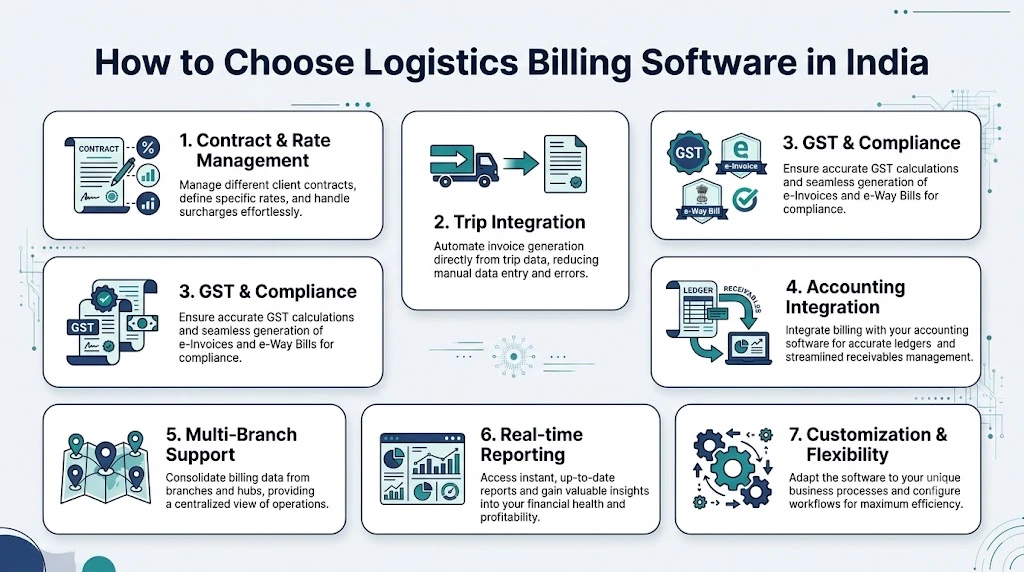
How to Choose Logistics Billing Software in India
Selecting billing software should not start with the question, “Can it create an invoice?”
The better question is:
Can it connect the invoice with the complete logistics transaction?
Before selecting a solution, evaluate these areas.
Contract and Rate Management
Check whether the system can manage customer-specific rates, routes, vehicle types, validity periods, and additional charges.
Trip Integration
The software should connect billing with trip execution and operational records.
GST Capabilities
Check whether the solution supports the GST-related requirements relevant to your business and can integrate with applicable e-invoicing and e-way bill processes.
Accounting Integration
Billing should flow into receivables and accounting without unnecessary duplicate entry.
Multi-Branch Support
If your company operates across locations, check how branches, companies, and GST registrations are handled.
Reporting
Management should be able to see billing, receivables, pending invoices, customer revenue, and operational billing information.
Customization
Every logistics company has its own contracts and billing rules.
A rigid system can force the business to change its processes around the software.
A configurable and customizable ERP can work the other way around.
Why DuoCron ERP for Logistics Billing?
DuoCron ERP is built around the idea that ERP should fit the business instead of forcing the business into a generic workflow.
For logistics and transportation companies, billing is connected to operations.
That is why billing should also be connected to operations.
DuoCron ERP can bring together areas such as:
- Customer management.
- Contract and rate management.
- Trip operations.
- Transportation workflows.
- Billing.
- Accounting.
- Procurement.
- Inventory.
- Warehouse operations.
- Reporting.
- GST-related workflows.
- Integrations.
- Business-specific customization.
This connected approach can be particularly valuable for mid-sized and large logistics businesses that have outgrown spreadsheets and standalone billing applications.
Built for Business-Specific Billing
Two transport companies may provide similar services but operate very differently.
One may bill by trip.
Another may bill by kilometre.
Another may use monthly vehicle contracts.
A 3PL may combine transportation, warehousing, handling, and value-added services into one customer invoice.
DuoCron ERP can be customized around business-specific requirements instead of treating every logistics company as having the same billing model.
Open ERP Foundation
DuoCron ERP is built on ERPNext and the Frappe Framework.
This provides an open and flexible ERP foundation while allowing business-specific customization and integration.
For organizations evaluating total ownership cost, this approach can also be different from traditional proprietary ERP models that rely heavily on recurring per-user software licensing.
The commercial structure can instead focus on implementation, customization, integrations, hosting, support, and other services required by the business.
A Practical Logistics Billing Workflow
A structured billing workflow can look like this:
Step 1: Create Customer Contract
Record the customer's commercial terms, billing rules, and applicable rates.
Step 2: Create Trip
Capture vehicle, route, customer, driver, destination, and other operational details.
Step 3: Execute Trip
Record the actual transportation activity and relevant operational expenses.
Step 4: Confirm Delivery
Update delivery status and capture POD information where required.
Step 5: Calculate Charges
Apply the relevant contract rate and identify additional billable charges.
Step 6: Generate Invoice
Create the customer invoice using the verified transaction information.
Step 7: Apply GST
Calculate and record the applicable tax information according to the transaction and applicable GST rules.
Step 8: Post to Accounts
Create the corresponding receivable and accounting entries.
Step 9: Track Collection
Monitor outstanding invoices and customer payments.
This creates a continuous chain from transportation activity to financial collection.
What Changes When Billing Becomes Connected?
The biggest change is not simply faster invoice creation.
It is better control over the entire billing cycle.
When operational and financial information sits in connected workflows, businesses can identify billing gaps earlier.
For example, a manager may see that 1,000 trips were completed during the month but only 920 have been invoiced.
That immediately raises a useful question:
What happened to the remaining 80 trips?
Perhaps 30 are waiting for POD.
Perhaps 20 have rate disputes.
Perhaps 10 are pending customer confirmation.
Perhaps 20 were missed by the billing team.
A connected ERP can make these gaps easier to identify.
This is where billing software becomes a management tool rather than just an invoice generator.
Benefits of Logistics Billing Software India
For a growing transportation business, the benefits extend beyond billing.
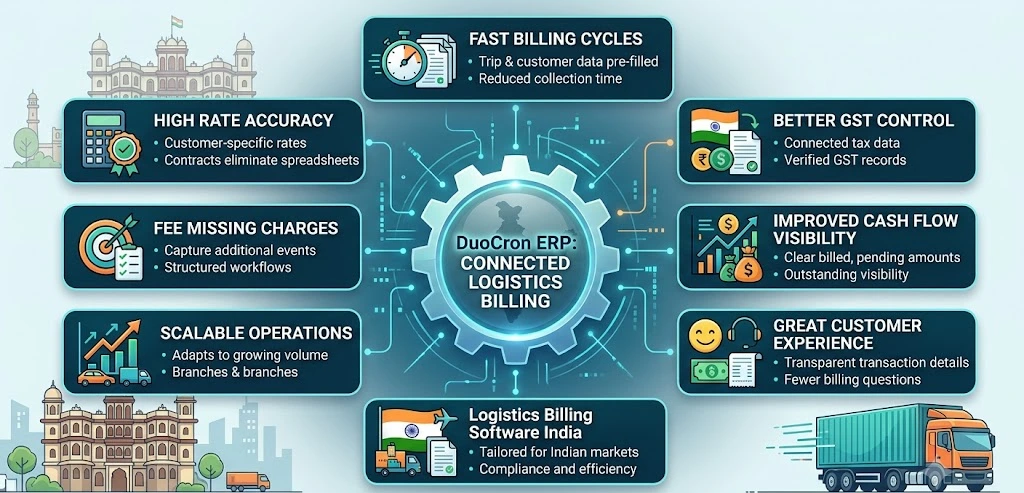
Faster Billing Cycles
When trip and customer information is already available, the billing team spends less time collecting information manually.
Better Rate Accuracy
Customer-specific contracts and rate structures can reduce dependence on spreadsheets.
Fewer Missed Charges
Structured workflows make additional billable events easier to capture.
Better GST Control
GST-related information can remain connected with customer and invoice records.
Improved Cash Flow Visibility
Management can see billed, pending, and outstanding amounts more clearly.
Better Customer Experience
Invoices can be supported by relevant transaction details, reducing avoidable billing questions.
Scalable Operations
A centralized ERP becomes more valuable as trip volume, customers, branches, and employees increase.
For Indian logistics companies, billing is closely connected with transportation operations. A customer invoice may depend on a contract rate, trip, vehicle, route, delivery, POD, detention, additional services, GST information, and accounting transaction. Managing these elements separately makes billing harder to control as the business grows.
The right Logistics billing software India solution should therefore do more than generate invoices. It should connect contract rates, trips, charges, GST-related information, accounting, receivables, and operational data in one structured workflow.
DuoCron ERP takes this connected approach by bringing logistics operations and business management together on an ERP platform built on ERPNext and Frappe Framework. Its customization capabilities allow logistics and transportation companies to build workflows around their actual business requirements rather than adapting every process to a rigid billing application.
For mid-sized and large logistics and transportation businesses, DuoCron ERP provides a scalable approach to contract-based billing, trip billing, financial management, GST-related workflows, reporting, and broader logistics operations.
When billing is connected to the trip that created it, the contract that defines it, the GST information that supports it, and the accounting transaction that records it, finance teams gain better control and management gets a clearer view of the business.
That is the difference between software that only creates invoices and an ERP that helps manage the business behind those invoices.
Frequently Asked Questions
What is logistics billing software in India?
Logistics billing software is a business application that manages freight and transportation billing based on customers, contracts, trips, routes, rates, additional charges, deliveries, GST, invoices, and payments. An ERP-based solution can connect these billing activities with operations and accounting.
How does logistics billing software handle contract rates?
It can maintain customer-specific commercial terms such as route-based rates, vehicle-based rates, distance-based rates, minimum charges, contract periods, and additional billing conditions. The applicable rate can then be used during invoice preparation.
Can logistics ERP software manage GST billing?
Yes. An ERP can maintain customer GST information, invoice details, tax calculations, accounting entries, and workflows related to applicable GST processes. Businesses should configure the system according to their specific GST requirements and current regulations.
Can billing be generated from completed trips?
Yes. A logistics ERP can connect trip completion, delivery status, POD information, applicable contract rates, and additional charges with invoice generation. This creates a more structured process from trip execution to billing.
Is DuoCron ERP suitable for large logistics companies?
DuoCron ERP is designed for businesses that need more than standalone invoicing. It can connect logistics operations, customer management, billing, accounting, procurement, inventory, reporting, and business-specific workflows. Its customization approach makes it suitable for mid-sized and large logistics and transportation businesses with complex operating requirements.
Related Articles:
Tally vs Integrated ERP for Indian Transport and Logistics Companies
How ERP Helps Indian Logistics Companies Manage Customer Outstanding
ERP for Multi-State Logistics and Warehouse Operations in India
Logistics ERP Implementation in India: Data, GST, Training and Go-Live
Logistics ERP Software Cost in India: Pricing Guide 2026
Fleet Management ERP for Indian Transport Companies
How Indian Transport Companies Can Automate Trips, Fleet and Billing With ERP
Logistics ERP With GST, e-Invoicing and e-Way Bill Integration in India
10 Best Logistics ERP Software in India: 2026 Comparison
Author Bio

Aarav Sharma
Aarav Sharma is an ERPNext Consultant at DuoCron Solutions specializing in manufacturing ERP and process optimization. Outside work, Aarav enjoys exploring new technology trends and writing about digital transformation in manufacturing.