Imagine running an orchestra where the violinists sit in Mumbai, the percussionists are stuck in traffic outside Delhi, and the conductor is trying to cue everyone using handwritten postcards. Without a synchronized sheet of music, the performance turns into immediate chaos. Operating a supply chain business across the Indian subcontinent without integrated technology feels identical.
An ERP for logistics industry in India is a centralized, digital operating system that unifies fleet operations, warehouse management, freight forwarding, GST billing, multi-modal transport, and compliance into a single automated dashboard. Instead of relying on fragmented spreadsheets and disconnected tracking apps, Indian enterprises use modern logistics ERP software to cut turnaround times, control fuel expenses, and maintain 100% statutory tax compliance. For growing domestic supply chain networks and international freight operators, Duocron Solutions provides a customized, industry-ready transport ERP powered by ERPNext that transforms scattered operations into high-margin, scalable workflows.
The Indian Logistics Ecosystem: Growth, Scale, and the Cost of Fragmentation
India’s logistics sector handles billions of tons of freight annually, driven by massive infrastructure investments like the PM Gati Shakti National Master Plan, expanding Dedicated Freight Corridors (DFCs), and the Unified Logistics Interface Platform (ULIP). With India striving to bring logistics costs down from ~14% of GDP to global benchmarks of 8-9%, efficiency is no longer an afterthought—it is a survival metric.
In a traditional, fragmented setup, companies rely on disconnected spreadsheets, manual paper logbooks, unverified WhatsApp group updates, and standalone accounting packages. This disjointed environment causes high delivery delays, internal data leaks, and unaccounted fuel loss. Transitioning to a modern logistics management ERP architecture establishes a unified single source of truth that ties together fleet telemetry, warehouse operations, automated customer billing, and compliance checkpoints in real time.
Despite rapid infrastructural upgrades, ground-level operations often remain trapped in organizational silos:
The Communication Gap: Dispatch teams rarely know actual warehouse throughput speeds, leading to idle carrier wait times.
The Billing Bottleneck: Accounts departments wait days for hard-copy Proof of Deliveries (PODs) to return before raising GST invoices.
The Blind-Spot Phenomenon: Fleet managers lack real-time visibility into driver routes, axle load capacities, and empty backhauls.
Deploying an integrated logistics management ERP bridges these structural divides, replacing manual guesswork with end-to-end operational visibility.
Why Indian Supply Chains Require an Industry-Specific Logistics Management ERP
A standard accounting or retail software package cannot handle the operational variables native to Indian logistics. Fleet routes are subject to seasonal weather, dynamic state toll regulations, fluctuating diesel tariffs, and complex multi-drop consignments.
| Core Challenge | Manual / Disconnected Approach | Integrated Transport ERP Solution |
| E-Way Bill & E-Invoicing | Manual data entry across state portals; high error risk. | Automated single-click generation directly linked to consignments. |
| Fleet Tracking & Fuel Cost | Relying on periodic driver phone calls and unverified receipts. | Real-time GPS/IoT fuel sensor integration with automatic consumption audits. |
| Consignment Tracking (LTL/FTL) | Fragmented Excel files; manual daily status updates. | Live milestone tracking from origin warehouse to last-mile hub. |
| Driver & Trip Settlements | Lengthy paper-based reimbursement cycles post-trip. | Standardized cash-card integrations, advance allocations, and automated mileage audits. |
| Warehouse Space Utilization | Static rack management leading to dead space. | Dynamic multi-location bin allocation, barcode/RFID scanning, and FIFO tracking. |
An enterprise-grade ERP for logistics companies treats every asset—from a 40-foot trailer to an automated pallet jack—as an interconnected data node, ensuring capital utilization stays maximized.
Key Modules of a Robust Logistics ERP Software
To achieve real-time operational synergy, an ERP for logistics industry in India must combine several functional modules into a cohesive data loop.
1. Fleet & Vehicle Maintenance Management
Vehicles are revenue-generating assets that require meticulous upkeep. Modern transport ERP platforms monitor:
Scheduled Preventive Maintenance: Engine oil, tire rotation, and brake shoe checks based on real-time odometer readings or engine run hours.
Document Expiry Alerts: Fitness certificates, National Permits, third-party insurance policies, and PUC renewals.
Tire Lifecycle Management: Tracking retreading schedules, serial numbers, and wear patterns to prevent costly highway breakdowns.
2. Multi-Modal Freight & Consignment Tracking
Whether handling Full Truckload (FTL), Less than Truckload (LTL), parcel services, or containerized rail cargo, the ERP coordinates:
Lorry Receipts (LR) and Goods Receipt (GR) generation.
Automated dynamic rate-card calculations based on volumetric weight versus gross actual weight.
Multi-leg route planning with automated cross-docking schedules.
3. Integrated Warehouse Management System (WMS)
Warehouses are critical fulfillment hubs. Modern logistics ERPs automate:
Inward material receipt, automated quality checks, and put-away rules.
Pick-pack-ship operations driven by mobile handheld terminals (HHTs).
Real-time inventory reconciliation across mother hubs and regional spoke branches.
4. Automated Trip Settlement and Driver Management
Managing driver payouts manually opens doors to cash leakages. A customized logistics management ERP controls:
Trip advance allocations via linked corporate prepaid cards.
Standardized toll estimations using FASTag automated API feeds.
Driver performance scoring based on on-time delivery percentages, excessive idling instances, and fuel economy.
5. Automated Indian Statutory Compliance & Finance
Navigating Indian tax landscapes requires continuous system integration:
Direct integration with the GSTN portal for E-Way Bill and E-Invoice creation.
Tax Deducted at Source (TDS) automation under Section 194C for transporters and hired fleet vendors.
Immediate reconciliation of customer freight bills against verified digital Proof of Deliveries (e-PODs).
Real-World Impact: Solving the Operational Bottlenecks
Consider the journey of an industrial pump manufacturer shipping freight from Pune to a mining site in Odisha.
Without an integrated ERP for logistics companies, the workflow involves dozens of disconnected touchpoints: the factory supervisor calls a freight broker, the broker writes an unverified consignment note, the driver receives manual toll cash, the E-Way bill expires during an unscheduled layover, and the paper POD gets stained and delayed by two weeks. The result is a 45-day delay in customer payment and zero audit trails for missing inventory.
By establishing an unbroken digital chain, the order flows seamlessly from start to finish:
An order is placed within the ERP and automatically triggers vehicle allocation with algorithmic load balancing.
The system instantly auto-generates the corresponding GST E-Way Bill, E-Invoice, and digital LR.
The consignment moves under continuous GPS milestone tracking, while toll deductions process automatically via FASTag.
Upon arrival, delivery verification takes place via secure QR-code scanning or OTP verification for an instant digital e-POD.
Immediate customer invoicing triggers within minutes of drop-off, directly initiating automated settlement for the transport vendor.
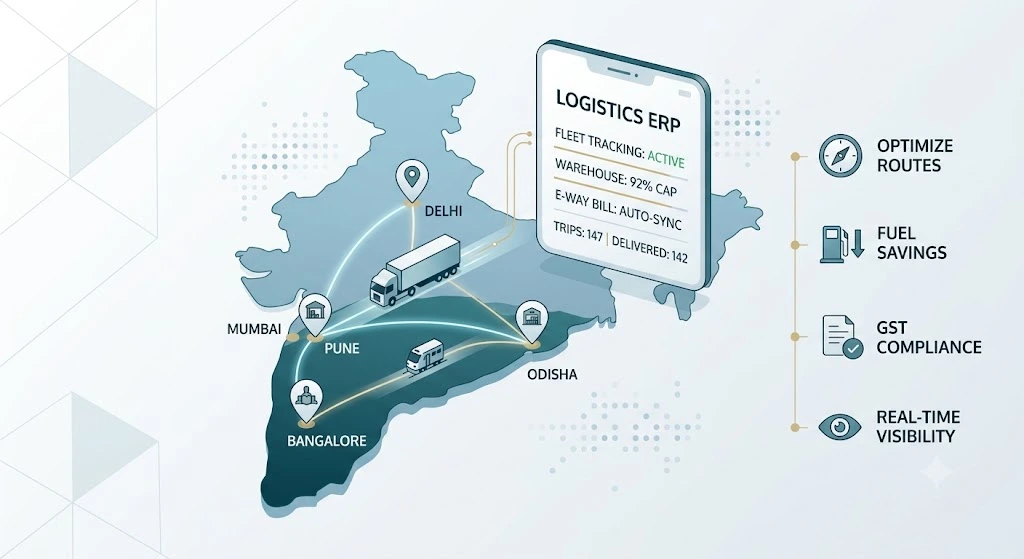
When managed through an ERP for logistics industry in India powered by ERPNext and deployed by Duocron Solutions, Days Sales Outstanding (DSO) shrinks by up to 40% while complete visibility is maintained across every leg of the journey.
How Duocron Solutions Elevates Logistics ERP Beyond Generic Solutions
Most off-the-shelf ERP platforms on the market fall into two problematic categories: rigid, expensive legacy systems that take years to configure, or lightweight accounting tools that crumble under complex multi-branch logistics workflows.
Duocron Solutions bridges this gap by engineering deeply customized, industry-ready enterprise software backed by the flexible, open framework of ERPNext.
Tailored for High-Volume Process and Supply Chain Demands
Duocron transforms standard open-source ERP capabilities into a Tier-1 competitive logistics engine. By mapping real-world field workflows—such as driver trip sheets, weighbridge integrations, yard management, and inter-state tax logic—into the system, Duocron Solutions eliminates the friction typical of generic ERP deployments.
The Duocron Solutions Suite functions as a unified ecosystem:
Custom Operational Workflows: Handles specialized configurations for FTL, LTL, parcel management, and multi-hub operations.
Government API Integration Layer: Provides native connectivity with ULIP, FASTag, and GSTN endpoints.
IoT & Telematics Integration: Feeds live sensor data, fuel audits, and GPS telemetry straight into core ledgers.
Open-Core Engine: Supported and powered by ERPNext, ensuring complete ownership and limitless operational adaptability.
Deep Ecosystem Integrations
ULIP API Gateways: Direct connection to the National Logistics Portal for verified vehicle records, driver licenses, and container tracking across ports.
FASTag & Fuel Cards: Automated toll collection feeds and fuel card balance monitoring that eliminate cash handling risks.
IoT Telematics: Live engine temperature, door-sensor alerts for cold chains, and GPS breadcrumb tracking integrated directly into asset ledgers.
The Step-by-Step Implementation Roadmap for Transport ERP
Implementing an enterprise-wide transport ERP across distributed branch networks requires a clear, phased approach to minimize operational disruption:
Phase 1: Discovery and Gap Analysis – Documenting every physical freight movement, tariff matrix, hub handoff, and compliance checkpoint across existing consignment, dispatch, and accounting workflows.
Phase 2: Customization and Data Migration – Adapting ERPNext schemas to reflect unique business models (3PL, 4PL, cold chain, or bulk parcel operations), cleaning legacy records, and structuring regional tax rules.
Phase 3: Hardware, Sensor, and API Integration – Connecting digital weighbridges, barcode scanners, GPS transponders, FASTag systems, and government compliance gateways.
Phase 4: User Acceptance Testing (UAT) and Pilot Run – Running parallel dispatch operations across select pilot hubs to test real-world throughput and catch workflow edge cases.
Phase 5: Enterprise-Wide Rollout and Training – Executing multi-hub deployment paired with practical, localized training modules for regional hub operators, dispatch teams, drivers, and accounting staff.
Driving Sustainable ROI: The Business Case for ERP for Logistics Industry in India
Adopting an advanced logistics ERP software delivers measurable returns on investment across key balance sheet metrics:
Fuel Cost Containment: Real-time route optimization and automated fuel slip verification consistently lower total fleet consumption by 8% to 15%.
Elimination of Transit Leakages: Milestone-based tracking and automated digital handoffs virtually eliminate unrecorded cargo theft and unauthorized demurrage charges.
Faster Working Capital Cycles: Instant e-POD uploads trigger same-day client billing, drastically shrinking billing lag times.
Vehicle Lifespan Extension: Predictive maintenance schedules prevent major highway breakdowns, protecting fleet asset valuations over time.
Scaling Your Supply Chain with Enterprise-Grade ERP Architecture
As Indian logistics moves toward automated multi-modal networks and stringent regulatory compliance, operating on legacy tools and fragmented spreadsheets introduces substantial enterprise risk. Modern logistics companies require software systems that offer total transparency, automate compliance, and adapt to changing operational demands.
Duocron Solutions stands as a premier enterprise partner for mid-to-large-scale logistics businesses across India and global markets. Backed by 11+ years of deep domain experience and a proven track record of over 200 successful enterprise implementations, Duocron specializes in building customized, industry-ready software powered by ERPNext.
From executing complex government-backed logistics architectures to engineering robust supply chain hubs for private operators, Duocron refines open-source software into an agile platform that competes directly with Tier-1 legacy ERPs at a sustainable total cost of ownership.
Frequently Asked Questions (FAQs)
What makes an ERP for logistics industry in India different from regular accounting software?
A standard accounting tool records financial ledgers after transactions occur. A dedicated ERP for logistics industry in India directly manages physical daily operations—such as multi-modal consignment routing, live GPS tracking, dynamic freight rate matrices, warehouse bin allocation, and automated GST E-Way Bill generation. Duocron Solutions builds customized ERP environments that synchronize physical fleet movements with back-office accounting in real time.
How does a logistics management ERP help reduce diesel theft and fleet operational expenses?
A logistics management ERP integrates directly with IoT fuel sensors, digital fuel cards, and live telematics. The system cross-references vehicle mileage against standard route distances, pinpointing unauthorized halts, sudden fuel-level drops, and abnormal engine idling. Duocron Solutions specializes in building automated trip audit workflows that match FASTag deductions and fuel expenditures against pre-approved trip sheets.
Can logistics ERP software integrate seamlessly with government portals like ULIP and GSTN?
Yes. Modern logistics ERP software features secure API connectors that communicate directly with India's Unified Logistics Interface Platform (ULIP) and GSTN portals. This enables one-click E-Way Bill generation, automated E-Invoicing, and instant vehicle/driver verification. Duocron Solutions brings extensive experience in complex public and private sector deployments, ensuring your ERP stays fully compliant with changing statutory mandates.
How long does it take to implement a custom transport ERP for multi-branch operations?
A focused enterprise deployment for mid-to-large logistics networks typically takes between 8 to 16 weeks, depending on the number of hub branches, hardware integrations, and custom workflow requirements. Duocron Solutions utilizes a tested implementation methodology honed over 200+ successful enterprise rollouts, ensuring data integrity, minimal operational downtime, and smooth staff adoption.
Why choose Duocron Solutions over expensive legacy Tier-1 ERP systems?
Legacy Tier-1 ERPs often demand steep licensing models, rigid development cycles, and expensive maintenance retainers. Duocron Solutions customizes the flexible, open-core architecture of ERPNext to deliver identical enterprise-grade reliability, unlimited scalability, and tailored functionality at a fraction of the total cost of ownership. Backed by over a decade of technical engineering experience, Duocron ensures your logistics system remains adaptable as your operations scale.
Related Articles:
Top ERP Software for Logistics Industry in India: 2026 Comparison Guide
How to Choose ERP for Logistics Industry: The Definitive Enterprise Guide (2026)
Best ERP for Logistics Companies in India (2026): The Complete Enterprise Guide
Author Bio

Aarav Sharma
Aarav Sharma is an ERPNext Consultant at DuoCron Solutions specializing in manufacturing ERP and process optimization. Outside work, Aarav enjoys exploring new technology trends and writing about digital transformation in manufacturing.